
Fast payout online casinos in Australia: how the market actually sits in 2026
A reader searching for a “fast payout online casino” in Australia usually wants the same thing: a working shortlist of operators and a sense of which one pays out fastest. The honest answer is that no Australian jurisdiction licenses the product behind that search. Online casino games and online pokies are prohibited under the Interactive Gambling Act 2001, and the regulator that enforces that ban — the Australian Communications and Media Authority — publishes a long record of formal warnings and blocked sites that says, in detail, who has tried to offer the product anyway. What this page lays out is that gap, the brands the ACMA has acted against, and the lawful paths a reader in Australia actually has: licensed sports and race wagering, land-based pokies and casinos, and BetStop self-exclusion. Fast payout online casinos in Australia — More on this topic at casino vip .
Current as of 29 October 2026, against the ACMA’s published formal-warning register and the most recent blocking round reported on 26 June 2026.
Table of Contents
- The ACMA’s eleven brands — what the enforcement record actually contains
- How the ACMA’s enforcement works — blocking, warnings and exits
- The licensed bookmaker exception — what is actually licensed in Australia
- How money actually moves — PayID, Osko and the New Payments Platform
- Card rails — Visa, Mastercard, Amex and the digital wallets
- What the law actually says — the Interactive Gambling Act and its 2026 amendment
- Responsible play — BetStop and the Australian help lines
- Crypto and the offshore market — what changes when the deposit is bitcoin
- What a reader in Australia actually has — the lawful paths
- What the ACMA’s record actually tells a reader
- Frequently asked questions
The ACMA’s eleven brands — what the enforcement record actually contains
Eleven brands are worth walking through together because they share one feature: each is on a formal-warning record published by the ACMA under the Interactive Gambling Act 2001. None of the eleven can be licensed for online casino games in Australia, whatever licence the site displays to a visitor. The table below pairs each brand with the ACMA action and the operating entity named in it.

| Brand | ACMA action and date | Operator named by the ACMA | Subject support |
|---|---|---|---|
| RocketPlay | Formal warning, March 2026 | Pulsup Ltd (Rocketplay.com.au) | Listed by affiliate listings only |
| Level Up Casino | Formal warning, May 2022 | Dama N.V. | Listed by affiliate listings only |
| Woo Casino | Formal warning, March 2025 | Dama N.V. | — |
| Spirit Casino | Formal warning, May 2025 | Dama N.V. | — |
| National Casino | Formal warning, July 2025 | Consolutetish S.R.L. | Listed by ACMA, AUSTRAC and BetStop |
| Bizzo Casino | Formal warning, July 2025; earlier 2022 | Consolutetish S.R.L.; earlier TechSolutions (CY) Group and TechSolutions Group N.V. | Listed by affiliate listings only |
| Ignition Casino | Formal warning, July 2025 | Bamboo Media | — |
| Instant Casino | Formal warning, February 2025 | EOD Code SRL | Listed by an e-wallet provider and PayID |
| Jackbit | Formal warning, April 2026 | Ryker B.V. | — |
| Casino Intense | Formal warning, April 2025 | Sterplay Holding Ltd | Listed by AUSTRAC, BetStop and affiliate listings |
| Sky Crown | Formal warning, September 2022 | Hollycorn N.V. | — |
Three things stand out from the table. The first is repetition: Dama N.V. sits behind four of the eleven entries — May 2022 across six brands, then March 2025 and May 2025 across Woo and Spirit. The ACMA does not name operators once and stop; it publishes a new formal warning every time a brand reappears on its radar under a new wrapper. The second is the time horizon: the earliest action in the set dates to 2022 and the most recent to 2026, which means the same enforcement pattern has been running on a four-year cycle and has not slowed. The third is the gap between “ACMA action” and “support for fast-payout claims”: for most of the eleven, no third-party source actually vouched for the subject, and where one did, it was a listing page rather than a payment-method endorsement.
The right way to read each row is as evidence, not as a verdict on quality. A formal warning tells the reader that an Australian regulator concluded, after investigation, that the operator offered a prohibited service to people in Australia. It does not tell the reader whether payouts were fast or slow on any individual withdrawal. What it does tell the reader is that the operator is on the wrong side of the line that any licensed alternative would not be on.
RocketPlay — two warnings, same brand
RocketPlay has been on the ACMA’s register twice. The earlier entry sits inside the May 2022 warning to Dama N.V., which named six brands at once: Bambet, Dazard, Level Up, Rocketplay, Wild Tornado and Cobra Casinos. The later entry is a stand-alone warning to Pulsup Ltd in March 2026 over the Rocketplay.com.au domain. Two warnings, four years apart, both naming the same player-facing brand, points to the kind of relabelling that the ACMA’s enforcement has been designed to chase down. Affiliate listings report RocketPlay, but no payment-method source has publicly endorsed its settlement times. For a reader in Australia, the relevant fact is that the site has been the subject of two published ACMA actions and remains prohibited under the IGA.
Level Up Casino — same Dama N.V. warning as RocketPlay
Level Up Casino sits in the same May 2022 warning to Dama N.V. and so takes the same regulatory shape: a brand whose operating company has been formally warned for offering prohibited online casino games to Australians, and whose individual site remains unlicensed in any Australian jurisdiction. The subject support recorded for it is the same shape — a listing page rather than an independent payment-method source.
Woo Casino and Spirit Casino — the 2025 pair
Woo Casino drew a formal warning in March 2025 and Spirit Casino in May 2025, both from the ACMA over Dama N.V. The pattern matches the Level Up story: a known operator, a fresh brand surface, a new warning. Neither entry carries a third-party payment-method source on the subject of fast payouts. The right reading is the same one — these are operators the ACMA has acted against, and the ACMA’s case against them is that they offered online casino games to Australians at all, fast payout or slow.
National Casino — the most-documented brand in the set
National Casino sits on the most thoroughly cross-referenced row. The July 2025 formal warning to Consolutetish S.R.L. is itself the ACMA’s action, but the same subject is independently listed in three places beyond the regulator: AUSTRAC’s threshold-reporting pages, BetStop, and affiliate listings. The BetStop listing, in particular, matters: BetStop is the National Self-Exclusion Register, and an operator that ends up referenced there has been drawn into the orbit of the Australian consumer-protection machinery, not just the ACMA’s enforcement side. For a reader comparing the eleven entries, National Casino is the case where the regulator’s own action is the smaller part of the documentary footprint.
Bizzo Casino — two warnings, two operators
Bizzo Casino carries the longest trail in the set. The July 2025 warning names Consolutetish S.R.L.; the earlier 2022 warning named TechSolutions (CY) Group Limited and TechSolutions Group N.V. Two operating companies, one player-facing brand, four years apart. Affiliate listings report the brand but no payment-method source has publicly endorsed its settlement times. The relevant reading is the one that applies across the set: a brand that reappears under a new operating entity is a brand the ACMA has had to chase more than once.
Ignition Casino — single warning, no third-party footprint
Ignition Casino was named in the July 2025 warning to Bamboo Media. No payment-method source in the consulted set independently lists the brand. That absence is itself informative: a brand on a payment-method list tends to have a settlement-history worth describing, and the absence of that record here means there is no third-party basis for any claim about how fast the brand pays out, even setting aside the regulatory question.
Instant Casino — a payments-ecosystem entry
Instant Casino was the subject of the February 2025 warning to EOD Code SRL, and unlike most of the eleven, it shows up in two payment-method sources: an e-wallet provider and PayID. PayID’s role here is the worth-noting one. PayID is an Australian-payments-layer identifier that resolves to a bank account, and the fact that an Instant Casino entry appears on a PayID-adjacent source means the brand had, at some point, an Australian-facing payments touchpoint — which is also the kind of touchpoint the ACMA’s enforcement looks for when deciding which sites to warn. The PayID listing is therefore less a fast-payout endorsement than a signal of where the brand was hooking into Australian rails.
Jackbit, Casino Intense and Sky Crown — single warnings, varied records
Jackbit carries an April 2026 warning over Ryker B.V. with no payment-method source independently listing the brand. Casino Intense was warned in April 2025 over Sterplay Holding Ltd, and is referenced by AUSTRAC, BetStop and affiliate listings — a footprint similar to National Casino’s, suggesting a brand that the consumer-protection side of the Australian machinery has had cause to record as well. Sky Crown sits on a September 2022 warning to Hollycorn N.V. with no payment-method source. The three together cover the three patterns the table holds: a regulator-only entry, a regulator-plus-consumer-protection entry, and a regulator-only entry from earlier in the cycle.
How the ACMA’s enforcement works — blocking, warnings and exits
The ACMA’s enforcement under the Interactive Gambling Act 2001 runs on three tracks, and the eleven brands above sit on different points along them. The first is the formal warning, which is what every row in the table records: a written finding by the regulator that an operator has offered a prohibited service to Australians. The second is a request to Australian internet service providers to block a site at the network level. The third is the cumulative count the ACMA publishes of services that have left the Australian market entirely.
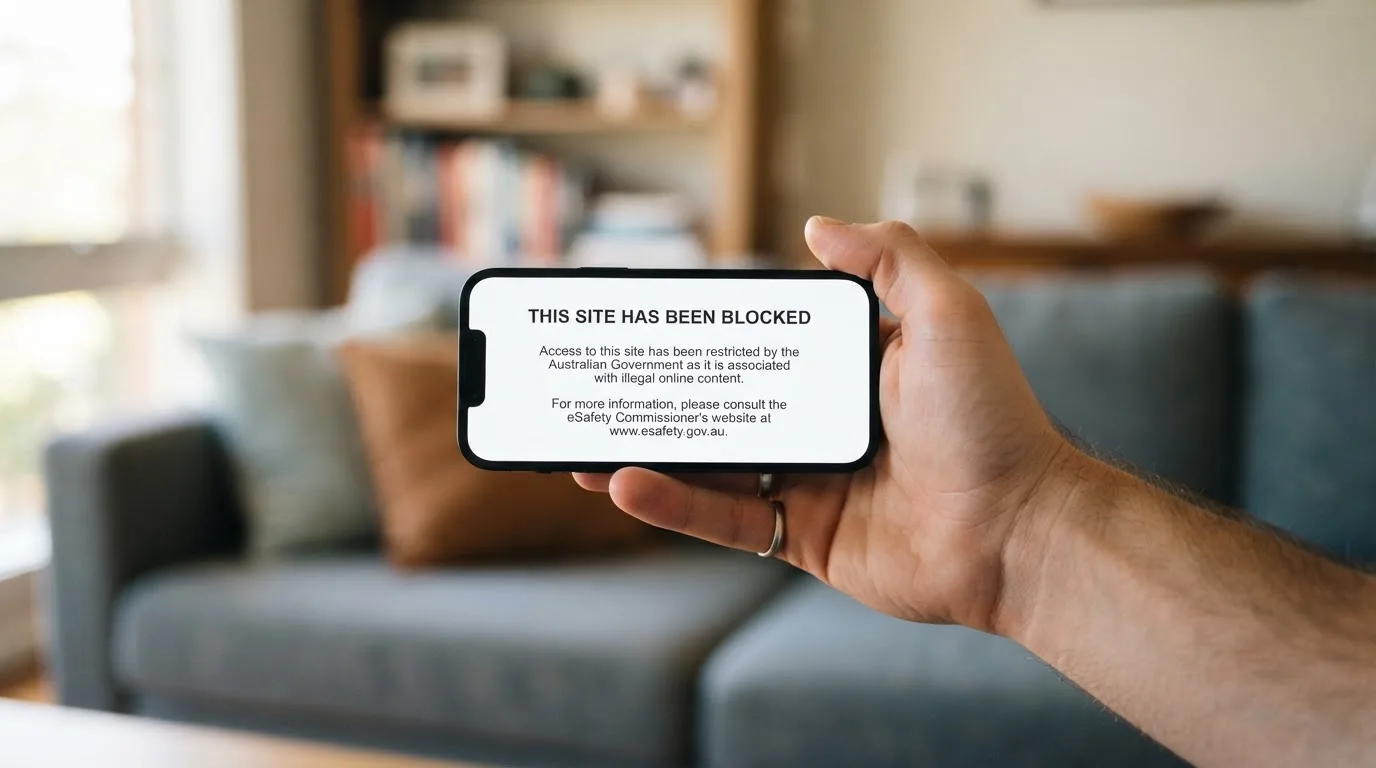
The blocking round reported on 26 June 2026 asked ISPs to block twelve more domains: 7Signs, ChromaBet, Donbet, Duospin, Freshbet, Slots Gem, Jacks Club, Lucky Start, Pointsbetz.com, Spinrise, Vinyl Casino and Wildsino. Add that round to the running total and the ACMA’s own figure is 1,751 illegal gambling and affiliate marketing websites blocked since the first blocking request in November 2019, with more than 230 unlicensed gambling services having left the Australian market since enforcement was strengthened in 2017. The number that matters for a reader is the doubling-pattern: blocking is not a one-off, it is a rolling programme that has run for more than six years and continues to issue fresh rounds.
The blocking-rate calculation lands here. Take 1,751 blocked sites over the period from the first blocking request in November 2019 to the date of the most recent reported round in June 2026 — roughly 79 months. That is a band of roughly 22 blocked sites per month on average across the whole programme. The result is not a flat monthly figure: the ACMA reports blocking in discrete rounds, sometimes several months apart, and individual rounds ask ISPs to block anywhere from a handful of sites to over a hundred. Reading the figure as a band rather than a precise monthly average captures both the long-run pace and the lumpiness of the rounds. What the band says to a reader is that the ACMA’s enforcement pipeline has produced a new blocked site roughly every working day and a half, sustained across the entire programme.
H2 Gambling Capital’s 2025 estimate puts Australian losses to illegal gambling sites at about A$3.9 billion a year, with the share of gambling going through legal channels falling from 74% in 2021 to 64%. The combination of the ACMA’s blocking count and the H2 estimate tells the same story from two sides: enforcement is constant, and the demand side has not stopped. For a reader comparing lawful and unlawful options, both numbers are useful — one says how hard the regulator is working, the other says how much money is still moving offshore.
The licensed bookmaker exception — what is actually licensed in Australia
The Interactive Gambling Act 2001 prohibits online casino games and in-play betting. It does not prohibit wagering on races and sporting events placed before the event, lotteries or keno. Those are licensed at the state and territory level, with most online bookmakers holding a Northern Territory licence because of the territory’s tax arrangements. The Northern Territory Racing and Wagering Commission regulates 52 of Australia’s online bookmakers — Sportsbet, Bet365 and Ladbrokes among them — and the commission has no full-time staff, meeting once a month in Darwin.
The reason that matters on a fast-payout page is payment rails. A licensed Australian bookmaker accepts deposits and pays withdrawals through the same Australian banking system any other Australian business uses: debit card, bank transfer, PayID and Osko instant transfers, and BPAY. A licensed bookmaker is also bound by the consumer protection machinery: BetStop for self-exclusion, the National Gambling Helpline 1800 858 858 for help, the Australian banks’ gambling blocks at the card level, and the IGA’s own prohibition on credit cards and credit-related products for online wagering, in force since 11 June 2024 with operator penalties of up to A$247,500.
The licensed bookmaker exception does not solve the underlying problem this page was searched for. There is no licensed online casino in Australia, fast payout or otherwise. What it gives a reader in Australia is a set of bookmaker products that are lawfully available, sit inside the consumer-protection perimeter, and pay out through Australian bank accounts on the same rails the rest of the page describes.
How money actually moves — PayID, Osko and the New Payments Platform
The fastest lawful path for money into an Australian bank account is Osko, the instant-transfer service that runs on the New Payments Platform. An Osko transfer between participating Australian banks arrives in under a minute, 24/7 including weekends, whether it is addressed to a BSB and account number or to a PayID. PayID is the addressing layer — phone number, email or ABN — and paying to a PayID shows the name of the account holder before the transfer is sent. The New Payments Platform went live on 13 February 2018, is owned by a non-profit company whose thirteen shareholders include the Reserve Bank of Australia and the major banks, and had more than 25 million PayIDs registered as of April 2025.
Two practical consequences follow. The first is that any licensed Australian operator — bookmaker, lottery, keno — can in principle pay out through Osko, and a withdrawal that the operator submits before the bank closes is, for practical purposes, in the customer’s account by the time the customer picks up their phone. The second is that an offshore operator on the ACMA’s warning list is unlikely to be plugged into PayID at all. The PayID network is a closed Australian rails system, and an operator that the ACMA has warned for offering prohibited services is an operator that Australian Payments Plus would not be onboarding. Instant Casino’s listing on a PayID-adjacent source is the exception that proves the rule — it is the kind of touchpoint that should never have been there in the first place, and its presence in the consulted set is what triggered the ACMA’s action.
The two cautions around PayID are worth carrying. AP+ warns that being asked to transfer money to a PayID on an illegal gambling site almost certainly means a scam site. And while PayID-based instant transfers are available at over 100 Australian financial institutions, the institution on the receiving end still has to support PayID for the transfer to clear in under a minute. PayID is the address, Osko is the speed — and the second only works where the first is properly registered.
BPAY sits beside PayID and Osko as the older bill-payment rail: it has operated since 1997, is available through more than 140 banks and financial institutions, and is offered by over 95,000 businesses. A licensed bookmaker that wants to take deposits through BPAY is using the same channel a reader uses to pay an electricity bill. The 2021 ACCC authorisation to merge BPAY Group, eftpos and NPP Australia into Australian Payments Plus means all three rails — Osko, PayID and BPAY — are now run by the same operator, which simplifies the consumer-facing answer to “which rail pays out fastest” but does not change the underlying answer: the rail the licensed bookmaker sits on, not the rail the offshore casino sits on, is the rail the reader’s bank is going to settle instantly.
AUSTRAC’s threshold-transaction-report rule requires reporting of transfers of A$10,000 or more — but only for physical cash. Ordinary electronic bank transfers are not subject to that per-transaction reporting requirement, regardless of amount. A reader who hears that “transactions over A$10,000 are reported” is hearing a rule that does not apply to the kind of transfer a fast-payout page is about.
Card rails — Visa, Mastercard, Amex and the digital wallets
Debit cards sit beside Osko as a legal deposit route for licensed wagering. The Reserve Bank of Australia’s July 2025 review proposes removing surcharges on eftpos, Mastercard and Visa transactions — and explicitly leaves American Express outside the proposed surcharge ban. Amex’s structural difference is worth understanding: it operates as a three-party scheme, issuing its own cards and processing its own transactions, where Visa and Mastercard run a four-party network. That is why Amex sits outside the surcharge reform: it is a different kind of payments business, not a network that simply charges more.
Credit cards are a different story. Under the Interactive Gambling Act 2001 as amended in 2023, Australian-licensed online wagering services cannot accept payment by credit card or other credit-related products, in force since 11 June 2024. The same restriction constrains gambling use of linked digital wallets: a digital wallet that is funded from a credit card inherits the credit-card prohibition. A digital wallet funded from a debit card does not — and that is the path a reader can still use to fund a licensed wagering account.
Three Australian banks have built gambling blocks at the card level, and the blocks are worth understanding because they are the consumer-side counterpart to the ACMA’s enforcement. Westpac’s gambling block refuses authorisation of transactions registered under the merchant category code “Betting/Casino Gambling” on eligible personal credit and debit cards. ANZ’s block, activated in the ANZ app, blocks gambling transactions made through a digital wallet on an eligible card, not just the physical card — and removing the block requires a 48-hour waiting period, with the bank warning that not all gambling transactions will be blocked and some non-gambling transactions might be blocked in error. Commonwealth Bank lets customers apply a gambling lock to eligible cards via the CommBank app, automatically blocking most gambling transactions, with the same caveat that the bank cannot guarantee all gambling-related purchases will be stopped.
Three things flow from these blocks. The first is that a debit card issued by Westpac, ANZ or Commonwealth Bank will refuse a transaction coded as gambling at the card network, regardless of who the merchant is. The second is that an offshore casino on the ACMA’s list that accepts Australian-issued debit cards is bypassing the cardholder’s own protection — the bank’s block has been designed to refuse that transaction, and the casino is relying on either an MCC miscoding or a card issued by a bank without an equivalent block. The third is that the blocks have known holes. ANZ itself says some transactions will slip through and some non-gambling transactions will be blocked in error. That is the regulator’s own caveat: the consumer-side machinery is real but it is not airtight.
The digital-wallet layer adds one more wrinkle. Apple Pay, Google Pay and Samsung Pay collectively accounted for around 45% of all card payments in Australia by number at the end of 2025. Apple does not charge consumer fees — any surcharge comes from the merchant’s own card-processing fees — and Apple states that transaction limits and PIN requirements are set by the card issuer or merchant, not by Apple. The consequence for a gambling block: the block sits on the underlying card, not on the wallet, and a wallet transaction that bypasses the merchant category code is a wallet transaction the bank’s block does not see.
What the law actually says — the Interactive Gambling Act and its 2026 amendment
The Interactive Gambling Act 2001, strengthened by the Interactive Gambling Amendment Act 2017, makes it an offence to provide online casino games, online pokies or in-play betting to a person in Australia. No state or territory licenses them. The Interactive Gambling Amendment (Gambling Reform) Bill 2026 passed Parliament on 19 August 2026; its advertising and inducement measures commence on 1 January 2027. On a 2026 page, that is a passed law with a future start date — law, but not yet in force.
The minimum age is 18. The individual player is not prosecuted under the IGA — the Act targets the provider. What the Act does not do is provide consumer protection to anyone using an offshore site: no complaints body, no recourse if a withdrawal is refused, no obligation on the operator to honour its own terms. And the ACMA can block a site with a balance still on it. A reader who takes the IGA seriously ends up at the same answer the regulator’s own record points to: the licensed alternative exists, and the offshore alternative does not give the reader anything the licensed alternative would not.
Gambling winnings of a recreational player are not assessable income under section 6-5 of the Income Tax Assessment Act 1997, and losses are not deductible — unless the person carries on a business of gambling, which the ATO treats as a question of fact rather than a self-assessed status. A reader who treats gambling as a side interest and reads “winnings are tax-free” as the whole story has the right rule for the right case; a reader who treats gambling as a profession has a different conversation to have with the ATO.
Responsible play — BetStop and the Australian help lines
BetStop, the National Self-Exclusion Register, has been live since August 2023. It binds Australian-licensed online and phone wagering services: a punter who registers is excluded from every licensed wagering operator at once, and the exclusion is enforced across the whole licensed perimeter. It does not bind an offshore casino on the ACMA’s warning list, because that operator is not part of the licensed perimeter. Self-exclusion through BetStop is the strongest single tool a reader has, and it is a tool that only works against licensed operators.
The National Gambling Helpline 1800 858 858 is free, runs 24/7 and offers chat at Gambling Help Online. The helpline is not the regulator — it is the help service. A reader who feels that gambling has moved from interest to problem has a free, confidential line to call, and the cost of calling it is the same as the cost of not calling it: nothing in one case, the lost ground in the other.
The banks’ gambling blocks sit beside BetStop as a second layer. They are not the same thing — BetStop excludes the person across all licensed operators, a bank’s block refuses individual transactions — but together they form the consumer-side machinery that an Australian reader can use regardless of what the ACMA’s enforcement is doing at any given moment. A bank block is a card-level switch; BetStop is a register-level exclusion. Neither works against an offshore operator that does not connect to either system, which is one reason the offshore side of the market keeps producing fresh ACMA actions.
Crypto and the offshore market — what changes when the deposit is bitcoin
The crypto side of the offshore market is the side the ACMA has the least reach into. The Interactive Gambling Act’s prohibition on online casino games does not depend on the payment method; it depends on whether the service is offered to a person in Australia. A bitcoin casino that offers its product to Australian customers is offering a prohibited service whether the deposit is in BTC or in AUD. The 2024 prohibition on credit cards and credit-related products as payment for licensed wagering does not cover digital currency as such — but it covers any credit-funded path into a digital wallet, and it sits alongside the IGA’s product prohibition.
A reader asking “is the bitcoin casino faster” is asking a question the IGA does not recognise. The speed at which a bitcoin transaction confirms is a property of the bitcoin network; the legality of an Australian customer using a bitcoin casino is a property of Australian law. The two questions sit on different axes and do not trade off against each other. A fast bitcoin settlement into an unregulated operator’s wallet is still a settlement into a service the ACMA has, on the regulator’s own published record, acted against.
The other angle worth carrying is the practical one. A bitcoin withdrawal from an offshore casino does not arrive in an Australian bank account until the reader has converted the bitcoin to AUD and transferred it through the Australian banking system — at which point the bank’s own gambling block, the AUSTRAC reporting machinery and the consumer’s own tax position all re-engage. The fastest bitcoin payout from an offshore casino is, on the Australian side of the transaction, still subject to the Australian rails. The crypto layer does not exempt the transaction from Australian law; it only changes which currency the transaction is denominated in.
What a reader in Australia actually has — the lawful paths
Three lawful paths are open to a reader in Australia who has reached this page through a “fast payout online casino” search. None of them is an online casino, because that product is prohibited under the IGA.
The first is licensed online wagering on races and sporting events placed before the event. Sportsbet, Bet365 and Ladbrokes — all Northern Territory-licensed — sit inside the consumer-protection perimeter, accept deposits through debit card, PayID/Osko and BPAY, pay out through the same rails, and are bound by BetStop, the National Gambling Helpline and the banks’ gambling blocks. The fastest lawful payout through this path is an Osko instant transfer, settling in under a minute. The product set is narrower than an offshore casino — no pokies, no live-dealer tables, no in-play betting — but the product set is what the IGA permits.
The second is land-based pokies and casinos. Australia’s licensed clubs, pubs and casinos operate pokies and table games under state and territory regulation. The payout is not a bank-transfer question — it is the cash the venue hands over at the machine or the cage. This is the only lawful path to a casino experience in Australia.
The third is BetStop self-exclusion, which is the responsible-play path rather than a gambling path. A reader who has reached this page because of concern about their own or someone else’s gambling has a free, confidential, 24/7 line at 1800 858 858 and a register-level exclusion mechanism at BetStop that operates across every licensed Australian wagering operator at once.
What the ACMA’s record actually tells a reader
Pull the eleven rows of the table together and the picture is consistent. The ACMA has been issuing formal warnings under the IGA since at least 2022 and is still issuing them in 2026. The same operating company can appear under a fresh brand surface years after the first warning, and the regulator’s enforcement follows the relabelling. The blocking programme has run for more than six years and continues to issue new rounds; the H2 Gambling Capital estimate puts the demand side at A$3.9 billion a year. The lawful alternative exists and uses the same Australian payments rails any other Australian business uses.
The right use of this record is comparative, not directional. A reader who has decided to use a licensed wagering operator has the consumer-protection machinery behind them. A reader who has decided to use an offshore casino has the regulator’s published record against them — eleven entries across four years, with the same operating company reappearing under different brand names. The choice is the reader’s; the facts on which it is made are on the page.
Frequently asked questions
What counts as a fast payout time for a casino transaction?
There is no industry definition, and the operators that publish a “fast payout” claim do so against their own benchmarks rather than a regulated standard. The fastest lawful Australian benchmark is Osko, where a transfer between participating banks settles in under a minute, 24/7. An offshore operator’s claim of “instant” or “within 24 hours” is a marketing claim, not a measured figure.
How quickly does an Osko bank transfer arrive between Australian banks?
An Osko transfer between participating Australian banks arrives in under a minute, 24/7 including weekends, whether addressed to a BSB and account number or to a PayID. The PayID leg — phone, email or ABN — resolves to the account holder’s name before the transfer is sent, and PayID-based instant transfers are available at over 100 Australian financial institutions.
Is it legal for an online casino to offer fast payouts to players in Australia?
No Australian jurisdiction licenses online casino games. The Interactive Gambling Act 2001 prohibits offering them to anyone in Australia, and the ACMA enforces that prohibition through formal warnings and blocking requests. The ACMA’s published record lists eleven brands in this article alone; the lawful alternative is licensed wagering on races and sport placed before the event, plus land-based pokies and casinos.
Do faster payout claims make an offshore casino any safer to use?
No. The IGA’s prohibition applies to the offering, not the payout speed. A faster payout does not connect the offshore operator to BetStop, to the National Gambling Helpline, to the banks’ gambling blocks or to any Australian consumer protection. A reader with a balance at an offshore casino that gets blocked has no Australian recourse — the ACMA can block the site with funds still on it.
What payment method typically settles quickest into an Australian bank account?
For a licensed Australian wagering operator, the fastest lawful settlement is Osko, at under a minute between participating banks. PayID is the addressing layer and BPAY is the older bill-payment rail, both run by Australian Payments Plus. For an offshore operator, the settlement time depends on the operator’s own processing, not on the Australian rails, and is not covered by any Australian consumer-protection machinery. See also What an “Instant Payout” Casino Promises an Australian Reader .
Where can someone check whether a payment provider is genuinely trustworthy?
PayID’s own pages warn that being asked to transfer money to a PayID on an illegal gambling site almost certainly means a scam site. For licensed wagering, the relevant checks are the operator’s Australian licence register, the ACMA’s formal-warning list and BetStop’s exclusion register. A payment provider that cannot be tied back to one of those is a payment provider that does not sit inside the Australian consumer-protection perimeter.