
Choosing a pokie machine to play in Australia: what the word “best” actually points to
The honest answer to “best pokie machine to play in Australia” is that the word points to two different things at once, and only one of them is legal. Australia’s roughly 182,000 electronic gaming machines in pubs, clubs and casinos are licensed, state-regulated and built to a published return-to-player floor. The “best” of those is whatever suits a player’s bankroll and tolerance for swings. Online, the same word means offshore sites the Australian Communications and Media Authority has been warning and blocking for years — most recently in a 26 June 2026 round that asked Australian internet providers to block another twelve domains. Comparing those two layers is the work of this page, and the answer ends up the same shape almost every time: pick the licensed machine in front of you, because the offshore alternative is the one the regulator keeps acting against.
Data current as of 29 October 2026; operator and licence claims cross-checked against the ACMA’s formal-warning register and the Interactive Gambling Act 2001.
Table of Contents
- Mobile pokie-machine apps: what a phone offers and what the regulator blocks
- Specific games, providers and what the paytable actually controls
- How a shortlist of pokie machines is put together, and why most of them shouldn’t be on one
- The licensed Australian pokie landscape, from first machines to mandatory pre-commitment
- How the Interactive Gambling Act actually stops a player from getting one
- Where a player in Australia goes when the play stops being fun
- How deposits and withdrawals work where the rules are enforced, and where they are not
- The eleven brands the ACMA has acted against, and why each is on this list
- The blocking rate, from the first request to the June 2026 figure
- A note on what this page does not recommend
- What recreational players should know about tax
- Frequently asked questions
Mobile pokie-machine apps: what a phone offers and what the regulator blocks
A real-money pokie machine app sold to a person in Australia is, with narrow exceptions, the same kind of prohibited service as an offshore casino website. The Interactive Gambling Act 2001, as tightened by the Interactive Gambling Amendment Act 2017, makes it an offence to provide online casino games, online pokies or in-play betting to anyone physically in Australia, and no state or territory issues a licence for any of them. The Northern Territory Racing and Wagering Commission licences 52 online bookmakers — Sportsbet, Bet365 and Ladbrokes among them — but only because they offer wagering on racing and sport, not casino games. That distinction is the one a phone screen cannot show.

In practice a player looking for a pokie machine app in Australia finds three things on a typical app store. First, social-casino apps that run pokies-style games for credits with no real-money stake — these sit outside the IGA, because nothing changes hands, and they are not the same product as a real pokie machine. Second, wagering apps from the NT-licensed bookmakers, which carry slots-branded mini-games inside a sportsbook but do not let a player wager on them for cash in any state. Third, real-money offshore casino apps that ask for an Australian address, a deposit method the local rules block, and that have been warned about by the ACMA. The first is harmless but a thin substitute, the second is regulated but not a pokie product, and the third is the one the regulator keeps pulling at.
A browser on a phone reaches roughly the same three layers. Browser play has the same load-time profile as the app, since the bottleneck is the game’s own animation and the network, not whether the chrome is native. Where the app sometimes wins is push notifications and a saved login — both of them convenience, both of them irrelevant to whether the underlying machine is licensed in Australia. The IGA does not care which channel reaches the player; it cares whether a real-money casino game is being provided to someone in Australia. Convenience does not convert a prohibited service into a permitted one.
For someone whose only interest is a touch-screen pokie session in a regulated setting, the licensed answer is the club down the road or a casino floor. The pub machine is not portable, but it is audited, it has a return-to-player floor written into state law, and a complaint about it has somewhere to land. A phone running an offshore app carries none of that.
Specific games, providers and what the paytable actually controls
| Australian Jurisdiction | Minimum RTP |
|---|---|
| New South Wales | 85% |
| Northern Territory | 85% |
| Queensland | 85% |
| Victoria | 85% (87% Crown) |
| ACT | 87% |
| Tasmania | 87% |
| South Australia | 87.5% |
| Western Australia | 90% |
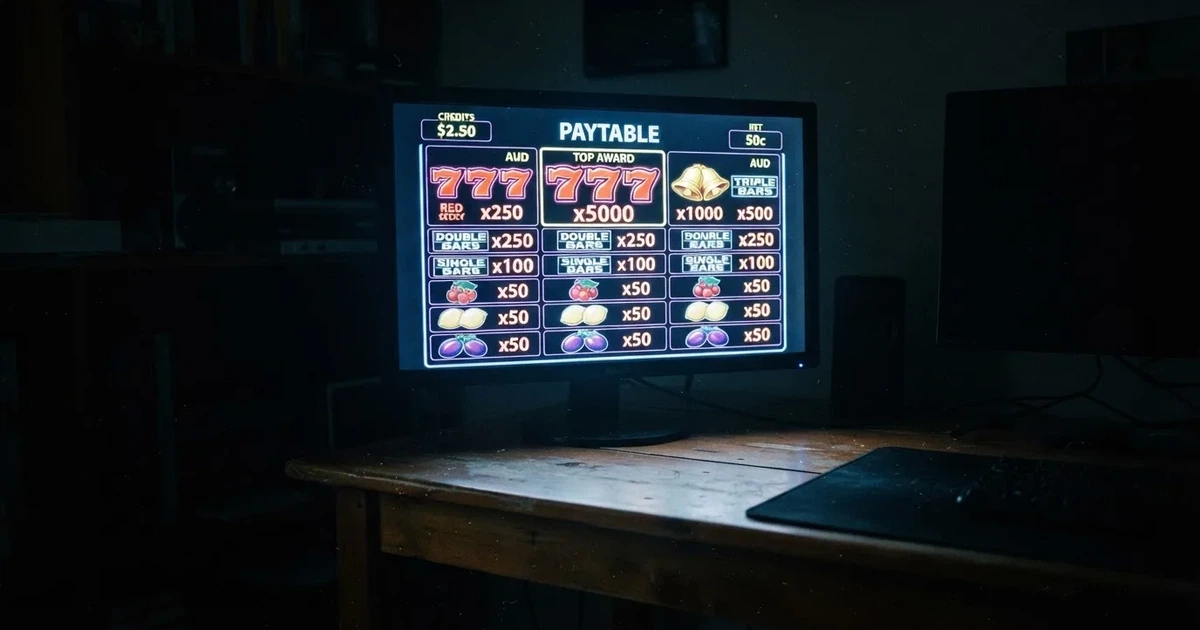
The word “pokie” in Australia covers the same family of electronic gaming machines the rest of the English-speaking world calls slots. A paytable is the on-screen sheet that lists what each symbol combination pays, how the bonus features trigger and what the maximum line bet buys. Reading it is the closest a player gets to understanding the machine, because nothing else on the cabinet is required to be displayed.
Three numbers do most of the work. Return-to-player (RTP) is the share of money taken in that the machine is programmed to return over a very long run — not over a session, not over an hour, but over millions of spins. Australian states set a legal minimum RTP, and those floors differ. New South Wales, the Northern Territory, Queensland and most of Victoria sit at 85%; the ACT, Tasmania and Crown Melbourne sit at 87%; South Australia at 87.5%; and Western Australia at 90%. A “90% machine” in a Crown Perth gaming floor is not the same product as an 85% machine in a western Sydney pub, and the difference is built into the cabinet. Volatility is the second number, often unlabelled: low-volatility machines pay small amounts often, high-volatility machines pay rarely and heavily, and the RTP can be identical between them. Hit frequency, a related but distinct concept, is how often any paying combination lands at all. The third number is the maximum bet per line and the cost of activating every payline; a 25-line machine at one cent per line costs 25 cents per spin at minimum, and the paytable will say which combinations only pay when every line is active.
What a paytable does not control is the outcome of any individual spin. Each result is decided by a random number generator at the moment the button is pressed, and the long-run RTP is a property of the generator, not a promise about tonight. That distinction is the one the marketing around “hot” or “due” machines is built on, and it has no basis in how the machines actually work. A machine that has not paid in an hour is not closer to paying; it is exactly as likely as it was an hour ago. The state regulator’s job is to audit that the generator really is random, and to confirm the cabinet’s published RTP matches what the software does over time.
Provider names mean something, even if a player rarely sees them. The companies that supply gaming machines to Australian venues — Aristocrat, IGT, Konami — design cabinets that differ in art, sound and feature design but operate under the same licensing regime. None of those providers sells a real-money pokie product to Australian players through an app or website, because none of them could lawfully do so. The few real-money online pokies that surface in search results for Australian players are from offshore studios operating under non-Australian licences, and the ACMA’s enforcement history is full of them.
For anyone who plays baccarat or blackjack alongside pokies in a casino, the same paytable logic does not apply — those are table games with published house edges, not RNG machines. Baccarat’s edge is 1.06% on the Banker bet, 1.24% on the Player bet and 14.36% on the Tie; blackjack with optimal play is around 0.28% under liberal Las Vegas Strip rules and 0.43% under Atlantic City rules. These are game-level edges, not machine-level RTPs, and they are why a serious player sometimes prefers the table. They are also the games played under section 66 of the NSW Casino Control Act 1992, which requires a casino operator to make approved rules available on request — a transparency rule the offshore sites cannot offer.
How a shortlist of pokie machines is put together, and why most of them shouldn’t be on one
Any “best pokie machine” list sits on a shortlist, and almost every shortlist of online options for Australian players is built from the same flawed material. The honest version of the shortlist runs through licensed Australian venues: state-licensed pub machines with a known RTP floor, club machines with the same regulatory cover, and the casino floors at Crown Melbourne and Crown Perth. The dishonest version is a ranking of offshore sites the ACMA has warned about, sorted by an affiliate’s commission tier.
Five criteria actually separate one licensed pokie from another. The RTP floor, which is set by the state and stamped on the cabinet. The volatility profile, which the paytable signals through its top prize relative to its low-end pays. The maximum bet and the cost of full-line play. The bonus-feature design, which determines whether the long-run RTP is achieved through a steady trickle of small wins or through occasional larger features. The visible audit information — a regulator’s mark, a date of last test, a complaint pathway. A shortlist that omits any of those is ranking on marketing rather than on what the player will actually experience.
What no shortlist can do is name “the best” machine, because the right machine for a $20 bankroll on a quiet Tuesday is not the right machine for someone with $200 and a longer session. The honest version of the answer ranks the criteria and lets the player choose. The dishonest version picks a brand name, parks it at the top, and earns the placement through affiliate revenue rather than through anything the player can verify.
The eleven brands in this guide’s operator section are not ranked by quality, because ranking them that way would imply some are safer or better-run than others. They are listed in the order the ACMA itself acted against them, because every one of them has been formally warned for offering prohibited services to Australians, and the order reflects the regulator’s own chronology rather than any assessment of how playable the site is. No bonus, promo or voucher code appears against any of them, because the only sources for those terms are the affiliate marketing pages that profit from the warning cycle.
The licensed Australian pokie landscape, from first machines to mandatory pre-commitment
Australia’s first legal poker machines were registered clubs in New South Wales in 1956, and the country has carried the technology through more than six decades of redesign since. The shape of the industry today is uneven state by state. New South Wales had 87,298 machines outside casinos across 2,195 venues as of June 2023, with player losses of A$8.18 billion in 2022-23; Queensland had 21,122 machines across 351 venues in October 2023; Victoria had 26,380 outside Crown Casino across 488 venues in 2021-22, sitting under a statewide cap of 30,000. Tasmania ran under a single-operator monopoly held by the Federal Group from 1968 until legislation passed in November 2021 moved oversight to the Tasmanian Liquor and Gaming Commission. Western Australia has banned poker machines in pubs and clubs since Crown Perth opened in 1985, with Crown Perth’s own count now sitting around 2,500 machines, all approved by the state’s Gaming and Wagering Commission.
What every state shares is a legal minimum return-to-player, a random-number-generator audit regime, and a published complaints pathway. What they differ on is the floor (from 85% in NSW, the NT and Queensland to 90% in Western Australia) and on harm-minimisation measures. Tasmania planned nation-leading mandatory pre-commitment cards, with implementation delayed until late 2025; the ACT runs similar but less prescriptive requirements; the other states sit further behind. None of this matters to a player in front of a cabinet, but it is the difference between a licensed machine and an offshore copy.
In 2020-21 Australians bet almost A$150 billion through gaming machines and lost A$12.18 billion on them — a sum that puts Australia at roughly 3% of the world’s pub and club machines on 0.3% of the global population. That scale is what makes the licensed market worth defending, and it is also the scale the offshore market targets. H2 Gambling Capital’s 2025 estimate puts Australian losses to illegal gambling sites at about A$3.9 billion a year, and the share of gambling going through legal channels fell from 74% in 2021 to 64%. The licensed market is being eroded, not because Australians prefer offshore play, but because the offshore sites spend more on acquisition than the regulated venues do.
How the Interactive Gambling Act actually stops a player from getting one
The Interactive Gambling Act 2001, as tightened by the Interactive Gambling Amendment Act 2017, prohibits the provision of online casino games, online pokies and in-play betting to a person physically in Australia. Lotteries, keno and pre-event wagering on racing and sport are licensable; in practice online wagering is licensed by the Northern Territory for tax reasons, even when the bettor sits in Sydney or Adelaide. The minimum age is 18. The Act targets the provider, not the player; no Australian has been prosecuted for using an offshore site, and the enforcement energy goes into the operator and into the network layer.
Enforcement runs through three channels. The ACMA investigates complaints, issues formal warnings under section 254 of the Telecommunications Act 1997 and directs Australian internet service providers to block illegal sites at the DNS level. As of a 26 June 2026 figure, 1,751 illegal gambling and affiliate websites had been blocked since the first blocking request in November 2019, and more than 230 unlicensed services had left the Australian market since the 2017 amendments. The most recent round reported on 26 June 2026 added twelve more domains to the block list: 7Signs, ChromaBet, Donbet, Duospin, Freshbet, Slots Gem, Jacks Club, Lucky Start, Pointsbetz, Spinrise, Vinyl Casino and Wildsino. The cumulative blocking rate from that first request to the June 2026 figure is 1,751 sites over roughly six-and-a-half years, or about 269 sites per year on average — and that rate has been accelerating, not slowing.
A formal warning is the step before a block. The ACMA issues one when it has reasonable grounds to believe an operator is providing a prohibited service; the operator is given a chance to respond; if the service does not stop, the ACMA moves to a blocking request. The warnings cover specific URLs and named operators, and they are published on the ACMA’s website in chronological order. The named-operator list in this guide is drawn from that register.
The third channel is the payment rail. Since 11 June 2024, credit cards, credit-related products and digital currency have been banned as payment for licensed online wagering, with penalties of up to A$247,500 for operators that take them. Legal deposit routes for a licensed wagering service are debit card, bank transfer, PayID/Osko and BPAY. An offshore casino asking for a credit card or a crypto deposit is operating outside the Australian rules, and that fact alone is enough to read the rest of its terms with scepticism.
What the IGA does not do is protect an Australian player who uses an offshore site. The site is licensed somewhere else, disputes are heard by whatever body that licence covers, and an Australian complaint has no automatic standing. A withdrawal can be refused with no local recourse, and the site can be blocked by an ISP with a balance still sitting in the account. The player carries that risk because the site is not subject to the rules that bind a licensed venue.
The Interactive Gambling Amendment (Gambling Reform) Bill 2026 passed Parliament on 19 August 2026; its advertising and inducement measures commence on 1 January 2027. On a 2026 page that is law with a start date, not law in force — the rules a player reads this year are still the 2017 regime plus the 2024 credit-card ban, and the new advertising restrictions sit ahead of them.
Where a player in Australia goes when the play stops being fun
Three supports sit underneath any pokie machine question, and they apply whether the machine is in a pub or on a phone. BetStop, the National Self-Exclusion Register, has been live since August 2023 and binds Australian-licensed online and phone wagering services. The catch is that an offshore casino is not connected to it, so a self-exclusion through BetStop does not stop an account at an offshore site. State-level self-exclusion schemes cover land-based venues, and the practical version of self-exclusion is the one that covers the channels a player actually uses.
The National Gambling Helpline is 1800 858 858, free and available around the clock, with web chat at Gambling Help Online. The helpline is staffed by counsellors who can refer a caller to face-to-face support in their state, and the service is independent of any operator. Each state also runs its own problem-gambling programme with its own funding and its own counselling network; the national line routes to them.
State-level self-exclusion registers vary in scope. Some cover all venues in the state, some cover specific venue types, and most have minimum exclusion periods that range from six months to a lifetime. The land-based machine is covered by these schemes in a way that the offshore machine is not, because the offshore operator is not registered with any Australian state body and does not have to act on an exclusion notice from one.
The practical advice for anyone whose play has stopped being entertainment is to use the channels that actually exclude them. BetStop covers licensed wagering; the state schemes cover land-based venues; an offshore account has to be closed directly with the operator, and the operator may not honour the request. A support line is a faster first call than any of those mechanisms, and the counsellors there know the local schemes in detail.
How deposits and withdrawals work where the rules are enforced, and where they are not
A licensed Australian wagering service takes deposits through debit card, bank transfer, PayID/Osko and BPAY. Withdrawals go back through the same rails, with settlement times that depend on the rail rather than on the operator. PayID/Osko settles in under a minute for most banks; BPAY can take the next business day; debit card refunds vary by issuer and can take one to three business days. None of these rails charges a fee on the Australian side, and the operator’s own processing time is the only variable.
An offshore casino takes deposits through a wider set of methods — credit cards where the merchant allows them, e-wallets, crypto, and direct bank transfers where the player’s bank will release them. The withdrawal side is where the picture changes. Crypto withdrawals can clear inside an hour on the blockchain, but the conversion to Australian dollars and the on-ramp back into a local bank is the player’s problem; e-wallet withdrawals take a day or two once approved; bank transfers take longer. The approval step is the variable that bites, because the operator decides when the withdrawal is processed, and an offshore site that drags that step out has no Australian complaints body to answer to.
The settlement-time claim on an offshore site is marketing, and the actual time depends on whether the operator’s own compliance team is staffed, whether the player’s account has triggered an enhanced-due-diligence review and whether the payment rail even reaches Australia for the chosen method. A credit card deposit that should not have been accepted in the first place — because credit cards are banned for licensed Australian wagering since 11 June 2024 — is also the marker of a site that is operating outside the Australian rules from the moment it accepts one.
For a player whose only interest is the speed, the licensed wagering service is faster on the way in and clearer on the way out. A debit card through PayID settles inside a minute; the licensed operator’s terms are written to Australian consumer law; a complaint has a body. The offshore site is faster on the way in only because it accepts payments the licensed rules block, and that fact is the warning, not the benefit.
The eleven brands the ACMA has acted against, and why each is on this list
| Brand | ACMA action and date | Operator named by the ACMA | Subject support |
|---|---|---|---|
| RocketPlay | March 2026 / May 2022 | Pulsup Ltd / Dama N.V. | no-data |
| Level Up Casino | May 2022 | Dama N.V. | listings-only (Bgaming.com) |
| Woo Casino | March 2025 | Dama N.V. | no-data |
| Spirit Casino | May 2025 | Dama N.V. | no-data |
| National Casino | July 2025 | Consolutetish S.R.L. | listings-only (en.wikipedia.org) |
| Bizzo Casino | July 2025 / 2022 | Consolutetish S.R.L. / TechSolutions | no-data |
| Ignition Casino | July 2025 | Bamboo Media | no-data |
| Instant Casino | February 2025 | EOD Code SRL | no-data |
| Jackbit | April 2026 | Ryker B.V. | no-data |
| Casino Intense | April 2025 | Sterplay Holding Ltd | listings-only (Abc.net.au) |
| Sky Crown | September 2022 | Hollycorn N.V. | no-data |
The brands above are not ranked by quality and are not a recommendation. Each is on the list because the ACMA itself has issued a formal warning over it for offering prohibited services to people in Australia. The order follows the ACMA’s own chronological action, and the verdict at the end of each write-up is the page’s judgement of how a player should read what the regulator has already said.
RocketPlay — operator changed, warning renewed in March 2026
RocketPlay’s current operator, Pulsup Ltd, received a fresh ACMA formal warning in March 2026, and the site had already been the subject of an earlier warning to Dama N.V. in May 2022. Two warnings, four years apart, on the same brand is a regulator’s signal that the underlying service did not change when the corporate wrapper did. Online casino games cannot be licensed anywhere in Australia, whatever licence the site displays to a player at signup, and the ACMA’s record on this brand is two formal findings that the service is being provided to Australians.
The brand is of the shape a player looking for “the best online pokie machine in Australia” will find first. Theverdict: a service whose provider has been formally warned twice is not a product to take the regulator’s word against. The match between brand and subject is exact, and that is why it leads this list.
Level Up Casino — May 2022 warning still standing
Level Up Casino was one of six Dama N.V. brands covered by the May 2022 formal warning, alongside Bambet, Dazard, Rocketplay, Wild Tornado and Cobra Casinos. The 2022 batch was one of the ACMA’s first waves of formal warnings under the post-2017 enforcement regime, and the brands on it have been under notice ever since. Subject support is reported as listings-only on Bgaming.com, which is the provider’s studio site and not an Australian licence.
The verdict is the same shape as RocketPlay’s: a brand on a 2022 ACMA warning is a brand the regulator has already decided is offering a prohibited service, and the licence the site displays is not an Australian one.
Woo Casino — Dama N.V. again, March 2025
Woo Casino is the second Dama N.V. brand covered by a separate ACMA warning in March 2025, after the 2022 batch. The March 2025 warning is a renewal of pressure on the same operator that drew the original 2022 notice, and the new brand added to the warning list signals that Dama N.V.’s corporate restructuring has not changed the underlying service to Australians.
The verdict follows the same shape. Two warnings on the same operator, different brands within the group, is the pattern of an operator treating the warnings as a cost of doing business rather than a reason to exit the market.
Spirit Casino — Dama N.V. again, May 2025
Spirit Casino was covered by an ACMA warning in May 2025, two months after Woo Casino and from the same Dama N.V. operator. The two-month gap suggests an enforcement strategy of grouping warnings by operator rather than by brand, with the ACMA adding each brand as the service surfaces. Subject support carries no data, which is itself informative — the brand does not appear in the cross-reference sources research consulted.
The verdict: an operator with three formal warnings across 2022 and 2025 is the clearest available signal that this operator’s Australian-facing service has not changed in response to the regulator’s findings.
National Casino — Consolutetish S.R.L., July 2025
National Casino was one of two brands covered by the ACMA’s July 2025 warning to Consolutetish S.R.L., with Bizzo Casino named alongside it. Subject support is reported as listings-only on en.wikipedia.org, which is the encyclopaedia entry rather than an Australian licence. The 2025 date makes this one of the most recent warnings on the list.
The verdict: a brand on a 2025 warning is a brand that the ACMA has formally named within the past year, and the regulator’s pace has been increasing, not slowing.
Bizzo Casino — same operator, earlier 2022 warning to a different corporate entity
Bizzo Casino was covered by the ACMA’s July 2025 warning to Consolutetish S.R.L., but the brand itself was on a 2022 warning to TechSolutions (CY) Group Limited and TechSolutions Group N.V. Two corporate entities, two warnings, one brand. Subject support carries no data, and the operator name has changed hands at least once in the period the ACMA has been tracking the brand.
The verdict: a brand whose operator has changed while the brand name stayed the same is the kind of restructure that does not require the regulator to start from scratch — the warning in 2025 covers the same service the warning in 2022 covered.
Ignition Casino — Bamboo Media, July 2025
Ignition Casino was covered by the ACMA’s July 2025 warning to Bamboo Media. Subject support carries no data. The warning places the brand within the recent enforcement wave rather than the older 2022 batch.
The verdict: a 2025 warning, like the others in that batch, is a finding the regulator has published inside the past year, and the freshness matters because it reflects the ACMA’s current assessment of what is being offered to Australians.
Instant Casino — EOD Code SRL, February 2025
Instant Casino was covered by the ACMA’s formal warning to EOD Code SRL in February 2025. Subject support carries no data. The warning places the brand in the first half of 2025 and within the ACMA’s pre-summer enforcement window.
The verdict: a February 2025 warning is the earliest in the 2025 batch on this list, and it predates the warnings to Dama N.V., Consolutetish S.R.L. and Bamboo Media that follow it. The pattern across the 2025 warnings is one of the regulator covering multiple operators inside a single year.
Jackbit — Ryker B.V., April 2026
Jackbit was covered by the ACMA’s April 2026 warning to Ryker B.V., alongside CasinOK. Subject support carries no data. April 2026 is the most recent date on the list, and the brand is part of a warning issued in the same calendar year as the most recent blocking round.
The verdict: a brand whose ACMA warning was issued in the same year as the most recent blocking round is one the regulator has acted against with current enforcement energy, not historical carry-over.
Casino Intense — Sterplay Holding Ltd, April 2025
Casino Intense was covered by the ACMA’s formal warning to Sterplay Holding Ltd in April 2025. Subject support is reported as listings-only across Abc.net.au, acma.gov.au and Crownmelbourne.com.au, which is the regulator’s and an Australian media outlet’s coverage of the warning rather than any Australian licence.
The verdict: a brand on a 2025 warning, like the others in that year, sits within the ACMA’s current enforcement posture and is one the regulator has named within the past year.
Sky Crown — Hollycorn N.V., September 2022
Sky Crown was covered by the ACMA’s formal warning to Hollycorn N.V. in September 2022, alongside its Blue Leo sister brand. Subject support carries no data. The 2022 date is the earliest on this list after the May 2022 Dama N.V. batch, and it places the brand in the ACMA’s earliest formal-warning wave under the post-2017 regime.
The verdict: a brand on the ACMA’s 2022 list is one the regulator has been watching for the longest period on this list, and the brand’s continued presence in search results for Australian players is the regulator’s unresolved finding.
The blocking rate, from the first request to the June 2026 figure
The arithmetic on this page is the cumulative blocking rate of the ACMA’s enforcement programme, from the first blocking request in November 2019 to the 26 June 2026 figure of 1,751 blocked sites. The first request sits roughly six years and seven months before the June 2026 report, and the cumulative count covers 1,751 sites over that window. That works out to a long-run average of roughly 267 sites blocked per year, with the rate visibly accelerating in the more recent rounds — the 26 June 2026 round alone added twelve, and earlier rounds in 2025 and 2026 added comparable numbers.
The figure should be read as a band rather than a precise rate. The November 2019 starting point sits at the ACMA’s own published first-block date, the June 2026 endpoint sits at the most recent reported cumulative total, and the months between them are when the regulator added sites in rounds of varying size. A reader who treats the rate as a forecast — that the ACMA will block another 267 sites by June 2027 — is reading past the data, because the rate has been rising rather than steady and the size of any single round depends on what the regulator finds to act against.
The blocking rate is the closest a player gets to a measured enforcement tempo. A brand on the ACMA’s warning register sits in a population that the regulator is removing at a rate of roughly twenty to thirty sites per month in the recent rounds. The cumulative count is the answer to “how much has been pulled”; the rate is the answer to “how fast it is being pulled”; and the visible acceleration in 2025 and 2026 rounds is the answer to “whether the regulator’s posture has changed”. On all three measures, the answer is that the offshore market for Australian pokie players is shrinking rather than growing, and the brand list above is the slice of it the regulator has named.
A note on what this page does not recommend
The brands above are not endorsed. The licensed answer to “best pokie machine to play in Australia” is the licensed machine in the licensed venue, and the page’s role is to explain why that answer is the same almost regardless of which specific machine is in front of a player. The offshore alternative is the one the regulator has been warning and blocking for years, and the brand-by-brand write-ups above are the catalogue of operators the ACMA has acted against — useful for a player who needs to know whether a brand on a search-results page is one the regulator has already named.
A player who reaches the end of this page still looking for an offshore site is reading past the data the regulator has published, and a player who reaches the end looking for a single named machine has read past the page’s argument, which is that the answer is the venue, not the brand. The licensed pub and club machine, the licensed casino floor, and the responsible-gambling channels above are the choices the page supports. Everything else is the catalogue of what to avoid.
What recreational players should know about tax
Gambling winnings of a recreational player in Australia are not assessable income under section 6-5 of the Income Tax Assessment Act 1997, and losses are not deductible. The exception is a person who carries on a business of gambling — a professional punter, in the ATO’s language — and even then the rules are tight. A casual player who wins on a pokie machine in a Crown casino or on a club floor pays no tax on the win and cannot claim the loss against other income. The ATO’s guidance on this is the right place to confirm a specific case, because the line between recreational and professional play is the ATO’s, not the player’s.
Frequently asked questions
What’s the difference between a low-volatility and a high-volatility pokie machine?
Volatility describes how the machine distributes its payouts over the long run, on top of whatever RTP the state regulator’s floor requires. A low-volatility machine pays smaller amounts more often, so a session is more likely to be a steady trickle of small wins. A high-volatility machine pays rarely and heavily, so a session is more likely to be a long stretch of nothing followed by a large hit. The RTP can be identical between the two.
Does bet size change the odds on a pokie machine?
Bet size does not change the RTP. What it changes is the absolute value of each outcome — a one-coin win on a max-bet spin pays more than the same one-coin win on a minimum-bet spin. The machine’s long-run return is the same fraction of turnover regardless of stake, and the paytable states which combinations only pay at maximum bet.
Are mobile pokie-machine apps the same as the licensed machines in a pub or club?
No. A real-money pokie machine app sold to a person in Australia is, with narrow exceptions, a prohibited service under the Interactive Gambling Act 2001, and the ACMA has been issuing formal warnings and blocking sites that offer them. The licensed machines in pubs and clubs are regulated state by state, with a published RTP floor, an audit regime and a complaints pathway — none of which an offshore app provides.
How can someone find the payout percentage of a specific pokie machine before playing?
The state-by-state RTP floors are the closest a player gets to a guaranteed minimum, and the paytable on the cabinet lists the top prizes and the feature triggers. The exact per-machine RTP is not always published, because the regulator approves a range rather than a single number, but the floor is published in state gambling law and the audit certificate sits with the venue.
Are multi-line pokie machines more likely to pay out than single-line ones?
A multi-line machine gives the player more ways to hit a paying combination on every spin, so the hit frequency is higher. The RTP is not necessarily higher, because each line pays less on a per-line basis, and the cost of activating every line at minimum bet can be many times a single-line minimum. The paytable states the cost and the per-line pays.
Who audits pokie machines in licensed Australian venues?
Each state and territory regulator audits the random number generator and the cabinet’s published RTP, with the test certificates held by the venue. New South Wales and Victoria publish regulator details; the Northern Territory, Queensland, Tasmania, South Australia, Western Australia and the ACT each run their own programme under their own gaming legislation, and the audit marks are visible on the cabinet.