
Best progressive jackpot slots in Australia: the mechanics, the money, and the regulator’s record against offshore sites
The data in this guide is current as of 29 October 2026 and was checked against the Australian Communications and Media Authority’s public register of formal warnings and blocking actions.
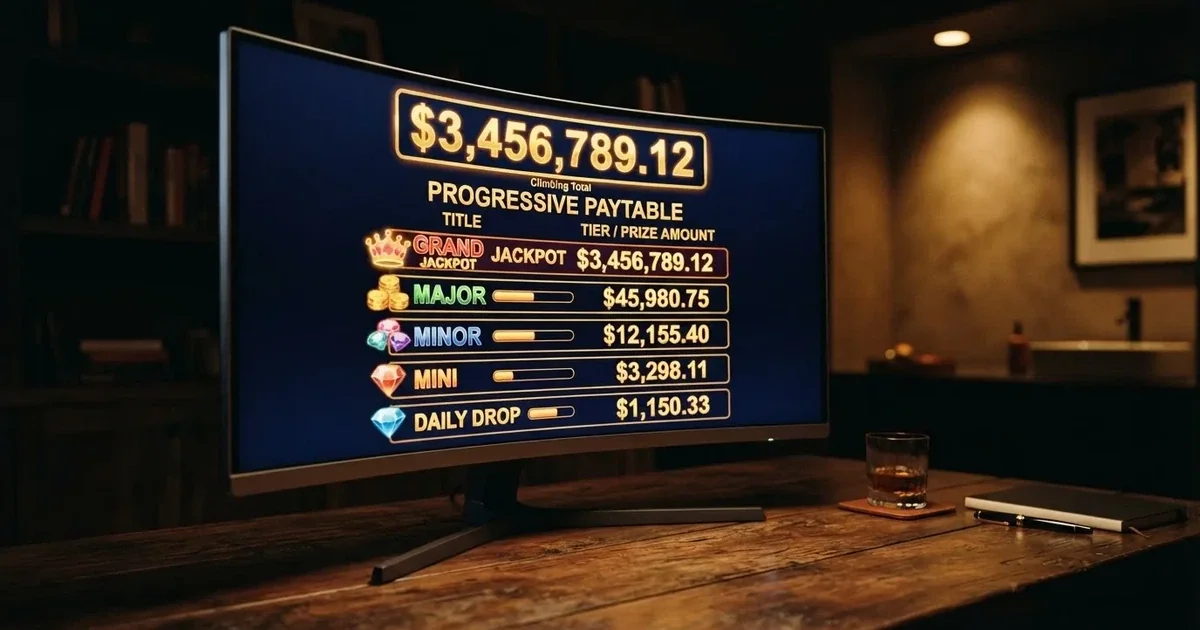
A progressive jackpot slot is the only kind of casino game where the prize grows with every losing wager placed somewhere on the same network. That is the mechanic worth understanding, and the headline figure worth chasing is what the pool has reached right now. The reason that headline matters less than it first looks is that almost every site advertising a progressive jackpot to an Australian reader is an offshore operator outside the Interactive Gambling Act 2001, and the ACMA has spent the last several years sending formal warnings, issuing blocking notices and asking Australian internet service providers to cut these brands off. The mechanics behind the prize pool are interesting in their own right; what the regulator has done about the people offering it is the part that decides whether a player in Australia can actually collect.
This guide works through the mechanics first, then the legal frame, then the ACMA’s published record against eleven offshore brands that have advertised progressive jackpot slots to Australian customers, and finishes with the calculation that puts a floor under the regulator’s enforcement rate.
Table of Contents
- How a progressive jackpot pool actually grows
- Why progressive jackpots pay less on the base game
- What triggers a progressive jackpot round
- The record payout and what it was
- Where progressive jackpot slots sit under Australian law
- What the ACMA has done about offshore sites offering progressive jackpot slots to Australians
- Reading each warning as it applies to a player
- Theverdict on the offshore shelf
- What the player protection regime does and does not cover
- The arithmetic the regulator’s record produces
- What a player reading this should take away
- Frequently asked questions
How a progressive jackpot pool actually grows
A progressive jackpot is a prize that climbs while it is unclaimed. A fraction of every losing wager — typically a small slice of each spin — feeds the pool instead of the house’s ordinary take, and the pool keeps climbing until somebody lands the qualifying combination, the trigger condition or the mystery jackpot range, and is paid the full amount. After the payout, the pool resets to a preset minimum (the “seed”) and starts climbing again. The seed is funded by the operator, not by player wagers, which is why even a freshly-reset pool sits well above zero.

The shape of that climb is what makes a progressive jackpot a different bet from a fixed-jackpot game. A fixed-jackpot slot pays the same top prize on every spin regardless of history. A progressive slot pays a top prize that has been growing for as long as nobody has hit it, which is why the published figures run into the millions and tens of millions.
The structural choices behind a progressive jackpot determine how fast it grows and how often it pays.
- Standalone progressive. A single machine, or a single online game, with its own pool. The pool climbs slowly because only wagers on that one game feed it. A standalone pool rarely breaks into seven figures before it pays.
- Linked or in-venue progressive. A bank of machines inside one casino, sharing one pool. A network of this kind climbs faster because more spins per hour feed the same total.
- Wide-area progressive. Machines or online games across many venues, sometimes across many operators, contributing to the same pool. This is the configuration that produces the headline figures. The Mega Moolah series, distributed by Games Global and formerly by Microgaming, is a wide-area online progressive; the original Megabucks network in Nevada is a wide-area land-based progressive.
A fourth variant sits beside these three. A must-hit-by progressive, sometimes called a mystery jackpot, has a payout amount set by a random number generator within a preset range — for example A$1,000 to A$3,000 — the moment the previous jackpot is won. The ceiling of that range is the “must hit by” figure, and the game guarantees the jackpot will pay out before the pool crosses it. Players do not need to land a specific symbol combination; the trigger is time-based or value-based, not symbol-based.
Every progressive jackpot, of whatever kind, shares the same basic arithmetic: a slice of every losing wager feeds the pool, the pool climbs until somebody hits the trigger, and the operator funds the seed that lets the next pool start above zero. What changes between configurations is the speed of the climb, the size of the eventual payout, and the probability that any single spin is the one that pays.
Why progressive jackpots pay less on the base game
A progressive slot’s base return to player — the portion of every dollar wagered that the game returns through ordinary line wins, scatters and bonus features — sits below the return of an equivalent fixed-jackpot slot. The reason is structural. The slice of every wager that feeds the progressive pool is paid back only when the jackpot is hit, which for any given spin is almost never. The portion of the wager that does NOT go to the pool has to carry the entire base-game return on its own, so the base game is calibrated to pay slightly less per spin to make room for the contribution.
A slot with a published base RTP of, say, 88% is feeding roughly the remaining 12% to the operator’s house edge and to the progressive pool. A fixed-jackpot slot with the same volatility and feature set might publish a base RTP of 96%. The headline figure on the progressive — the size of the pool — is funded by that gap.
There is a published edge case. In some progressive jackpot games where the pool has grown large enough, the game’s theoretical return to player can cross 100% and the bet becomes positive-expectation. This break-even point is well-documented for certain video poker and Caribbean Stud Poker variants where every card is visible. It is essentially impossible to calculate for slot machines, because the reel layouts and symbol weights are not published, and the calculation depends on the exact distribution of combinations the software actually uses.
For the everyday player, the practical reading is the inverse: while the pool is small, the slot is paying less per spin than a comparable fixed-jackpot game. The pool only “evens out” the return when it has climbed far enough to outweigh the base game’s structural disadvantage, and the threshold at which that happens is not knowable in advance for slots.
What triggers a progressive jackpot round
The trigger varies by game and is the one piece of information worth checking before playing any progressive slot.
The most common trigger is a specific symbol combination on a designated line — for example, five jackpot symbols across a single payline on a maximum-coin spin. Some games require a max bet to qualify, which is itself a piece of information worth knowing: a smaller wager may pay the line-win prize but not the progressive.
A second trigger is the bonus round. Landing the right scatter or bonus symbols opens a separate feature (a wheel spin, a pick-em screen, a coin trail), and the outcome of that feature decides whether the progressive pays. This is the design behind Mega Moolah, where the bonus wheel has multiple tiers and the top tier is the wide-area progressive.
A third trigger is the mystery or must-hit-by mechanic described above, where the prize is guaranteed to pay once the pool crosses a ceiling the RNG has set internally. The player does not need to land any particular combination; the game pays the pool when it reaches the threshold.
A fourth trigger is rarer and worth knowing about. Random triggering fires the jackpot on any spin at random, regardless of what symbols landed. The probability is small but non-zero on every spin, which is why a player can win a progressive jackpot on what looks like a losing spin with no special symbol showing.
The trigger matters because the published probability of hitting it is, in practice, never disclosed. Slot machines are not required to publish the symbol weights on their virtual reels, and most do not. A player choosing between two progressive slots has access to the headline pool figure, the base RTP if the operator publishes it, and the trigger condition in the paytable — and nothing else about the underlying odds.
The record payout and what it was
The record online slot jackpot stands at €19,430,723.60, won on 27 April 2021 by a player in Belgium playing Absolootly Mad: Mega Moolah at Napoleon Sports & Casino on the Microgaming network. The game is now distributed by Games Global, the business that took over Microgaming’s progressive jackpot portfolio. Games Global has since announced Mega Moolah wins of £11.5 million and £13.5 million on the same network.
The land-based record is older and held by the original Megabucks network. International Game Technology introduced Megabucks in 1986 and paid the network’s first jackpot of $4,988,842.17 on 1 February 1987. Megabucks was the first wide-area progressive slot network and remains the configuration most land-based jackpot records sit on.
The practical point is that the largest progressive jackpots are wide-area network payouts, not standalone machine wins. A standalone progressive pool, by definition, climbs only as fast as one game is played. A wide-area network, by definition, climbs as fast as every connected game combined, which is what produces seven-figure and eight-figure pools.
Where progressive jackpot slots sit under Australian law
Australia’s position on online casino games and online pokies is straightforward and has been since 2017. The Interactive Gambling Act 2001, as tightened by the Interactive Gambling Amendment Act 2017, makes it an offence to provide online casino games, online pokies or in-play betting to a person in Australia. No state or territory licenses them. What is licensable is wagering on races and sport placed before the event, lotteries and keno — in practice licensed by the Northern Territory through the Northern Territory Racing and Wagering Commission.
The NTRWC regulates 52 of Australia’s online bookmakers — Sportsbet, Bet365 and Ladbrokes among them — under Northern Territory licences taken out for tax reasons rather than for any substantive regulation of the products on offer. The commission has no full-time staff and meets once a month in Darwin, which is the configuration the ABC reported on in April 2026 and which an April 2026 bill proposed to reform.
The distinction matters because the legal frame for online casino games in Australia is a prohibition, not a licensing regime. A site displaying a Curaçao or Malta licence is licensed somewhere; it is not licensed in Australia, because Australia does not license the product it is offering. The licence the site advertises does not change what the ACMA considers it to be doing under the IGA.
The Interactive Gambling Amendment (Gambling Reform) Bill 2026 passed Parliament on 19 August 2026. Its advertising and inducement measures commence on 1 January 2027. The law has a start date; it is not yet in force on a page being read in 2026.
What the ACMA has done about offshore sites offering progressive jackpot slots to Australians
The ACMA investigates complaints, issues formal warnings, and asks Australian internet service providers to block illegal sites. The individual player is not prosecuted — the IGA targets the provider. The practical consequence for a player is that an offshore site gives no Australian consumer protection, no complaints body, and no recourse if a withdrawal is refused, and it can be blocked while a balance is still sitting on the account.
The blocking programme is the most measurable part of the enforcement record. According to the ACMA as reported in June 2026, a total of 1,751 illegal gambling and affiliate marketing websites had been blocked since the first blocking request in November 2019, and more than 230 unlicensed gambling services had left the Australian market since enforcement was strengthened in 2017. In a single round reported on 26 June 2026 the ACMA asked Australian ISPs to block another 12 sites: 7Signs, ChromaBet, Donbet, Duospin, Freshbet, Slots Gem, Jacks Club, Lucky Start, Pointsbetz, Spinrise, Vinyl Casino and Wildsino. The pattern is consistent — names change, the request to ISPs does not.
The economic scale is set out in H2 Gambling Capital’s 2025 report, which estimates that Australians lose about A$3.9 billion a year to illegal gambling sites, and that the share of gambling going through legal channels fell from 74% in 2021 to 64%. The fall is the consequence of the channel mix, not of the ACMA’s record; it is what the prohibition is up against.
The formal warnings are the regulator’s named record against specific brands, and they are the part that lets a reader see which operators the ACMA has actually acted against. Eleven brands the ACMA has warned, in roughly the order the warnings were issued:
| Brand | ACMA action and date | Operator named by the ACMA | Subject support |
|---|---|---|---|
| Level Up Casino | Formal warning, May 2022 | Dama N.V. | — |
| Woo Casino | Formal warning, March 2025 | Dama N.V. | — |
| Spirit Casino | Formal warning, May 2025 | Dama N.V. | — |
| Instant Casino | Formal warning, February 2025 | EOD Code SRL | — |
| Casino Intense | Formal warning, April 2025 | Sterplay Holding Ltd | — |
| National Casino | Formal warning, July 2025 | Consolutetish S.R.L. | — |
| Bizzo Casino | Formal warning, July 2025; earlier warning 2022 | Consolutetish S.R.L.; earlier TechSolutions | — |
| Ignition Casino | Formal warning, July 2025 | Bamboo Media | — |
| RocketPlay | Formal warning, March 2026; earlier warning May 2022 | Pulsup Ltd; earlier Dama N.V. | — |
| Jackbit | Formal warning, April 2026 | Ryker B.V. | — |
| Sky Crown | Formal warning, September 2022 | Hollycorn N.V. | — |
A reader looking at the table will notice that the ACMA’s enforcement action clusters around a small number of operators. Dama N.V. alone accounts for five of the warnings — over Level Up, Woo Casino, Spirit Casino, Bizzo Casino and RocketPlay — across four years. That is the regulator’s record, not a recommendation about the brands; the only way a brand ends up on the list is that the ACMA itself issued the warning.
Reading each warning as it applies to a player
The eleven brands below are not a shortlist to play at. They are listed because the ACMA named them, and the description of each is built around what the ACMA’s record says about the operator and what, if anything, the offshore listings say about the brand’s own product. There is no ranking; the order is the regulator’s.
RocketPlay
The ACMA issued a formal warning over RocketPlay in March 2026, naming Pulsup Ltd as the operator. A separate warning over the same brand went to Dama N.V. in May 2022. Two warnings, two operators, four years apart — RocketPlay has had its offering to Australian customers acted against by the regulator under both of the operating companies that have run the site. Online casino games cannot be licensed anywhere in Australia, whatever licence the site displays. The brand’s progressive jackpot slots are an offshore product.
Level Up Casino
Dama N.V. received a formal warning in May 2022 covering Level Up alongside five other Dama brands. The warning is the ACMA’s record against the operator at a specific date; subsequent enforcement actions against other Dama brands do not extend or replace this one. The brand itself surfaces in third-party listings of offshore progressive jackpot slots as a place where the games are advertised. A reader comparing the warning record finds Level Up is on it.
Woo Casino
The ACMA issued a formal warning to Dama N.V. over Woo Casino in March 2025. The Dama N.V. cluster of warnings is the largest single operator block on the regulator’s record, and Woo Casino is part of it. The March 2025 date places the warning in the most recent wave of Dama enforcement, which has continued across 2025 and into 2026.
Spirit Casino
Dama N.V. received a formal warning over Spirit Casino in May 2025, two months after the Woo Casino warning. The two-month gap is the closest spacing between any two warnings on the regulator’s published record, and it shows the regulator treating the operator’s full portfolio as a single enforcement target rather than picking off brands one at a time.
National Casino
Consolutetish S.R.L. received a formal warning in July 2025 over National Casino and Bizzo Casino together. The warning names both brands in the same action, which is how the regulator signals that the operator — not the individual site — is the unit being acted against. National Casino appears in third-party listings as an offshore brand carrying progressive jackpot titles.
Bizzo Casino
The ACMA’s formal warning over Bizzo Casino in July 2025 named Consolutetish S.R.L. as the operator. A separate warning over Bizzo Casino went to TechSolutions (CY) Group Limited and TechSolutions Group N.V. in 2022. Two warnings, two different operating companies, the same brand — the pattern mirrors RocketPlay’s and shows the brand itself, not the operator shell, as the unit the regulator has had to act against repeatedly.
Ignition Casino
Bamboo Media received a formal warning in July 2025 over Ignition Casino. The warning is the ACMA’s only published record against the operator for this brand. The brand surfaces in offshore listings as a progressive-jackpot-carrying casino; the regulator’s record is the basis on which the brand appears on this list.
Instant Casino
EOD Code SRL received a formal warning in February 2025 over Instant Casino. The February 2025 date places the warning in the early wave of the regulator’s 2025 enforcement expansion. The brand’s own product pages advertise progressive jackpot slots among its catalogue.
Jackbit
Ryker B.V. received a formal warning in April 2026 over Jackbit and CasinOK together. The April 2026 date makes Jackbit the most recent warning on the regulator’s published record. The same operator naming Ryker B.V. for two brands in the same action is the same pattern Consolutetish S.R.L. set with National Casino and Bizzo Casino nine months earlier.
Casino Intense
Sterplay Holding Ltd received a formal warning in April 2025 over Casino Intense. The brand surfaces in offshore listings and in published coverage of the ACMA’s enforcement record as a site carrying progressive jackpot titles.
Sky Crown
Hollycorn N.V. received a formal warning over Sky Crown and Blue Leo together, as published in the ACMA’s formal-warning PDF dated September 2022. Sky Crown is the earlier end of the regulator’s 2022-to-present warning record and the Hollycorn N.V. cluster sits beside the Dama N.V. cluster as the two largest single-operator warning groups on the published list.
Theverdict on the offshore shelf
The verdict across the eleven brands is the same. Each is an offshore operator outside Australian law, each has been the subject of a formal warning from the ACMA for offering prohibited services to Australians, and none of them is licensed to offer online casino games or online pokies in Australia — including progressive jackpot slots — whatever licence the site displays. The progressive jackpot slots these brands advertise are an offshore product sold to Australian customers in breach of the Interactive Gambling Act 2001.
The reason this matters in the specific context of progressive jackpots is that the headline figure on the prize pool is part of the marketing, not part of the payout guarantee. A site can advertise a pool climbing toward eight figures and be blocked the next morning. A player can land the qualifying combination and find the withdrawal refused with no Australian complaints body to appeal to. The pool is real; the framework for paying it out from an offshore operator is not.
What the player protection regime does and does not cover
The Australian player protection regime is built around licensed wagering services, and an offshore casino is not part of it.
BetStop, the National Self-Exclusion Register, has been live since August 2023. It binds Australian-licensed online and phone wagering services. An offshore casino is not connected to it. A player who has registered with BetStop is excluded from every licensed Australian wagering operator; the exclusion does not extend to an offshore brand advertising progressive jackpot slots to Australians.
The National Gambling Helpline is 1800 858 858, free, 24/7, with chat available at Gambling Help Online. The Helpline is a counselling service, not a complaints body. It is the right number for a player who is worried about their own or someone else’s gambling, and it is not the right body to appeal to about a refused withdrawal from an offshore site.
A statutory limit on payment methods applies only to licensed operators. Credit cards, credit-related products and digital currency have been banned as payment for licensed online wagering since 11 June 2024, with penalties up to A$247,500 for operators. The legal deposit routes for licensed wagering are debit card, bank transfer, PayID/Osko and BPAY. A site asking an Australian for a credit card or a crypto deposit is operating outside the Australian rules.
The arithmetic the regulator’s record produces
The blocking record gives the reader one clean calculation: the rate at which the ACMA has been cutting offshore sites off since the programme began.
From November 2019 to June 2026 is roughly 79 months. Over that period the ACMA asked Australian ISPs to block 1,751 illegal gambling and affiliate marketing websites. The simple rate is roughly 22 sites blocked per month, or roughly 265 per year, averaged across the life of the programme. The most recent published round, on 26 June 2026, added 12 sites in a single action.
The actual rate is not flat. The ACMA’s blocking programme has scaled up since 2019, and the early years of the programme ran at a fraction of the current rate. The 1,751 figure is the cumulative total since the first blocking request, not the rate in any given year. The condition under which the rate should be read is that the cumulative number is what the regulator has published, and any projection of the next twelve months off the headline average is a guess on top of a guess.
The calculation shows the regulator’s commitment to cutting off offshore sites. The first blocking request was made in November 2019; by June 2026 the cumulative total had reached 1,751. That is the published total, and the scale is worth noting: offshore brands advertising progressive jackpot slots to Australians are subject to a programme that has blocked roughly 22 sites per month since it began.
What a player reading this should take away
A progressive jackpot slot is a real casino product with a real mechanic, a real prize pool, and a real payout record — the €19,430,723.60 Mega Moolah win in April 2021 is the published proof. The pool grows because a slice of every losing wager feeds it; the seed at reset is funded by the operator; the wide-area network is the configuration that produces the headline figures.
In Australia, the online casino product that hosts these games is prohibited under the Interactive Gambling Act 2001. No state or territory licenses it. The brands offering it are offshore operators, and the ACMA’s published record lists eleven of them by name, by operating company and by date. The blocking programme has cut off 1,751 sites since November 2019. The National Self-Exclusion Register does not extend to offshore sites. The credit-card and crypto payment ban applies only to licensed operators.
The way the two halves of this guide meet is the decision the reader has to make. The mechanic is interesting and the prize pools are real; the legal frame means that for an Australian reader the only places offering progressive jackpot slots online are the ones the regulator has been warning and blocking. A player who wants the experience of a progressive jackpot without leaving the Australian regulatory frame has the licensed venues — Crown Melbourne, the Star Sydney, the licensed clubs — where the pokies on the floor are the IGA-compliant product. A player who goes offshore accepts that the prize pool is real, the payout framework is not Australian, and the site can be blocked with a balance still on the account.
Frequently asked questions
How does a progressive jackpot slot’s prize pool actually grow between wins?
A slice of every losing wager feeds the pool instead of the house’s ordinary take. The pool keeps climbing until somebody lands the trigger condition and is paid the full amount. After payout, the pool resets to a preset minimum (the “seed”), which is funded by the operator rather than by player wagers, so a freshly reset pool sits well above zero.
What’s the difference between a standalone jackpot and a network-wide progressive jackpot?
A standalone progressive is a single machine or single online game with its own pool, which climbs slowly because only wagers on that one game feed it. A wide-area network links machines or online games across many venues or operators to the same pool, which is the configuration that produces seven-figure and eight-figure prizes. The Mega Moolah series, distributed by Games Global and formerly by Microgaming, is a wide-area online progressive.
Do licensed Australian pokies venues offer progressive jackpot machines?
Yes. Crown Melbourne and the Star Sydney, along with the licensed clubs, operate progressive jackpot machines on the floor. These are subject to state-based regulation — the Victorian Gambling and Casino Control Commission in Victoria, Liquor & Gaming NSW in New South Wales — and are not part of the offshore product covered by the Interactive Gambling Act 2001. Online progressive jackpot slots are not licensed in Australia.
Why do progressive jackpot slots typically have a lower base return-to-player than fixed-jackpot games?
The slice of every wager that feeds the progressive pool is paid back only when the jackpot is hit, which for any given spin is almost never. The remainder of the wager has to carry the entire base-game return on its own, so the base game is calibrated to pay slightly less per spin. The headline pool figure is funded by that gap, and the structural disadvantage is the price of being eligible for the jackpot at all.
How is a record progressive jackpot payout verified?
The record online slot jackpot of €19,430,723.60, won on 27 April 2021 at Napoleon Sports & Casino in Belgium on Absolootly Mad: Mega Moolah, was confirmed by the operator and by trade press coverage in May 2021. Land-based records — including the original Megabucks payout of $4,988,842.17 on 1 February 1987 — are confirmed by the Nevada State Gaming Control Board. A reader comparing claims should look for confirmation by a named regulator, a named operator and a named date.