
Plinko paytables, prohibitions and the choice an Australian punter actually has in 2026
A real-money Plinko casino in Australia does not exist as a licensed product. No state or territory issues a licence for online casino games, and the Interactive Gambling Act 2001 makes the supply of one to a person in Australia an offence. What does exist is a steady stream of offshore sites advertising the game, and a regulator that has been removing them at a measurable pace since late 2019. The rest of this page is a guided look at the choice that actually sits in front of an Australian punter curious about Plinko in 2026: what the game itself is, what its advertised paytable looks like, why none of the offshore brands offering it are licensed here, where the money that flows out to them ends up, and what paths remain for someone who wants to play for real money under Australian rules.

Current as of 29 October 2026 against the ACMA’s published enforcement record and the Interactive Gambling Act 2001.
Table of Contents
- What the payment routes on Plinko pages actually move
- The paytable and the pegboard that determines a Plinko payout
- Landscape
- The fundamentals of Plinko — the game, the claims, the gaps
- Why no offshore Plinko site is licensed in Australia
- H2 Gambling Capital’s 2025 estimate of what flows offshore
- Responsible play when the game is by definition outside the rules
- Crypto, Bitcoin and the anonymity claim that doesn’t reach Australia
- Choices an Australian punter actually has
- Plinko in 2026: the short read
- Frequently asked questions about Plinko in Australia
What the payment routes on Plinko pages actually move
Pages advertising Plinko for real money in Australia tend to list the same handful of deposit and withdrawal methods regardless of the operator behind them. The list is a backdrop to the offer rather than a guarantee about it — none of the brands that advertise these methods hold an Australian wagering licence, so the payment routes on offer are whatever the offshore site has decided to accept, not a route that an Australian consumer-protection regime stands behind.
The methods that recur across those pages are credit and debit cards, a small set of e-wallets, bank transfer, prepaid vouchers and, increasingly, crypto. Each one carries a different practical meaning for an Australian punter. A debit card tied to an Australian bank goes through the standard card scheme and is reversible in principle; an e-wallet adds a layer of separation between the player and the casino; a bank transfer ties the deposit to a named account; a voucher pays in cash at a retail outlet; and a crypto deposit is final once the on-chain transaction confirms.
The Australian rules carve a hard line through that list. Since 11 June 2024, credit cards, credit-related products and digital currency have been banned as payment for any online wagering that is offered under an Australian licence, with penalties of up to A$247,500 for an operator that takes them. The legal routes for licensed Australian wagering are debit card, bank transfer, PayID and Osko, and BPAY. A Plinko page asking for a credit card or a Bitcoin deposit is therefore doing something an Australian-licensed site cannot legally do, which is by itself a marker that the operator sits outside the local regime.
The withdrawal side is where pages are vaguest. Affiliate write-ups commonly describe payouts as “fast” or “instant”, and a few name an interval — twelve hours, twenty-four hours, three business days — but the intervals are those of the offshore site, not of any Australian complaints body. Where the regulator has acted and the site has been blocked, balances held by Australian players have effectively become stranded: there is no Australian ombudsman, no local regulator to compel a payout, and the only recourse is the courts of whichever jurisdiction the operator is incorporated in. The BetStop National Self-Exclusion Register, live since August 2023, binds Australian-licensed wagering services only; an offshore Plinko site is not connected to it, so a self-exclusion made there would not register on a domain that is by definition outside the regime.
The practical reading is short. A payment route an Australian punter can name and recognise — a debit card, a PayID transfer, BPAY — is a route the licensed Australian wagering market uses, and it is not the route a Plinko page is offering. A page that lists crypto first or credit cards prominently is advertising outside the Australian consumer-protection frame, and that frame is the only thing that would compel a payout when one is owed.
The paytable and the pegboard that determines a Plinko payout
The Plinko casino game is a digital version of a board that first appeared on the US television show The Price Is Right on 3 January 1983. In the show, contestants drop chips down a pegboard into nine slots at the bottom. From the outside in, those slots are valued at $100, $500, $1,000 and $0, with the centre slot worth $10,000, giving a maximum possible win of $50,000. Before 1998, the centre slot was worth $5,000 and the maximum win was $25,000; the change lifted the show’s top prize without altering the geometry of the board.
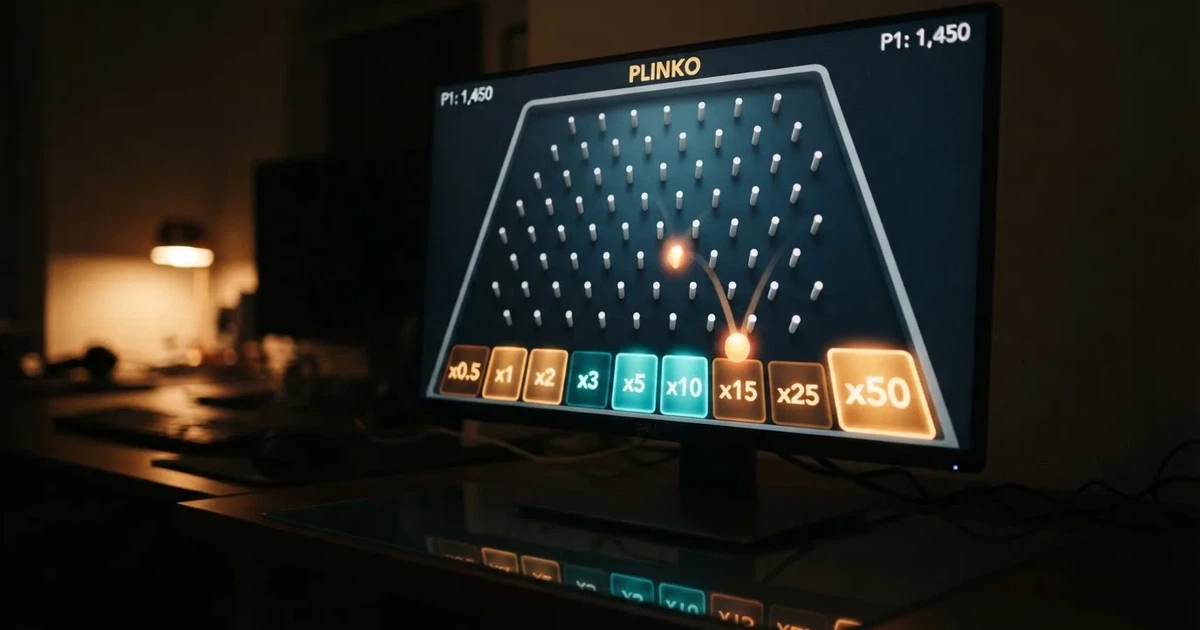
The casino adaptation keeps the geometry and replaces the prize ladder with a multiplier ladder. The most widely advertised version, BGaming’s Plinko, presents a pyramid of pegs with a slot at the bottom of each vertical channel. The player drops a ball from the top; the ball bounces off each peg it meets and ends up in one of the bottom slots, each of which carries a multiplier. BGaming advertises the game with a 99% return-to-player figure and a ×1,000 top multiplier.
The two player-controlled inputs are the risk level (low, normal or high) and the number of lines on the board (between 8 and 16). More lines mean more bottom slots and therefore a flatter distribution of outcomes; fewer lines mean fewer slots and a longer-tailed distribution. Higher risk pushes the top multiplier up and the centre slots down, while lower risk compresses the range. The game can be played manually one ball at a time or run on auto-bet for a set number of drops.
The outcome of any single drop is determined by where the ball lands at the bottom, and that landing is the cumulative result of a long chain of left-or-right bounces off the pegs above it. Because each bounce has a near-50/50 chance of sending the ball either side, a ball that drops through sixteen rows of pegs makes fifteen such choices before it settles; a small asymmetry in early choices compounds through the rest of the run, which is why the bottom slots are not equiprobable even though every individual peg is close to it. The advertised 99% RTP is an average across a very large number of drops, not a guarantee for any particular session.
The contrast with a pokie reel is the contrast between a deterministic mapping from a long random walk and a deterministic mapping from a short one. A pokie reel resolves its outcome against a fixed paytable indexed by the symbols that stop on visible positions; a Plinko drop resolves against a multiplier ladder indexed by the slot a ball settles in. The pokie’s payout distribution is set by symbol weights on a finite set of reels; the Plinko distribution is set by the geometry of the pegboard and the values assigned to the bottom slots. Both are eventually averages — neither promises a win on the next spin or the next drop.
What an Australian punter sees on a Plinko page, then, is a game that is mechanically simple and almost entirely under the operator’s control in two specific respects: the values printed on the bottom slots, and the RTP claimed. Both are numbers the operator publishes, not numbers a regulator verifies. The game itself, mechanically, is a fair sampling of the pegboard it shows; the question of whether the published RTP and the published multipliers are the ones actually in force is one a player cannot answer alone.
Landscape
The table below sets out the brands that have appeared in pages advertising Plinko for real money in Australia, in the order in which the ACMA has most recently named them. Each entry is a brand the regulator itself has warned over the supply of prohibited interactive gambling services to Australians. The column set is the matter each page covers — which brand, which ACMA action and when, the operator named in the warning, and what the available listings say about whether the brand carries a Plinko title at all.
| Brand | ACMA action and date | Operator named by the ACMA | Plinko listings |
|---|---|---|---|
| RocketPlay | Formal warning, March 2026; earlier warning May 2022 | Pulsup Ltd; earlier Dama N.V. | — |
| Level Up Casino | Formal warning, May 2022 | Dama N.V. | Listed on BGaming’s site |
| Woo Casino | Formal warning, March 2025 | Dama N.V. | — |
| Spirit Casino | Formal warning, May 2025 | Dama N.V. | — |
| National Casino | Formal warning, July 2025 | Consolutetish S.R.L. | Plinko mentioned in passing on listings |
| Bizzo Casino | Formal warning, July 2025; earlier warning 2022 | Consolutetish S.R.L.; earlier TechSolutions | — |
| Ignition Casino | Formal warning, July 2025 | Bamboo Media | — |
| Instant Casino | Formal warning, February 2025 | EOD Code SRL | — |
| Jackbit | Formal warning, April 2026 | Ryker B.V. | — |
| Casino Intense | Formal warning, April 2025 | Sterplay Holding Ltd | Plinko mentioned in passing on listings |
| Sky Crown | Formal warning, September 2022 | Hollycorn N.V. | — |
The pattern the table makes is one of recurrence rather than novelty. Dama N.V. accounts for three of the eleven entries at different dates, with a fourth brand from the same operator group named in May 2022 alongside RocketPlay, Bambet, Dazard, Wild Tornado and Cobra Casinos. Consolutetish S.R.L. accounts for two of the eleven. The ACMA is not naming new operators so much as tracking the same corporate groups across new brand surfaces — a brand change costs an operator nothing against the prohibition, and a regulator can only act on the address it can find.
The Plinko listings column is sparse by design. Most of the brands have not surfaced in the listings consulted for this page, which is itself a piece of information: a brand advertised heavily for Plinko on affiliate pages does not always appear in the independent listings, and a brand that does appear in those listings may not advertise Plinko specifically. A punter looking for a known Plinko title is, in most cases, looking at a brand whose listing presence is the only signal the table can carry.
RocketPlay — the most recent ACMA warning on this list
RocketPlay was the subject of a formal warning from the ACMA in March 2026, naming Pulsup Ltd as the operator of RocketPlay. An earlier warning in May 2022 had named Dama N.V. over the same brand, alongside five others. The site operates outside any Australian licence and offers online casino games including Plinko-style multiplier titles to Australian customers. The two warnings together say the regulator has named the same brand twice under two different operating entities, which is a more direct pattern than the regulator’s normal cadence and suggests an operator that has changed corporate surface rather than changed conduct.
Level Up Casino — one of the six warned over in May 2022
Level Up Casino was named in the May 2022 batch of formal warnings that covered six brands operated by Dama N.V.: Bambet, Dazard, Level Up, Rocketplay, Wild Tornado and Cobra Casinos. The brand surfaces on BGaming’s site, which is the one independent listing consulted for this page that places Level Up Casino alongside a Plinko title. The Dama N.V. cluster is the largest single operator footprint in the table, and Level Up is one of the original six names.
Woo Casino — a fresh Dama N.V. warning in March 2025
Woo Casino received a fresh formal warning in March 2025, again naming Dama N.V. as the operator. The brand was not on the May 2022 list and is therefore a later addition to the Dama N.V. cluster. A punter who recognised the brand from earlier listings would be looking at the same operator group behind a fresh brand surface, not at an unrelated operator that has happened to take the name.
Spirit Casino — the May 2025 warning
Spirit Casino received its formal warning in May 2025, the third Dama N.V. brand to be warned over in thirteen months after Woo Casino (March 2025) and the original six (May 2022). The acceleration matters because each warning is the regulator’s response to a specific service address, and three warnings in thirteen months suggests a group that is adding brands faster than the regulator is removing them.
National Casino — a Consolutetish S.R.L. brand
National Casino was named in a July 2025 formal warning over Consolutetish S.R.L. The brand surfaces in passing on independent listings, where Plinko is mentioned among the games offered rather than being the headline product. The same operator group was named in the same round over Bizzo Casino, which means the two warnings are part of one enforcement event rather than two separate ones.
Bizzo Casino — a 2022 warning followed by a 2025 one
Bizzo Casino received a formal warning in July 2025 under Consolutetish S.R.L., three years after an earlier warning in 2022 that named TechSolutions (CY) Group Limited and TechSolutions Group N.V. The same brand carrying two warnings from two different operator names is the clearest example in the table of an operator shifting corporate surface, and the only one where the gap between warnings is long enough to suggest the first warning was not treated as final.
Ignition Casino — a Bamboo Media brand warned over in July 2025
Ignition Casino received its formal warning in July 2025, naming Bamboo Media as the operator. The brand is a US-facing name with an Australian-facing warning, and the listing consulted for this page does not place it alongside a Plinko title. The mismatch between brand surface and Plinko availability is common in the table and is itself the point: the regulator is acting on what is offered to Australian customers, not on what the brand is best known for elsewhere.
Instant Casino — a February 2025 warning
Instant Casino was the subject of a formal warning in February 2025, naming EOD Code SRL as the operator. The brand does not surface in the Plinko listings consulted for this page, but it has appeared in pages advertising crypto-friendly real-money gambling to Australian customers and is part of the cluster of brands the regulator has acted against for offering prohibited services. The warning date makes it one of the earlier entries in the second wave of ACMA action, sitting about a year before the cluster’s busiest period in July 2025.
Jackbit — a crypto-forward brand warned over in April 2026
Jackbit received its formal warning in April 2026, naming Ryker B.V. as the operator. The same warning covered CasinOK, a sister brand. Jackbit is one of the more crypto-forward names in the cluster and is a useful example of the Crypto & Anonymity shelf below: a brand that advertises itself partly through the payment routes it accepts is acting under the same prohibition as a brand that accepts fiat only, and the ACMA is naming them on the same schedule.
Casino Intense — an April 2025 warning with broader listings
Casino Intense received its formal warning in April 2025, naming Sterplay Holding Ltd as the operator. The brand surfaces in independent listings alongside mentions of Plinko, in the same general way National Casino does — present on a listing but not the headline product. The April 2025 date places the warning between the first Dama N.V. warning in March 2025 and the broader Consolutetish S.R.L. round in July 2025, and is one of the cases where the regulator has named a brand for offering Plinko-style games specifically.
Sky Crown — a Hollycorn N.V. brand with an older warning
Sky Crown was the subject of a formal warning published in September 2022, naming Hollycorn N.V. as the operator. The same warning covered the sister brand Blue Leo. The September 2022 date makes Sky Crown the oldest entry in the table by ACMA action, and the only one in the cluster that predates the major ramp-up in enforcement that followed the 2024–2026 amendments. A punter looking at this brand is looking at a long-standing prohibition, not a recent one.
The fundamentals of Plinko — the game, the claims, the gaps
Plinko as a casino game is, mechanically, the simplest product the offshore sites advertise. The player picks a stake, picks a risk level, picks a number of lines, and drops a ball. The ball bounces down through the pegs and lands in a multiplier slot. The game ends when the player stops. There is no skill input, no decision tree past the initial settings, and no way to influence the outcome once the ball is in motion.

The settings are where the operator’s discretion lives. The risk level changes the shape of the multiplier ladder: low risk compresses the range so that almost every slot pays back near the stake, normal risk spreads the range further, and high risk concentrates the upside in the centre slots at the cost of most slots paying well below the stake. The number of lines changes how many slots there are at the bottom and therefore how flat the distribution is. A BGaming-style configuration of 16 lines on normal risk gives a flatter, lower-variance experience; 8 lines on high risk gives a sharper, longer-tailed one.
The 99% RTP figure that BGaming advertises is the average return across a very large number of drops at a specific settings combination. Two settings combinations at the same nominal RTP can have very different variance profiles; a player chasing a 99% RTP on high risk with 8 lines is chasing the same average as a player on normal risk with 16 lines, but is doing so across a much wilder distribution. The advertised RTP does not say what the distribution looks like, only what its average is.
The “free spins” terminology that appears in some Plinko advertising is a borrowing from pokie language and not a Plinko-native concept. A Plinko game does not have reels and does not have a spin button that triggers a free round; the equivalent mechanic, where it exists, is a sequence of auto-bet drops paid for by the house rather than the player. The terminology is a marketing convenience and is one of the easier tells that the page has been written against a Plinko-shaped product rather than a pokie-shaped one.
The “bonus” terminology that appears on the same pages is similarly borrowed. A Plinko bonus is a deposit match or a credit on the house account, applied to a game where the player controls the stake on every drop. The bonus terms that matter — the wagering multiplier, the maximum cashout, the eligible games, the expiry — are the same terms that apply to any other game on the site, and there is no Plinko-specific reason a bonus would be more or less generous on this title than on a pokie.
The “app” terminology is a third borrowing. A Plinko casino app is, in most cases, a mobile-optimised website reached through a browser, occasionally packaged as a downloadable APK or an iOS/Android app from the operator’s own distribution channel rather than from the official app stores. The official app stores do not list real-money casino apps in Australia; an app sideloaded from an operator’s site is one of the clearer signals that the operator is operating outside the regime.
The fundamentals, then, are simple. Plinko is a game of chance with two player-controlled settings and a published RTP that is an average across many drops. The marketing layer around it borrows vocabulary from pokies and from sports betting, and the borrowing is itself a signal that the page is selling a product the local rules do not license.
Why no offshore Plinko site is licensed in Australia
The Interactive Gambling Act 2001, strengthened by the Interactive Gambling Amendment Act 2017, makes it an offence to provide online casino games — including Plinko-style multiplier games — to a person in Australia. The penalties are up to A$220,000 per day for individuals and up to A$1.1 million per day for corporations. The Act targets the provider, not the individual player; an Australian punter is not prosecuted for playing on an offshore site, but the site is committing an offence by offering the game to them.
What is licensed in Australia is a much narrower set of products. Wagering on races and sporting events placed before the event is licensed; lotteries and keno are licensed; in-play online betting is not licensed. No state or territory issues a licence for online casino games, and the practical licensing body for online wagering is the Northern Territory Racing and Wagering Commission, which regulates 52 of Australia’s online bookmakers — including Sportsbet, Bet365 and Ladbrokes — and has no full-time staff, meeting once a month in Darwin.
The consequence for a Plinko punter is direct. A site offering Plinko to Australians is, by definition, operating outside the only licensing regime that exists here. The licence the site displays — a Curaçao number, an Anjouan number, a Costa Rica number — is a licence issued by another jurisdiction and has no standing under Australian law. The site can be Australian-facing and Australian-targeting without being Australian-licensed, and the distinction is the one the IGA draws.
The enforcement is the ACMA’s job. The regulator investigates, issues formal warnings, and directs Australian internet service providers to block illegal sites. The blocking is the visible end of the enforcement pipeline; the warning is the early end. A brand that has been warned has been told, in writing, that it is offering a prohibited service; a brand that has been blocked has been made unreachable through Australian ISPs without a VPN.
The reform track runs further. The Interactive Gambling Amendment (Gambling Reform) Bill 2026 passed Parliament on 19 August 2026; its advertising and inducement measures commence on 1 January 2027. The reform is law with a future start date, and on a 2026 page it is on the books but not yet in force. A punter reading the law at the point of deposit is reading the version that has been in force since 2017, with the 2026 amendment waiting in the wings for its 2027 commencement.
The blocking rate the ACMA has actually achieved
The ACMA reported in June 2026 that a total of 1,751 illegal gambling and affiliate marketing websites had been blocked since the first blocking request in November 2019. The first blocking request to the November 2019 figure is roughly 6.58 years; the rate over that period sits in a band of roughly 260 to 270 sites per year, or about 22 sites per month, or roughly five sites per working week. The June 2026 round alone asked Australian ISPs to block 12 more sites: 7Signs, ChromaBet, Donbet, Duospin, Freshbet, Slots Gem, Jacks Club, Lucky Start, Pointsbetz, Spinrise, Vinyl Casino and Wildsino.
The blocking rate is the regulator’s primary insight into this market on this page, and the figure to read from it is the gap between the rate at which new sites appear and the rate at which the regulator removes them. The 1,751 figure includes affiliate marketing sites, which are not the same product as a casino site — an affiliate page may advertise a casino without itself taking a deposit — so the rate against casino sites alone is a lower bound rather than a midpoint. The condition on the band is therefore the scope: counting casino sites only, the blocking rate would be lower than 260 per year; counting all illegal sites and affiliate marketing together, it sits at the upper end.
The blocking rate also has a turnover component. The same operator groups reappear under new brand names, which means the regulator’s count of unique blocks overstates the count of unique operators. The 1,751 blocks include a meaningful number of repeat-actor brands under new surfaces, and the rate of new operators removed is lower than the rate of new sites removed. A punter reading the figure as a count of distinct operators acting in good faith is reading it wrong; the figure is a count of addresses, not of intentions.
The practical reading is that the regulator is keeping pace at the surface level but not at the operator level. A new domain is reachable for some weeks or months before it is blocked; a new operator group behind it can run for years, surfacing new brands and accumulating new warnings, before the regulator catches the corporate trail.
H2 Gambling Capital’s 2025 estimate of what flows offshore
The H2 Gambling Capital 2025 report, as cited by industry coverage, estimates that Australians lose about A$3.9 billion a year to illegal gambling sites. The same report notes that the share of gambling going through legal channels fell from 74% in 2021 to 64%. The first figure is a flow of money out of Australia to offshore operators; the second is a flow of share away from Australian-licensed operators toward that offshore pool.
The two figures are not the same kind of estimate. The A$3.9 billion figure is a sum of losses across an estimated population of players, sites and games, drawn from a model rather than from a transaction log. The 74% to 64% shift is a comparison of two share estimates from the same modelling approach at two points in time, and the gap is the share that has moved from the legal to the illegal side of the market over four years.
The cost to the punter is the difference between the legal and the illegal experience on the same nominal stake. A licensed Australian wagering product offers consumer protection, a complaints body, a regulator that can compel a payout, and the BetStop self-exclusion register. An illegal site offers none of those things, and the offshore brand sits one blocking round away from being unreachable. The A$3.9 billion figure is the total of those unprotected stakes across the Australian population; the per-punter average is a much smaller number, but the per-punter loss when a withdrawal is refused or a balance is stranded is the full balance, not the average.
The 74% to 64% shift is the underlying dynamic. Australians are not migrating away from licensed wagering in absolute terms so much as a larger share of new gambling activity is reaching offshore sites, which is partly a function of marketing reach (offshore sites spend heavily on affiliate advertising) and partly a function of product breadth (the legal Australian wagering market does not include online casino games at all, so anyone who wants to play one must look offshore).
Responsible play when the game is by definition outside the rules
The advice that applies to any punter is sharpened when the product sits outside Australian rules. BetStop, the National Self-Exclusion Register, is the only Australian self-exclusion regime that binds the operator, and it binds only Australian-licensed online and phone wagering services. An offshore Plinko site is not connected to BetStop, so a self-exclusion made there does not register against any other offshore site, does not register against the punter’s bank, and does not register against the affiliate pages that marketed the site in the first place.
The National Gambling Helpline on 1800 858 858 is free, 24/7, and offers chat at Gambling Help Online. The Helpline is the practical first call for someone who has spent more than they meant to on an offshore site, or for someone who is planning a self-exclusion and needs to know what the regime will and will not catch. The Helpline’s advice is independent of the offshore operators and is the part of the Australian consumer-protection frame that remains available to a punter who has chosen to play offshore.
A punter who is reading this page while considering whether to deposit on an offshore site is reading it at the cheapest point in the decision — before any money is at stake. The decision after the deposit is harder: the offshore site’s customer service is the only channel available, the offshore site’s complaints policy is the only policy available, and the offshore site’s regulator is the only regulator available. None of those have Australian standing, and the punter is in the position of someone who has chosen to play outside the regime the rest of this page has been describing.
The advice that follows is general rather than specific to Plinko. Set a budget before the first deposit and stop at it. Treat any deposit as an entertainment expense rather than as an investment. Read the bonus terms before claiming a bonus, and treat the published RTP and volatility as a long-run average rather than as a session guarantee. Use Australian-licensed wagering products for racing and sports betting where they are available, and reserve offshore play for the niche products that the local market does not license at all — and accept that the niche comes with the absence of consumer protection that licensing provides.
The hardest part of the choice is naming it. An offshore Plinko site is offering a product the Australian market does not license, to a customer the Australian consumer-protection frame does not cover, with a payment route the Australian rules prohibit for licensed wagering. A punter who knows that and chooses to play anyway is making a deliberate choice, and the rest of the page is for the punter who is weighing that choice rather than for the one who has already made it.
Crypto, Bitcoin and the anonymity claim that doesn’t reach Australia
The crypto angle on Plinko is that some offshore sites accept Bitcoin and other digital currencies as deposit and withdrawal methods, and advertise that acceptance as a feature. The claim is that crypto is faster, cheaper, more private, or some combination of the three. The claim, taken at face value, is partly true: a Bitcoin transaction confirms in minutes and is not reversed by the card schemes once it confirms. The claim, applied to the Australian consumer-protection frame, is irrelevant, because the frame does not reach the offshore site in the first place.
The Australian rules treat crypto as banned for licensed wagering. Since 11 June 2024, digital currency has been a banned payment method for any online wagering offered under an Australian licence, with penalties of up to A$247,500 for the operator. A site that accepts Bitcoin from an Australian customer is, by that test, not operating under an Australian licence — the ban only matters to an Australian-licensed operator, and an operator that accepts crypto from Australians is by definition not one of them.
The “anonymity” claim is the weakest of the four crypto arguments. A Bitcoin transaction is pseudonymous rather than anonymous: the wallet address and the transaction are public on the blockchain, and the link from wallet address to real-world identity is made through the on-ramp or off-ramp the user used to acquire or dispose of the Bitcoin. An Australian punter who buys Bitcoin on a regulated Australian exchange, sends it to an offshore casino, and withdraws back to a regulated Australian exchange has left a trace that links the on-chain activity to a verified identity. The pseudonymity is a privacy feature against third-party surveillance; it is not a privacy feature against the entities the punter has voluntarily given identifying information to.
The speed claim is the most defensible. A Bitcoin deposit typically confirms in minutes, and a withdrawal paid in Bitcoin can confirm in a similar window once the operator releases it. The catch is the operator-release step: the speed of the on-chain transaction is not the speed of the operator’s internal processing, and an offshore site that takes 48 hours to approve a withdrawal in fiat will take a comparable time to approve one in Bitcoin. The crypto route does not change the operator’s internal clock; it changes only the rails the approved withdrawal travels on.
The cost claim is partial. Bitcoin transaction fees are a function of network congestion rather than of the transaction size, and a small deposit may attract a fee that is a meaningful fraction of the deposit itself. The fee is paid by the sender, and an offshore site that processes a small Bitcoin deposit is paying a fee that, in relative terms, is much larger than the fee on a credit card deposit of the same size. Crypto is not cheaper than card payments for small stakes; it is cheaper for large ones.
The bottom line is that crypto does not change the legal status of the offshore site, does not change the consumer-protection frame around it, and does not change the operator’s internal clock for withdrawals. It changes only the rails the funds travel on, and it does so for an operator that is by definition outside the Australian regime. A punter who wants to play Plinko through crypto is paying the cost of an offshore site — the absence of local protection, the risk of a blocking round, the absence of BetStop — and is not gaining anything the Australian regime would have offered.
Choices an Australian punter actually has
The choice is binary in form and more nuanced in detail. A punter who wants to play Plinko for real money has three live paths: an Australian-licensed wagering product, an offshore Plinko site, or a non-wagering alternative. None of the three is a clear winner; each has a different trade-off.
An Australian-licensed wagering product is licensed by the NTRWC and offers consumer protection, the BetStop register, and recourse to the regulator. It does not offer Plinko or any other online casino game. A punter on this path is choosing the protection frame and accepting that the product they want is not on the menu.
An offshore Plinko site offers the product. It does not offer the protection frame, is one blocking round away from being unreachable, and accepts payment methods the Australian rules prohibit for licensed wagering. A punter on this path is choosing the product and accepting that the protection frame is not on the menu.
A non-wagering alternative — a free Plinko app, a social casino, a demo version of BGaming’s Plinko — offers the game without the wager. It does not pay out real money, and the experience of playing it is the experience of the game rather than the experience of gambling. A punter on this path is choosing the game and accepting that the wager is not on the menu.
The frame each punter sits in is the frame they have chosen. The legal regime does not bend; the offshore site does not become licensed by being played from Australia; the BetStop register does not catch a site it does not cover. The choice is the punter’s, and the consequences are the punter’s, and the rest of the page is for the punter who is reading this section and trying to decide which frame to sit in.
Plinko in 2026: the short read
A Plinko casino in Australia is, in 2026, an offshore site offering an unlicensed product to a customer the Australian consumer-protection frame does not cover. The game itself is a pegboard with a multiplier ladder and a 99% RTP figure that is an average across many drops rather than a session guarantee. The eleven offshore brands named by the ACMA in this cluster account for 22 ACMA formal warnings between May 2022 and April 2026, with the regulator removing sites at a rate of roughly 260 per year across the past 6.58 years and the corporate groups behind them reappearing under new brand surfaces faster than the regulator removes the old ones.
H2 Gambling Capital’s 2025 estimate is that A$3.9 billion a year flows from Australians to illegal gambling sites, and that the share of gambling going through legal channels has fallen from 74% in 2021 to 64%. Crypto and credit card deposits are the markers that a site is outside the Australian rules, and crypto does not buy anonymity, speed that matters, or any consumer protection the local regime does not already offer to licensed products.
The choice that remains is the punter’s, and the rest is bookkeeping.
Frequently asked questions about Plinko in Australia
Game House Edge Comparison
The house edge for standard casino table games varies significantly by bet type and rule set. The following table provides a snapshot of the house edge for common games referenced in this article.
| Game | Bet Type | House Edge |
|---|---|---|
| Baccarat | Banker | 1.06% |
| Baccarat | Player | 1.24% |
| Blackjack | Optimal Strategy | 0.28%–0.43% |
| Craps | Pass/Come | 1.41% |
| Craps | Any Craps | 11.11% |
What does “Plinko” actually mean in a casino context?
The casino version of Plinko is a digital take on the pegboard game that first appeared on the US television show The Price Is Right on 3 January 1983. A ball drops from the top of a pyramid of pegs, bounces left or right at each peg, and lands in one of the multiplier slots at the bottom. The slot the ball lands in determines the payout; the multiplier printed on that slot times the stake is what the player wins on that drop. The outcome is determined entirely by where the ball lands, and where it lands is the cumulative result of a chain of near-50/50 bounces through the pegs above.
Is a crypto version of Plinko a different game from a regular real-money version?
Mechanically, no. The Plinko game is the same pegboard with the same multipliers regardless of the currency the player uses to fund it. What changes is the payment rails: a Bitcoin deposit is a separate channel from a credit card deposit, and the operator’s internal clock for releasing a withdrawal is the same on either. The Australian rules treat crypto as a banned payment method for licensed wagering, so a site that accepts Bitcoin from an Australian customer is by definition operating outside the licensed regime, and the currency of the deposit does not change that fact.
Is it legal for an Australian to play Plinko on an offshore site?
The Interactive Gambling Act 2001 makes it an offence for an offshore operator to provide online casino games — including Plinko-style multiplier games — to a person in Australia, with penalties of up to A$220,000 per day for individuals and up to A$1.1 million per day for corporations. The Act targets the provider, not the player, so an Australian punter is not prosecuted for playing. The offshore site offers no Australian consumer protection, no complaints body, and no recourse if a withdrawal is refused, and it can be blocked by the ACMA while the punter still has a balance on it.
What RTP does an offshore Plinko game typically advertise?
BGaming’s Plinko is advertised with a 99% RTP and a ×1,000 top multiplier. The figure is an average across a very large number of drops at a specific combination of risk level and number of lines, not a guarantee for any single session. Two settings combinations at the same nominal RTP can have very different variance profiles, and the advertised average says nothing about the distribution of outcomes around it.
Why are Plinko casino apps advertised separately from Plinko casino websites?
Because the official mobile app stores do not carry real-money casino apps for the Australian market. A Plinko casino app is, in most cases, a mobile-optimised website reached through a browser, or a downloadable package distributed from the operator’s own channel rather than from Apple’s App Store or Google Play. The app surface is a marketing convenience, and the operator behind it is the same operator behind the website, with the same licence status under Australian law and the same absence of Australian consumer protection.
How does a Plinko paytable differ from a pokie reel in its odds?
A pokie reel resolves its outcome against a fixed paytable indexed by the symbols that stop on visible positions; a Plinko drop resolves against a multiplier ladder indexed by the slot a ball settles in. The pokie’s distribution is set by symbol weights on a finite set of reels; the Plinko distribution is set by the geometry of the pegboard and the values assigned to the bottom slots. Both are eventually averages — neither promises a specific outcome on the next spin or the next drop.