
Best BGaming online casinos in Australia in 2026
A reader typing the words “best BGaming online casinos Australia” is, in practical terms, asking a question with no licensed answer. No online casino carrying BGaming’s slot catalogue operates under an Australian licence. The Interactive Gambling Act 2001 prohibits the offering of online casino games and online pokies to anyone in Australia, and no state or territory issues the licence such a product would need. What does exist is a thick offshore market of sites that accept Australian sign-ups anyway, a long list of formal warnings the Australian Communications and Media Authority has issued against them, and a payments and consumer-protection regime that treats those sites as illegal. This page walks through what BGaming is as a studio, why every brand associated with its games in Australia sits outside Australian law, and what a player here actually faces when one of those offshore sites accepts their deposit.
Current as of 29 October 2026 · Verified against the Australian Communications and Media Authority register of formal warnings and blocking notices.
Table of Contents
- Payments, deposits, and the practical money side
- Bonuses, free spins, and what these offers actually cost
- Mobile play and what an app-based BGaming casino would involve
- Paytables and what a BGaming slot shows the player
- Overview of ACMA-warned brands
- Fundamentals of BGaming and the studio behind the games
- The prohibition and what it costs players who cross it
- Responsible gambling and the support that is available
- The eleven brands the ACMA has formally warned
- Frequently asked questions
Payments, deposits, and the practical money side
Money side first, because it is the part that bites earliest. For an Australian-licensed wagering service — the only kind the IGA permits at all — the deposit rails were narrowed sharply on 11 June 2024. Credit cards, credit-related products and digital currency are now banned as a means of paying for any licensed online or phone wagering, with penalties of up to A$247,500 for an operator that breaks the rule. What remains legal for a licensed bookmaker is debit card, bank transfer, PayID/Osko and BPAY. The same rule has nothing to say about an offshore casino, because that casino is not licensed here and has no reason to follow the rule. It will quite happily accept the credit card or the Bitcoin deposit the licensed bookmaker cannot.
That is the structural gap the offshore sites live in. They are not Australian-licensed, so the credit-card ban does not bind them. They are also not bound by the Australian ePayments Code, not subject to Australian Financial Complaints Authority oversight, and not connected to BetStop, the National Self-Exclusion Register that has been live since August 2023. If a player asks an offshore support desk to close their account in self-exclusion, the answer is whatever the offshore desk decides — there is no Australian register to enforce it. Where the licensed route gives a player the ePayments Code and an AFCA escalation, the offshore route gives the site’s own terms and whatever goodwill its operator extends.
Withdrawal speed is the second half of the money question. Research and affiliate marketing pages tend to advertise same-day or 24-hour payouts from offshore BGaming sites. The honest reading: many of those sites can pay quickly when they want to, and many can also stall, cancel withdrawals on identity-verification grounds, or freeze balances pending source-of-funds checks the player never agreed to in advance. The pattern is well documented across the offshore sector and the ACMA’s enforcement file carries enough of it that “fast payout” is more a sales line than a guarantee. A player who has won on a site the regulator has already warned is, in practice, asking the same site to send the winnings back. Sometimes it does. Sometimes it does not.
The third point is the one Australian-licensed operators do not have to defend: where the money comes from. A licensed wagering service runs KYC and AML checks against Australian standards and reports to AUSTRAC. An offshore casino runs its own checks, against its own licence’s standards, and an Australian player has no Australian recourse if a source-of-funds query goes badly. For a player with a normal bank account and a normal-sized deposit, this rarely matters. For a player with a larger balance or a flagged transaction history, it can become the dominant fact about the site.
The conclusion is unsentimental: the licensed Australian route protects deposits, withdrawals and self-exclusion because the law requires it. The offshore route offers none of those protections because the law does not reach it. A reader deciding where to play should know which side of that line they are on.
Bonuses, free spins, and what these offers actually cost
Every bonus marketing page in this market opens with the same kind of headline — a hundred percent match, two hundred free spins, a “welcome package” worth four-figure sums. The arithmetic underneath those headlines is what determines what the offer actually costs.
A matched-deposit bonus carries a wagering requirement, almost always expressed as a multiple of the bonus amount, sometimes of the deposit plus the bonus together. A 35x wagering multiple on a A$200 bonus means the player must place A$7,000 in qualifying bets before any of the bonus balance converts to withdrawable cash. Free spins carry their own conversion rules — the winnings from the spins typically land as bonus balance, then run through their own wagering multiple, and frequently a cap on how much of the resulting balance can be withdrawn. A typical structure on the offshore sites is bonus cash with a 40x multiple and free-spin winnings capped at a small fixed amount. None of this is hidden; all of it is in the terms. The marketing line is what makes the offer look like a gift, and the small print is what makes it look like a loan.
The “no deposit” variant is the most misread offer in this market. The marketing claim — free money, no deposit, just sign up — sidesteps the question of how the offer exits the bonus wallet. It exits under the same conversion rules as a deposit bonus, sometimes with a stricter multiple and always with a maximum-cashout cap. A no-deposit offer that pays A$20 in bonus cash with a 50x wagering multiple and a A$50 maximum cashout is asking the player to risk turning A$20 of bonus money into a withdrawal of no more than A$50, against a house edge on every spin they make along the way. The expected loss against the wagering volume is usually larger than the maximum cashout cap, which is the structural reason the offers exist: the math favours the house even before the cap is applied.
The free-spin element deserves its own note. The headline number is the spin count, not the value of the spins, and not what the player is likely to walk away with. A “200 free spins” line on Book of Cats or Elvis Frog in Vegas refers to spins at a fixed coin value, usually the minimum on the game, against a fixed paytable. The realised value of the spins is a function of hit rate, volatility, and the conversion cap on the resulting bonus balance. Marketing presents the number; the small print converts it.
The honest framing: a bonus is a marketing spend dressed as a present. The wagering multiple and the cashout cap are the price the player pays for it. Any site — licensed or offshore — that obscures those numbers is not offering a bonus; it is offering a trap. The reader who decides to claim one should read the wagering multiple first, the cashout cap second, and the eligible-game list third. The headline is the least informative part of the offer.
The reason this section is here at all is that no licensed Australian casino offers these bonuses to Australian players, because no licensed Australian casino exists in this product category. The offers exist on offshore sites only, where the small print is the contract and the regulator is not on the player’s side.
Mobile play and what an app-based BGaming casino would involve
BGaming builds its portfolio in HTML5, which is the universal standard for browser-delivered games on phones and tablets. That choice matters: an HTML5 game does not require an app download, does not require iOS or Android approval, and runs in any modern mobile browser. The same is true of most of the studios whose names turn up alongside BGaming on offshore casino lobbies — 1spin4win, for example, builds its catalogue in HTML5 specifically to support low-bandwidth connections. The mobile product these studios hand to operators is, by default, a browser product.
What an operator does on top of that is its own decision. Some build a progressive web app — a wrapper around the mobile site that adds a home-screen icon and a slightly more app-like feel. Some publish a native app through the App Store and Google Play, which is a more expensive route and one that requires the operator to clear platform review. A number of offshore casinos sit somewhere between the two, with a mobile-optimised site that behaves more or less like an app when added to the home screen. None of this is unique to BGaming; the same architecture serves any studio on the same site.
For an Australian player, the mobile question has a second layer. Apple’s App Store and Google Play both enforce policies on real-money gambling apps in Australia, and the categories of app they permit are narrower than what an offshore operator wants to offer. Real-money casino apps from unlicensed offshore operators are not generally available through either store. The realistic Australian experience is the mobile browser, not the downloaded app, regardless of what an affiliate page claims.
The deeper question is whether mobile changes the underlying calculus of the offshore offer, and the answer is no. The same wagering multiple applies, the same cashout cap applies, the same lack of Australian consumer protection applies. A small phone screen does not turn a site the ACMA has warned into a safer place to play. The mechanics move; the legal frame does not.
The practical recommendation for a reader who has decided to play on an offshore site anyway: use the mobile browser rather than installing anything, treat the site as untrusted by default, and assume the deposit is at risk until it is back in a bank account the player controls.
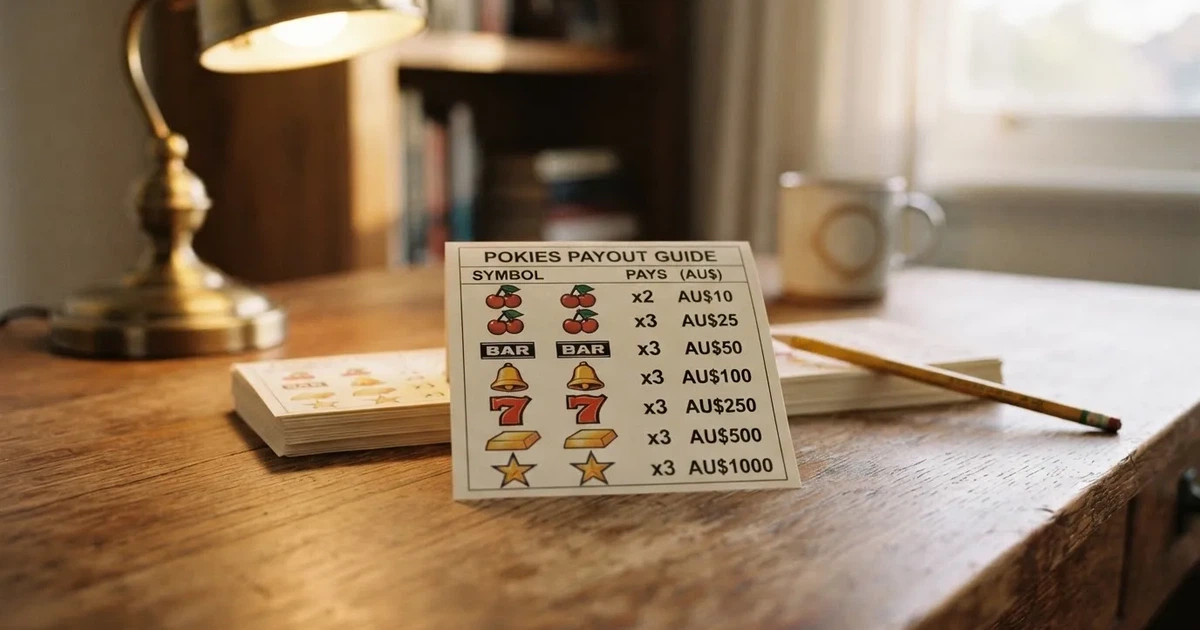
Paytables and what a BGaming slot shows the player
A paytable is the small chart inside a slot that tells the player what each symbol is worth, which combinations pay, and what the bonus features trigger. Every reputable studio publishes one. BGaming’s portfolio includes 250+ certified games across video slots, video poker, lottery, card, scratch, crash and casual titles, and each slot ships with its own paytable that states the symbol values, the line structure, the RTP, and the volatility class. The studio’s own proprietary mechanics show up in those paytables in ways that distinguish a BGaming title from a generic five-reel game.
TRUEWAYS is the most distinctive. A traditional five-reel, three-row slot offers a fixed number of ways to win — usually 243 at the upper end. A BGaming TRUEWAYS game expands the win calculation across the reel set, offering up to 262,144 ways to win when all the positions are live. Mechanically, the game evaluates symbol combinations across adjacent reels rather than fixed paylines, and the number of live ways shifts as the reels land. MultiDice X and Merge UP are the studio’s other proprietary mechanics; both appear in the portfolio catalogue alongside the standard slot formats. None of this is mysterious once a player reads the paytable, and a paytable that does not explain its own structure is a paytable to avoid.
A comparison with another studio is instructive. Betsoft’s slot The Slotfather, live since 13 December 2012, sits at the other end of the structure: five reels, thirty paylines, medium volatility, a published RTP of 95.69% and an 8.17% hit rate. Betsoft’s Good Girl Bad Girl 2, more recent, plays on five reels and twenty paylines with a 96.22% RTP, “very high” volatility and a 15.59% hit rate. The two Betsoft examples show the same paytable conventions BGaming uses — symbol values, line counts, volatility, hit rate — laid out in the same way a player reads them. The reading skill transfers.
The practical skill for a player is short. Find the paytable button on the game, open it, and read four numbers: the RTP, the volatility class, the hit rate if listed, and the maximum payout. The RTP is the long-run theoretical return to player; volatility is the swing — high volatility means long dry patches punctuated by occasional larger wins; hit rate is how often a spin returns anything at all; maximum payout caps the upside on a single spin. With those four numbers, the paytable is the contract between the game and the player. Without them, the player is guessing.
The deeper point: a paytable is the only piece of the slot a player can read before placing a bet. Marketing pages will not give an honest volatility reading. Affiliate pages will not give a hit rate. The paytable is the studio’s own statement, and on a licensed game it is audited as part of the certification. On an offshore site, the same paytable appears in the game but the certification behind it is whatever the operator’s own licence claims. The player cannot tell the difference from inside the game. They have to take the operator’s word for the audit, and that is the central reason the offshore offer is the offer it is.
Overview of ACMA-warned brands
A ranking page in this category usually lists ten or eleven brands, scores them on bonus size, payout speed, game count and licensing prestige, and ships the list. For Australian players searching “best BGaming online casinos”, that format is dishonest. The brands in this market are not legitimately comparable on the dimensions a ranking would score, because none of them is licensed to take Australian players in the first place. The honest comparison is on what each brand has actually done in the Australian market — and the cleanest measure of that is the ACMA’s own enforcement file.
The table below lists every brand the ACMA has formally warned over a BGaming-relevant product or category, in the order the warnings were issued and the operator behind the warning as the ACMA named it.
| Brand | ACMA action and date | Operator named by the ACMA | Subject support |
|---|---|---|---|
| RocketPlay | Formal warning, March 2026 (earlier May 2022 against Dama N.V.) | Pulsup Ltd | — |
| Level Up Casino | Formal warning, May 2022 | Dama N.V. | Listings only (Wazdan operator directory) |
| Woo Casino | Formal warning, March 2025 | Dama N.V. | — |
| Spirit Casino | Formal warning, May 2025 | Dama N.V. | — |
| National Casino | Formal warning, July 2025 | Consolutetish S.R.L. | Listings only (Betsoft, Pragmatic Play and Wikipedia mentions) |
| Bizzo Casino | Formal warning, July 2025; earlier 2022 | Consolutetish S.R.L. (2025); TechSolutions (2022) | — |
| Ignition Casino | Formal warning, July 2025 | Bamboo Media | — |
| Instant Casino | Formal warning, February 2025 | EOD Code SRL | — |
| Jackbit | Formal warning, April 2026 | Ryker B.V. | — |
| Casino Intense | Formal warning, April 2025 | Sterplay Holding Ltd | Listings only (1spin4win, Wikipedia, UK Gambling Commission) |
| Sky Crown | Formal warning, September 2022 | Hollycorn N.V. | — |
The “subject support” column reads as a string of dashes because the research on this question is thin: for most of these brands, no third-party game studio or regulator publishes a confirmation that BGaming content is actually present on the site. Where listings do exist, they are the studios’ own operator directories or general encyclopaedia entries, not the casino’s own statements. The honest reading of the column is that almost nothing here has been independently verified.
The pattern in the “operator named by the ACMA” column is more informative than the brand names suggest. Dama N.V. appears three times in this list — Level Up, Woo, Spirit — and was previously warned over six brands in 2022, including Rocketplay under its earlier incarnation. Consolutetish S.R.L. appears twice, for National and Bizzo, with Bizzo carrying a second warning from an earlier 2022 action against TechSolutions. The ACMA is not warning eleven independent operators; it is warning the same handful of corporate parents on a rotating cast of brand names. New skins appear under the same parent, the ACMA warns the parent, the parent moves to the next skin. The “ranking” of these brands is, in practice, a ranking of how recently the regulator has come back to each parent.
The point is not that any one of these brands is worse than another. The point is that the ranking a player is searching for does not exist as a meaningful product. What exists is a list of offshore sites the Australian regulator has identified as offering prohibited services, with the operator behind each name in plain text. A reader comparing options on the Australian market is, in effect, comparing which warning they are willing to disregard.
Fundamentals of BGaming and the studio behind the games
BGaming is a game studio, not an operator. The brand itself debuted in 2018, though the team behind it has worked on games since 2012, and the corporate parent is Stable Games Ltd, registered in Valletta, Malta. The studio holds a Malta Gaming Authority Critical Gaming Supply Licence under number MGA/B2B/785/2020, issued 18 March 2021, for Type 1 B2B gaming services. That licence is a supply-side credential — it authorises BGaming to provide games to licensed operators, not to operate a casino itself. The studio’s catalogue of 250+ certified titles is licensed into 3,000+ operator integrations, with named partners on the studio’s own site including Blaze, Pin-Up and Gamdom.
The studio’s signature mechanics are TRUEWAYS, offering up to 262,144 ways to win by evaluating symbol combinations across adjacent reels rather than fixed paylines, MultiDice X, and Merge UP. The portfolio spans video slots, video poker, lottery, card, scratch, crash and casual titles, and the studio publishes the RTP, volatility and feature structure for each game in its own catalogue. None of this is unique to BGaming; it is the standard that studios of comparable size and licence status publish. The differentiator is the catalogue shape and the proprietary mechanics, which a player notices after a few sessions rather than from a marketing page.
1spin4win, named in some affiliate contexts alongside BGaming, is a separate studio. Founded in 2021 by a team with 15 years of iGaming experience, headquartered at Scharlooweg 39 in Willemstad, Curaçao, and operating under a Curaçao gaming licence, the studio’s portfolio covers more than 190 online slots built in HTML5 for low-bandwidth mobile connections. The studio claims more than 1,000 partnerships with online casinos and aggregators and a 46% increase in total bet sum across the first half of 2025 compared with the first half of 2024. The point of including 1spin4win here is not to confuse it with BGaming; the point is to clarify that “BGaming casino” is shorthand for “a casino whose lobby includes BGaming content”, and the lobby is almost always a multi-studio lobby.
Aristocrat Leisure, mentioned for context because it is the Australian gambling-machine manufacturer, is the largest slot-machine manufacturer in the country and the second-largest slot-maker worldwide behind International Game Technology. Founded in 1953, listed on the Australian Securities Exchange in 1996 under the ticker ALL, the company runs electronic gaming machines, casino management systems, online real-money gambling technology, iLottery products and social casino games from its North Ryde headquarters. Its 2025 revenue was A$6.30 billion, with normalised net profit after tax and amortisation of A$1.55 billion and 7,400 employees. Aristocrat Interactive, the regulated online real-money arm, was formed in April 2024 by combining the Anaxi unit with the newly acquired NeoGames group — a roughly US$1 billion acquisition announced in 2023 and completed in April 2024. None of this connects Aristocrat to BGaming or to offshore casino play; the relevance is that Aristocrat is the licensed Australian gambling-machine manufacturer, and BGaming is a software supplier to offshore sites that the IGA prohibits.
The takeaway from the fundamentals is short: BGaming is a real, MGA-licensed B2B supplier of casino content. The sites that carry its games to Australian players are not licensed to do so. The supplier’s standing does not transfer to the site.
The prohibition and what it costs players who cross it
The Interactive Gambling Act 2001, strengthened by the Interactive Gambling Amendment Act 2017, makes it an offence to provide online casino games, online pokies or in-play betting to a person in Australia. No state or territory issues a licence for these products. What is licensable is wagering on races and sporting events placed before the event, lotteries and keno — in practice licensed by the Northern Territory Racing and Wagering Commission, which regulates 52 of Australia’s online bookmakers including Sportsbet, Bet365 and Ladbrokes. The commission has no full-time staff and meets once a month in Darwin, a structural detail that recurs whenever reform is debated. Minimum age is 18.
Enforcement sits with the ACMA. The authority investigates complaints, issues formal warnings, and can direct Australian internet service providers to block illegal sites. By the ACMA’s own reporting, 1,751 illegal gambling and affiliate marketing websites had been blocked since the first blocking request in November 2019, and more than 230 unlicensed gambling services had left the Australian market since enforcement was strengthened in 2017. A round reported on 26 June 2026 added twelve more: 7Signs, ChromaBet, Donbet, Duospin, Freshbet, Slots Gem, Jacks Club, Lucky Start, Pointsbetz, Spinrise, Vinyl Casino and Wildsino. The enforcement pace is, on average, roughly 22 sites per month across the seven-year span from November 2019 to June 2026 — a band that includes affiliate marketing pages alongside the gambling services themselves, and that has not slowed materially over the period.
The scale of the offshore market is harder to estimate than the scale of the enforcement. H2 Gambling Capital’s 2025 report puts Australian losses to illegal gambling sites at about A$3.9 billion a year, and notes that the share of gambling going through legal channels has fallen from 74% in 2021 to 64%. The figures are estimates, not audited numbers, but the direction is consistent with what the ACMA’s blocking file shows: a market that is large, growing, and almost entirely offshore.
The individual player is not the target of the IGA. The Act targets the provider, not the punter, and there is no realistic prosecution risk for an Australian who places a deposit on an offshore site. The cost the player pays is different: no Australian consumer protection, no complaints body, no recourse if a withdrawal is refused, and no guarantee the site will still exist in the form the player deposited with. The site can be blocked while a balance sits on it. The site can change its terms between deposit and withdrawal. The site can decline a withdrawal on a verification ground and pocket the balance. None of these outcomes is hypothetical; all of them are visible in the ACMA’s complaints record and in the offshore casino dispute forums a player can find with a short search.
The 2026 reform — the Interactive Gambling Amendment (Gambling Reform) Bill 2026 — passed Parliament on 19 August 2026 and is law with a deferred commencement. The advertising and inducement measures it contains take effect on 1 January 2027. That is law with a start date, not law in force on a 2026 page, and the implications for affiliate marketing of offshore BGaming casinos will be tested in the year that follows. The honest note for a 2026 reader is that the rule is settled; the timing is not.
The tax position is the only part of the legal frame that runs in the player’s favour. Gambling winnings of a recreational player are not assessable income under section 6-5 of the ITAA 1997, and losses are not deductible, unless the person carries on a business of gambling. That is the general rule, and it applies whether the site is licensed in Australia or offshore. For the small population of players whose gambling is a business, the ATO is the right reference, not this page.
The net of the prohibition is unsentimental: the IGA closes the Australian side of the market for online casino games and online pokies, the ACMA enforces the closure against the operators, and the cost of the closure falls on Australian players who play offshore in the form of unprotected money. A reader who decides to play anyway is making a deliberate trade-off — a wider game catalogue and a bigger bonus headline against the absence of Australian recourse. The trade-off is the player’s to make. The trade-off is also the player’s to lose.
Responsible gambling and the support that is available
For any reader whose thinking about offshore casino play is starting to feel compulsive or stressful, the support available in Australia is real and immediate. The National Gambling Helpline on 1800 858 858 is free, confidential and available 24 hours a day. Gambling Help Online, the web counterpart, runs live chat and email support around the clock. Both services are run by funded Australian providers and treat the call as confidential regardless of whether the player is on a licensed or an offshore site.
BetStop, the National Self-Exclusion Register, has been live since August 2023 and is the structural answer for players who want a hard cut-off. A registration with BetStop binds every Australian-licensed online and phone wagering service to refuse the player’s account openings and to close any existing accounts. The limit of the regime is that it only binds Australian-licensed services. An offshore casino is not connected to BetStop, and a BetStop registration does not stop a determined player from opening an account on a site the ACMA has already warned. The honest framing is that BetStop closes the licensed side and the offshore side requires a separate decision.
The licensed-side payment controls also exist as a harm-reduction route. The credit-card ban introduced on 11 June 2024 has the side effect of forcing a player who wants to gamble on a licensed wagering service through a debit card, bank transfer, PayID/Osko or BPAY, which is a friction the player cannot route around by switching cards. That friction does not extend to offshore sites, which accept whatever the offshore payment processor clears. A player who finds the friction useful as a self-control mechanism has to acknowledge that it only works on the licensed side.
The deeper point is that offshore play is not a structural part of the Australian harm-reduction regime. It sits outside BetStop, outside the credit-card ban, outside the licensed operator’s responsible-gambling team. A player in harm from offshore play has the same helpline, the same chat service, the same clinical pathway as a player in harm from licensed wagering. What the player does not have is a register that closes the offshore accounts on their behalf. The decision to stop has to be the player’s.
For a reader at the early stage — wondering whether the offer is worth it, weighing the bonus headline against the small print, scanning the ACMA’s warning list — the useful framing is that the gambling industry, licensed or offshore, is built to keep the player playing. The Australian framework exists to limit how effectively it can do that on the licensed side. The offshore side has no such limit. A reader who decides the offer is worth it anyway is making that decision without the framework, and that is the single most important fact the rest of this page carries.
The eleven brands the ACMA has formally warned
The brands below are described on the basis of what the ACMA itself has published about them. None is recommended as a place to play; all are listed because the regulator has identified them as having offered prohibited services to Australians.
RocketPlay
The ACMA issued a formal warning to Pulsup Ltd over RocketPlay in March 2026, building on an earlier 2022 warning to Dama N.V. that covered Rocketplay under its earlier operation. The pattern across the two warnings is the one that recurs throughout this list: the brand survives a regulatory action under one corporate parent and re-emerges under another, and the regulator has to warn the new parent separately. For a player weighing RocketPlay against any of the other ten brands on this list, the structural question is not which parent is more reputable — both have already been warned — but whether the brand’s continued operation under successive parents is itself a fact about the operator.
Level Up Casino
The ACMA issued a formal warning to Dama N.V. in May 2022 covering six brands, of which Level Up Casino was one. The studio-side trace for Level Up Casino is thinner than for some of its sibling Dama brands: Wazdan’s own operator directory lists Level Up Casino among the sites carrying Wazdan content, which is the kind of third-party listing that places the brand in a multi-studio context without confirming BGaming specifically. The verdict on Level Up is the same shape as the verdict on the rest of Dama’s 2022 cohort: a brand that has been on the regulator’s list for four years and has continued to operate in the Australian market regardless.
Woo Casino
The ACMA issued a formal warning to Dama N.V. over Woo Casino in March 2025, three years after the same parent was warned over the original six-brand cohort. Woo is one of two Dama brands warned in 2025; the second is Spirit Casino, warned in May of the same year. The relevant fact is not the gap between warnings — three years of continued operation is a long time to operate under a regulator’s eye — but the operating pattern of a parent that absorbs one warning and then exposes two more of its brands to a second. The verdict: Woo is half of a pair, and the pair tells the same story.
Spirit Casino
The ACMA issued a formal warning to Dama N.V. over Spirit Casino in May 2025, two months after the Woo Casino warning. Spirit Casino does not appear in the original 2022 Dama cohort and is a newer brand on the same corporate parent. For a player, the Spirit Casino entry on this list is a near-mirror of Woo Casino: same parent, same regulator, same year, different brand. The marketing case for treating Spirit as a separate option from Woo is weak; the legal and regulatory case for treating them as the same operator is strong.
National Casino
The ACMA issued a formal warning to Consolutetish S.R.L. over National Casino in July 2025, alongside a parallel warning over Bizzo Casino under the same parent. National Casino’s third-party footprint is broader than most brands on this list: Betsoft’s own catalogue, Pragmatic Play’s own catalogue and Wikipedia entries all list National Casino among operators carrying their respective content. The studio-side breadth tells the player that National Casino is a multi-studio lobby, which is a marketing positive and a regulatory neutral. The legal situation is unchanged from any other brand on this list: prohibited in Australia, warned by the ACMA, no Australian recourse.
Bizzo Casino
Bizzo Casino carries two ACMA warnings. The first was issued in 2022 to TechSolutions (CY) Group Limited and TechSolutions Group N.V.; the second was issued in July 2025 to Consolutetish S.R.L. Two warnings across two operators in three years is unusual within this list — most brands carry a single warning under a single parent. For a player, the second warning is the more informative: it means the ACMA identified a new corporate parent running the same brand and had to re-issue the warning under the new parent’s name. The verdict: Bizzo is the brand on this list the regulator has had to come back to twice.
Ignition Casino
The ACMA issued a formal warning to Bamboo Media over Ignition Casino in July 2025. Ignition’s profile differs from most of the other brands on this list in that its primary market identity is US-facing; the brand’s Australian exposure appears to be a function of accepting Australian sign-ups on an offshore site built for a different audience. For a player weighing Ignition against a more obviously Australian-targeted brand, the structural difference is that Ignition is a US-market brand that crossed into Australia rather than a brand built for Australia from the outset. The verdict: a brand the regulator named for the same reason as the rest, on a different commercial trajectory.
Instant Casino
The ACMA issued a formal warning to EOD Code SRL over Instant Casino in February 2025, the earliest 2025 warning on this list. Instant Casino is not part of a multi-brand cohort the way Woo and Spirit are, or the way National and Bizzo are; the warning is a single-brand action against a single operator. The honest read of an isolated warning is the same as the read of a cohort warning: the brand has offered prohibited services to Australians and the regulator has named it. The cohort structure does not change the legal status; it changes the breadth of the operator behind the brand.
Jackbit
The ACMA issued a formal warning to Ryker B.V. over Jackbit and CasinOK in April 2026. Jackbit is paired with CasinOK on the same warning, and the pairing tells a player that Ryker B.V. operates more than one brand under the same parent. The April 2026 warning is the second-most-recent on this list behind only the March 2026 Rocketplay action. The verdict: a freshly warned brand with the same structural risk as the rest of the cohort, and a parent that already has a second brand on the regulator’s list.
Casino Intense
The ACMA issued a formal warning to Sterplay Holding Ltd over Casino Intense in April 2025. Casino Intense is the third brand on this list with a third-party studio trace: 1spin4win’s own operator list, Wikipedia entries and the UK Gambling Commission’s public materials all reference the brand. The UK Gambling Commission reference is the most useful for an Australian player, because the UK regulator publishes operator status in a form a reader can check. The verdict: a brand with a wider third-party footprint than most on this list, and the same legal status as the rest.
Sky Crown
The ACMA issued a formal warning to Hollycorn N.V. over Sky Crown and its sister brand Blue Leo in September 2022, the earliest warning on this list by more than two years. Sky Crown is the brand the regulator warned longest ago, and the warning has not been re-issued; there is no parallel 2025 or 2026 action over the same parent on this list. For a player weighing Sky Crown against the rest, the structural fact is that the warning is older but not retracted. The verdict: the longest-standing entry on the list and the only one with no fresh regulatory action to update it.
Frequently asked questions
Is BGaming itself an operator, or just a game studio that supplies content to sites?
BGaming is a game studio, not an operator. The brand debuted in 2018 under Stable Games Ltd of Valletta, Malta, and the corporate parent holds a Malta Gaming Authority Critical Gaming Supply Licence (MGA/B2B/785/2020, issued 18 March 2021) for Type 1 B2B gaming services. The licence authorises BGaming to supply games to licensed operators, not to run a casino itself, and the studio distributes its 250+ certified titles to 3,000+ operator integrations.
Can BGaming titles be played for real money at any licensed Australian casino?
No. The Interactive Gambling Act 2001 prohibits the offering of online casino games and online pokies to anyone in Australia, and no state or territory issues a licence for these products. BGaming-powered online casino play in Australia exists only on offshore sites that operate outside Australian law, and the ACMA has issued formal warnings against eleven of those sites in recent years.
How does a BGaming slot typically differ from other studios’ games in its paytable?
A BGaming slot uses the same paytable conventions as comparable studios — symbol values, line counts, RTP, volatility and hit rate — but the studio’s proprietary mechanics show up in the structure. TRUEWAYS expands the win calculation across the reel set for up to 262,144 ways to win, while MultiDice X and Merge UP appear as named mechanics in the catalogue. A player who reads four numbers — RTP, volatility, hit rate and maximum payout — is reading the contract.
Does BGaming operate its own casino, or license its games to other operators?
BGaming licenses its games to other operators. The studio’s commercial position is B2B supply, not B2C operation, and its MGA licence authorises supply to licensed operators rather than the operation of a casino. The named operators on BGaming’s own partner list include Blaze, Pin-Up and Gamdom; none of those is an Australian-licensed casino, because no Australian-licensed casino carries BGaming content.
Why do offshore casinos highlight BGaming as a selling point to Australian visitors?
Offshore casinos highlight BGaming because the studio’s MGA supply licence and 250+ title catalogue make it a useful signal of quality to a player who is choosing among offshore sites. The signal is real at the studio level — BGaming is a licensed, audited supplier — and it does not transfer to the offshore site carrying the games, which is not licensed to take Australian players at all. The honest framing is that the studio’s standing is genuine and the site’s standing in Australia is not.