
Microgaming casinos in Australia: what the law actually permits
Microgaming is a real supplier with a real catalogue, a real RNG certification and a real history. The Isle of Man studio traces back to a 1994 launch out of Durban and shipped the world’s first online progressive-jackpot slot in 1998. None of that resolves the question a reader typing “Microgaming casino Australia” is actually asking, because the Interactive Gambling Act 2001 prohibits offering online casino games to anyone in Australia and no state or territory issues a licence for them. The shortlist the reader is looking for does not exist, and the page that pretends to provide one would be misleading the reader before the first deposit. The job here is different. It is to set out what the search term runs into — the legal frame, the supplier context, the warnings the ACMA has already issued, and the licensed alternatives that an Australian reader can actually use.
Current as of 29 October 2026 against the ACMA’s register of formal warnings.
Table of Contents
- Paytables, payouts and the offshore cashier
- Bonuses, free spins and the wagering that sits behind them
- Playing on a phone — the browser-first experience
- Inside the catalogue — Microgaming and the providers riding alongside
- Eleven brands, eleven formal warnings — the comparison that doesn’t recommend one
- Fundamentals — what Microgaming actually is, and why the Australian question looks different
- Prohibition under the Interactive Gambling Act 2001, and how the ACMA enforces it
- What an Australian reader can actually use — BetStop, the helpline and the licensed venues
- Each operator on the list
- Frequently asked questions
Paytables, payouts and the offshore cashier
A “no deposit bonus” is the marketing handle that pulls most readers into a Microgaming-style casino funnel. The handle is the same everywhere — a sum appears on the cashier screen before a card has been touched — but the rails it sits on are not the same in Australia as they are at the offshore operators the search term resolves to. For an Australian-licensed wagering service the deposit methods the law permits are debit card, bank transfer, PayID, Osko and BPAY. Credit cards, credit-related products and digital currency have been banned as payment instruments for licensed online wagering since 11 June 2024, with penalties of up to A$247,500 for any operator that takes them. That list is the closed set. The open set, at the operators the page is about, is whatever the operator decides to take.
The decision, at an offshore casino, is to take whatever gets the deposit across fastest. A Visa or Mastercard deposit at an offshore site will succeed where it would be refused at a Sportsbet cashier. A Bitcoin or USDT transfer will succeed where a domestic PayID would bounce. An e-voucher purchase from a third-party processor will succeed where an AUSTRAC-cleared Australian bank transfer would not. None of those rails are recognised by the Australian payments regime for this product, and that is exactly why the operator uses them — the regime is not the audience.
Two consequences follow. The first is procedural. An Australian depositing at one of these sites is paying into a Curaçao or Anjouan entity through a payment processor that has not been cleared by AUSTRAC for the purpose, in a currency the local bank will convert at the wholesale rate with a foreign-transaction fee layered on top. The deposit lands at the cashier, but it has crossed a payment boundary the local regulator did not clear. The second is procedural too, and it is the more expensive one. There is no ePayments Code arbitration if a withdrawal stalls. There is no AFCA complaint. There is no recourse through the issuer’s chargeback mechanism if the operator refuses to honour a payout, because the operator is not a participant in any scheme an Australian bank or card issuer can reach through. Once the deposit leaves Australia, the local protections stop at the border.
The payout side runs on the same rails in reverse, with longer lag. A casino that lets a player deposit in five minutes can sit on the withdrawal for three to five business days once the player wants the money out. Most of the warned sites accept a few dozen payment methods at the deposit end but settle withdrawals through a narrower set, and that narrower set is usually a bank transfer or an e-wallet. The marketing line of “instant payouts” almost always refers to the in-wallet balance, not to the arrival of the funds in an Australian bank account. The reader who expects the latter has misunderstood what the operator is selling. The in-wallet credit is a number on a screen. The bank credit is the same number minus three to seven days of operator-controlled queue, minus the e-wallet’s own withdrawal fee, minus the FX conversion on the way out.
The PayID-versus-BPAY-versus-bank-transfer distinction is worth keeping in mind here. PayID and Osko settle between Australian bank accounts in seconds, and they are how the licensed Australian wagering market moves money. None of the ACMA-warned Microgaming-style sites runs on PayID at all, because PayID only connects to Australian financial institutions and Australian KYC. An Australian trying to settle through PayID at an offshore casino is, in effect, trying to pay a non-resident merchant through a domestic real-time system — the bank will reject it or the merchant will not receive it. What works at these operators instead is a card deposit plus a card-originated transfer refund for the withdrawal, which is precisely the friction the credit-card ban was designed to remove from the licensed market.
The lesson of the shelf is mechanical. Where the deposit goes, the deposit can be taken from. Where the payout can be reversed, the payout can be withheld. An offshore casino gives the player neither of the protections the Australian licensed market gives — debit-only, real-time, audited, recourse-bearing — and gives the operator both of the flexibilities the licensed market bans — credit cards, crypto, no-enquiry payout queues. The deposit method is not a footnote in the comparison. It is the first place the comparison turns against the reader.
Bonuses, free spins and the wagering that sits behind them
The bonus shelf is the loudest part of any offshore casino review, and the part where the arithmetic does the most work against the headline. A welcome package along the lines of “200% match up to A$500 plus 200 free spins on Mega Moolah” reads, in the marketing, as a gift. In the terms it is a loan with a multiplier attached, and the multiplier is what the page is for.
Three terms recur on almost every welcome package at the brands the ACMA has named. There is a wagering requirement, normally expressed as a multiple of the bonus — 35x to 50x is the common band, with some packages climbing higher. There is a maximum bet per spin while the bonus is being cleared, usually somewhere between A$5 and A$10, and the cap exists to stop a player from finishing the requirement in two spins and walking away with the cash. And there is a game-weighting table, which is a list saying that slots contribute 100% of each spin’s value to the requirement, table games contribute somewhere between 5% and 20%, and live casino often contributes nothing at all. A player who clears the requirement at the blackjack table is clearing it ten to twenty times slower than the marketing copy implies, and a player who tries to clear it at the live-casino lobby is clearing it not at all.
The “no deposit” bonus is the smaller, sharper version of the same mechanism. It looks like free money because nothing leaves the player’s account to claim it. The same wagering multiplier attaches, the same maximum-cashout cap usually sits underneath — “max withdrawal from no-deposit bonus: A$100” is a common clause — and the requirement is calculated on the bonus rather than on a deposit the player could reclaim. A A$20 no-deposit bonus at 50x wagering is A$1,000 of qualifying turnover before any of it becomes withdrawable, with a cashout cap that means the player is unlikely to realise more than a fraction of the headline number anyway. The bonus is small. The friction is the same.
Free spins on a Microgaming progressive are the same loan in a smaller wrapper. A “200 free spins on Mega Moolah” allocation usually pays out in bonus funds rather than cash; the bonus funds then carry the wagering requirement; the maximum win is typically capped at a few hundred dollars; and the underlying game is the one in the catalogue whose published RTP is among the lowest. The marketing sees a jackpot name. The terms see a low-RTP slot feeding bonus funds through a high multiplier. The reader is being paid in something that looks like Mega Moolah but is actually a small, capped, wager-locked slice of it.
There is another cost the marketing copy does not name. Time. A player has, typically, between seven and thirty days to clear a welcome package from the moment it is credited. The clock starts whether or not the player has read the terms. A player who deposits, plays a few hands of blackjack, then logs in two weeks later to find the bonus has expired loses both the bonus and any winnings attributable to it. The wagering clock is what most players miss first; it is also what most terms are written to bury.
What the bonus shelf amounts to, in the end, is a comparison the marketing copy is not willing to make. A A$500 bonus at 40x wagering means A$20,000 of qualifying turnover before the bonus becomes cash. At a slot contributing 100% and a maximum bet of A$5, that is 4,000 spins at the catalogue’s median RTP, and the median RTP is itself the slot where the bonus is most efficiently cleared. None of this is hidden; it is in the terms. The page’s job is to point at the terms, because the marketing page will not.
Playing on a phone — the browser-first experience
Microgaming has been HTML5-first for years. Most of the catalogue — every title released in the last decade — runs in a mobile browser without a separate download, and the older Flash-based games have been retired or rebuilt into HTML5 wrappers. For a reader asking whether the software “works on mobile,” the short answer is yes, on any modern phone, in the browser the phone came with.
What that answer leaves out is the rest of the question. A mobile browser at an offshore casino is not a casino app. It is a web view wrapped in a casino’s chrome, and the experience depends on the wrapper. Some of the warned operators run their own first-party apps through TestFlight-style sideloads on iOS or APK downloads on Android, neither of which is the App Store or Play Store distribution the reader is used to. Sideloaded APKs bypass the platform security review, and that is exactly why they are used. A phone set to “install from unknown sources” to load a casino APK has been opened in a way the user cannot easily reverse, and the APK itself has not been audited by Google or Apple in the way that every other app on the phone has been.
The UX differences matter too. A licensed Australian wagering app — Sportsbet, Ladbrokes, bet365, the Tabcorp app — is built to the platform’s interface guidelines, supports biometric login, integrates with Apple Pay or Google Pay where the deposit rules allow it, and lives in a sandbox the OS can revoke if the publisher misbehaves. None of those rails exist at an offshore operator’s mobile build. The login is a password. The deposit is a card or a crypto address. The support link is a chat window. The OS cannot help if the app quietly stops paying out, because the OS was never asked to vet the app in the first place.
A second mobile question is whether the mobile product is the desktop product or a smaller version of it. At most of the ACMA-named brands the mobile site is the desktop site rendered down — fewer games visible at once, the live-dealer lobby collapsed into a vertical scroll, the cashier squeezed into a multi-step form. Live dealer in particular degrades. A multi-camera blackjack table on a 27-inch monitor is a different product from the same table streamed at 480p into a portrait phone screen, with the bet controls stacked where the dealer’s hands used to be. The Microgaming slots themselves are fine in portrait. The surrounding casino is what gets squeezed.
A third mobile question is data. An HTML5 slot at an offshore casino makes dozens of small server requests during a session — reel spins, balance updates, bonus triggers, tournament tickers — and most of those requests are unencrypted in the broad sense: TLS, but through a payment processor the phone has never heard of, in a jurisdiction the phone cannot identify. A reader playing on a work phone, on a corporate VPN, or over a hotel network is exposing the session to whatever the network chooses to log. That is not a Microgaming problem; it is an offshore-casino problem the mobile format hides.
What the mobile shelf shows, in summary, is that the technology works in the narrow sense the question is asked in. The browser will load the games. The games will play. What the technology does not do is give the reader any of the platform-level guarantees the reader’s phone is normally built to give. The phone is doing its job. The app it has been asked to run is not doing the same job back.
Inside the catalogue — Microgaming and the providers riding alongside
The Microgaming story starts in 1994 in Durban. Martin Moshal, fresh out of university, launched Gaming Club at casino.co.za the same year CryptoLogic shipped the secure transaction layer that made real-money online play possible. The Isle of Man-registered company that grew out of that 1994 launch is the one credited, in the public record, with developing the first fully functional online gambling software. Four years later, in 1998, Microgaming released Cash Splash — the world’s first online progressive-jackpot slot — and a format that has since been copied by every other slot studio in the industry. The Mega Moolah progressive that anchors most Microgaming welcome packages traces directly to that 1998 prototype. It is a real software house with a real catalogue and a real history; the difficulty for an Australian reader is that none of that history translates into a licence at this end.
Around Microgaming, the ACMA’s warned-brands list carries games from a handful of other studios, and the catalogues overlap more than the marketing suggests. Four of them are worth naming because they recur in the third-party listings the operator profiles point to.
1spin4win is a Curaçao-licensed slot provider founded in 2021 by a team that brings fifteen years of iGaming experience to a deliberately small catalogue. Headquartered at Scharlooweg 39 in Willemstad, the studio ships more than 190 online slots, all of them HTML5-built for low-bandwidth connections, and reports more than 1,000 partnerships with online casinos and aggregators. Its total bet sum grew 46% in the first half of 2025 against the same window in 2024. The studio’s business model is the volume end of the market — small, simple, fast-loading slots the operator can drop into a lobby without an integration project. A reader who sees a 1spin4win title in a Microgaming-branded lobby is not seeing a slip. The studios share aggregators, and aggregators do not check that the operator’s “Microgaming casino” branding actually corresponds to a Microgaming software stack.
Betsoft is the older, larger counterpart. Founded in 2006, Betsoft describes a catalogue of more than 200 RNG games spanning slots, table games, video poker and specialty titles. Two of its slots are widely published. Good Girl Bad Girl 2 — a 5-reel, 20-payline slot — carries a published RTP of 96.22%, a “Very High” volatility rating and a 15.59% hit rate. The Slotfather, live since 13 December 2012, runs at 95.69% RTP, “Medium” volatility and an 8.17% hit rate on a 5-reel, 30-payline layout. Betsoft states it operates in compliance with licensing authorities including Italy’s ADM, carries RNG certification from Quinel and Gaming Labs International, and lists more than 500 operator partnerships across regulated markets in Europe, Scandinavia, Latin America and Africa. The catalogue is broader than 1spin4win’s and the volatility profile is wider; what the studios share is the HTML5-first build that drops into the same mobile wrapper.
BGaming is the third of the trio and the most formally licensed. The BGaming brand debuted in 2018, although its team has shipped games since 2012. The studio now publishes 250-plus certified titles — video slots, video poker, lottery, card, scratch, crash and casual games — out of Valletta, Malta, where the operating company Stable Games Ltd holds a Malta Gaming Authority Critical Gaming Supply Licence, MGA/B2B/785/2020, issued 18 March 2021. The MGA B2B licence is the most credible regulator in the third-party listing set: it does not authorise BGaming’s operator partners to take players from anywhere, but it does mean the supplier’s own RNG and platform have passed a real review.
To those three the reader can add Aristocrat Leisure, which is not a Microgaming-style slot studio at all but is the largest gambling-machine manufacturer in Australia and the second-largest slot-machine manufacturer in the world behind International Game Technology. Founded in 1953 by Leonard Ainsworth and listed on the ASX in 1996 under the ticker ALL, Aristocrat runs administrative and research headquarters in North Ryde in Sydney’s north, with offices in South Africa, Russia and the United States. Its 2025 revenue was A$6.30 billion against a normalised net profit after tax and amortisation of A$1.55 billion, with 7,400 employees. The acquisition trail tells the M&A story: Video Gaming Technologies in 2014 for about US$1.3 billion, Plarium in 2017 for US$500 million, Big Fish Games in 2017 for US$990 million, and the roughly US$1 billion NeoGames deal completed in April 2024 after a 2023 announcement. The 2021 US$3.7 billion bid for Playtech was rejected by Playtech shareholders. Aristocrat’s online real-money arm — Aristocrat Interactive — was formed in April 2024 from the Anaxi unit and the newly acquired NeoGames group, which brought Aspire Global, BtoBet and Pariplay into the fold. Aristocrat is not what a Microgaming reader is searching for, but it is the closest thing Australia has to a home-grown slot manufacturer with global reach, and its presence in the licensed market is part of the reason the legal frame on this page is what it is.
What the catalogue shelf shows is that “Microgaming casino” is often a brand on the operator’s homepage rather than a software stack at the cashier. The aggregators that pipe 1spin4win, Betsoft and BGaming into the same lobby also pipe Microgaming titles where the operator has the licence to take them, and a number of the ACMA-warned operators carry the brand label without carrying the supplier. The page cannot confirm Microgaming at most of those operators, because the listings the research carries do not confirm Microgaming at most of them. What the page can do is name the studios whose catalogues do appear at each operator, and let the reader see how thin the Microgaming claim looks beside the supplier list that the operator actually runs.
Eleven brands, eleven formal warnings — the comparison that doesn’t recommend one
The set the page walks through below is not a shortlist of places to play. It is a record of places the ACMA has formally warned for offering prohibited services to Australians. Eleven operators, eleven formal warnings, no Australian licence between them. The table lists them as the ACMA records them; the write-ups that follow say what each warning covers, what the third-party listings report, and what that means for the reader who searched for a Microgaming shortlist and landed here.
| Brand | ACMA action and date | Operator named by the ACMA |
|---|---|---|
| RocketPlay | Formal warning under the IGA 2001, March 2026; earlier warning to Dama N.V. covering the same brand, May 2022 | Pulsup Ltd (March 2026); Dama N.V. (May 2022) |
| Level Up Casino | Formal warning under the IGA 2001, May 2022 | Dama N.V. |
| Woo Casino | Formal warning under the IGA 2001, March 2025 | Dama N.V. |
| Spirit Casino | Formal warning under the IGA 2001, May 2025 | Dama N.V. |
| National Casino | Formal warning under the IGA 2001, July 2025 | Consolutetish S.R.L. |
| Bizzo Casino | Formal warning under the IGA 2001, July 2025; earlier warning to TechSolutions (CY) Group Ltd and TechSolutions Group N.V., 2022 | Consolutetish S.R.L. (July 2025); TechSolutions (2022) |
| Ignition Casino | Formal warning under the IGA 2001, July 2025 | Bamboo Media |
| Instant Casino | Formal warning under the IGA 2001, February 2025 | EOD Code SRL |
| Jackbit | Formal warning under the IGA 2001, April 2026 | Ryker B.V. |
| Casino Intense | Formal warning under the IGA 2001, April 2025 | Sterplay Holding Ltd |
| Sky Crown | Formal warning under the IGA 2001, September 2022 | Hollycorn N.V. |
The shape of the table is the shape of the market. Five of the eleven names — RocketPlay, Level Up, Woo Casino, Spirit Casino and (initially) Bizzo — sit inside the Dama N.V. cluster, with the others spread across separate corporate envelopes that the ACMA has named individually. The dates span September 2022 to April 2026, which is the full window of the post-2017 enforcement regime. The supplier question — does this operator actually run Microgaming? — is the one the table does not answer, because the third-party listings research carries do not confirm Microgaming at most of these brands. The page turns to that question in the write-ups that follow.
Fundamentals — what Microgaming actually is, and why the Australian question looks different
Microgaming is a real supplier. The history is not in dispute. The 1994 launch in Durban, the Isle of Man incorporation that followed, the 1998 release of Cash Splash as the first online progressive jackpot, the catalogue that grew out of those two anchors — these are the public facts that the third-party listings all carry. The Mega Moolah progressive that anchors most Microgaming welcome packages is a real game with a real jackpot history. The supplier’s RNG certification is real. The studio’s HTML5 build is real. None of that is in question, and none of it changes the fact that the Australian market does not licence what Microgaming sells.

The Australian question looks different because the question is not really about Microgaming. It is about the gap between what an Australian reader can lawfully do and what an offshore operator can lawfully offer. Microgaming is the search term that brings the reader to the page; the page the reader actually needs is one that explains why the search term does not resolve to a shortlist.
The fundamentals the reader needs are three. The first is the legal frame. No Australian licence exists for online casino games, online pokies or in-play betting, and the Interactive Gambling Act 2001 makes the offer to an Australian person an offence against the operator, not against the player. The second is the supplier reality. Most of the ACMA-warned operators carry the “Microgaming” label on a marketing page, but the research the page is built on does not confirm Microgaming at most of them. Where third-party listings do name the brand, the listings name other studios’ games — Wazdan, Betsoft, Pragmatic Play, 1spin4win, the UK Gambling Commission — rather than Microgaming’s. The third is the recourse reality. A player at one of these operators has no AFCA complaint, no ePayments Code arbitration, no AUSTRAC-recognised payment processor, and no Australian court that will entertain a small-claims action against a Curaçao or Anjouan entity in a meaningful way. The balance of what the player puts in against what the player can take out is no longer the player’s once the deposit leaves Australia.
The Microgaming question, looked at as a fundamentals question, is therefore a question about what the supplier would be worth if the Australian market were open. It would be worth a lot. The supplier’s catalogue, supplier’s RNG certification and supplier’s progressive-jackpot history all point to a real product. The Australian market is closed, and that is why the page does not hand the reader a shortlist of Microgaming casinos. The reader who arrived expecting one has arrived at a page that has to disappoint them on the way to being useful.
Prohibition under the Interactive Gambling Act 2001, and how the ACMA enforces it
The Interactive Gambling Act 2001 makes it an offence to provide an “interactive gambling service” to a person in Australia. The Interactive Gambling Amendment Act 2017 strengthened the original act by extending the prohibition to in-play betting online and by adding the offshore-enforcement teeth the ACMA now uses. What the act covers is online casino games, online pokies and in-play betting. What the act does not cover is wagering on sports and races placed before the event, lotteries and keno — those are the licensed channels, in practice licensed by the Northern Territory Racing and Wagering Commission, which regulates 52 of Australia’s online bookmakers including Sportsbet, Bet365 and Ladbrokes for tax reasons. The NTRWC has no full-time staff and meets once a month in Darwin, which is itself a footnote on how thinly the licensed Australian wagering market is staffed at the territory level, but it is licensed in a way no online casino is.
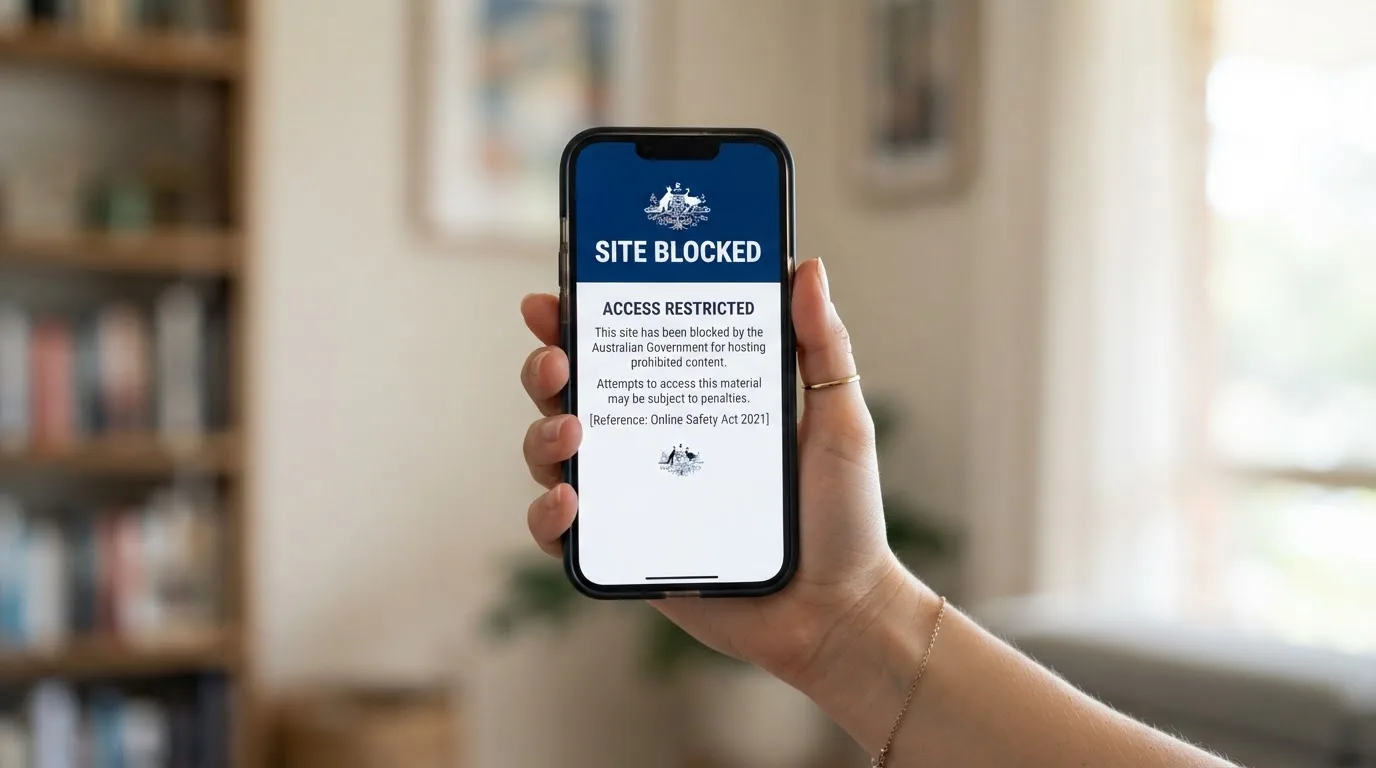
The enforcement teeth sit with the ACMA. Since the first blocking request in November 2019, the ACMA has directed Australian ISPs to block illegal sites, with the running total reaching 1,751 by the round reported in June 2026. More than 230 unlicensed operators have left the Australian market since enforcement was strengthened in 2017. The June 2026 round alone added 12 sites: 7Signs, ChromaBet, Donbet, Duospin, Freshbet, Slots Gem, Jacks Club, Lucky Start, Spinrise, Vinyl Casino and Wildsino.
The arithmetic the page owes the reader is the blocking rate. From November 2019 to the snapshot reported in June 2026 is six years and roughly seven months — 79 months in total. Across that window the ACMA’s running total of blocked sites reached 1,751. That works out to an average of around 22 blocks a month, or roughly 266 blocks a year, with the larger rounds clustering in 2024 and 2025. The figure is uneven — early rounds were small, the larger ones came in the second half of the window — but the order of magnitude is the one the reader should hold: somewhere between 200 and 300 sites a year have been added to the Australian block list since 2019, against an underlying market that H2 Gambling Capital’s 2025 estimate puts at about A$3.9 billion in annual losses to illegal operators. The share of gambling going through legal channels fell from 74% in 2021 to 64% in the 2025 figure. The block list is growing. The legal share of the wallet is shrinking. The two trends together are the picture of the Australian offshore market.
What the ACMA enforcement does not do is prosecute individual players. The act targets the provider, not the customer. The consequence for a player is not criminal. The consequence is practical. An offshore casino gives no Australian consumer protection, no complaints body and no recourse if a withdrawal is refused — and the site can be added to the ACMA block list with a balance still on it. The player has no chargeback leverage once the operator has stopped answering support, no AFCA complaint, no local court that will entertain a small-claims action against a Curaçao or Anjouan entity in a meaningful way, and no guarantee the money in the cashier is recoverable once the operator is no longer reachable through an Australian ISP.
The act’s 2026 reform — the Interactive Gambling Amendment (Gambling Reform) Bill 2026 — passed Parliament on 19 August 2026 and commences its advertising and inducement measures on 1 January 2027. It is law with a start date, not law in force at the time this page is being read. The 2026 page reads against the 2001 act, the 2017 amendment and the existing ACMA enforcement; the 2027 reforms sit ahead.
What the legal frame amounts to, on this page, is a single fact repeated three ways. Online casino games cannot be licensed in Australia. Any operator offering them to a person in Australia is breaking Australian law. The ACMA enforces against the operator, not the player — but the player’s money is exposed when the operator is no longer reachable through an Australian ISP, and the page is being read because the reader typed the search term that brings players to those operators in the first place.
What an Australian reader can actually use — BetStop, the helpline and the licensed venues
The licensed alternatives fall into three groups, and each is what the page points the reader to when the search term resolves to a closed door.
BetStop, the National Self-Exclusion Register, has been live since August 2023. BetStop binds every Australian-licensed online and phone wagering service — Sportsbet, Ladbrokes, bet365, Tabcorp and the rest — to honour a single registration. An Australian who registers with BetStop cannot open a new account with any of those operators for the exclusion period they choose (three months, twelve months, or longer), and any existing account is closed and the balance refunded within a defined window. The limitation is real and worth naming: BetStop binds only Australian-licensed services. An offshore casino is not connected to BetStop, and a self-excluded Australian who tries to open an offshore account is not stopped from doing so. The register is the strongest single tool the licensed market offers; it is not a tool that covers the offshore market the search term resolves to.
The National Gambling Helpline at 1800 858 858 is free, available 24/7, with chat support through Gambling Help Online. The helpline is for any Australian whose gambling has become a problem, regardless of whether the gambling is happening on a licensed site, an offshore site, a land-based venue or a pub pokie. It is the right number to call regardless of the search term that brought the reader to this page.
The licensed venues are the third group. Land-based casinos — Crown Melbourne, The Star Sydney, Crown Perth, The Star Gold Coast, Treasury Brisbane, Wrest Point, the casino floor at SkyCity Adelaide — operate under state and territory regulation, with the same self-exclusion and problem-gambling support obligations that apply to online wagering. Pub and club pokies — “poker machines” or “slots” depending on the state — operate under state-level regulation, with state-level self-exclusion registers that are separate from BetStop. The point is not to redirect the reader to a particular venue; the point is that the venues exist under rules, with audits, with self-exclusion mechanisms, with consumer protections. The offshore Microgaming-style casino the reader searched for does not.
The mechanics of the redirection are simple. If the reader is in Australia and typing “Microgaming casino Australia” with the expectation of a shortlist, the right output of the search is the set of legal, regulated gambling venues available in the reader’s jurisdiction, plus the self-exclusion and support tools the licensed market is bound to honour. The wrong output is a list of offshore operators who cannot lawfully serve the reader and who the ACMA has, in most cases, already named.
Each operator on the list
The eleven write-ups that follow are not reviews. They are records. Each one sets out the formal warning the ACMA has issued, the operating entity named in it, and what third-party supplier listings — if any — confirm. The verdicts are short and specific to the brand; the reader who has read the catalogue section above will already know what to make of a “no third-party confirmation” verdict.
RocketPlay — freshest envelope, two warnings, no third-party confirmation
RocketPlay is the most recently named brand on the list. The ACMA’s March 2026 formal warning was issued to Pulsup Ltd, and it followed an earlier May 2022 warning to Dama N.V. that covered the brand alongside five others — Bambet, Dazard, Level Up, Wild Tornado and Cobra Casinos. The Dama-to-Pulsup succession is the operating-company pattern across most of this list, and RocketPlay is the clearest example of it: same brand, different corporate envelope, fresh ACMA action. The third-party listings the catalogue section above covers do not name RocketPlay at all, and the payments section explains what that means at the cashier. What the page has is two warnings, two operating envelopes, and a marketing claim the listings cannot back.
Level Up Casino — original 2022 Dama cluster, Wazdan is the only third-party listing
Level Up’s May 2022 warning is one of the original Dama N.V. cluster, issued alongside the same warnings to Bambet, Dazard, RocketPlay, Wild Tornado and Cobra Casinos. Wazdan’s site lists the brand among operators running its slots, which is the only third-party confirmation the research carries — and the listing is confirmation of Wazdan, not of Microgaming. The catalogue section sets out the supplier mix at most of the operators on this list. The implication for a reader is the same one that section reaches: the operator is real, the supplier mix is a mix, and the marketing line is the part the page cannot endorse.
Woo Casino — Dama N.V. second round, paired with Spirit Casino
Woo Casino’s warning is the March 2025 entry in a second round of Dama N.V. actions. Spirit Casino is the May 2025 entry in the same round, and the two warnings together suggest a coordinated ACMA review of the operator’s portfolio rather than a one-off action on a single brand. The catalogue section walks through the supplier mix at most of the brands on this list; the research carries no third-party listing for Woo Casino at all. The reader looking at Woo is looking at an operator the ACMA has named twice over.
Spirit Casino — Dama N.V. second round, paired with Woo Casino
Spirit Casino is the May 2025 second half of the Dama N.V. round, with Woo Casino covering the March 2025 half. The pairing is the editorial point: the ACMA treats Dama N.V.’s brands as a portfolio, and the reader comparing one brand to another inside the same envelope is comparing variants of the same operator rather than separate businesses. The research does not mention the brand in any independent supplier listings, and the page does not attach a Microgaming claim to Spirit Casino. The distinction from Woo Casino is mostly a matter of timing; the operator behind both is the same.
National Casino — strongest third-party confirmation on the list
National Casino’s warning was issued to Consolutetish S.R.L. in July 2025, alongside the Bizzo Casino warning to the same operator. Of the eleven brands on this list, National Casino carries the strongest third-party confirmation: Betsoft’s site lists the brand, Wikipedia’s coverage of the brand exists, and Pragmatic Play’s site lists National Casino among operators running its games. None of those listings confirm Microgaming specifically; what they confirm is that the operator runs a multi-studio lobby. The “Microgaming casino” branding is one studio among several, and the page treats the listing as evidence the operator exists — not as evidence the marketing claim holds.
Bizzo Casino — two warnings, four years apart, the brand outlived the cycle
Bizzo is the other half of the July 2025 Consolutetish S.R.L. round, with an earlier warning to TechSolutions (CY) Group Ltd and TechSolutions Group N.V. covering the brand in 2022. The two warnings, four years apart, are the cleanest illustration on the list of how the ACMA’s enforcement follows the operator entity rather than the brand: the brand stayed live, the operating company changed, the warning followed. No third-party listing confirms Microgaming at Bizzo in the research. The brand outlived the warning cycle, and the warning cycle caught up.
Ignition Casino — Bamboo Media envelope, brand shared with a separate US operation
Ignition’s July 2025 warning was issued to Bamboo Media. The Ignition brand is shared with a separate US-facing site that the ACMA has not named, and the Australian-facing Ignition is the entity the warning actually covers. The two operations share a name without sharing a licence or an operating envelope, and the ACMA’s warning binds only the Australian one. Independent supplier data provides no confirmation for the brand in the research, so the warning is the only verified fact on the page. The brand is shared. The operator envelope is not.
Instant Casino — heavily marketed, named by the ACMA the same month
Instant Casino’s February 2025 warning was issued to EOD Code SRL. The brand is one of the more heavily marketed on the warned list, and the marketing reach is what the ACMA’s warning specifically addresses. Evidence from third-party suppliers remains absent in the research, and the page does not attach a Microgaming claim to Instant Casino. A reader who reached Instant Casino through a “Microgaming casino” advert has reached an operator the ACMA has already named.
Jackbit — Ryker B.V., the freshest warning on the page
Jackbit’s April 2026 warning was issued to Ryker B.V., alongside the same warning to the same operator over CasinOK. Ryker’s name is the freshest corporate envelope among the eleven, and the timing — within the last few months before the page is being read — is what makes the warning the most current on the list. Public supplier listings do not mention the brand in the research. Of the eleven, this is the one the ACMA named most recently.
Casino Intense — broadest third-party confirmation, UK Gambling Commission mention
Casino Intense’s April 2025 warning was issued to Sterplay Holding Ltd. Of the eleven brands, Casino Intense carries the broadest third-party confirmation in the research: 1spin4win lists the brand among operators running its slots, Wikipedia’s coverage of the brand exists, and the UK Gambling Commission’s public materials include the brand. The UKGC listing is the most regulator-grade item in the third-party set, and it covers the brand’s UK-facing operations rather than its Australian-facing one. As with the other confirmations, the page treats the third-party evidence as proof the operator exists in the supplier catalogues; the Microgaming claim is not one the listings support.
Sky Crown — Hollycorn N.V., the oldest warning on the page
Sky Crown’s warning was issued to Hollycorn N.V., and is the oldest on the table — the formal warning is dated to September 2022 in the public register, alongside the same operator’s Blue Leo service. Hollycorn is the parent of a small cluster of brands, and the September 2022 publication is what makes Sky Crown the entry on the list that has been on the ACMA’s record the longest. No third-party listing confirms Microgaming at Sky Crown in the research. This is the oldest formal warning on the page, and it is still on the ACMA’s register.
Frequently asked questions
What kind of games does Microgaming actually make?
Microgaming’s catalogue spans online slots — including the Mega Moolah progressive jackpot family that traces back to the studio’s 1998 Cash Splash release, widely credited as the world’s first online progressive-jackpot slot — table games, video poker and live-dealer products, with most releases since the early 2010s built in HTML5 for desktop and mobile browser play.
Does any Australian-licensed casino use Microgaming?
No Australian jurisdiction issues a licence for online casino games, online pokies or in-play betting, so there is no Australian-licensed online casino for Microgaming to integrate with in the first place. Microgaming-powered games do appear at land-based Australian venues in adjacent formats, but the online channel is closed.
Is it legal for someone in Australia to play Microgaming slots online?
The Interactive Gambling Act 2001 targets the provider, not the player, so the individual is not prosecuted for playing at an offshore casino. The provider is the party breaking Australian law. The practical exposure for the player is at the cashier: no AFCA complaint, no chargeback leverage, and no Australian recourse if a withdrawal is refused.
What’s worth checking before trusting a site that says it runs Microgaming?
First, check whether the operator holds a licence the reader’s jurisdiction recognises; for an Australian reader, none applies to online casino games. Second, check the supplier listings — aggregators carrying 1spin4win, Betsoft and BGaming will name the brands they integrate with, and a real Microgaming label will appear there too. Third, check the ACMA’s free formal-warnings register.
Does Microgaming’s software work on a phone browser?
Modern Microgaming releases are HTML5-built and run in any current mobile browser. The mobile experience at an offshore operator is not, however, the same as a licensed Australian wagering app: there is no App Store or Play Store review, no Apple Pay or Google Pay integration under Australian deposit rules, and no platform-level recourse if the operator stops paying out.