
The “best online pokies in Australia 2026” question, and the one answer the regulator gives it
Under the Interactive Gambling Act 2001, offering online casino games or online pokies to a person physically in Australia is an offence. No state or territory issues the licence that “best online pokies in Australia 2026” would imply exists. What follows is the comparison the search request points at, written with that single fact placed where it actually belongs — at the top, not at the bottom of a footnote.
Currency stamp: information current as of 29 October 2026, cross-referenced against the ACMA register of formal warnings and blocking requests under the Interactive Gambling Act 2001.
Table of Contents
- Bonuses, free spins and the “no deposit” trap that frames this search
- The paytable, the symbols and the win lines: what an online pokie actually shows a player
- What the licensed machines look like, state by state
- What “Top 11” looks like when the regulator won’t let the list exist
- ACMA enforcement summary
- Why this is not a ranking, and what would change it
- How fast the block list is growing — the calculation this page adds
- The legal frame that holds this together
- Help that does reach an Australian player
- The payments side, kept informational
- What an honest comparison would weigh
- Frequently asked questions
Bonuses, free spins and the “no deposit” trap that frames this search
The phrase “online pokies Australia bonus credit” and its near-twins — “Australia pokies sign up bonus”, “Australia pokies free spins” — describe a market the Interactive Gambling Act 2001 does not allow. None of those offers can be made to an Australian player through a site licensed in Australia, because no Australian licence covers online pokies. They reach Australian inboxes and search results via offshore operators, and the marketing language is what the ACMA has spent the last several years issuing formal warnings over.

Three things follow from that, and they are worth saying before any list of offers appears. First, the offer itself — “A$500 bonus + 200 free spins” — is a marketing construction aimed at someone who will never see an Australian regulator on the other side of it. The offshore operator holds the bonus terms, the withdrawal rules, the identity check that gates your payout and the absolute right to refuse your withdrawal. None of those levers are reachable through BetStop, the Australian Financial Complaints Authority or a state gaming office. Second, a “no deposit” offer is not free money. It is a contract: the free spins or bonus credit carry a wagering requirement, a maximum cash-out ceiling, a list of games that contribute at reduced rates or not at all, and a verification check that runs only at withdrawal time. The most common read of “no deposit” is that you find out the cost when you try to leave. Third, an offer described as “PayID” or “no deposit” does not make a site Australian or legal. PayID is a payment rail operated by Australian banks for use at licensed Australian merchants; an offshore casino using PayID is moving money through a rail that does not authorise the transaction it is paying for. The deposit may still arrive. What is missing is the regulatory frame around it.
The honest framing of the bonus shelf, then, is two questions. Does the offer exist on a site the ACMA has acted against, or on one it has not yet acted against? And what is the actual cost — of clearing the wagering, of the maximum cash-out cap, of the games the bonus refuses to count on — versus the headline number? On the first question, this page carries the ACMA record directly. On the second, the maths is the page’s own work and it appears in the calculation that closes the comparison.
The paytable, the symbols and the win lines: what an online pokie actually shows a player
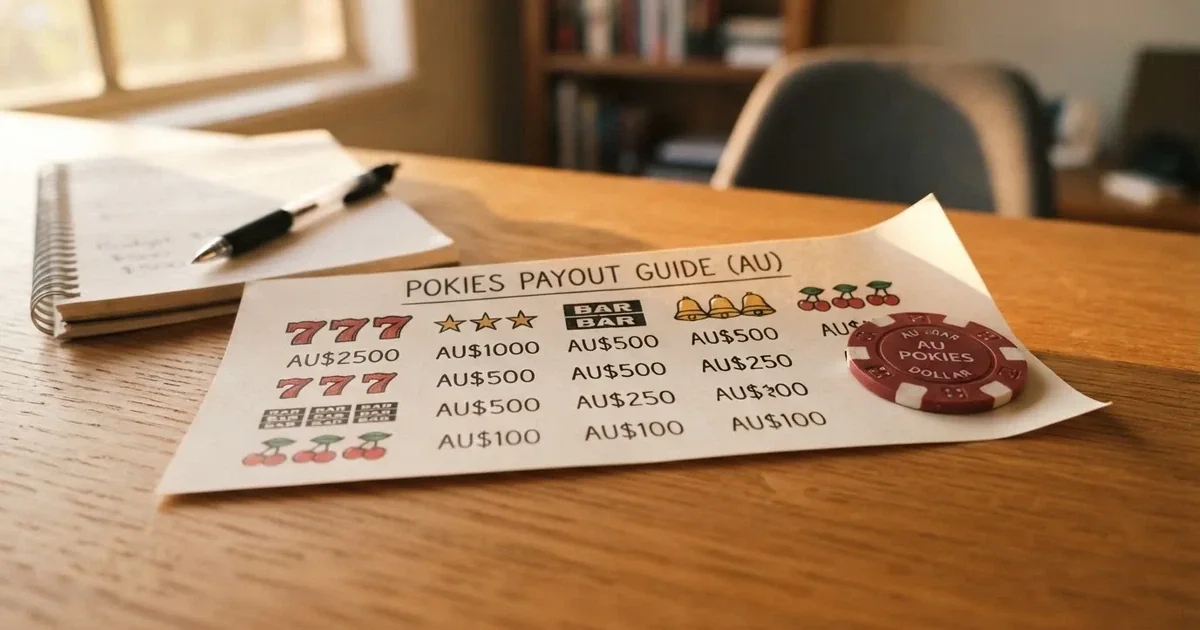
A “pokie” — the local word for a slot or video slot — is, mechanically, a reel game with a paytable, a return-to-player figure and a volatility band. The visible side of the machine is the paytable: it lists each symbol, the credit value of each combination and the structure of the win lines across the reels. A traditional three-reel pokie pays on a single line straight across the middle; a five-reel video pokie typically pays on twenty, thirty or more lines, often with separate rules for scatter symbols (which pay anywhere on the reels) and for bonus triggers (three or more scatters opens a feature round).

The numbers that decide what a pokie returns are the return-to-player percentage and the volatility. RTP is the share of money taken in that the machine is mathematically programmed to return to players over a very large number of spins — millions, in practice. It is not a forecast for a single session. A 96% pokie returns, on average, A$96 for every A$100 wagered across that long run; a 94% pokie returns A$94. The difference looks small in percentage terms and is large in cumulative losses over the kind of session a “no deposit bonus” is built to extend. Volatility is the shape of the distribution: a low-volatility pokie returns small wins frequently; a high-volatility pokie returns nothing for long stretches and then a single large payout. Both can carry the same RTP on paper and feel entirely different in play.
In a licensed Australian pub, club or casino, those numbers sit inside a regulated envelope. The legal minimum return-to-player for poker machines varies by jurisdiction: 85% in New South Wales, the Northern Territory, Queensland and (generally) Victoria — 87% at Crown Melbourne — 87% in the Australian Capital Territory and Tasmania, 87.5% in South Australia, and 90% in Western Australia, where the machines exist only at Crown Perth. Each state and territory also regulates machine design — the spin rate, the maximum bet, the mandatory display of losses — and each venue is required to make the approved rules available on request. None of that regulatory scaffolding exists at an offshore site. The same screen, the same paytable layout, the same scatter-trigger logic — and the machine is being run from a server in a jurisdiction where the ACMA has no authority and the player has no complaints body.
What the licensed machines look like, state by state
The electronic gaming machine is the legal Australian form of this product. Its footprint is large: New South Wales alone had 87,298 gaming machines outside casinos across 2,195 venues as of June 2023, and players on those machines lost A$8.18 billion in 2022–23. Queensland had 21,122 machines across 351 venues in October 2023; Victoria operated 26,380 outside Crown Casino in 488 venues under a 30,000-machine statewide cap. In 2020–21 Australians bet close to A$150 billion through gaming machines and lost A$12.18 billion on them; the country holds about 3% of the world’s pub and club poker machines while accounting for 0.3% of the global population. The product exists at scale, on every state and territory’s terms, and on a different legal footing from the offshore sites that buy ads for the search this page answers.
Western Australia is the deliberate outlier. Crown Perth opened in 1985 and the state simultaneously banned poker machines in pubs and clubs; Crown Perth’s own machine count has since grown from about 200 in 1985 to roughly 2,500, all approved by the state’s Gaming and Wagering Commission. Tasmania ran the other kind of experiment, holding Federal Group under a monopoly licence for all the state’s poker machines from 1968 until legislation in November 2021 ended that monopoly and moved oversight to the Tasmanian Liquor and Gaming Commission. Tasmania also planned nation-leading mandatory pre-commitment cards for its poker machines — cards that would let a player set a hard loss limit before play — but implementation of the reform was delayed until late 2025. None of those machines, in any state, is the product this search is for.
What “Top 11” looks like when the regulator won’t let the list exist
The ranking the search asks for cannot honestly be produced. A list of “the best” implies a comparison on safety, fairness, payout speed and recourse — and every one of those criteria is foreclosed for an Australian player on an offshore site. What does exist, and what this page carries instead, is the ACMA’s own record: the formal warnings issued under the Interactive Gambling Act 2001 to operators offering prohibited services to Australians. Each entry below names the operator the ACMA acted against, the date the warning was published, and what is and is not known about the site on the actual subject of this page. The point is not to rank these sites against each other. The point is to show the field the search points at, on the terms the only authority that has actually examined them uses.
RocketPlay
The ACMA issued a formal warning over RocketPlay to Pulsup Ltd in March 2026, and an earlier warning covering RocketPlay and five other Dama N.V. brands in May 2022. Two warnings, four years apart, on the same offering. Online casino games cannot be licensed anywhere in Australia, whatever licence the site displays in its footer; an Australian player opening RocketPlay cannot reach the ACMA, BetStop or an Australian bank chargeback if a withdrawal is refused. The site has no Australian regulatory anchor to defend the player, and the warning history shows the ACMA has had cause to revisit it.
Level Up Casino
Level Up Casino was among the six Dama N.V. brands the ACMA named in its May 2022 formal warning. The site’s footer lists its operator as Dama N.V., a Curaçao-registered company; no state or territory in Australia issues a licence for the product Level Up sells. Where the subject is game providers, listings place the site as carrying BGaming content, which is a third-party supplier note rather than an endorsement. The relevant facts for an Australian player are unchanged: the operator is offshore, the regulator with jurisdiction is offshore, and the Australian consumer protection layer is absent.
Woo Casino
The ACMA issued a formal warning to Dama N.V. over Woo Casino in March 2025. The site presents itself as a Dama N.V. brand; Dama N.V. has accumulated multiple ACMA warnings across its portfolio over the last several years — a pattern that matters, because it tells you the regulator has identified the operator structure behind the brand, not just one rogue site. There is no Australian licence to fall back on, no state gaming office to complain to, and no path through BetStop, which covers Australian-licensed wagering services only.
Spirit Casino
The ACMA issued a formal warning to Dama N.V. over Spirit Casino in May 2025. Spirit is one of the more recent names on the Dama portfolio warning list; the warning history is short and recent, but the structure is the same — an offshore operator, a Curaçao licence displayed for credibility, and an offering the IGA 2001 prohibits from being supplied to a person in Australia. The single fact that matters is the warning itself, on the regulator’s own page.
National Casino
The ACMA issued a formal warning to Consolutetish S.R.L. over National Casino in July 2025. National appears in some third-party listings alongside the Australian regulatory story; the listings note, the ACMA’s enforcement action is the regulator’s own record. National cannot be licensed to offer online casino games to Australians, and the July 2025 warning is the ACMA’s clearest statement that it has offered them.
Bizzo Casino
The ACMA issued a formal warning to Consolutetish S.R.L. over Bizzo Casino in July 2025. Bizzo had already been the subject of a 2022 formal warning to TechSolutions (CY) Group Limited and TechSolutions Group N.V. Two warnings, two different parent entities named, on the same brand. The pattern is worth noticing — the operator behind a brand can change by acquisition and the brand persists — but the conclusion for an Australian player does not. No licence is in scope.
Ignition Casino
The ACMA issued a formal warning to Bamboo Media over Ignition Casino in July 2025. Ignition’s product is online casino games, which the IGA 2001 prohibits from being supplied to an Australian player. The ACMA warning is the only authoritative statement of the operator’s status as far as Australia is concerned.
Instant Casino
The ACMA issued a formal warning to EOD Code SRL over Instant Casino in February 2025. The site is named explicitly in the ACMA’s own publication. There is no Australian licence to appeal to, no BetStop registration to fall back on, and the offshore structure means an unresolved dispute stays unresolved.
Jackbit
The ACMA issued a formal warning to Ryker B.V. over Jackbit in April 2026, in the same round as CasinOK. A crypto-heavy offering is not a special case under the IGA; the prohibition is on the supply of online casino games and online pokies, not on the payment method. A site that asks an Australian for a credit card or a crypto deposit is, in fact, operating outside the Australian rules — credit cards, credit-related products and digital currency are banned as payment for licensed online wagering since 11 June 2024 — but Jackbit is not licensed wagering at all, and the ban on credit and crypto at licensed operators is one more reason Jackbit’s offer sits outside the Australian system rather than within it.
Casino Intense
The ACMA issued a formal warning to Sterplay Holding Ltd over Casino Intense in April 2025. Third-party listings place Casino Intense alongside other ACMA-named brands; the warning itself is the regulator’s record. Australian-licensed alternative: the Victorian Gambling and Casino Control Commission regulates Crown Melbourne’s table games, including three baccarat variants — Traditional Baccarat, Crown Baccarat and 2 to 1 Baccarat — but those are land-based table games, not online pokies, and Casino Intense is not part of that frame.
Sky Crown
The ACMA issued a formal warning to Hollycorn N.V. over Sky Crown and Blue Leo. The published warning is from September 2022 and sits among the earlier entries on the ACMA’s enforcement record. Hollycorn N.V. is the operator name on the warning; Sky Crown is one of the two brands the warning covers. The pattern is the same as the rest of the list.
ACMA enforcement summary
| Brand | ACMA action and date | Operator named by the ACMA | Subject support |
|---|---|---|---|
| RocketPlay | March 2026 (also May 2022) | Pulsup Ltd (March 2026); Dama N.V. (May 2022) | — |
| Level Up Casino | May 2022 | Dama N.V. | BGaming |
| Woo Casino | March 2025 | Dama N.V. | — |
| Spirit Casino | May 2025 | Dama N.V. | — |
| National Casino | July 2025 | Consolutetish S.R.L. | en.wikipedia.org |
| Bizzo Casino | July 2025 (also 2022) | Consolutetish S.R.L. (July 2025); TechSolutions (2022) | — |
| Ignition Casino | July 2025 | Bamboo Media | — |
| Instant Casino | February 2025 | EOD Code SRL | — |
| Jackbit | April 2026 | Ryker B.V. | — |
| Casino Intense | April 2025 | Sterplay Holding Ltd | ABC News, ACMA, Crown Melbourne |
| Sky Crown | September 2022 | Hollycorn N.V. | — |
Why this is not a ranking, and what would change it
A ranking sorts its entries from best to worst, and the only honest answer to the implied question is the one above the list: no licence exists for the product the search names, and the entries above are the regulator’s record of operators that have offered it anyway. The reasons a comparison cannot honestly rank them are practical, and they are the same for every entry.
The first is recourse. An Australian player with a complaint about an Australian-licensed wagering service can take it to the operator’s internal dispute process, then to an external dispute resolution scheme, then to the Australian Financial Complaints Authority. The same player with a complaint about an offshore online casino has the operator’s internal process, the operator’s licensing regulator (typically Curaçao, Anjouan or another offshore jurisdiction), and no Australian complaints body. If the operator refuses a withdrawal, the dispute goes nowhere an Australian body can adjudicate.
The second is payment integrity. Credit cards, credit-related products and digital currency are banned as payment for licensed online wagering since 11 June 2024, with penalties up to A$247,500 for operators. Legal deposit routes for licensed wagering are debit card, bank transfer, PayID/Osko and BPAY. An offshore online casino that accepts a credit card or a crypto deposit from an Australian is operating outside the Australian rules on payment, on top of the prohibition on the supply itself.
The third is the block list. The ACMA has, since the first blocking request in November 2019, directed Australian internet service providers to block illegal gambling and affiliate marketing websites. The cumulative total reported by the ACMA reached 1,751 blocked sites by June 2026, with more than 230 unlicensed gambling services having left the Australian market since enforcement was strengthened in 2017. A blocked site is one that an Australian player may simply not be able to reach, possibly with a balance still on it.
How fast the block list is growing — the calculation this page adds
The blocking-rate calculation takes the running total of blocked sites as of June 2026 and the date of the first blocking request, in November 2019. Across the roughly 79 months from November 2019 to June 2026, the ACMA moved from zero to 1,751 blocked sites. Across those 79 months, that is an average of 22.2 sites added to the block list every month, or roughly 266 a year — though the rate has not been constant, and the ACMA’s enforcement rounds have been visibly stepped up since 2017, with 230 or more unlicensed services leaving the market over the same period.
The honest way to read the figure is as a band rather than a single number. A run-rate of about 22 blocked sites per month covers the cumulative total since November 2019; a recent enforcement round in 2026 added a further 12 sites in one announcement, and other rounds in the same year have been comparable. The right conclusion is that the block list is not a single act, it is a rolling practice that adds roughly one new site every business day and has done so for years. The condition that makes the figure meaningful is that the ACMA has continued to direct new blocks across the period in question — the cumulative count is a moving target, and any “rate” derived from it describes the practice up to that snapshot rather than the rate at which any one of the entries above was added.
What the figure does not tell you is whether the blocks have measurably reduced demand. H2 Gambling Capital’s 2025 report estimates that Australians lose about A$3.9 billion a year to illegal gambling sites, and that the share of gambling going through legal channels fell from 74% in 2021 to 64%. The block list is the supply-side response; the loss figure is the demand-side read. They move on different timescales, and a higher block count does not automatically show up as a lower loss figure.
The legal frame that holds this together
The Interactive Gambling Act 2001, strengthened by the Interactive Gambling Amendment Act 2017, makes it an offence to provide online casino games, online pokies or in-play betting to a person in Australia. No state or territory issues the licence that would authorise such a supply. What is licensable is wagering on races and sport placed before the event, lotteries and keno. In practice, online bookmakers — Sportsbet, Bet365 and Ladbrokes among them — are licensed in the Northern Territory for tax reasons, under the Northern Territory Racing and Wagering Commission. The Commission regulates 52 of Australia’s online bookmakers; it has no full-time staff and meets once a month in Darwin.
The minimum age for any gambling in Australia is 18. The individual player is not prosecuted under the IGA — the Act targets the provider — but the practical protections that follow from an Australian licence are not available to a player using an offshore site.
The Interactive Gambling Amendment (Gambling Reform) Bill 2026 passed Parliament on 19 August 2026. Its advertising and inducement measures commence on 1 January 2027 — law with a start date, not yet in force on a 2026 page. The shape of the reform, when it takes effect, is to tighten the rules around inducements — bonus offers, sign-up credits, “free” entry — that the IGA already prohibits. A 2026 reader does not yet act under those new measures, but the direction is clear.
Help that does reach an Australian player
Two services are designed for the case in this page, and both work whether the player is using an Australian-licensed product or an offshore one. BetStop, the National Self-Exclusion Register, has been live since August 2023 and binds Australian-licensed online and phone wagering services — an offshore casino is not connected to it, so registering on BetStop will not stop an offshore site from accepting a deposit. The other is the National Gambling Helpline on 1800 858 858, free, 24/7, with chat available at Gambling Help Online. Both are confidential, and both exist for the moment the marketing stops feeling like entertainment.
The payments side, kept informational
The payment methods an Australian player sees at an offshore site — debit card, credit card, PayID, BPAY, cryptocurrency, e-wallet — are not the same thing as a regulated deposit at an Australian-licensed wagering service. At an Australian-licensed bookmaker, the legal deposit routes are debit card, bank transfer, PayID/Osko and BPAY; credit cards, credit-related products and digital currency are banned since 11 June 2024, with penalties up to A$247,500 for operators. At an offshore site, the operator sets the menu, and an Australian deposit can move through a rail — PayID, for instance — that does not authorise the transaction it is paying for.
The honest read of “PayID pokies Australia” is that PayID is a fast Australian bank transfer rail, not a regulatory clearance. The deposit will arrive at the operator’s account. Whether the operator pays out the winnings is the operator’s call, on the operator’s terms, in the operator’s jurisdiction. PayID does not reach inside an offshore operator’s terms of service, and it does not provide a chargeback path the way a credit card does in some circumstances. Treating PayID as a sign of an “Australian” or “legal” offer is reading the rail for the licence, and the rail is not the licence.
What an honest comparison would weigh
If the IGA did not prohibit the product, the comparison the search asks for would weigh safety, fairness, payout speed and recourse. On the licensed-Australian axis, all four are answered by the regulator. On the offshore axis, none of them are. Safety is a question of whether the operator holds your funds and your identity data to a standard you can verify; fairness is a question of whether the games are independently tested and the test reports are reachable; payout speed is a question of how long the operator takes to process a withdrawal, with the operator’s own terms as the only reference; recourse is a question of who you take a complaint to when the answer is no. None of those questions are answered by the licence the site displays in its footer, because no licence from a regulator with Australian jurisdiction exists for the product.
The H2 Gambling Capital estimate — A$3.9 billion a year in losses to illegal sites, and a falling share of gambling through legal channels — is the macro picture the regulator is working against. The ACMA’s enforcement record, the block list and the formal warnings are the regulator’s toolset. The honest framing of this page is that the comparison the search points at is one the regulator has decided is not allowed to exist, and the entries above are the operators the regulator has decided to act against for offering it anyway.
Frequently asked questions
Is there a licensed, ranked list of online pokies sites for Australian players?
No. No Australian licence is issued for online pokies, under the Interactive Gambling Act 2001 as strengthened by the Interactive Gambling Amendment Act 2017. A ranked list of “best” sites implies a regulator that has compared them on player protection, fairness and payout, and no Australian regulator has done so because no such offer is legal. The ACMA’s register of warnings under the IGA is the only published regulator-side list.
Does a PayID deposit make an online pokies site more Australian or legal?
No. PayID is a payment rail operated by Australian banks; it moves money quickly but does not authorise the transaction it is paying for. An offshore casino using PayID is still offering a product the IGA prohibits from being supplied to a person in Australia, and a PayID deposit does not give the player any of the protections a licensed Australian wagering service would — no BetStop coverage, no AFCA recourse, no chargeback path through a credit card issuer.
What separates a licensed pub or club poker machine from an offshore online pokie?
The pub or club machine is licensed and regulated by the state or territory in which it operates, with a minimum return-to-player set by law (85% in NSW, the NT, Queensland and (generally) Victoria — 87% at Crown Melbourne — 87% in the ACT and Tasmania, 87.5% in South Australia, 90% in Western Australia), and the operator is answerable to the state gaming regulator. The offshore online pokie is licensed in a different jurisdiction (typically Curaçao or Anjouan), is not subject to any Australian state regulator, and gives the player no Australian complaints body if a withdrawal is refused.
Can an offshore online pokies site legally advertise a sign-up bonus credit to Australians?
No. Offering online casino games, online pokies or in-play betting to a person in Australia is an offence under the Interactive Gambling Act 2001, and a sign-up bonus is an inducement to use the prohibited service. The ACMA has issued formal warnings to operators under the IGA for the practice, and the Interactive Gambling Amendment (Gambling Reform) Bill 2026 — passed on 19 August 2026, commencing 1 January 2027 — adds further inducement measures.
How would payouts on an offshore online pokies site be verified as fair?
They would not, by any Australian body. The operator sets its own withdrawal rules, its own identity-check triggers and its own maximum-cashout limits, and the only body with authority over the operator is the regulator in the jurisdiction where the operator holds its licence. An Australian player with an unresolved dispute has no path through BetStop, the Australian Financial Complaints Authority or a state gaming office. The verification the IGA prohibits is the verification an Australian player would otherwise rely on.
Is online pokies play covered by the same prohibition as online casino table games?
Yes. The Interactive Gambling Act 2001 prohibits the supply of “online casino games” — a category that includes online pokies, online table games and online in-play betting — to a person in Australia. The prohibition is on the category, not on individual game types, and the ACMA’s enforcement record covers operators across the category. A site offering online blackjack or baccarat to Australians is in the same legal position as a site offering online pokies.