
Safe Online Casino Australia 2026: What the Word Actually Means
The phrase “safe online casino” gets used as a marketing label before it gets used as a description. In Australia that distinction matters more than anywhere else, because the law treats online casino games and online pokies as a prohibited interactive gambling service, and what is licensed in this country does not include them. This page works through what that does to the word “safe”, who gets to claim it, and what falls apart when a player assumes the marketing is doing the work the regulator will not.
Data current as of 29 October 2026; ACMA enforcement record and Australian bank gambling-block disclosures verified against the regulator’s published warnings, the major banks’ own support pages, and the Reserve Bank of Australia’s public statements on card payments.
Table of Contents
The Brands the ACMA Has Acted Against
This is not a ranking. None of the eleven brands below is recommended. Each appears here because the Australian Communications and Media Authority has issued a formal warning about it under the Interactive Gambling Act 2001, usually for providing prohibited casino games to people in Australia. The point of the list is to put names to the abstract phrase “offshore casino”, so a player who recognises one can see what kind of operation it was and what the regulator’s response looked like.

| Brand | ACMA action and date | Operator named by the ACMA | Subject support |
|---|---|---|---|
| RocketPlay | Formal warning, March 2026 | Pulsup Ltd (Rocketplay.com.au) | Listings only — Gamblinginsider.com |
| Level Up Casino | Formal warning, May 2022 | Dama N.V. | Listings only — Westpac.com.au |
| Woo Casino | Formal warning, March 2025 | Dama N.V. | — |
| Spirit Casino | Formal warning, May 2025 | Dama N.V. | — |
| National Casino | Formal warning, July 2025 | Consolutetish S.R.L. | Listings only — acma.gov.au, austrac.gov.au, betstop.gov.au |
| Bizzo Casino | Formal warning, July 2025; prior warning, 2022 | Consolutetish S.R.L.; earlier TechSolutions | Listings only — Gamblinginsider.com |
| Ignition Casino | Formal warning, July 2025 | Bamboo Media | — |
| Instant Casino | Formal warning, February 2025 | EOD Code SRL | Listings only — Ecopayz.com, Payid.com.au |
| Jackbit | Formal warning, April 2026 | Ryker B.V. | — |
| Casino Intense | Formal warning, April 2025 | Sterplay Holding Ltd | Listings only — austrac.gov.au, betstop.gov.au, Gamblinginsider.com |
| Sky Crown | Formal warning, September 2022 | Hollycorn N.V. | — |
A few things stand out before the operator names get any closer inspection. The ACMA is not chasing dozens of small unknowns; it has named entities that already operate recognisable casino brands across multiple jurisdictions. Dama N.V. alone appears three times on this list. Consolutetish S.R.L. appears twice, with one brand already warned once before. The regulator is not picking fights with single sites that popped up last month. It is documenting a pattern in which one corporate group operates multiple “casino” brands and the warning has to be issued against each one separately.
The other thing the table shows is speed. Six of the eleven warnings were issued in 2025 or 2026. Enforcement is not slowing down; it is accelerating, and the pace matters more than the specific names. A player reading this list in 2027 will find a longer one. The same logic that put these eleven here is still running.
What the ACMA Actually Did
A formal warning under the Interactive Gambling Act 2001 is the regulator’s first public move. It is not a fine, not a prosecution, and not yet a website block. The ACMA’s published material describes it as the regulator telling the operator, in writing, that a specific activity is prohibited, that the operator must stop, and that further action follows if it does not. That is the entry point. The next steps are referral to the Australian Federal Police, civil penalty proceedings in the Federal Court, and a request to internet service providers to block the offending site at the network level.
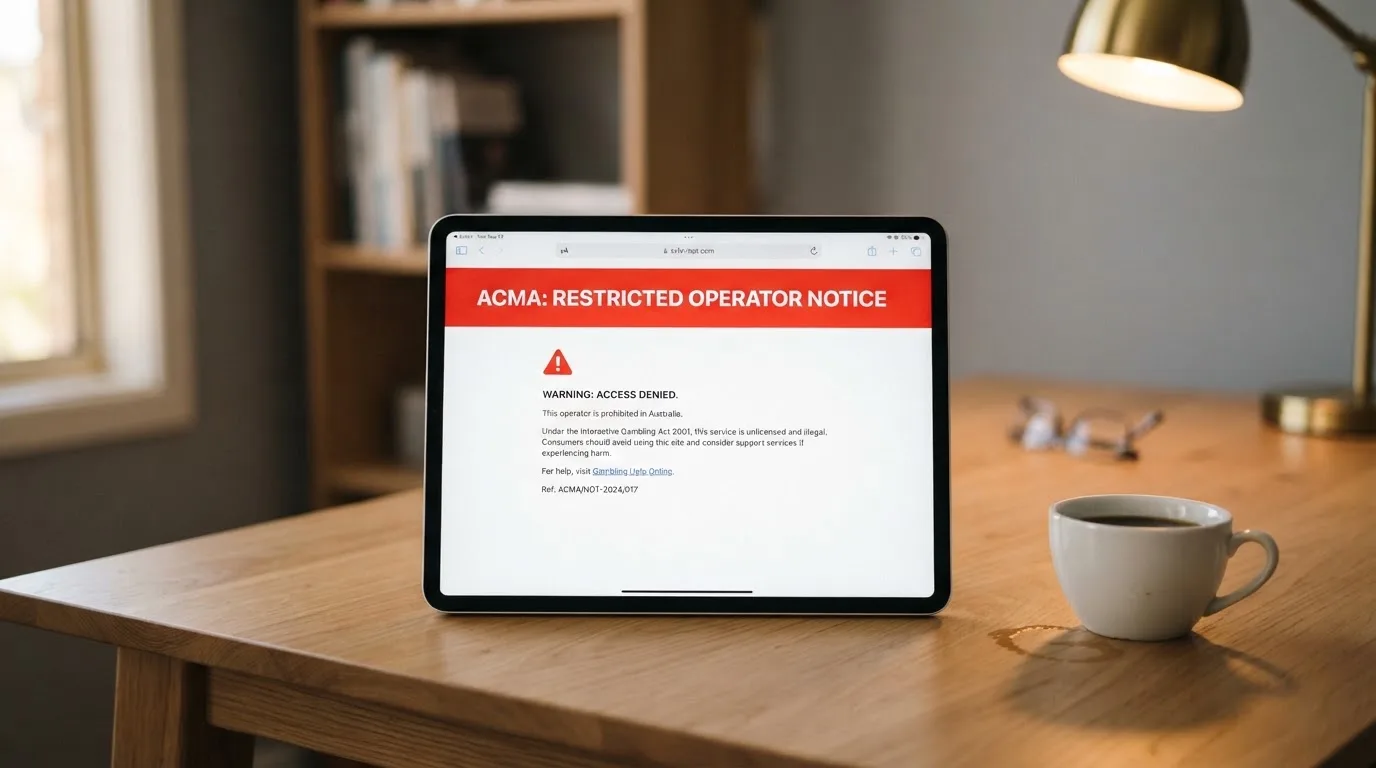
The 26 June 2026 blocking round is a useful worked example. The ACMA asked Australian ISPs to block twelve more illegal gambling sites in a single round: 7Signs, ChromaBet, Donbet, Duospin, Freshbet, Slots Gem, Jacks Club, Lucky Start, Pointsbetz.com, Spinrise, Vinyl Casino and Wildsino. Each name is a separate site, but they came through together because that is how a blocking round is structured. The cumulative total reported by the regulator at the same date was 1,751 illegal gambling and affiliate marketing websites blocked since the first blocking request in November 2019, with more than 230 unlicensed gambling services having left the Australian market since enforcement was strengthened in 2017.
Reading the Operator Names
The right-hand column is where the “safe” claim starts to look thin. Pulsup Ltd, Consolutetish S.R.L., Bamboo Media, EOD Code SRL, Ryker B.V., Sterplay Holding Ltd — these are not names a player in Sydney or Perth recognises, and that is the point. An Australian licence for online casino games does not exist, so any site offering them to Australians cannot have an Australian company behind it. The companies are typically incorporated in Curaçao, Cyprus or another offshore jurisdiction, and they operate multiple “casino” brands as a portfolio. Some of them have been warned, changed name, and continued. The warnings about Bizzo Casino in 2022 and again in 2025, against two different operators, are the clearest case on this list.
What this means for a reader is that the warning is rarely a one-off event for a brand. It is part of a corporate pattern in which the same group of people runs a string of similar sites and the regulator catches up with them one by one. A “safe” claim from any of the brands above, or one of their sister sites, is a marketing claim made by an entity the ACMA has already documented for the same activity.
Where the Verdict Falls
These eleven brands share one trait. They offer online casino games to people in Australia, the IGA prohibits that, and the regulator has named the operator behind each one. None of them is safe in the sense a player means by the word when they ask for a safe online casino: licensed, regulated, accountable to an Australian complaints body, and bound by the player-protection rules that apply to Australian-licensed wagering services. The list is not exhaustive. It is a sample of the brands the ACMA has got around to acting on.
How to Read a “Safe” Casino Claim
Marketing writers describe their product as “safe” the way a salesperson describes a used car as “reliable”. The word does work. It is also vague enough to mean almost nothing until the reader pins it down. In Australia, where the legal category the brand is offering does not exist, the unpicking matters more than usual.
The Fourth Test: How the Brand Markets Itself
The word “safe” appears with one or more of the following companions on the marketing pages of offshore casinos: “regulated”, “licensed”, “responsible gaming”, “SSL secured”, “RNG certified”. Each of those words means something in a regulated market. None of them, taken alone, means anything in Australia for an offshore casino offering prohibited games. The combination is a marketing pattern, not a regulatory fact.
The Australian government has noticed the pattern. The Interactive Gambling Amendment (Gambling Reform) Bill 2026 passed Parliament on 19 August 2026. Its advertising and inducement measures commence 1 January 2027. That is law with a start date, not yet in force at the time of writing. It does signal the direction. The “safe casino” advertorial that fills these search results is exactly what the next round of regulation is aimed at.
The Legal Frame Australians Actually Face
This is the part the marketing page never puts first. The reason it matters more than the licence number or the bonus percentage is that the rest of the answers follow from it.
What the Interactive Gambling Act 2001 Prohibits
The IGA, as tightened by the 2017 amendments, makes it an offence to provide a prohibited interactive gambling service to a person in Australia. “Prohibited” includes online casino games, online pokies and in-play betting on sport. Lotteries, keno and pre-event wagering are not prohibited and are licensed through state and territory regimes.
The Act targets the provider, not the player. Australians are not arrested for placing a bet on an offshore casino. What they lose by doing so is not criminal exposure. It is the consumer protections that come with an Australian licence, the Australian complaints pathways, the Australian access to self-exclusion, and the practical ability to recover a disputed balance. Those protections are real, and they are exactly what an offshore site cannot offer.
How ACMA Enforcement Works
The ACMA investigates complaints, issues formal warnings, refers matters for civil penalty proceedings, and asks ISPs to block illegal sites. The blocking mechanism is what changes the practical landscape. Once a site is on the blocking list, Australian customers cannot reach it through the major ISPs without using workarounds they have to know about and seek out. The site does not disappear — the people behind it still exist — but the path to it for an ordinary Australian player is closed.
The total reported in June 2026, 1,751 sites blocked since November 2019, is not a number that flatters the offshore industry. The blocking rate that produces it is the calculation below.
The Cost the Country Is Carrying
H2 Gambling Capital’s 2025 report estimates that Australians lose about A$3.9 billion a year to illegal gambling sites, and that the share of gambling going through legal channels fell from 74% in 2021 to 64%. The fall is itself the point. The legal market in Australia is wagering, not casino. The illegal market is everything else the legal market does not cover, and the A$3.9 billion figure is what “illegal” costs the country each year. None of that money is recoverable through any Australian consumer protection, because none of it was paid to an Australian-licensed operator in the first place.
Calculating How Fast the Blocklist Is Growing
This is the arithmetic the page exists to do. It is small, but the figure tells the reader how serious the regulator is.
The ACMA reported on 26 June 2026 that 1,751 illegal gambling and affiliate marketing websites had been blocked since the first blocking request in November 2019. The 26 June 2026 blocking round itself added twelve more. That is the numerator. The denominator is the time elapsed from November 2019 to June 2026 — roughly seventy-nine months, or about six and a half years.
Dividing 1,751 by 79 months gives approximately 22 sites blocked per month over the full period, or roughly 265 a year. That is the average. The actual rate is uneven. Early years saw fewer blocks as the mechanism was being used for the first time; recent rounds have been much denser, with twelve added in a single round in June 2026 alone. So the honest reading is a band, not a point.
Result, as a band with its condition: under the ACMA’s published blocking record from November 2019 to June 2026, the cumulative blocklist has been growing at roughly 22 sites per month on average over the full period, and at well over 100 sites per month on the busiest recent rounds — meaning an offshore casino that wants to remain reachable to Australian customers in 2026 is paying a subscription fee to a regulator that has demonstrated it can add dozens of sites to the list in a single round.
That is the point of the calculation. The arithmetic is not the headline; the headline is that the rate at which the regulator is removing access is faster than the rate at which most readers are reading about it.
Responsible Play, Australian-Style
The point of the previous sections is not that nobody in Australia gambles online. It is that anyone who does is gambling in a space the regulator does not supervise and the consumer protections do not reach. What follows is the practical scaffolding that does apply.
Tools That Work in Australia
The first tool is BetStop, the National Self-Exclusion Register. It has been live since August 2023 and binds every Australian-licensed online and phone wagering service. A person who signs up is excluded for a chosen period from Sportsbet, Ladbrokes, Bet365 and the rest of the licensed wagering market. As above, an offshore casino is not connected to it. BetStop does what it can in the legal market, and the legal market is most of wagering and none of online casino.
The second tool is the bank’s own gambling block. Westpac, ANZ and Commonwealth Bank all offer one. Westpac’s block works at card level and refuses authorisation of transactions registered under the merchant category code “Betting/Casino Gambling” on eligible personal credit and debit cards. ANZ’s block, activated in the ANZ app, also blocks gambling transactions made through a digital wallet such as Apple Pay on an eligible card, not just the physical card. Once turned on, removing ANZ’s block requires a 48-hour waiting period — a deliberate cooling-off designed to stop an impulse switch-off. Commonwealth Bank’s gambling lock is set up in the CommBank app and works similarly.
The caveat the banks themselves attach is important. Each bank warns that it cannot guarantee every gambling-related purchase will be stopped and that some non-gambling transactions may be blocked in error. The block works on the merchant category code, which the merchant sets. A casino coded as something else, or routed through a payment intermediary, may slip past the block. That is the limit of what a single tool can do.
The Payment Picture
The legal market for online wagering in Australia runs on debit cards, bank transfers, PayID/Osko and BPAY. Credit cards, credit-related products and digital currency are banned as payment for licensed online wagering since 11 June 2024. Penalties for accepting a banned payment run up to A$247,500 for operators. The ban also constrains gambling use of linked digital wallets such as Apple Pay, because the underlying card still has to be a debit card.
Apple Pay itself does not charge consumers a fee; any surcharge is the merchant’s own card-processing fee, not Apple’s. Apple also states that transaction limits and PIN requirements are set by the card issuer or merchant, not by Apple. By the end of 2025, Apple Pay, Google Pay and Samsung Pay transactions collectively accounted for around 45% of all card payments in Australia by number, so the question of whether a digital wallet counts is not academic.
PayID and Osko are the closest thing to a neutral fast payment rail Australia has. Osko transfers between participating Australian banks arrive in under a minute, 24/7 including weekends. Paying to a PayID shows the name of the account holder before the transfer is sent, and AP+ warns that being asked to transfer money to a PayID on an illegal gambling site almost certainly means a scam site. As of April 2025, more than 25 million PayID identifiers were registered on Australia’s New Payments Platform.
BPAY is the older bill-payment service in online banking, in operation since November 1997 and available through more than 140 banks and financial institutions. It is run by Australian Payments Plus, the same operator as PayID and Osko, and it is owned equally by ANZ, Commonwealth Bank, National Australia Bank and Westpac. The platform’s monthly outages are capped at two minutes by the operating rules — a level of reliability the offshore casino is not required to match.
One AUSTRAC point worth noting for any reader who assumes a large bank transfer triggers something official: the AUSTRAC threshold-transaction-report rule, which requires reporting of transfers of A$10,000 or more, applies only to physical cash. Ordinary electronic bank transfers are not subject to that per-transaction reporting requirement, regardless of the amount sent. The “large transfer will be reported” claim sometimes made by offshore casino support is not how the regime works.
The Tax Point
Gambling winnings of a recreational Australian player are not assessable income under section 6-5 ITAA 1997. Losses are not deductible. The only exception is a person who carries on a business of gambling, which is not the situation being discussed on this page. Any reader in doubt about their own position should check with the ATO; that is the standard the ATO itself sets.
Help That Costs Nothing
For anyone worried about their own play or someone else’s, the National Gambling Helpline is 1800 858 858, free and 24/7. Chat is available at Gambling Help Online. Both services are Australian and free, and both are the right place to start. A self-exclusion through BetStop is a separate decision; it is a register, not a counselling line. Each does what it does.
What the Operator Write-Ups Look Like
This section gives the eleven brands the same treatment in sequence, with the ACMA warning they attracted, the operator the regulator named, and the verdict that follows from those facts. No brand is recommended. Each is presented so a reader who recognises it knows exactly what the regulator said about it.
RocketPlay
The ACMA issued a formal warning to Pulsup Ltd in March 2026 over Rocketplay.com.au, and an earlier formal warning to Dama N.V. covered Rocketplay in May 2022 alongside five other casino brands. The regulator has therefore named two different corporate owners of the same product over four years, which is not a record of an operation the regulator considers minor. Subject support for the brand is reported only by listings sources.
Level Up Casino
The ACMA named Dama N.V. in May 2022 as the operator behind Level Up Casino, in the same warning that covered five other brands. Subject support comes only from listings. The same operator appears three times on the page-wide list. The pattern is not a coincidence; it is how a corporate group that runs multiple “casino” brands gets recorded by the regulator, brand by brand.
Woo Casino
Dama N.V. was the named operator for Woo Casino in March 2025. The subject-support field is empty in the research record, which means no Australian-facing source has published data on the operator’s specific payment or self-exclusion arrangements. That absence is itself part of the picture: a brand with no Australian-facing infrastructure is a brand an Australian player has no Australian point of contact with.
Spirit Casino
Dama N.V. again, in May 2025. Spirit Casino is the third brand in this list traced back to the same corporate group, which makes the marketing claim of separate brand identities a statement of cosmetics rather than of legal substance. The subject-support field is empty.
National Casino
Consolutetish S.R.L. was named by the ACMA in July 2025. Subject support is reported by the regulator’s own material, by AUSTRAC and by BetStop — that is, by Australian regulatory and consumer-protection sources, not by gambling listings. The presence of those Australian-facing sources is unusual for this list and is worth noting as such.
Bizzo Casino
The ACMA named Consolutetish S.R.L. in July 2025 and a prior warning was issued to TechSolutions (CY) Group Limited and TechSolutions Group N.V. in 2022. The same brand, two operators, two warnings, two jurisdictions. Subject support comes from listings only. The regulator’s persistence on this brand is the relevant fact.
Ignition Casino
Bamboo Media was named in July 2025. Subject support is empty. The corporate pattern on the regulator’s side is consistent with the others: a non-Australian operator named by the ACMA for offering prohibited services in Australia.
Instant Casino
EOD Code SRL was named in February 2025. Subject support comes from listings including Ecopayz.com and Payid.com.au, which means Australian-facing payments references do exist for this brand — though the regulator’s view of its legality in Australia has not changed.
Jackbit
Ryker B.V. was named in April 2026. Subject support is empty. This is one of the more recent warnings on the list and shows the regulator continuing to add names at the rate described in the calculation above.
Casino Intense
Sterplay Holding Ltd was named in April 2025. Subject support comes from AUSTRAC, BetStop and Gamblinginsider.com. As with National Casino, the appearance of Australian regulator-side sources in the support record is unusual and worth noting.
Sky Crown
Hollycorn N.V. was named in a formal warning in September 2022. Subject support is empty. This is the oldest warning on the list and the only Hollycorn-named entry.
The Shared Verdict
The eleven write-ups above do not produce eleven different verdicts. They produce the same verdict for slightly different brands. Each one offered online casino games or pokies to people in Australia, and the regulator named the operator behind it. Each one shows up on a list that already has more than a thousand entries, with dozens more added every month. The marketing claim of “safe” is doing work that nothing behind the brand can substantiate. None of them is safe in the sense a reader means by the word when they ask for a safe online casino.
The Rate of Blocking, Restated
Three numbers carry most of the weight on this page. The first is 1,751 — the cumulative block count to June 2026. The second is the 22-sites-per-month average rate, with the much higher recent-round rate as the live figure. The third is A$3.9 billion, the H2 Gambling Capital estimate of what illegal gambling costs Australians each year.
The “safe online casino” search is in part an attempt to find a brand that is not what the search describes. The reader wants a casino that is licensed and accountable. None of the eleven brands on this page is licensed in Australia, because none of them can be. The brands that are licensed in Australia — Sportsbet, Bet365, Ladbrokes and the rest — are not casinos. They are bookmakers. That is the shape of the Australian market in 2026, and the “safe casino” label sits on top of it as marketing rather than description.
Frequently Asked Questions
What are the clearest signs that an online casino claiming to be “safe” is not actually licensed anywhere reputable?
If it offers online casino games or online pokies to people in Australia, it cannot be Australian-licensed, because that category does not exist. The licence it shows is offshore. Check the operator’s corporate name against the ACMA’s published formal warnings; if it appears, the claim of “safe” is contradicted by the regulator.
Is a PayID deposit any safer than a card deposit at an offshore online casino?
The deposit rail is Australian and instant. The destination is not. Paying to a PayID shows the account-holder name before the transfer is sent, which is a useful anti-scam check, but it does not change the legality of the transaction at the receiving end. AP+ itself warns that a request to transfer to a PayID on an illegal gambling site almost certainly means a scam.
Is it legal for an Australian to use an offshore online casino even if that site markets itself as “safe”?
The Interactive Gambling Act 2001 targets the provider, not the player. Australians are not prosecuted for placing bets. What they give up is the consumer protections, complaints pathways and self-exclusion coverage that come with an Australian licence — and BetStop, the National Self-Exclusion Register, does not bind offshore casinos at all.
What should someone do if they realise they have been playing at an offshore casino and want to stop?
Close the account, withdraw any balance you can, and contact the bank’s gambling-block service to lock future transactions at the card level. Sign up to BetStop for the licensed wagering market. For free, confidential support around the decision itself, the National Gambling Helpline is 1800 858 858, available 24/7, with chat at Gambling Help Online.
How does a genuinely regulated gambling operator’s safety record differ from an offshore casino’s own marketing claims?
A regulated operator holds player funds under Australian rules, is supervised by an Australian regulator, takes dispute resolution through Australian channels, and is bound by BetStop. An offshore casino holds funds under its home jurisdiction’s rules, which is typically little or none, and offers no comparable complaint or self-exclusion pathway. The marketing language is similar; the substance is not.
What free support services exist in Australia for someone concerned about their own online casino use?
The National Gambling Helpline at 1800 858 858 is free, 24/7 and confidential, with web chat at Gambling Help Online. BetStop, the National Self-Exclusion Register, is the practical exclusion tool for Australian-licensed wagering. Counselling, financial counselling and the relevant state-based gambling support services are reachable through the helpline as a starting point.
The First Test: Is It Legal at All?
For an Australian player, this is the test that disposes of most of the field before any other check gets a turn. Under the Interactive Gambling Act 2001, as amended in 2017, it is an offence to provide online casino games, online pokies and in-play betting to a person physically in Australia. No state or territory licenses those products. What is licensed is wagering on races and sport placed before the event, lotteries and keno — in practice licensed through the Northern Territory Racing and Wagering Commission, which oversees 52 of Australia’s online bookmakers including Sportsbet, Bet365 and Ladbrokes. The commission has no full-time staff and meets once a month in Darwin. Even licensed wagering on the Australian market is a small, narrow thing compared with what an offshore “casino” advertises.
So the first question any reader should ask is the simplest one. If a site offers casino games or pokies to Australians, by what Australian licence is it doing that? There is no such licence. Whatever licence the site displays — Curaçao, Kahnawake, Anjouan — it is not an Australian one, because no Australian one exists. The “safe” claim is therefore doing work the regulator will not.
The Second Test: Who Answers If Something Goes Wrong?
An offshore operator does not bind itself to an Australian complaints body. There is no Australian ombudsman for a Curaçao-licensed casino. There is no Australian small-claims path to recover a disputed withdrawal. The player who cannot get their money out has, in practical terms, the operator’s customer support team and whatever the operator chooses to do.
BetStop, the National Self-Exclusion Register, makes the asymmetry explicit. It binds Australian-licensed online and phone wagering services. An offshore casino is not connected to it. A player who self-excludes through BetStop has excluded themselves from Sportsbet and Ladbrokes and nowhere else. The offshore site they were playing on yesterday is still open today.
The same is true for the National Gambling Helpline at 1800 858 858, free and 24/7 with chat at Gambling Help Online. It is an Australian service for Australians; it has no leverage over an operator in another country.
The Third Test: How Is the Player’s Money Held?
A licensed Australian wagering service holds player funds under Australian rules and is supervised by an Australian regulator. An offshore casino holds player funds under whatever rule the operator’s home jurisdiction applies, which is typically little or none. When the site is blocked at the Australian network level — and 1,751 sites have been — the balance on it can be inaccessible. The regulator’s blocking order is not paired with a refund scheme.