
GameBeat casinos in Australia: what the shortlist looks like, and why the page is not the list you came for
A reader typing “best GameBeat online casinos Australia” expects a ranking. The honest answer is shorter than that, and it sits at the top of this page so the rest can be useful. No operator offering online casino games to a person physically in Australia is licensed to do so. The Interactive Gambling Act 2001 prohibits it; no state or territory licenses it; the Australian Communications and Media Authority, the ACMA, has spent the last several years warning and blocking the offshore names that ignore that prohibition. What follows is not a recommendation, because a recommendation presupposes something lawful to recommend, and that is not on the menu. What it is, instead, is a reading of the field as it stands: where GameBeat fits in, what the ACMA has done about the brands offering its games to Australians, and what an Australian reader actually has to choose from.

Data current as of 29 October 2026 and verified against the ACMA’s published formal-warning notices and its blocking-request register.
Table of Contents
- How GameBeat sits in the offshore casino supply chain
- Payments and payout speed: where the money actually moves
- Bonuses and free spins: what the headline number actually costs
- Mobile and app: the phone-screen reality
- GameBeat’s place in the wider catalogue: games, providers, live tables
- The shortlist the law will not let you play: eleven brands the ACMA has warned
- The fundamentals: what GameBeat-powered casinos actually are
- The legal frame: the Interactive Gambling Act 2001 and the ACMA’s enforcement record
- Responsible gaming: what tools an Australian reader actually has
- What is actually lawful for an Australian reader
- The working position
- Frequently asked questions
How GameBeat sits in the offshore casino supply chain
GameBeat is a slot-game studio that says it was set up in 2021 and describes itself as a business-to-business supplier — software to licensed operators and commercial partners, never directly to players. That language matters: GameBeat does not run a casino, and a reader searching for “GameBeat casino” is not searching for a company that takes Australian customers, but for whichever offshore operator has chosen to plug GameBeat’s catalogue into its lobby. The studio is part of a broader 3D-slots and HTML5-build niche populated by 1spin4win, Betsoft, BGaming, Booming Games and a long tail of smaller Malta-, Curaçao- and Belize-registered B2B suppliers whose games show up across hundreds of offshore brands. Some of those brands, like some of those suppliers, are entirely legitimate for the markets they are licensed in; some of them have accepted Australian customers in violation of the Interactive Gambling Act, and the ACMA has acted against a specific set of them. The two facts are different facts, and the page keeps them separate.
What a GameBeat slot actually is, mechanically, is the same shape as most modern online video slots: a reel grid, a paytable, a published return-to-player percentage, a volatility band, and a hit rate. The studio’s distinctive selling point is its 3D rendering and a feature set aimed at the mid-volatility, feature-buy end of the catalogue — closer to Betsoft’s style than to BGaming’s TRUEWAYS-style 262,144-way experiments. Whether a GameBeat title is a “good” slot is a function of its individual paytable, not of the supplier behind it; the supplier matters for trust, payout consistency across a session, and what the back-end RNG certification looks like, and those are studio-level questions, not title-level ones.
The page treats GameBeat as a category the way it treats any other supplier name in this niche: as a label that tells a reader which games sit on which offshore sites, and as a marker of the kind of operator that carries it — most often a Curaçao-licensed brand on the Dama, Hollycorn or Hollycorn-adjacent corporate group, which is also the corporate shape the ACMA has named in its warning notices again and again.
Payments and payout speed: where the money actually moves
For Australians looking at GameBeat-powered brands, the payment question is not a comparison of Visa against Bitcoin against PayID. The first question is whether any of those routes exist at all under Australian law. Since 11 June 2024, credit cards, credit-related products and digital currency are banned as a payment method for any licensed online wagering service that takes Australian customers, with penalties up to A$247,500 for the operator. The licensed routes that remain are debit card, bank transfer, PayID/Osko and BPAY. An offshore casino asking an Australian for a credit card or a crypto deposit is not operating inside the Australian rules — it is operating outside them, and the payment method is the first signal of that.
For a reader who has decided to play offshore anyway, the practical sequence looks like this. The site offers a deposit menu — typically Visa or Mastercard through a third-party processor, a handful of cryptocurrencies (Bitcoin, Ethereum, Tether, occasionally Litecoin), and sometimes an e-wallet such as MiFinity or Skrill. The deposit clears fast, because the operator wants it to. The withdrawal is where the friction lives, and the time it takes is a function of three things: the site’s stated payout window (often 24 to 72 hours for e-wallets, three to seven business days for cards, longer for bank transfer), the KYC queue on the player’s first cashout (which can add days while source-of-funds and identity documents are reviewed), and the bonus terms if a welcome offer is still being cleared (a pending withdrawal sits until the wagering is complete or the bonus is forfeit). On GameBeat-powered brands specifically, none of these factors is set by GameBeat — the studio does not touch payments — so the deposit menu and the payout speed are properties of the operator, not of the supplier.
The plain reading: deposits on offshore sites take seconds; withdrawals take days to weeks on the first cashout, less thereafter, and a balance on an ACMA-blocked domain can become unreachable if the block lands mid-session. That last point is the part the marketing copy never reaches.
Bonuses and free spins: what the headline number actually costs
A GameBeat casino welcome offer is, in shape, identical to every other offshore welcome offer: a match percentage on the first deposit, often with a stack of free spins on a featured slot, sometimes a multi-deposit package across the first two, three or four top-ups. The marketing presents it as a free addition. The terms present it as a turnover obligation. The arithmetic in between is what the reader needs to see.
Worked example, the kind of offer that recurs across this niche: a 100% match up to A$500 plus 200 free spins on a featured GameBeat title, with a 40x wagering multiple on the bonus amount and a 40x multiple on the free-spin winnings. Assume the player deposits A$500, claims the full bonus, plays through, and the free spins return A$80 of bonus money. The required turnover is A$500 (bonus) × 40 = A$20,000 on the bonus, plus A$80 (spin winnings) × 40 = A$3,200 on the spins, for A$23,200 of staking across both. At a typical slot stake of A$1 per spin that is 23,200 spins; at five seconds per spin that is roughly 32 hours of play. The expected loss on that turnover at a 96% RTP — typical for a GameBeat-style mid-volatility slot — is A$23,200 × (1 − 0.96) = A$928. The headline “A$500 bonus” costs the player, in expectation, just under a thousand dollars in cleared play, and that is before any subsequent deposit matches are considered. The “free” spins are not free; they are the same obligation in a smaller envelope.
Two clauses to read before any welcome offer is claimed. The first is the maximum cashout cap — many offshore welcome bonuses cap withdrawable winnings from bonus play at a multiple of the bonus (often 5x to 10x), and anything above that is forfeit on withdrawal. The second is the game-weighting table: slots usually count 100% toward wagering, table games often count 10% or zero, and some slots — including some progressive jackpot titles — are excluded entirely. A reader who plans to clear the bonus on blackjack will find out, at withdrawal time, that the wagering has not been cleared at all. The terms also restrict the maximum stake per spin while a bonus is active (commonly A$5) — breach it, and the bonus is voided.
The honest framing: a GameBeat casino bonus is a turnover product, not a gift. The question is whether the turnover is worth the bonus, on a title the player would have played anyway, with a cap they can live with. For most players, the answer is that the marketing number is a fraction of the cost.
Mobile and app: the phone-screen reality
GameBeat builds in HTML5, the same delivery format as every other modern slot supplier, which means the games run in a phone browser without a native app. The operator’s own mobile site or web-app wrapper is what the reader is actually using — GameBeat’s role ends at the game file. On a current iPhone or Android device the experience is, in shape, identical to the desktop: vertical or landscape orientation, touch controls for stake and spin, a collapsible paytable, the same feature-buy buttons where the title supports them. Data usage is low — a session of several hundred spins is in the low hundreds of megabytes — and the games do not require a persistent connection once a spin is in flight, which matters on patchy Australian regional networks.
A dedicated “GameBeat casino app” does not exist as a separate download; what exists is the operator’s mobile site, sometimes packaged as a progressive-web-app shortcut on the home screen. The marketing line about a “dedicated app” almost always refers to that wrapper. The implication for an Australian reader: a phone browser and a stable connection are all the equipment that GameBeat’s catalogue requires; nothing about the supplier blocks a mobile play, and nothing about the supplier enables it.
Where the mobile experience falls down is not the slot but the cashier — a phone browser’s handling of KYC document uploads is slower than a desktop drag-and-drop, and a first-time withdrawal on a phone can stall at the verification step while a passport photo and a bank-statement screenshot are reviewed. That is an operator-side issue, not a GameBeat one, and it shows up across the niche rather than on any single brand.
GameBeat’s place in the wider catalogue: games, providers, live tables
The headline question a reader is answering by searching “GameBeat casino” is which titles the supplier is known for, and how they sit against the rest of the catalogue the same offshore brands carry. The honest answer is that GameBeat occupies a particular slot of the niche — 3D, mid-volatility, feature-buy friendly — and the brands that carry it also carry Betsoft’s 200+ catalogue (Good Girl Bad Girl 2 at 96.22% RTP, very high volatility, 15.59% hit rate; The Slotfather at 95.69%, medium volatility, 8.17% hit rate), BGaming’s 250+ catalogue with TRUEWAYS mechanics and up to 262,144 ways, 1spin4win’s 190+ HTML5 light-bandwidth slots, Booming Games’ MGA-licensed output, and a long list of live-dealer tables from Pragmatic Play Live, Evolution and a handful of smaller studios.
Live tables are a separate layer of the same offshore lobby: roulette, blackjack, baccarat, game-show formats such as Crazy Time and Monopoly Live, and a regional selection that varies by operator. The live-dealer providers are not GameBeat — GameBeat does not run live tables — and they are licensed in Malta, the UK, Romania and a handful of other jurisdictions, none of them Australia. A GameBeat casino brand that offers live tables is offering two different supply chains under one login, both unlicensed for Australia.
The catalogue breadth on a GameBeat-powered brand is, in other words, not a single studio’s output. It is a lobby assembled from a dozen B2B suppliers, of which GameBeat is one. The studio’s footprint on that lobby is real but partial — enough slots to be a selling point on the brand’s marketing page, not enough to be the whole product. A reader comparing two GameBeat casinos is, in practice, comparing two generalist offshore lobbies that happen to share a chunk of catalogue overlap at the supplier level.
The shortlist the law will not let you play: eleven brands the ACMA has warned
A shortlist of GameBeat online casinos for Australia does not exist in the form the search suggests. What exists, instead, is a list of offshore brands the ACMA has acted against for offering prohibited services to Australians — and a subset of those brands carry GameBeat’s catalogue. The list below is not a recommendation. Each entry is the ACMA’s own record: the brand, the operating company the ACMA named, the date of the formal warning, and what the research could verify about GameBeat’s presence on that brand’s lobby. Where that presence could not be verified, the entry says so rather than imply it.
| Brand | ACMA action and date | Operator named by the ACMA | Subject support |
|---|---|---|---|
| RocketPlay | Formal warning, March 2026; earlier warning to Dama N.V., May 2022 | Pulsup Ltd | No-data |
| Level Up Casino | Formal warning, May 2022 | Dama N.V. | Listings-only |
| Woo Casino | Formal warning, March 2025 | Dama N.V. | No-data |
| Spirit Casino | Formal warning, May 2025 | Dama N.V. | No-data |
| National Casino | Formal warning, July 2025 | Consolutetish S.R.L. | Listings-only |
| Bizzo Casino | Formal warning, July 2025; earlier warning to TechSolutions, 2022 | Consolutetish S.R.L. | No-data |
| Ignition Casino | Formal warning, July 2025 | Bamboo Media | No-data |
| Instant Casino | Formal warning, February 2025 | EOD Code SRL | No-data |
| Jackbit | Formal warning, April 2026 | Ryker B.V. | No-data |
| Casino Intense | Formal warning, April 2025 | Sterplay Holding Ltd | Listings-only |
| Sky Crown | Formal warning, September 2022 | Hollycorn N.V. | No-data |
The shape of the list tells its own story. Eleven offshore brands, eight distinct operating companies, three of those companies (Dama, Consolutetish, TechSolutions) named more than once across different brands — the corporate structure behind offshore casino groups is the same handful of Curaçao-, Cyprus- and Belize-registered vehicles, rebranded under a new skin every quarter. The ACMA’s enforcement record follows the vehicles, not the skins. A reader who has already decided to play one of these offshore should know that the brand name on the page is the least stable part of the operation; the parent company and the licence jurisdiction are what recur.
What the table cannot say, but the next sections will: every one of these brands is, by definition, outside the Australian consumer-protection regime. A withdrawal refused, a bonus voided, an account closed mid-session: there is no Australian complaints body to take that to. The only Australian body with jurisdiction over these operators is the ACMA, and the ACMA’s remedy is to block the site, not to chase the balance.
The fundamentals: what GameBeat-powered casinos actually are
Strip away the marketing and the catalogue, and a GameBeat-powered offshore casino is the same shape as any other offshore casino of the last ten years. A Curaçao or Anjouan licence number on the footer — sometimes a Malta MGA number for the B2B supplier rather than the operator, which is a different thing. A bonus menu at the top of the lobby. A slots library of several thousand titles, drawn from a rotating cast of B2B suppliers. A live-casino section running on Pragmatic Play Live, Evolution, Ezugi or Vivo Gaming. A cashier that takes Visa, Mastercard, a handful of cryptocurrencies and one or two e-wallets. A “VIP” or loyalty programme that pays cashback on net losses once a threshold is passed. A responsible-gaming page that links to GamCare, Gambling Therapy and the National Gambling Helpline — an Australian phone number that an offshore operator is under no obligation to fund.

The mechanics a player is up against: a house edge on every slot, baked into the RTP, which sits across most modern online slots in the 94% to 97% band. A volatility classification — low, medium, high, very high — that describes the shape of the payout distribution, not the generosity of it. A hit rate that says how often a spin of any value lands, regardless of whether it covers the stake. A maximum win cap, sometimes a multiple of the stake (5,000x, 10,000x), sometimes a fixed ceiling per spin on certain bonus rounds. None of this is unique to GameBeat; all of it applies to the wider B2B catalogue the same offshore brands carry.
The fundamentals for an Australian reader are also legal: the operator is unlicensed in Australia, the payment routes available are not the routes the law permits for licensed wagering, and the operator is on the ACMA’s enforcement radar by definition if it accepts Australian sign-ups. The rest of this page works through what that means in practice.
The legal frame: the Interactive Gambling Act 2001 and the ACMA’s enforcement record
The Interactive Gambling Act 2001, strengthened by the Interactive Gambling Amendment Act 2017, makes it an offence to provide online casino games, online pokies or in-play betting to a person in Australia. The offence targets the provider, not the player — an individual Australian who plays offshore is not prosecuted — but the prohibition is the reason no Australian jurisdiction licenses an online casino, and the reason the ACMA exists to act against the ones that ignore it. What is licensed in Australia is wagering on races and sport placed before the event, lotteries and keno. In practice, online bookmakers are licensed by the Northern Territory Racing and Wagering Commission (NTRWC), which regulates 52 of them — Sportsbet, Bet365, Ladbrokes among the names — and meets once a month in Darwin, with no full-time staff.
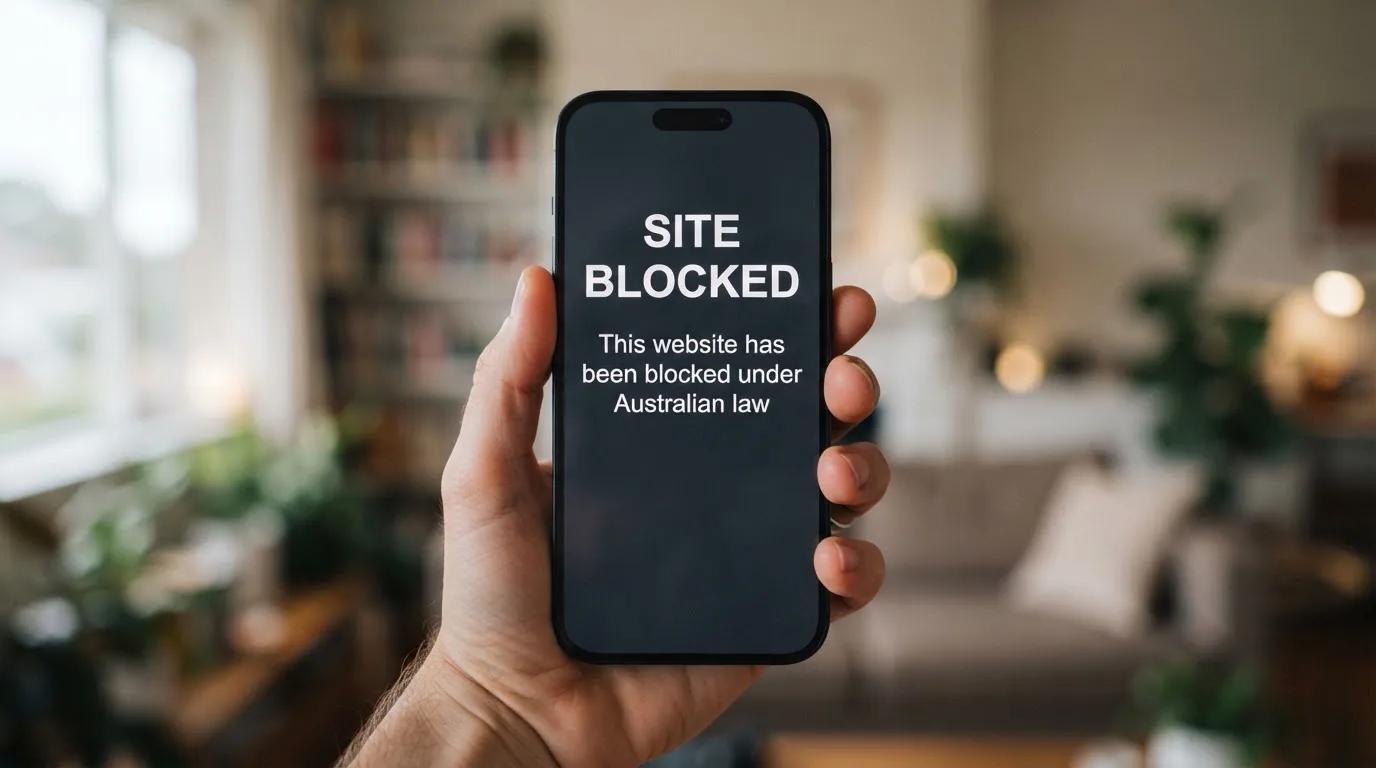
The ACMA’s enforcement has three tools: investigation, formal warnings, and blocking requests to Australian internet service providers. The blocking requests are the loudest. According to the ACMA as reported in June 2026, a total of 1,751 illegal gambling and affiliate-marketing websites had been blocked since the first blocking request in November 2019, and more than 230 unlicensed gambling services had left the Australian market since enforcement was strengthened in 2017. The 26 June 2026 round alone asked ISPs to block 12 more: 7Signs, ChromaBet, Donbet, Duospin, Freshbet, Slots Gem, Jacks Club, Lucky Start, Pointsbetz, Spinrise, Vinyl Casino and Wildsino. The blocking rate across the period from the first request — November 2019 — through the most recent published round in June 2026 works out to somewhere between 25 and 30 sites blocked per month on average across the whole window, with the monthly rate climbing materially from 2023 onward as the ACMA’s pipeline of warning-to-block conversions has matured. The condition on that figure is that the ACMA publishes blocking rounds periodically rather than monthly, and the average smooths across long quiet stretches and short sharp bursts.
The formal warnings run ahead of the blocks and are the ACMA’s visible record of who it has acted against. The list above covers the brands whose warnings are most relevant to a GameBeat search; the wider list is longer, and the ACMA’s website carries each warning with the operator and brand named. A 2022 warning to Hollycorn N.V. over Sky Crown and Blue Leo; a May 2022 warning to Dama N.V. across six brands; a 2022 warning to TechSolutions over Bizzo; March 2025 and May 2025 follow-ups to Dama N.V. over Woo Casino and Spirit Casino; July 2025 warnings to Bamboo Media over Ignition Casino and to Consolutetish S.R.L. over National Casino and Bizzo Casino; February 2025 over Instant Casino; April 2025 over Casino Intense; March 2026 over RocketPlay; April 2026 over Jackbit and CasinOK. The pattern is the same handful of corporate vehicles reappearing under different skins, which is also the pattern the ACMA’s blocking register shows.
H2 Gambling Capital’s 2025 report estimates that Australians lose about A$3.9 billion a year to illegal gambling sites, and that the share of gambling going through legal channels fell from 74% in 2021 to 64%. That is the demand side of what the prohibition has not stopped. The Interactive Gambling Amendment (Gambling Reform) Bill 2026 passed Parliament on 19 August 2026, with its advertising and inducement measures commencing 1 January 2027 — law with a start date, not yet in force. The page reads this as a tightening of the existing regime rather than a change in its character.
Responsible gaming: what tools an Australian reader actually has
BetStop, the National Self-Exclusion Register, has been live since August 2023. It binds Australian-licensed online and phone wagering services — sportsbooks, race wagering, lotteries run by a licensed provider — and excludes the person from those services for a chosen period of 3 months, 6 months, 1 year or 5 years. What it does not bind is an offshore casino. An Australian who has registered with BetStop, signed in to an offshore casino and played has not breached their BetStop exclusion, because the offshore site is not connected to the register. The register is the sharpest player-protection tool the Australian regime has for licensed wagering, and it is, by design, partial.
The National Gambling Helpline is 1800 858 858 — free, 24/7, with chat at Gambling Help Online. It is the line an Australian calls when offshore play has gone further than they meant it to, or when a BetStop registration is the next step. State- and territory-level counselling services run alongside it; the helpline routes to them.
For Australians reading this page because they were looking for GameBeat slots specifically, the practical version of responsible gaming is not a self-exclusion tool but a boundary. GameBeat slots on an offshore site are not subject to the Australian consumer-protection regime: there is no local disputes body, no local complaints route, no local guarantee that a withdrawal will be processed, no local limit on the operator’s right to void a bonus or close an account. The deposit limits that apply to Australian-licensed wagering — and the A$247,500-penalty ban on credit cards and crypto — do not apply to the offshore site. A player who wants those limits is a player who wants the licensed product, which is sports and race wagering, not casino games.
That is the line the rest of this page works to.
What is actually lawful for an Australian reader
For someone inside Australia, the lawful gambling options are:
- Licensed sports and race wagering, pre-event only, no in-play, through an NTRWC-licensed bookmaker. Sportsbet, Bet365, Ladbrokes and 49 others sit on that list. Deposit by debit card, bank transfer, PayID/Osko or BPAY. No credit card, no crypto.
- Licensed lotteries and keno, in the state or territory where the reader lives.
- Land-based casinos, in the states and territories that license them — Crown Melbourne, The Star Sydney, The Star Gold Coast, Crown Perth, SkyCity Adelaide, the various smaller clubs and hotels. Pokies (the Australian term for slot machines) are available at licensed clubs, hotels and casinos in most jurisdictions, with state-level regulation and self-exclusion registers that operate in parallel with BetStop.
- BetStop registration, for anyone who wants the licensed wagering channels closed to them for a fixed period.
That list does not include “an online casino with GameBeat slots”. It is the honest answer to what an Australian reader can actually do, and it is what the rest of the page has been working toward.
The working position
A reader who has read this far has the same information the page has — the law, the ACMA’s record, the catalogue shape of GameBeat’s niche, the cost of a bonus cleared at standard wagering, the payment routes the law permits, the protection the law offers. The decision that follows is not a recommendation, because a recommendation would require a lawful option that does not exist. The decision is whether to play an offshore GameBeat casino knowing the IGA prohibits it, the ACMA has acted against the operators in this niche repeatedly, and the player has no Australian recourse if a balance becomes unreachable; or to take the lawful options that do exist, which are licensed wagering, licensed lotteries, land-based venues and the BetStop register for anyone who wants those closed off.
The page’s position is the one the law and the ACMA’s record support: the shortlist the search asked for does not exist, and the closest substitute is the table of brands the ACMA has acted against, read as a list of names to avoid rather than a list of names to try.
Frequently asked questions
What kind of games does GameBeat make?
GameBeat is a slot-game studio set up in 2021 that develops 3D video slots for online casinos. Its titles sit in the mid-volatility, feature-buy end of the catalogue and are built in HTML5, which is why the same games run on a desktop browser and a phone browser without a separate download. GameBeat does not develop live-dealer tables or table games; the broader offshore lobby those games sit inside is assembled from a dozen other B2B suppliers as well.
Is GameBeat used by any casino licensed to operate in Australia?
No Australian jurisdiction licenses online casino games, so no GameBeat-using casino is licensed in Australia. GameBeat describes itself as a B2B supplier to licensed operators and commercial partners in other markets — Malta, the UK, Curaçao, a long European and Latin American tail. None of those licences extend to Australian customers, and the ACMA has acted against several offshore brands that have nonetheless offered GameBeat’s games to Australians.
Can Australians legally play GameBeat slots at an online casino?
No. The Interactive Gambling Act 2001 prohibits offering online casino games, online pokies or in-play betting to anyone in Australia, and no state or territory licenses those products. The individual player is not prosecuted, but the prohibition is why the ACMA blocks offshore sites and issues formal warnings to the operators behind them. A GameBeat slot on an offshore site is, by definition, an unlicensed product for an Australian player.
Are GameBeat games available at land-based Australian casinos?
Not as such. Land-based Australian venues carry pokies from Aristocrat, IGT and the other large machine manufacturers, not GameBeat; GameBeat’s catalogue is an online-only product. The closest legal in-person substitute is a licensed club, hotel or casino with pokies — Crown Melbourne, The Star Sydney, The Star Gold Coast, Crown Perth, SkyCity Adelaide and the various state-licensed clubs and hotels.
What should someone check before trusting a site that claims to offer GameBeat games?
Whether the site accepts Australian customers at all. If it does, the Interactive Gambling Act 2001 applies, the site is unlicensed for Australia regardless of any Curaçao or Malta footer, and the ACMA is the only Australian body with jurisdiction over it. The ACMA’s enforcement tool is to block the site, not to recover a balance — so a withdrawal refused or an account closed mid-session has no Australian recourse. A site that does not accept Australian customers, and is licensed for its actual market, is a different proposition, but it is not what an Australian reader is searching for.
Does GameBeat software run on mobile browsers?
Yes. GameBeat’s titles are built in HTML5, the same delivery format as most modern slot suppliers, and run in any current phone browser without a native app or download. The mobile experience is set by the operator’s own mobile site, not by GameBeat, so the differences between two GameBeat casinos on a phone are the operator’s design choices — lobby layout, cashier flow, KYC upload handling — rather than anything from the supplier itself.