
Where big jackpot slots stand for Australian players in 2026
The phrase “best online casinos with big jackpot slots” promises a tidy answer. It can’t deliver one for anyone reading from Australia. The Interactive Gambling Act 2001 prohibits offering online casino games — slots included — to a person physically in Australia, and no state or territory issues a licence for them. The brands that promise the world’s biggest progressive jackpots cannot legally take an Australian customer, and the regulator has spent the last several years telling offshore operators exactly that, in writing, on a regular cadence. What follows is what the picture actually looks like: how the prohibition is enforced, what real big-jackpot machinery exists inside the Australian-regulated perimeter, and which offshore brands sit on the regulator’s warning list — written plainly, because honest is what this subject needs.

Current as of 29 October 2026 · cross-checked against the Australian Communications and Media Authority’s published register of formal warnings and blocking requests.
Table of Contents
- How the Interactive Gambling Act 2001 reaches online jackpot slots
- Where Australian players who want jackpot-style play actually stand
- The payment side of the prohibition
- The blocking-rate picture: how fast the offshore perimeter is being closed
- Landscape
- How a progressive jackpot actually works
- The wider catalogue an offshore casino offers
- Frequently asked questions
How the Interactive Gambling Act 2001 reaches online jackpot slots
The prohibition sits in section 15 of the Interactive Gambling Act 2001, tightened materially by the Interactive Gambling Amendment Act 2017. A “prohibited interactive gambling service” is one that is provided to a person in Australia and that involves gaming by way of a carriage service — which covers any online casino game, online pokie, online table game or in-play bet. Slot machines and progressive jackpot slots fall squarely inside that definition. What is licensed in Australia is wagering on races and sport placed before the event, lotteries and keno. Slots, live dealer tables, roulette wheels and the progressive jackpot feeds they connect to are not.

Minimum age for any Australian-licensed wagering service is 18. There is no upper age beyond which a person acquires different standing under the law — only the minimum that has to be met before a provider may lawfully take a wager.
The ACMA, the Australian Communications and Media Authority, runs enforcement. It does not chase individual players. The penalty falls on the provider. That distinction matters for two practical reasons. First, a player who signs up with an offshore casino is not personally committing an offence by doing so. Second, an offshore casino owes that player nothing: no Australian consumer protection, no local complaints body, no recourse when a withdrawal is refused. The offshore operator’s own terms are the only contract in play, and they are written for the operator.
What the ACMA does when an offshore brand targets Australians
Three mechanisms, used in escalating order.
Formal warnings come first. A formal warning is a written notice published on the ACMA’s own register, naming the operator entity behind a website and the specific brand it considers to be offering a prohibited service to Australians. A warning does not by itself block anything; it sets out that the ACMA considers the service prohibited and asks the operator to stop. Brands that ignore a warning move to the next stage.
Civil penalty proceedings can follow, with the Federal Court able to impose penalties on the operator entity under the Act. These are slower and rarer than formal warnings, and they target the corporate entity behind a brand rather than the URL itself.
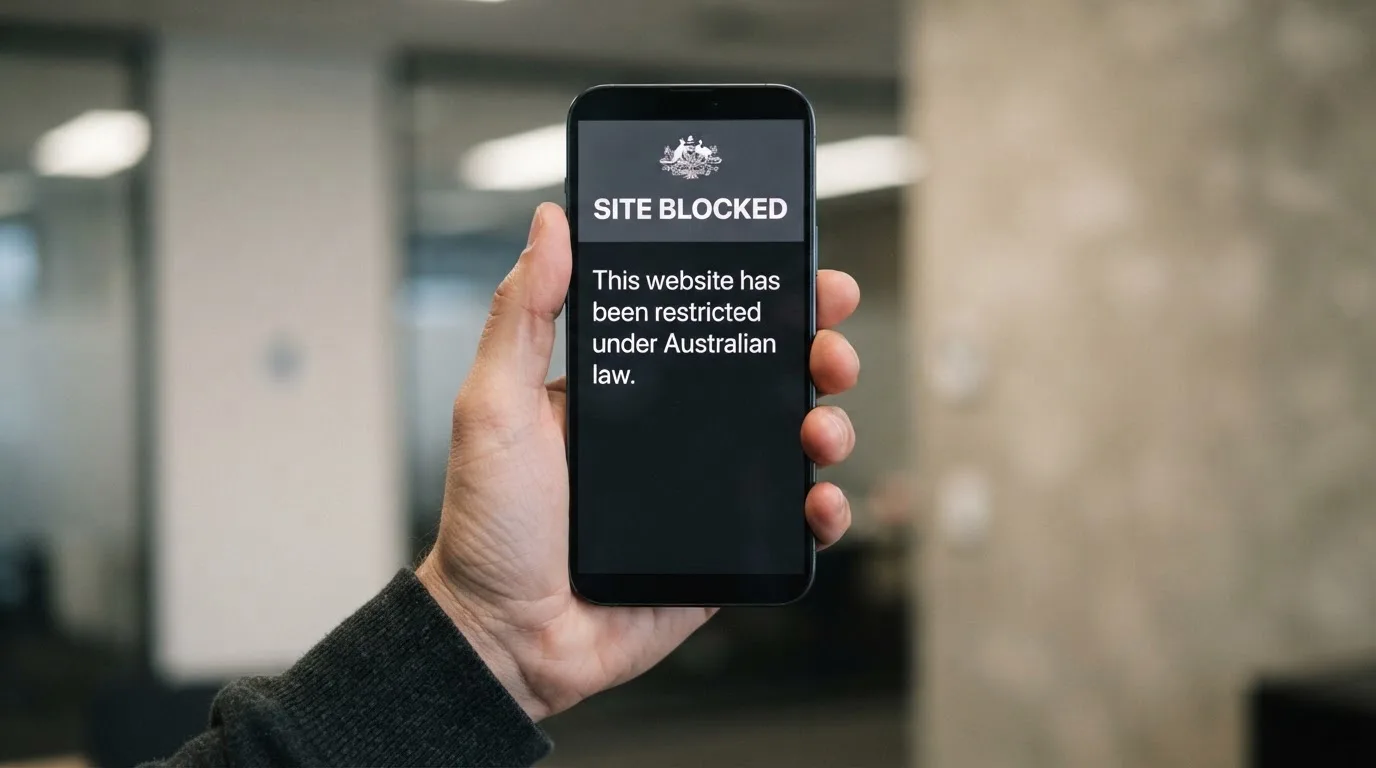
Website blocking is what most Australians notice. The ACMA can ask a Federal Court registrar to direct Australian internet service providers to block specific URLs, and the ISPs comply. Once a site is blocked, traffic from an Australian IP address simply does not resolve. The blocking round reported on 26 June 2026 added 12 more sites — 7Signs, ChromaBet, Donbet, Duospin, Freshbet, Slots Gem, Jacks Club, Lucky Start, Pointsbetz, Spinrise, Vinyl Casino and Wildsino — to a list that began in November 2019 with the first blocking request. As of June 2026, the running total of blocked sites since that first request stood at 1,751, alongside more than 230 unlicensed services that have withdrawn from the Australian market since enforcement was strengthened in 2017. The numbers are large because the enforcement is steady, not because the court system is fast: blocking rounds happen in batches, often several times a year.
Why offshore “licences” don’t change the analysis
A brand may display a Curaçao, Anjouan, Kahnawake or other offshore licence in its footer. The display is not the issue. The issue is whether the operator is licensed to take a customer who is in Australia, and no offshore licence confers that right. The IGA is enforced against the provider, not against the licence displayed on the page; the regulator’s view is that the licence a site claims is irrelevant to whether the service it offers to Australians is lawful. An Australian player looking at such a brand is therefore not looking at a regulated product — they are looking at a brand the ACMA has, in most cases, already written to.
The Northern Territory’s narrow role
Australia’s online bookmakers are largely licensed in the Northern Territory, where the Northern Territory Racing and Wagering Commission regulates 52 of them — Sportsbet, Bet365 and Ladbrokes among the household names — for tax reasons. The commission has no full-time staff and meets once a month in Darwin. The NTRWC’s role is licensing the wagering providers the IGA permits. It does not, and cannot, license an online casino or an online pokie. There is no Australian route for an online casino licence.
Where Australian players who want jackpot-style play actually stand
What is lawfully available to someone in Australia, and what isn’t.
Licensed land-based venues and their progressive networks
Australian casinos operate progressive jackpot networks inside their own premises. Crown Melbourne, Crown Perth, The Star Sydney, The Star Gold Coast, Treasury Brisbane and Skycity Adelaide — together with smaller venues in each jurisdiction — host physical slot machines, including progressive machines linked locally within the venue or across multiple venues in the same operator’s network. The biggest prizes these machines pay out are typically smaller than the eight-figure sums that get posted about offshore Mega Moolah wins, but they are paid out under Australian consumer protection law, by an Australian-licensed operator, and winnings can be claimed at the cashier’s window.
Crown Melbourne’s gaming floor, for instance, runs progressive jackpot machines that link across the complex — the largest prizes paid out there run into the millions. The same applies to the larger Sydney and Gold Coast properties. The trade-off is the trip, the dress code, the membership card and the fact that the machines themselves are not the headline-grabbing Mega Moolah or WowPot feeds run by offshore aggregators. They are local progressive networks. The local network’s biggest payouts are smaller than the offshore networks’ biggest payouts, but the local network is the one Australian players can actually sit at.
Licensed pokies venues
Pokies venues — clubs, pubs and hotels — operate approved gaming machine networks. These are real slot machines with real progressive jackpots, but the prizes are smaller than the headline progressives that get written about online. A “Hyperlink” or “Must Hit By” progressive on a club floor typically tops out somewhere between a few thousand and a few hundred thousand dollars. That is a real payout, paid in cash, from a machine regulated by the state or territory’s gaming authority. It is not the experience a reader searching “best online casinos with big jackpot slots” is imagining — but it is the experience that is lawfully available.
BetStop and what it does and does not cover
BetStop, the National Self-Exclusion Register, has been live since August 2023. A person who registers with BetStop is excluded from every Australian-licensed online and phone wagering service, including every licensed sportsbook and every licensed racing bookmaker. The exclusion periods run from a minimum of three months up to a permanent exclusion, and the registered operator must not accept a wager from the person for the duration.
What BetStop does not cover is the offshore casino. An offshore brand is not connected to the Australian register; the offshore brand has its own self-exclusion procedure if it has one at all, and the exclusion only applies for as long as the offshore brand chooses to honour it. A person who has registered with BetStop and then goes to an offshore casino is operating outside the protection the register was designed to provide. That distinction is worth holding onto, because BetStop is the strongest single safeguard an Australian can put around their gambling — but only around the gambling the IGA permits.
National Gambling Helpline and Gambling Help Online
The National Gambling Helpline is 1800 858 858. It is free, available 24/7 and staffed by counsellors. Gambling Help Online carries the same service through web chat. These are the right first calls for anyone whose gambling — whether at an Australian club, a licensed bookmaker or an offshore casino — has become a problem. They are independent of any operator and they are not part of any casino’s terms and conditions.
The payment side of the prohibition
The payment rules matter as much as the service rules, because they tell a player what kind of operator they’re dealing with.
Credit cards and crypto are out for licensed Australian wagering
Since 11 June 2024, the use of credit cards, credit-related products and digital currencies has been banned as payment for any licensed online wagering service in Australia. The penalties for licensed operators who take such payments run up to A$247,500. The law’s purpose is to remove the fastest routes to overspending from the perimeter the IGA regulates. The licensed deposit routes are debit card, bank transfer, PayID/Osko and BPAY.
What that tells you about an offshore brand
A site asking an Australian customer to deposit with a credit card, with Bitcoin, with Ethereum or with USDT is, by definition, not operating under Australian rules. Offshore brands accept all of these because their own jurisdiction’s rules allow them. The Australian ban is irrelevant to them in practice, but it is the clearest signal an Australian player has that the brand is not regulated by anyone in Australia. The deposit method a site accepts is, in effect, a lie detector for whether the site is part of the Australian-regulated perimeter.
Payment methods: licensed vs. offshore
| Method | Licensed Australian Wagering | Offshore Casino |
|---|---|---|
| Debit card | Allowed | Accepted |
| Bank transfer | Allowed | Accepted |
| PayID/Osko/BPAY | Allowed | Not typically accepted |
| Credit card | Banned | Accepted |
| Crypto (BTC/ETH/USDT) | Banned | Accepted |
Tax position for a recreational player
Gambling winnings of a recreational player are not assessable income in Australia, under section 6-5 of the Income Tax Assessment Act 1997. Losses are not deductible. The position changes if the ATO considers the person to be carrying on a business of gambling, but the model position for a casual player is that winnings are tax-free and losses are personal. Anyone with winnings large enough to trigger a question should check with the ATO directly; the model answer here is the right starting position, not a substitute for advice.
The blocking-rate picture: how fast the offshore perimeter is being closed
The ACMA’s enforcement record over the last several years gives a working rate at which the offshore perimeter is being shut down against Australian customers. This gives a clearer view of enforcement trends.
The first blocking request was issued in November 2019. The running total reached 1,751 blocked sites by the end of June 2026. That is roughly 80 months from first action to that total, which works out to a long-run rate of approximately 22 blocked sites per month across the period. The rate is not uniform — some years are heavier than others, and the ACMA’s blocking rounds come in batches rather than continuously. The June 2026 round alone added 12 sites. Earlier rounds added more.
The block rate matters because it tells an Australian reader how fast the offshore list of “available” sites is shrinking. A site that took an Australian deposit this month may be blocked next month; a site that was on the warning list a year ago and ignored the warning is now most likely on the block list. The list itself is not a single document; it is the running count published in ACMA communications and trade press reports of each blocking round.
The upper end of the band — assuming the heavier pace of recent rounds continues — is closer to 30 sites per month. The lower end — if the recent rate reflects a one-off ramp and the underlying pace settles back toward the long-run average — sits closer to 15. Both ends of the band rest on the same underlying assumption: that the ACMA continues to add blocking rounds at roughly the cadence it has shown since 2019, and that offshore operators continue to spin up new URLs faster than the ACMA can block them. The blocking is not winning; it is holding the line at a rate that is, at best, keeping pace with the new supply.
Why the rate matters to a player, not just a regulator
A reader who types “best online casinos with big jackpot slots” into a search engine is looking at a list written by an offshore affiliate. The list is not the regulator’s list. The list does not warn that the brand has been blocked by the ACMA, or that the brand has ignored a formal warning, or that the brand will be blocked next month. The blocking rate is what tells the reader how quickly any particular name on that affiliate list will go dark from an Australian IP. The honest reading is: most of them, eventually.
Landscape
The offshore brands the ACMA has acted against
These eleven brands are not a recommendation. They are not a ranking. Each one appears on this page because the ACMA has, on the dates shown, issued a formal warning under the Interactive Gambling Act 2001 against the corporate entity operating the brand for offering prohibited services to Australians. The page lays them out side by side because the warning register is what matters, not the marketing.
| Brand | ACMA action and date | Operator named by the ACMA | Subject support |
|---|---|---|---|
| RocketPlay | Formal warning, March 2026; earlier Dama N.V. warning May 2022 | Pulsup Ltd (March 2026); Dama N.V. (May 2022) | — |
| Level Up Casino | Formal warning, May 2022 | Dama N.V. | BGaming listings report a presence |
| Woo Casino | Formal warning, March 2025 | Dama N.V. | — |
| Spirit Casino | Formal warning, May 2025 | Dama N.V. | — |
| National Casino | Formal warning, July 2025 | Consolutetish S.R.L. | Wikipedia listings report a presence |
| Bizzo Casino | Formal warning, July 2025; earlier TechSolutions warning 2022 | Consolutetish S.R.L. (July 2025); TechSolutions Group (2022) | — |
| Ignition Casino | Formal warning, July 2025 | Bamboo Media | — |
| Instant Casino | Formal warning, February 2025 | EOD Code SRL | — |
| Jackbit | Formal warning, April 2026 | Ryker B.V. | — |
| Casino Intense | Formal warning, April 2025 | Sterplay Holding Ltd | ABC, ACMA and Crown Melbourne listings report coverage |
| Sky Crown | Formal warning, September 2022 | Hollycorn N.V. | — |
What the table cannot carry on its own: that almost every brand on it is a re-skin of an earlier warning, often under a different operator entity. Dama N.V. has been warned over six brands since 2022 — Bambet, Dazard, Level Up, Rocketplay, Wild Tornado and Cobra Casinos in May 2022, then Woo Casino in March 2025 and Spirit Casino in May 2025. Consolutetish S.R.L. was warned in July 2025 over two brands at once, National Casino and Bizzo Casino, the latter of which had already been warned in 2022 under TechSolutions. The pattern is that offshore operators cycle brands quickly when one gets blocked, and the ACMA’s enforcement tracks that cycling rather than slowing it. The picture is not “eleven separate enforcement actions”; it is a smaller number of operator entities cycling through brand shells.
The shared profile across the eleven
What every brand on the list has in common, beyond the warning: the service they offer to Australians is not licensed in any Australian jurisdiction. The licence the brand displays — if it displays one — is an offshore licence, granted by a regulator that has no jurisdiction over an Australian player. The brand’s own terms of service are written from the perspective of a Curaçao- or Anjouan-licensed entity. The complaint pathway the brand advertises is its own complaints procedure, not an Australian external dispute resolution scheme. The customer service hours are set by the operator, not by an Australian regulator. The “responsible gambling” tools the brand offers are the brand’s own deposit limits and cool-off periods, not BetStop. The KYC process the brand runs is the brand’s own, not an AUSTRAC-supervised process. The brand is, in every material respect, an offshore operation that has been told in writing by the ACMA to stop offering its product to Australians and has not stopped.
What the brands differ on
Not much, honestly, on the dimensions that matter to an Australian reader. The brand names differ. The operator entities differ in their corporate registration, mostly clustered around Curaçao, Cyprus and a handful of smaller offshore jurisdictions. The game catalogues overlap heavily — BGaming, Pragmatic Play, Evolution and a handful of live-dealer studios appear across most of them, and where research does not name a subject specifically, the page does not assert one. The bonuses offered differ in shape — deposit matches of various multiples, free-spin bundles, reload packages — but the wagering requirements and the max-cashout caps that determine what those bonuses are actually worth to a player are the kind of detail only an affiliate page carries, and this page does not reprint affiliate material. The brands differ in marketing polish. They do not differ in their standing under Australian law.
RocketPlay
RocketPlay sits at the top of the table because it carries the most recent ACMA action — a March 2026 formal warning to Pulsup Ltd, sitting on top of a May 2022 warning to Dama N.V. over the same brand. A player reading this name on an affiliate page is reading about a brand the regulator has warned twice in under four years. The two warnings are two attempts by the ACMA to get the brand to stop offering its product to Australians; the brand is, by definition of the second warning, still doing so. That is the entire picture.
Level Up Casino
Level Up Casino is one of the six Dama N.V. brands warned in May 2022. Where research sources name BGaming specifically as a presence on the brand’s listing, this page records that as a listing observation, not as the operator’s own claim — and it carries no weight against the fact that the ACMA has already written to Dama N.V. about this brand. The verdict is the same as for every brand on the list: the brand is offering a prohibited service to Australians, regardless of which studios its games catalogue draws from.
Woo Casino
Woo Casino received a formal warning to Dama N.V. in March 2025. It joins Spirit Casino as a Dama N.V. brand that was warned after the May 2022 batch — meaning Dama N.V. now has at least eight brands on the ACMA’s warning register, and the operator’s pattern is that warnings have not changed its approach. The page records the warning and the date; the page does not record a claim about the brand’s games or bonuses, because no source the page works from carries one for this brand.
Spirit Casino
Spirit Casino received a formal warning to Dama N.V. in May 2025, two months after Woo Casino. The pair of warnings, close together, suggest the ACMA’s monitoring caught two Dama N.V. brands in the same period — which is consistent with a single operator entity running multiple brands in parallel and the ACMA working through them one warning at a time. The verdict for a reader is the same as for Woo Casino.
National Casino
National Casino received a July 2025 warning to Consolutetish S.R.L., the same operator entity warned at the same time over Bizzo Casino. Wikipedia-style listings place the brand in offshore aggregator coverage; the page records that as a listing observation. The substantive reading is that Consolutetish S.R.L. was running at least two brands simultaneously in the Australian market at the time of the warning.
Bizzo Casino
Bizzo Casino carries two warnings — the July 2025 warning to Consolutetish S.R.L. and an earlier 2022 warning to TechSolutions (CY) Group Limited and TechSolutions Group N.V. The earlier warning was to a different operator entity, which is the typical pattern for an offshore brand that has changed hands or changed corporate registration while continuing to operate under the same brand name. Two warnings across four years, two operator entities, the same brand name. That is the pattern an Australian reader should know about.
Ignition Casino
Ignition Casino received a July 2025 formal warning to Bamboo Media. The brand is well known in offshore-aggregator coverage, particularly in the US-facing market, and the warning is a function of the brand being offered to Australians as well. The same operator entity, Bamboo Media, was named in the warning; the brand’s standing under Australian law is unchanged by any offshore licence its footer displays.
Instant Casino
Instant Casino received a February 2025 formal warning to EOD Code SRL, one of the earlier warnings in the 2025 wave. A reader who sees the brand on an affiliate list written in the back half of 2025 is reading about a brand that was already on the ACMA’s warning register at the start of that year. The marketing on the affiliate page and the regulator’s position are not in alignment.
Jackbit
Jackbit received an April 2026 formal warning to Ryker B.V., at the same time as CasinOK under the same operator. The brand’s positioning as a cryptocurrency-friendly casino is consistent with the offshore deposit methods the brand accepts; it is also consistent with what an offshore operator offers because the Australian ban on crypto deposits only applies to Australian-licensed wagering, not to the brand the brand actually is. A crypto deposit at Jackbit is a deposit at an unregulated operator, not a workaround of the Australian rules.
Casino Intense
Casino Intense received an April 2025 formal warning to Sterplay Holding Ltd. The brand has been covered in ABC reporting and ACMA communications and Crown Melbourne’s own gaming-floor listings; the page records these as listing observations rather than as claims about the brand itself. The warning is the material fact.
Sky Crown
Sky Crown sits on the ACMA’s warning register under Hollycorn N.V., alongside Blue Leo, on a warning published in September 2022. A formal warning from 2022 is now several years old; the brand’s current status depends on whether Hollycorn N.V. continues to offer the brand to Australians. The brand’s positioning as an Australia-facing offshore casino is consistent with the warning’s existence.
The verdict across the table
The verdict on every brand on the table is the same: each one offers a prohibited service to Australians and has been told so in writing. The brands differ in how recently they were warned, in which operator entity the warning named, and in which game studios they draw their catalogue from. None of those differences changes the standing under Australian law. The page’s position is that none of these brands is a lawful option for an Australian reader, and the ACMA’s register is the document that says so.
How a progressive jackpot actually works
The reader who searches for “big jackpot slots” is usually looking for the progressive kind — the network-linked machines where the top prize climbs into seven and eight figures. The mechanics matter because they explain why the biggest prizes are offshore and why the Australian options top out lower.
The basic mechanism
A progressive jackpot is a prize pool that grows with each wager placed on the machine or network. The casino takes a small slice of each wager — typically a fraction of a percent — and routes it into the jackpot pool. The pool grows until a player wins it, at which point it resets to a predetermined minimum and starts growing again. A machine can be linked locally, within one venue, or across a wide area spanning many venues — the offshore Mega Moolah network is the canonical example of a wide-area link, connecting thousands of machines across hundreds of online casinos into a single prize pool.
The first Megabucks progressive, made by International Game Technology, paid out its inaugural jackpot of US$4,988,842.17 on 1 February 1987. Progressive machines have been climbing since then; the offshore networks today post wins in the tens of millions. Games Global, the business that now distributes the Mega Moolah series, has reported later wins of £11.5 million and £13.5 million. The headline figure — €19,430,723.60 — was won on 27 April 2021 by a player in Belgium at Napoleon Sports & Casino on Microgaming’s “Absolootly Mad: Mega Moolah”, and it remains the record.
Why the headlines belong to offshore networks
The offshore networks are wide-area: thousands of machines across hundreds of casinos feeding one pool. The prize grows faster because more wagers feed it. Australian networks are local: one venue, or one operator’s venues in one state. The prize grows slower because fewer wagers feed it. The trade-off is straightforward. The offshore network’s biggest prizes are larger; the Australian network’s prizes are paid out under Australian consumer protection law, by an Australian-licensed operator, in a venue a player can walk into with a complaint if the payout goes wrong. The offshore network’s biggest prizes are paid out by an offshore operator that has, in most cases, been told by the ACMA to stop taking Australian customers in the first place.
Why the headline machines pay less between big wins
A progressive slot has a lower return to player than a non-progressive slot of the same theme and feature set, because a portion of every wager is diverted to the jackpot pool rather than to the game’s regular payout structure. The base game still pays out, but it pays out less often, and at smaller amounts, than a non-progressive equivalent. The expectation is that the occasional jackpot win compensates for the leaner base play. Most players never see a jackpot. The few who do see one see a payout large enough to cover the leaner base play for every other player on the network for the entire accumulation period.
The “must-hit-by” variant
A “must-hit-by” progressive, sometimes called a mystery jackpot, sets a hard upper limit on the pool immediately after each win. A random number generator picks the actual payout amount within a preset range — say A$1,000 to A$3,000 — at the moment the previous jackpot is won, and the new pool grows from that figure. The player does not need to land a specific symbol combination to win; the machine triggers the win when the pool reaches its upper limit. The mechanic is closer to a lottery than to a slot. It is also the mechanic most commonly seen on Australian club and pub floors, where the headline prizes are smaller than offshore network progressives but the trigger is independent of the symbol combinations on the reels.
Positive-expectation edge cases
In some progressive games — certain video poker and Caribbean Stud Poker variants — the prize can grow large enough to push the game’s theoretical return above 100%, creating a positive-expectation bet. This break-even point is calculable for table games because the deck composition is known. It is not calculable for slot machines because the reel layouts are not published, so the threshold above which a slot progressive becomes positive-expectation cannot be determined from outside the operator. The positive-expectation cases are real but rare; they are also irrelevant to the Australian player’s standing, because the games that produce them are not lawfully offered to Australian customers online.
The wider catalogue an offshore casino offers
A reader looking at an offshore casino is not looking at a single product. The brand’s catalogue is typically built around a few core verticals.
Slot machines and progressive slots
The centre of the catalogue. Offshore brands carry thousands of slot titles, including the wide-area progressive networks that produce the headline jackpots. BGaming, Pragmatic Play, NetEnt, Microgaming/Games Global and Nolimit City are typical providers. Australian-licensed venues carry a smaller catalogue of slot machines, including local progressive networks, regulated by the state or territory gaming authority.
Live dealer tables
Live dealer tables — roulette, blackjack, baccarat, game-show formats — are streamed from offshore studios to the player’s screen. The minimum age for the offshore studio’s own jurisdiction is typically 18 or 21; the ACMA’s position is that offering these to Australians is offering a prohibited service, regardless of the studio’s home jurisdiction.
Table games in their RNG form
Roulette, blackjack and baccarat are also offered in software form, without a live dealer. RNG table games run on a certified random number generator; the certifications are typically issued by the offshore regulator the brand is licensed in. An Australian player cannot lawfully be offered any of these by an offshore brand.
Poker and game-show formats
Poker rooms, video poker, crash games and the game-show formats that have grown popular offshore — wheels, plinko-style games, dice games — round out a typical catalogue. The same prohibition applies.
Cryptocurrency funding
Some offshore brands accept Bitcoin, Ethereum, USDT and other cryptocurrencies as deposit methods. The brands that accept crypto and target Australian customers are doing so in deliberate disregard of the Australian ban on crypto as a payment for licensed wagering — and, more fundamentally, in breach of the IGA itself. Crypto deposits do not legalise the service; they make it harder to trace. They do not change what the player has bought.
Frequently asked questions
What is the single biggest online slot jackpot ever won?
The record is €19,430,723.60, won on 27 April 2021 by a player in Belgium at Napoleon Sports & Casino on Microgaming’s “Absolootly Mad: Mega Moolah”. Games Global, which now distributes the Mega Moolah series, has reported later wins of £11.5 million and £13.5 million on the same network, but the 2021 prize remains the headline figure.
Can a jackpot slot be funded with cryptocurrency?
Some offshore casinos accept Bitcoin, Ethereum and USDT as deposits for slot play. The Australian position is that crypto is banned as a payment for any Australian-licensed wagering service since 11 June 2024, with penalties up to A$247,500 for licensed operators who take such payments. An offshore brand accepting crypto from an Australian customer is, by definition, outside the Australian-regulated perimeter and the deposit method reflects that.
Is it legal for an online casino to offer jackpot slots to Australians?
No. The Interactive Gambling Act 2001 prohibits offering online casino games — including jackpot slots — to a person in Australia. No state or territory issues a licence for online casino games. The ACMA enforces against the provider, not the player. The brands that promise the biggest jackpots cannot legally take an Australian customer, and most of them have been told so in writing.
Why do jackpot slots pay out less often between big wins?
A portion of every wager is diverted into the jackpot pool rather than into the game’s regular payout structure, so the base game pays out less often and at smaller amounts than a non-progressive slot. The expectation is that an occasional large jackpot compensates for the leaner base play. Most players will never see a jackpot win.
What happened to the 2021 Mega Moolah record winner?
The €19.4 million win was paid out by Napoleon Sports & Casino in Belgium under Belgian gaming regulation. Games Global, which now distributes the Mega Moolah series, has continued to publicise later large wins on the network, including the £11.5 million and £13.5 million payouts reported in 2026, but no single win has exceeded the 2021 Belgian payout.
Is there a way to play jackpot-style slots for real money through a licensed Australian venue?
Yes. Australian land-based casinos — Crown Melbourne, Crown Perth, The Star Sydney, The Star Gold Coast, Treasury Brisbane and Skycity Adelaide — host progressive slot machines within their own networks. Club and pub pokies venues also operate smaller progressive networks, including “must-hit-by” machines with preset upper limits. The prizes are smaller than the offshore headline figures but they are paid out by Australian-licensed operators under Australian consumer protection law.