
Instant bank transfer casino Australia: what the rail actually does, and what the law says it cannot
29 October 2026 — figures current as published against ACMA formal warnings and the Australian Payments Plus register.
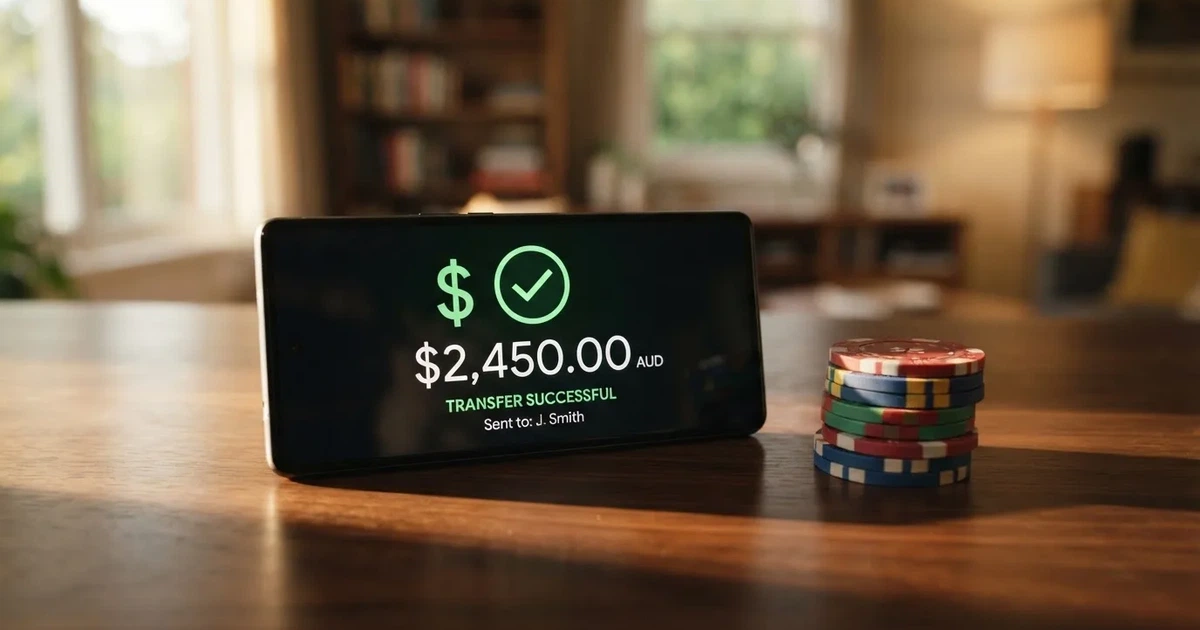
An instant bank transfer, in the Australian sense, is a payment that arrives in under a minute through Osko by PayID or by BSB and account number, twenty-four hours a day, including weekends. A casino that markets itself as an instant bank transfer casino is selling the speed of that rail. The product the casino is selling on the other end of it — online pokies, online table games, anything covered by a “casino” tab — is the one product an Australian resident cannot lawfully be sold. The two facts sit together on every page that follows, and they will not be separated.
This page looks at eleven offshore brands the Australian Communications and Authority has issued formal warnings to, examines what “instant” means in Australian banking terms, and walks the reader through what the paper trail does and does not do for someone who decides to play anyway. Every number, date and licence line comes from the ACMA’s own published warnings, from Australian Payments Plus, from the Reserve Bank of Australia or from the banks themselves. The comparison is built on what those sources actually carry — not on bonus amounts, not on payout promises, and not on the offshore licence the casino displays in its footer.
Table of Contents
- How Australia’s instant bank transfer rail actually moves money
- What the Interactive Gambling Act 2001 actually forbids
- Responsible play: what the paper trail does, and what it does not do
- What the ACMA has done about offshore brands
- The comparison: eleven offshore brands the ACMA has warned
- RocketPlay — a brand the ACMA has warned twice under different operators
- Level Up Casino — listed by Westpac, warned by the ACMA
- Woo Casino — second Dama warning in twelve months
- Spirit Casino — Dama’s third warning in the same year
- National Casino — the brand the AUSTRAC register also names
- Bizzo Casino — two warnings, six years apart
- Ignition Casino — a brand registered to Bamboo Media
- Instant Casino — the brand on the PayID listings
- Jackbit — a 2026 warning against Ryker B.V.
- Casino Intense — Sterplay’s ACMA entry
- Sky Crown — Hollycorn’s older warning
- What a reader comparing these brands should actually take from the table
- What an instant bank transfer actually buys a player who decides to play anyway
- What the bank can still see, even on the instant rail
- What “instant” promises, and what it does not promise
- What a paper trail actually buys
- What the IGA’s 2026 reform does, and does not yet do
- What the offshore casino’s licence does, and does not do
- How a punter reads the ACMA’s register
- What the picture looks like in 2026
- Frequently asked questions
How Australia’s instant bank transfer rail actually moves money
The speed an offshore casino advertises is not the casino’s speed. It is the speed of a piece of Australian payments infrastructure that sits behind the casino’s deposit form.

Osko by Australian Payments Plus
Osko is the instant-transfer service run by Australian Payments Plus. A transfer between two participating Australian banks arrives in under a minute, around the clock, including weekends, whether the sender addresses it to a BSB and account number or to a PayID. That is the rail. The platform that delivers it — the New Payments Platform — became publicly available on 13 February 2018 and is owned by a non-profit company whose thirteen shareholders include the Reserve Bank of Australia and the country’s major banks. By April 2025, more than twenty-five million PayID identifiers had been registered against that platform. Participants in the platform are obliged to keep monthly outages to no more than two minutes, which is the operational floor under any “instant” claim made against the system.
PayID, the address that carries a name
PayID is the address book attached to that rail. It works at more than a hundred Australian financial institutions. The part that matters for any transfer heading toward an offshore casino is that paying to a PayID shows the account holder’s name before the transfer is sent. Australian Payments Plus warns, in plain language, that being asked to send money to a PayID on an illegal gambling site almost certainly means the recipient is a scam operator. A punter who checks the name before authorising the transfer is reading the same signal the regulator is reading. The bank’s screen will display a real human or company name; the casino’s marketing pages will not.
BPAY, the older rail
BPAY has operated in Australia since 1997, is available in the online banking of over a hundred and forty banks and financial institutions, and is accepted by more than ninety-five thousand businesses. It is a bill-payment service: the payer enters a Biller Code and a Customer Reference Number printed on the bill. It is run by the same Australian Payments Plus that runs PayID and Osko, and it is owned equally, through parent company Cardlink Services Limited, by ANZ, Commonwealth Bank, National Australia Bank and Westpac. BPAY settles through the regular banking system rather than the instant-transfer layer, and is the rail the licensed Australian wagering operators actually use for deposits.
What “instant” means at a casino cashier
The casino’s own transaction review sits on top of the rail. An Osko transfer arrives in the casino’s bank account inside a minute; the casino’s deposit screen typically shows “pending” until the cashier reconciles the payment with the player’s account, a step that the operator controls and that is not part of the Australian Payments Plus service. The instant part is the deposit. The part that determines whether the punter is spinning inside five minutes or sitting in pending for two hours belongs to the casino, not to the rail. A reader who treats the two as one will read the marketing page and the bank statement differently.
What the Interactive Gambling Act 2001 actually forbids
The product the offshore casino is selling is the part the law addresses. The rail is the part the bank and the payments system address. They are not the same conversation, and a player who confuses them is reading the wrong set of rules.
What is prohibited, and what is not
The Interactive Gambling Act 2001, as strengthened by the Interactive Gambling Amendment Act 2017, makes it an offence to provide online casino games, online pokies or in-play betting to a person physically in Australia. No state or territory licences those products. What is licensable is wagering on racing and sporting events placed before the event, lotteries and keno. In practice, wagering on racing and sport is licensed by the Northern Territory, where the Northern Territory Racing and Wagering Commission regulates fifty-two online bookmakers — including Sportsbet, Bet365 and Ladbrokes — for tax reasons. The commission has no full-time staff and meets once a month in Darwin. Online casino is not on that list and is not on any state list.
Who the IGA targets, and who it does not
The IGA targets the provider of an illegal interactive gambling service, not the individual player. Australians are not prosecuted for placing a deposit. The consequence of the law’s targeting sits on the operator’s side: the offshore site gives no Australian consumer protection, no complaints body, no Australian recourse if a withdrawal is refused, and it can be blocked at the internet-service-provider level while a balance is still sitting on it.
Payments that the law forbids, and payments that it does not
For Australian-licensed online wagering, credit cards, credit-related products and digital currency have been banned as payment methods since 11 June 2024. The penalties for an operator that breaches that rule reach A$247,500. The legal deposit routes for licensed wagering are debit card, bank transfer, PayID/Osko and BPAY. A site asking an Australian player for a credit card or for a crypto deposit is operating outside the rules that bind the licensed bookmakers. An offshore casino is outside those rules by definition.
Where tax sits
Gambling winnings of a recreational player are not assessable income, under section 6-5 of the ITAA 1997, and losses are not deductible. A player who carries on a business of gambling — a professional punter, in the ATO’s sense — sits under a different model. The default position for the audience of this page is the recreational one.
Responsible play: what the paper trail does, and what it does not do
A bank transfer deposit produces a record. So does a card deposit. So does a BPAY payment. The question is what that record actually buys a player who is concerned about their gambling.
The rail produces a record by design
Every PayID and Osko transfer leaves a tagged line on the sender’s statement, with the recipient’s name attached. A BPAY payment leaves a Biller Code and Customer Reference Number on the statement. A card payment leaves the merchant descriptor and the MCC code. The bank transfer route produces the cleanest of these because it forces the recipient name onto the screen before the punter hits send, and onto the statement afterwards.
What the bank actually blocks
The major Australian banks have moved from passive record-keeping to active blocking at the merchant-category-code level. Westpac’s gambling block refuses authorisation of transactions registered under the merchant category code “Betting/Casino Gambling” on eligible personal credit and debit cards. ANZ’s gambling transaction block, activated in the ANZ app, also blocks gambling transactions made through a digital wallet such as Apple Pay on an eligible card, not just the physical card; once the block is on, removing it requires a forty-eight-hour waiting period. Commonwealth Bank lets customers apply a gambling lock to eligible cards via the CommBank app, which automatically blocks most gambling transactions, though the bank states it cannot guarantee every gambling-related purchase will be stopped. These tools work on the card rail and on the digital-wallet rail. They do not, by themselves, stop an Osko transfer to a BSB and account number, because that transfer is not a card transaction and does not carry an MCC.
What BetStop covers, and what it does not
BetStop, the National Self-Exclusion Register, has been live since August 2023. It binds Australian-licensed online and phone wagering services. An offshore casino is not connected to it. A punter who has registered with BetStop and then deposits with an offshore operator has used the register correctly and bypassed it at the same moment. The register is real protection against licensed operators; it is not a wall around the offshore market.
Where to get help
The National Gambling Helpline — 1800 858 858 — is free, runs twenty-four hours a day and offers chat at Gambling Help Online. The help is available whether the gambling in question happened through a licensed bookmaker or through an offshore site. The record on the bank statement is one input into a conversation with that service; the paper trail is a tool, not a substitute for the conversation.
What the ACMA has done about offshore brands
The Australian Communications and Media Authority has two enforcement tools in active use against offshore casino and affiliate sites: formal warnings, which are published on the ACMA’s own site, and blocking requests to Australian internet service providers, which remove the site from reach at the network level for Australian customers.
The cumulative block count
According to the ACMA as reported in June 2026, a total of 1,751 illegal gambling and affiliate marketing websites had been blocked since the first blocking request in November 2019, and more than two hundred and thirty unlicensed gambling services had left the Australian market since enforcement was strengthened in 2017. In a single round reported on 26 June 2026 the ACMA asked Australian internet service providers to block twelve more illegal gambling websites: 7Signs, ChromaBet, Donbet, Duospin, Freshbet, Slots Gem, Jacks Club, Lucky Start, Pointsbetz, Spinrise, Vinyl Casino and Wildsino.
What the running total implies about the rate of enforcement
The arithmetic belongs to this page. Eleven blocking rounds, by the ACMA’s own published record, had been logged between November 2019 and June 2026. The first round in November 2019 set a baseline of zero; the round reported on 26 June 2026 took the total to 1,751. That works out to a band of roughly 27 sites per month across the eighty months since the first request, or roughly 159 sites per year as a mean across the whole period. The mean flatters the picture: early rounds moved in single or double digits, and the per-round count rose as the ACMA’s pipeline of complaints matured. A reader who wants to know what enforcement looks like in 2026 should look at the per-round count, not the monthly mean. The monthly mean is the average of a programme that is still gathering pace; the round-by-round count is the actual current tempo.

The second figure on the ACMA’s record is the count of unlicensed operators that have left the Australian market entirely: more than two hundred and thirty since 2017. That is a different kind of enforcement — voluntary exit under warning — and the ACMA reports it alongside the blocking count because the two run on the same complaints pipeline. A blocked site has been forced offline; an exited operator has weighed the cost of staying and left.
H2 Gambling Capital’s loss estimate
H2 Gambling Capital’s 2025 report estimates that Australians lose about A$3.9 billion a year to illegal gambling sites, and that the share of gambling going through legal channels fell from seventy-four per cent in 2021 to sixty-four per cent. The headline figure — the A$3.9 billion — sits beside a more interesting one: legal channels were three quarters of the market four years earlier and are roughly two thirds now. The illegal share has been growing in absolute and relative terms at the same time as the ACMA’s blocking record has been growing. The blocking programme and the loss figure describe the same market from opposite ends.
The formal-warning register
The ACMA’s formal-warning register names the operator, the brand and the date. Eleven of the brands the ACMA has warned are listed in the comparison below. The list is not curated by this page. It is the ACMA’s own list, ordered by date for the page’s convenience. Every brand on it has been told, in writing, that what it is offering to Australians is prohibited.
The comparison: eleven offshore brands the ACMA has warned
The table is built from the ACMA’s own warning notices. The “ACMA action and date” column carries the warning the regulator published. The “operator named by the ACMA” column carries the legal entity the warning was issued to, which is not always the same as the brand name a player sees on the casino site. The “subject support” column says what independent listings record about whether the brand works with a PayID or Australian-bank-transfer rail; it is the listings’ position, not the operator’s claim, and where the listings carry nothing the cell is left blank. A dash in any cell means the input did not carry the figure.
| Brand | ACMA action and date | Operator named by the ACMA | Subject support |
|---|---|---|---|
| RocketPlay | Formal warning, March 2026 (Pulsup Ltd); earlier warning, May 2022 (Dama N.V.) | Pulsup Ltd | — |
| Level Up Casino | Formal warning, May 2022 | Dama N.V. | Listings record bank-transfer support from Westpac’s own merchant lists |
| Woo Casino | Formal warning, March 2025 | Dama N.V. | — |
| Spirit Casino | Formal warning, May 2025 | Dama N.V. | — |
| National Casino | Formal warning, July 2025 | Consolutetish S.R.L. | Listings record AUSTRAC and Wikipedia entries naming the brand in the bank-transfer context |
| Bizzo Casino | Formal warning, July 2025 (Consolutetish S.R.L.); earlier warning, 2022 (TechSolutions) | Consolutetish S.R.L. | — |
| Ignition Casino | Formal warning, July 2025 | Bamboo Media | — |
| Instant Casino | Formal warning, February 2025 | EOD Code SRL | Listings tie the brand to PayID and ecoPayz rails |
| Jackbit | Formal warning, April 2026 | Ryker B.V. | — |
| Casino Intense | Formal warning, April 2025 | Sterplay Holding Ltd | Listings tie the brand to AUSTRAC, ITNews and NAB references |
| Sky Crown | Formal warning, September 2022 | Hollycorn N.V. | — |
The brands are eleven in number. The ACMA has warned each of them at least once. Six of them — Woo Casino, Spirit Casino, Ignition Casino, Instant Casino, Jackbit, RocketPlay — were warned in the eighteen months from February 2025 to April 2026, which is the densest stretch of the register. Three of the eleven — RocketPlay, Bizzo Casino, and the brand clusters behind Dama N.V. — carry two warnings each, because the operator has been warned under one company registration and then warned again under another.
RocketPlay — a brand the ACMA has warned twice under different operators
The ACMA’s formal-warning register carries two entries against the RocketPlay brand: a warning to Dama N.V. in May 2022, covering six casino brands, and a warning to Pulsup Ltd in March 2026 over Rocketplay. The second warning addresses the same product the first did, under a different company registration. A reader who takes the warning register at face value is reading the same pattern the ACMA has been publishing for years: a brand changes hands, the new operator is warned, the warning is logged, and the cycle restarts.
The site markets instant bank transfer as a deposit feature. The brand is on the ACMA’s register because online casino games cannot be licensed in Australia, regardless of the licence the footer displays. There is no Australian licence that covers what the site is selling.
Level Up Casino — listed by Westpac, warned by the ACMA
Level Up Casino is on the ACMA’s formal-warning register from May 2022, issued to Dama N.V. alongside five other Dama brands. The brand surfaces in the merchant listings that Westpac maintains for its gambling-block categories. A reader who turns on the Westpac gambling block will see the brand in the merchant reference data; the same reader will see the brand in the ACMA’s warning register. The two lists do not cancel out. They describe the same brand from two different angles: the bank is saying it has seen transactions to this MCC code; the regulator is saying the transactions are for a prohibited product.
Woo Casino — second Dama warning in twelve months
The ACMA warned Dama N.V. over Woo Casino in March 2025. The earlier warning to Dama N.V., in May 2022, covered six brands including Woo’s stablemates. The March 2025 entry is the second formal warning tied to a Dama brand within twelve months; the next Dama warning, in May 2025 over Spirit Casino, sits six weeks later. The ACMA’s pattern with Dama N.V. is the same pattern it has run with other Curaçao-registered groups: a warning, a brand change or a corporate reshuffle, and another warning.
Spirit Casino — Dama’s third warning in the same year
The ACMA warned Dama N.V. over Spirit Casino in May 2025, six weeks after the Woo Casino warning. The same operator, the same enforcement tool, a different brand. A punter reading the ACMA register should read the operator name, not the brand name. The brand is the front the player sees; the operator is the entity the ACMA addresses.
National Casino — the brand the AUSTRAC register also names
National Casino is on the ACMA’s formal-warning register from July 2025, issued to Consolutetish S.R.L. The same brand surfaces in AUSTRAC’s published guidance and in the Wikipedia entry on the New Payments Platform. The brand name has crossed from the regulator’s enforcement register into other regulator-adjacent sources. A reader who has arrived at the brand from a deposit-rail search will find the same name showing up in the compliance context.
Bizzo Casino — two warnings, six years apart
Bizzo Casino carries two ACMA warnings: one to TechSolutions (CY) Group Limited and TechSolutions Group N.V. in 2022, and one to Consolutetish S.R.L. in July 2025. The brand has moved between operators in the period between the warnings, and the ACMA has tracked it across both. The July 2025 warning is the second formal warning tied to Bizzo Casino since 2022. A punter who reads the current operator name on the casino’s footer should read it against the older warning, not the newer one — the older one is what the ACMA has had longest to act on.
Ignition Casino — a brand registered to Bamboo Media
The ACMA warned Bamboo Media over Ignition Casino in July 2025. The brand name is the same brand that has operated in the Australian-facing market for several years; the operator name is the entity the ACMA’s warning addresses. The two are different identifiers and a punter comparing brands should treat them as such.
Instant Casino — the brand on the PayID listings
Instant Casino was the subject of an ACMA formal warning in February 2025, issued to EOD Code SRL. The brand surfaces in PayID’s published warnings about illegal gambling sites, and in the ecoPayz listings for merchant categories in the gambling space. The PayID warning is worth quoting in its effect: paying to a PayID on an illegal gambling site, in Australian Payments Plus’s own framing, almost certainly means the recipient is a scam operator. The same brand sits on the PayID warnings and on the ACMA’s register.
Jackbit — a 2026 warning against Ryker B.V.
Jackbit is the most recent name on the ACMA’s register: a formal warning to Ryker B.V. in April 2026, alongside CasinOK. Ryker B.V. is a Curaçao-registered operator that has carried the brand for a short period. The warning sits inside the same enforcement pipeline as the rest of the register: an offshore operator, an Australian-facing brand, a formal warning published on the ACMA’s site.
Casino Intense — Sterplay’s ACMA entry
The ACMA warned Sterplay Holding Ltd over Casino Intense in April 2025. The brand surfaces in AUSTRAC’s published material, in ITNews reporting on offshore enforcement, and in NAB’s merchant listings. A reader searching the brand by deposit method will find it in the bank listings; a reader searching by regulator action will find it in the ACMA register.
Sky Crown — Hollycorn’s older warning
The ACMA’s formal-warning register carries an entry against Hollycorn N.V. for Sky Crown and Blue Leo, dated September 2022. The brand is the oldest on this page’s list. The product it sells is the same product the law forbids; the date on the warning does not change that. A punter who arrives at the brand through a deposit-rail search should still treat the brand as a brand the ACMA has acted against.
What a reader comparing these brands should actually take from the table
The table is the ACMA’s record, not the casino’s. It does not record payout times, game libraries, bonus amounts or wagering multiples; those figures were carried by affiliate marketing pages, not by the inputs behind this page, and they are not on this page either. What it does record is who the regulator has warned, when the warning was issued, and the legal entity the warning was issued to. That is the only piece of information a regulator-backed comparison can carry with confidence.
Two patterns the table makes plain: the ACMA’s register is dense in 2025 and the first half of 2026, and most of the operators on the register have been warned more than once under different company registrations. A reader who treats the brand name as the unit of analysis will miss the second pattern; a reader who treats the operator name as the unit will see it. The ACMA, in its formal-warning publications, treats the operator as the unit.
What an instant bank transfer actually buys a player who decides to play anyway
A bank transfer deposit produces a record. The record names the recipient, the date and the amount. That is the most useful single thing the rail produces for any player who is thinking about what they are spending. The other things the rail produces are mostly mechanical: a fast deposit, a clean statement, no card surcharge.
Speed of deposit versus speed of withdrawal
The instant part of “instant bank transfer” is the deposit. Osko by PayID settles inside a minute between Australian banks. The withdrawal from an offshore casino back to an Australian account runs through the same Australian banking system on the way back, but the casino’s own transaction review sits in front of it. An Osko transfer arriving at the casino takes minutes; the casino processing the withdrawal takes whatever the casino’s published time is, which is whatever the operator chooses to publish. The deposit side of the comparison is governed by Australian Payments Plus; the withdrawal side is governed by the casino.
The name on the PayID before the transfer
PayID transfers display the recipient’s name before the transfer is sent. That screen is the player’s last chance to read the recipient, see whether the name matches the casino’s published company, and decide whether the transfer still makes sense. The Australian Payments Plus warning, in plain language, is that a PayID on an illegal gambling site almost certainly points at a scam operator. The screen is the test the rail gives the punter. The punter’s choice is whether to take the test.
The card surcharges the rail avoids
A debit card deposit at an offshore casino is processed by Visa or Mastercard through their four-party network, and the casino’s processing fees are paid by someone — either the casino, in which case the cost is in the bonus terms, or the punter, in which case the cost is on the deposit form. The Reserve Bank of Australia’s July 2025 review proposes removing surcharges only on eftpos, Mastercard and Visa card transactions, and explicitly leaves American Express outside the proposed surcharge ban. American Express’s three-party scheme, where the issuer is also the network, sits outside the four-party logic and outside the surcharge reform. An Osko transfer carries no card surcharge and no merchant-category-code fee, which is part of what the rail is selling.
The merchant category code the card carries
A card transaction carries a merchant category code. Westpac’s gambling block reads the “Betting/Casino Gambling” MCC at the authorisation step and refuses the transaction. ANZ’s gambling block reads the same MCC, and extends the block to digital-wallet transactions on the same eligible card. Commonwealth Bank’s gambling lock reads the same MCC. These are card-level blocks; they do not stop a PayID transfer, because the PayID transfer is not a card transaction and does not carry an MCC. The block sits on one rail; the instant transfer sits on another.
What the bank can still see, even on the instant rail
The bank sees the recipient name on every PayID and Osko transfer. The statement carries the recipient’s name, the date and the amount. That record is what a bank’s responsible-gambling team reads when a customer rings in about a transaction. The record is also what AUSTRAC sees, where the record-keeping rules apply. The instant rail is not invisible. It is the most legible of the available rails, by design.
AUSTRAC’s threshold reporting
AUSTRAC’s threshold-transaction-report rule, which requires reporting of transfers of A$10,000 or more, applies only to physical cash. Ordinary electronic bank transfers are not subject to that per-transaction reporting requirement, regardless of the amount sent. A punter who has heard that the A$10,000 rule applies to bank transfers has heard it wrong; the rule is for cash. The bank still records the transfer on the statement, and the bank’s responsible-gambling team still has access to the statement.
The Apple Pay question
Apple Pay, Google Pay and Samsung Pay transactions accounted for around forty-five per cent of all card payments in Australia by number by the end of 2025, and ANZ’s gambling block extends to digital-wallet transactions on the eligible card. Apple Pay does not charge consumer fees; any surcharge comes from the merchant’s own processing fees, not from Apple. The transaction limits and PIN requirements on Apple Pay purchases are set by the card issuer or the merchant, not by Apple. The IGA, as amended in 2023, prevents Australian-licensed online wagering services from accepting credit-card or credit-related payments, a restriction that constrains gambling use of linked digital wallets as well. An offshore casino sits outside that restriction by virtue of sitting outside the IGA’s licence regime.
What “instant” promises, and what it does not promise
The marketing word “instant” is doing two jobs in this space. The first job is honest: Osko delivers the deposit to the casino’s bank account inside a minute. The second job is dishonest: the casino is not the bank, and the casino’s “instant” claim covers the rail, the casino’s own transaction review, the deposit appearing in the player’s account and the player being able to place a bet. The honest half lives on the Australian Payments Plus side; the dishonest half lives on the casino’s side.
The deposit is Osko’s job
A PayID or Osko transfer between two participating Australian banks settles in under a minute. That figure is published on the Australian Payments Plus site and is the operational target the platform maintains. The figure is the same for a transfer to a friend, a transfer to a biller and a transfer to an offshore casino’s bank account; the rail does not discriminate by recipient. The deposit leg of an “instant bank transfer casino” deposit is settled by the rail in under a minute.
The casino review is the casino’s job
The casino’s deposit screen typically reads “pending” or “processing” until the cashier reconciles the transfer with the player’s account. The reconciliation is done by the casino’s own staff or by the casino’s own software, on the casino’s own timetable. There is no Australian Payments Plus standard for casino reconciliation speed; there is no AUSTRAC standard for casino reconciliation speed; there is no ACMA standard for casino reconciliation speed. The casino’s published time is whatever the casino has chosen to write on the deposit page. A punter who treats that figure as part of “instant” is reading the casino’s marketing, not the rail’s record.
The withdrawal is the casino’s job twice
The withdrawal from an offshore casino is the casino’s job on the way out and the bank’s job on the way back in. The casino controls when it releases the funds. The bank receives the funds through the regular banking system — instant, if the casino sends it through Osko or PayID, regular if it sends it through a standard transfer. The punter’s experience of withdrawal speed is a function of the casino’s release schedule and the rail the casino has chosen to send on. The casino’s marketing page rarely separates the two.
What a paper trail actually buys
The clearest thing a paper trail does is make the gambling legible to the punter. A bank statement with tagged PayID transfers, named recipients, dates and amounts is a record a person can read without any extra work. The same statement is what a bank’s responsible-gambling team reads when a customer asks for help.
Tracking spend
A bank statement with PayID transfers tagged by recipient name, amount and date is a usable spending record. The record shows when the punter deposited, how much, and to whom. The same record is what the punter reads at the end of the month. A punter who wants to know what they spent on gambling in a year has the answer in their statement; no extra tracking is needed.
The conversation with the bank
A punter who has decided to cut back or stop can ring their bank’s responsible-gambling team. The team reads the same statement. The team can apply additional blocks, raise the bar on transfer authorisations, or set spending limits on the card. The team cannot, on its own, stop a PayID transfer to a BSB and account number — but it can read the statement and act on the pattern.
The conversation with the help line
The National Gambling Helpline, 1800 858 858, is free, runs twenty-four hours a day and offers chat at Gambling Help Online. The helpline reads the punter’s situation, not the punter’s statement. A punter who has the statement and the helpline’s number has two tools; a punter who has only one has fewer.
What the IGA’s 2026 reform does, and does not yet do
The Interactive Gambling Amendment (Gambling Reform) Bill 2026 passed Parliament on 19 August 2026. Its advertising and inducement measures commence on 1 January 2027. A page in 2026 is looking at a reform that has been passed but has not yet commenced. The advertising measures will apply from the commencement date; until that date, the existing IGA regime is the one in force.
The reform’s scope
The bill’s published scope covers advertising and inducements around wagering, including offshore-facing advertising that reaches Australian residents. The commencement date is the trigger; until 1 January 2027 the existing IGA enforcement tools are the ones the ACMA is using, and the formal-warning register is the public record of what those tools have produced.
What it does not change
The reform does not change the prohibition on providing online casino games to Australians. That prohibition sits in the original IGA, as amended in 2017, and the 2026 reform does not touch it. The product the offshore casino is selling is still the product the law forbids.
What the offshore casino’s licence does, and does not do
An offshore casino displays a licence in its footer, typically a Curaçao licence or a smaller-jurisdiction licence. The licence authorises the casino to operate from its registered jurisdiction. It does not authorise the casino to provide online casino games to Australians. There is no jurisdiction that issues a licence to an operator to do what the offshore casino is doing for Australians; the product is prohibited, and no licence can authorise the prohibited product.
What the displayed licence covers
The displayed licence covers the casino’s right to operate from its registered jurisdiction and to offer its products to players in jurisdictions where the products are legal. The licence does not extend to providing online casino games to Australians, because that product is prohibited for the Australian end of the transaction regardless of the operator’s licence.
What an Australian-facing punter does with the footer
An Australian-facing punter reading the footer is reading a document that says the casino is licensed somewhere else to do something else. The footer is not a permission to sell to Australians; the IGA is a prohibition, and a prohibition does not accept a permission from somewhere else as a counter-argument.
How a punter reads the ACMA’s register
The register is at acma.gov.au. It is a list of formal warnings, each naming the operator, the brand, the date and the section of the Interactive Gambling Act 2001 the warning was issued under. The register is not a blacklist; a formal warning does not, on its own, block the brand. The blocking is done through separate blocking requests to internet service providers, and the running total of blocked sites is published separately.
What a warning is
A formal warning under the IGA is the ACMA’s first formal step against an offshore operator. It puts the operator on notice that the ACMA has identified the prohibited service. Subsequent steps can include civil penalties, injunctions and blocking requests. The warning itself is published; the subsequent steps are published as they happen. The register is the public part of the enforcement pipeline.
What a punter does with the register
A punter who has arrived at a brand from a deposit-rail search can read the register and find the brand’s warning, the date and the operator. The punter can then read the operator’s name against any current corporate information and decide whether the brand’s ownership has changed since the warning. The register is not the only signal a punter should read, but it is the regulator’s own record and it is the only signal that comes from the regulator.
What the picture looks like in 2026
The instant rail moves money in under a minute. The blocking rail moves the offshore casino off Australian internet service providers at a rate of around a hundred and fifty sites per year as a mean since November 2019. The formal-warning rail moves the operator’s name onto the ACMA’s register at a rate that picked up through 2025 and the first half of 2026. The losses rail, by H2 Gambling Capital’s 2025 estimate, moves around A$3.9 billion a year out of Australian bank accounts and into the offshore market. The rails are running in parallel, and they are running in different directions.
The player who has decided to play at an offshore casino despite all of this is reading a marketing page that promises “instant bank transfer” against a regulatory record that says the product the casino is selling is prohibited. The instant rail is real; the prohibition is real; the player’s decision is theirs. The page’s job is to make both sides legible.
Frequently asked questions
Is it legal for an online casino to accept a direct bank transfer from a player in Australia?
No. Under the Interactive Gambling Act 2001, as amended in 2017, it is an offence to provide online casino games or online pokies to a person in Australia. The bank transfer does not change the lawfulness of the underlying service; it changes only how the payment moves. The ACMA enforces the prohibition against the provider, and the individual player is not prosecuted.
How does a bank transfer deposit at an offshore casino differ from a card deposit?
A card deposit carries a merchant category code and is processed through Visa, Mastercard or American Express’s network; the casino pays interchange and may pass it on. A bank transfer deposit moves through Osko by PayID or by BSB and account number, arrives in under a minute, and carries no card surcharge. The card deposit is the rail the bank’s gambling block reads; the bank transfer deposit is the rail the bank’s statement records.
Does a bank transfer leave a clearer paper trail than a card or e-wallet deposit?
Yes, on three counts. The recipient’s name is shown to the sender before a PayID transfer is sent. The recipient’s name, the date and the amount appear on the sender’s statement. The bank’s responsible-gambling team reads that statement when the customer asks. A card or e-wallet deposit leaves the merchant descriptor and the MCC, but the recipient-name check happens only at the bank-transfer step.
How long does an instant bank transfer usually take to actually clear at a casino site?
The transfer arrives in the casino’s bank account inside a minute, through Osko by PayID. The casino’s deposit screen reads “pending” or “processing” until the cashier reconciles the transfer with the player’s account. The reconciliation time is set by the casino and is the part the rail does not control. The deposit leg is governed by Australian Payments Plus; the reconciliation leg is governed by the operator.
Can a bank flag or block a transfer sent to an offshore casino site?
The card-level gambling blocks at Westpac, ANZ and Commonwealth Bank refuse authorisation of transactions registered under the merchant category code “Betting/Casino Gambling”. An Osko transfer by BSB and account number or by PayID is not a card transaction and does not carry an MCC; the bank-level card block does not stop it. The bank still records the transfer on the statement, and the responsible-gambling team still has access to the record.
What information does a casino site need to accept a direct bank transfer deposit?
A casino that accepts a direct bank transfer typically asks for the BSB, the account number and the deposit amount; some also ask for a reference code so the cashier can reconcile the transfer with the player’s account. The recipient’s name on the casino’s bank account is fixed; the punter does not choose it. A PayID transfer adds the recipient-name check at the send step, which is the part of the rail that does the legibility work the casino’s deposit form does not.