
Where Booongo titles sit in the Australian market this year
A reader searching for Booongo-powered online casino play in Australia is, before anything else, looking for an answer to a question the market itself will not give them. Online casino games and online pokies cannot be licensed to anyone in Australia under the Interactive Gambling Act 2001, and no state or territory issues a licence for them. The studio name attached to the slot does not change that. Whatever the marketing page says, the product on offer is, by definition, operating outside Australian law.
That is the shape of the landscape this page covers, and the rest of it makes more sense against that fact than in front of it. The current state of the data is 29 October 2026, and the licence claims described below were checked against the register maintained by the Australian Communications and Media Authority.
Table of Contents
- How payment routes look when there is no licensed local product
- What a Booongo bonus offer generally involves
- How a mobile version of a Booongo casino generally works
- Paytables, symbol values and what a Booongo slot generally shows
- The eleven brands the ACMA has acted against
- The shape of the offshore market as the ACMA measures it
- The legal frame behind every warning on this list
- Where to turn if the picture starts to feel like a problem
- What a fair comparison of these brands would weigh
- Booongo, 3 Oaks and the studio behind the slots
- Where this leaves a reader comparing options
- Frequently Asked Questions
How payment routes look when there is no licensed local product
The “deposit bonus” headline that often sits beside a Booongo title means something only on a site licensed to offer it. In Australia, no licensed site offers online casino games, so no licensed site offers a Booongo casino deposit bonus, a Booongo no deposit bonus, or any of the variations that show up in the search results. The offers live where the games do: on offshore sites whose Australian status the ACMA has, in the cases covered below, formally recorded.

What the licensed side of the market looks like instead is narrower. Licensed Australian wagering — racing, sport before the event, lotteries and keno — takes deposits through debit card, bank transfer, PayID, Osko and BPAY. Since 11 June 2024, credit cards, credit-related products and digital currency have been banned as payment for those services, with penalties of up to A$247,500 for operators that take them. A site asking an Australian for a credit card or a crypto deposit is, by definition, not on that side of the line.
Payout speed, in the sense the term usually carries, belongs to licensed operators with a settlement obligation. An offshore casino running Booongo content has no Australian settlement obligation, no local dispute body and no requirement to return a balance if a withdrawal is refused. The relevant question is not how fast the money moves but whether it moves at all.
For a reader comparing options, the practical conclusion is straightforward. The Australian banking layer that supports licensed wagering will not, in practice, route to or from a site the ACMA has acted against, and the ACMA has acted against every offshore casino carrying the studio’s titles that is reviewed in this guide.
What a Booongo bonus offer generally involves
Searches built around the studio’s name tend to surface the same handful of offer types: a welcome package running across the first deposits, free spins tied to a specific slot, and the no-deposit variant of either. Each carries conditions that determine what the offer is actually worth.
A welcome package usually matches a percentage of an initial deposit up to a cap, and chains further matches across a second and third deposit. A free spins bundle credits a fixed number of spins at a fixed stake value on a named title. A no-deposit offer credits a small bonus balance or a handful of spins without requiring a deposit first. None of these is free money. Each converts a marketing headline into a contract whose terms govern whether anything is ever paid out.
Three terms do most of the work in deciding what an offer is worth. The wagering requirement sets how many times the bonus, or the bonus plus deposit, must be turned over before a withdrawal is permitted. A game weighting table restricts how much of that turnover counts against slots versus table games or live dealer titles. A maximum cashout cap limits how much of a no-deposit win can ever be withdrawn, even after the wagering is complete. These are not edge cases — they are the offer.
The arithmetic behind a typical wagering requirement is worth knowing in shape, even where the exact figures are not given here. Suppose a bonus of A$100 carries a 40× wagering requirement on the bonus only. The required turnover is 100 × 40 = A$4,000. At a slot stake of A$1 per spin, that is 4,000 spins. At roughly five seconds per spin, the play time is about 5.6 hours. The expected loss over those spins depends on the slot’s return-to-player, and a 96% title gives an expected loss of 4,000 × (1 − 0.96) = A$160. None of those figures is a promise — they are averages over many spins under the stated assumptions — and the offer is not complete without reading the term sheet attached to it.
Reading the term sheet is, in practice, where offers lose most of their advertised value. A 100% match sounds generous until the wagering is 50× and the weighting excludes the slot the reader wanted to play. A no-deposit spin bundle sounds free until the cap is A$50 and the rest of the win disappears. The marketing word, in each case, is doing the work the term sheet will undo.
How a mobile version of a Booongo casino generally works
Most of the offshore casinos reviewed on this site are browser-based rather than app-based, because the studios and aggregators behind Booongo titles ship their games in HTML5. A modern phone opens the casino through its browser, the site recognises the screen size and lays out a portrait-friendly interface, and the games load inside that frame. There is no install step and no app store rating to consult. Where a downloadable app does exist, it is usually a thin wrapper around the same browser product rather than a separately built client.
That description is generic on purpose. No specific app is named here, for the same reason no specific operator is recommended: each one of the brands reviewed below has been the subject of a formal warning from the ACMA, and installing software from an operator the regulator has acted against sits outside what this page is for.
What a reader comparing options can take from the technical picture is limited but real. A mobile-friendly casino does not need an app to be functional, and an app that does exist is, more often than not, a redundancy rather than a necessity. The relevant test for any of these sites is not whether it renders well on a phone but whether the regulator’s record on it gives a reader a reason to trust it with money.
Paytables, symbol values and what a Booongo slot generally shows
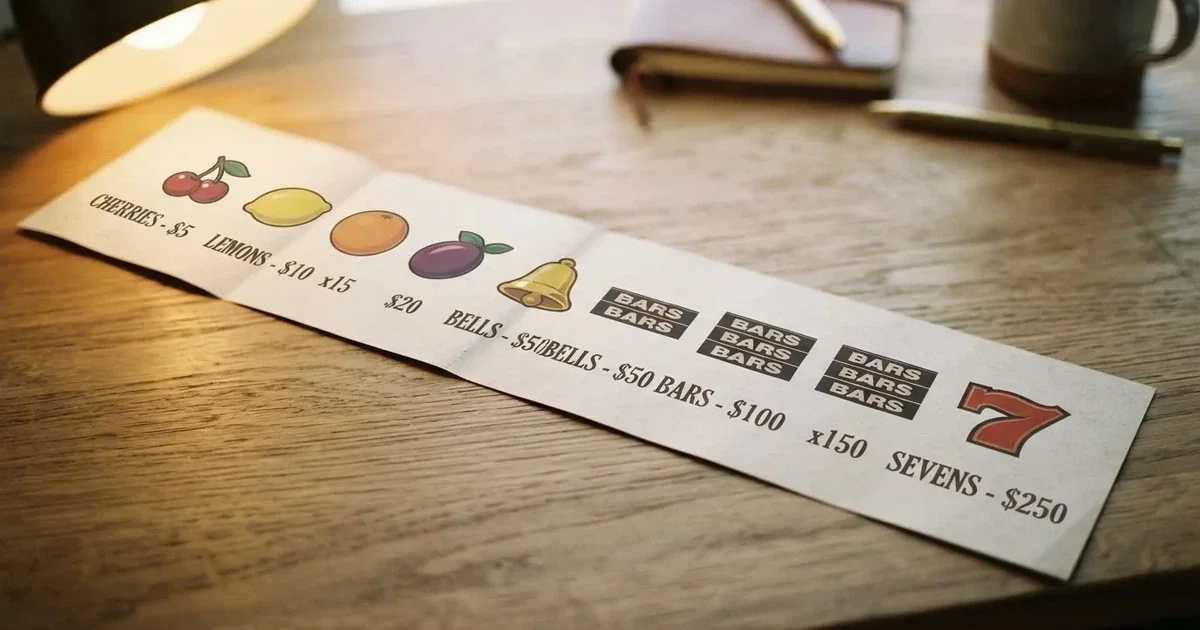
A paytable is the page inside a slot that lists what each symbol is worth, which combinations pay, and which features trigger. For a Booongo title, the layout is the studio’s house style: a stacked symbol set drawn from a single theme — Egypt, fruit, mythology, deep-sea — with a Hold and Win bonus round built around a fixed set of bonus symbols and a small number of jackpot tiers. The studio’s output after its 2021 restructuring now sits under the 3 Oaks Gaming brand; titles that have carried through into the new portfolio include Sun of Egypt 4, Coin UP: Lightning and 3 Hot Chillies.
The mechanics that matter for a reader reading a paytable are three. The return-to-player is the long-run percentage of stake the game returns to players across many spins; for most modern video slots it sits in the mid-90s. The volatility is the shape of the payout distribution — high volatility concentrates wins into rarer, larger payouts, low volatility spreads them across smaller and more frequent ones. The hit rate is the share of spins that produce any return at all, and is usually a smaller number than the RTP suggests because most returns are smaller than the stake.
A worked example is useful as a shape, not as a promise. On a slot with a 96% RTP and a 30% hit rate, three in ten spins return something, but the average size of those returns across many spins is below the stake. The expected loss on 1,000 spins at A$1 per spin is 1,000 × (1 − 0.96) = A$40, and that is what an honest paytable tells a reader before they put any money in.
The mathematical point worth holding onto is that none of these figures describes any individual spin. RTP and hit rate are averages across the long run; volatility describes the distribution around that average; the only thing that determines the result of any one spin is the random number generator behind it. The paytable is information about the game, not a forecast of what will happen on the next spin.
The eleven brands the ACMA has acted against
The list below is not a ranking. The brands are in the order the regulator’s record places them in the file, and each one is included because the ACMA itself issued a formal warning over it for offering prohibited services to Australians. The page does not recommend any of them as a place to play, and the licence claims attached to each are kept on the page only because the ACMA’s record is what gives a reader a reason to discount them.
The comparison table below sets out the brand, the ACMA action, the operator named by the ACMA in the formal warning, and whether any research source ties the brand to a Booongo subject.
| Brand | ACMA action and date | Operator named by the ACMA | Subject support |
|---|---|---|---|
| RocketPlay | Formal warning, March 2026; earlier warning to Dama N.V. covering this brand, May 2022 | Pulsup Ltd | — |
| Level Up Casino | Formal warning, May 2022 | Dama N.V. | listings-only |
| Woo Casino | Formal warning, March 2025 | Dama N.V. | — |
| Spirit Casino | Formal warning, May 2025 | Dama N.V. | — |
| National Casino | Formal warning, July 2025 | Consolutetish S.R.L. | listings-only |
| Bizzo Casino | Formal warning, July 2025; earlier warning to TechSolutions, 2022 | Consolutetish S.R.L. | — |
| Ignition Casino | Formal warning, July 2025 | Bamboo Media | — |
| Instant Casino | Formal warning, February 2025 | EOD Code SRL | — |
| Jackbit | Formal warning, April 2026 | Ryker B.V. | — |
| Casino Intense | Formal warning, April 2025 | Sterplay Holding Ltd | listings-only |
| Sky Crown | Formal warning, September 2022 | Hollycorn N.V. | — |
The “subject support” column shows whether any of the sources research draws on tie the brand to a Booongo-related subject. Where a source names the brand alongside a third-party studio or aggregator — Level Up alongside Wazdan, National Casino alongside Betsoft and Pragmatic Play, Casino Intense alongside 1spin4win and others — the link is reported as listings-only, since the source itself does not claim a direct Booongo supply. Where no such link appears in the sources research drew on, the cell carries an em dash and the brand is presented on its other fields.
A separate read on the same table: every brand on it has, at some point, been the subject of a formal warning from the ACMA. None of them can lawfully offer online casino games to a person in Australia. The Curaçao, Malta or other licence shown on the brand’s own site sits outside Australian law and gives no recourse if a withdrawal is refused.
RocketPlay
The most recent ACMA action on this brand was a formal warning in March 2026 to Pulsup Ltd over the .com.au version of the site. Dama N.V., the operator named in an earlier 2022 warning covering six brands including RocketPlay, is the same corporate family whose licence claims appear across much of the offshore market. No source research drew on ties the brand to a Booongo subject directly. For a reader who arrived here through a deposit bonus headline, the brand sits squarely in the category the ACMA’s record describes: an offshore operator running prohibited games for Australians.
Level Up Casino
A formal warning was issued in May 2022 to Dama N.V. covering six brands, of which Level Up was one. The brand shows up in a third-party studio’s listings alongside Wazdan content, which research reports as a listings-only link rather than a direct Booongo supply. The relevant comparison for a reader is that the brand is one of six pulled into the same regulator action, which means the same corporate group sits behind all of them.
Woo Casino
A formal warning to Dama N.V. in March 2025 covers this brand. The action is one of two Dama N.V. warnings the ACMA issued in 2025 — Spirit Casino is the other — and places Woo Casino on the same operator record as the other Dama brands reviewed here. Our research sources do not explicitly link this operator to the Booongo supply chain.
Spirit Casino
The companion Dama N.V. warning, issued in May 2025. The brand sits on the same operator record as Woo Casino, RocketPlay, Level Up and the rest of the May 2022 set. It does not appear in our review of Booongo-related supply lines.
National Casino
A formal warning to Consolutetish S.R.L. in July 2025. The brand shows up in research sources alongside Betsoft and Pragmatic Play content, but as a listings-only link rather than a direct Booongo supply. Consolutetish is also the operator named in the Bizzo Casino warning, which places the two brands on the same regulator record.
Bizzo Casino
The same July 2025 warning to Consolutetish S.R.L. covers this brand, and the brand was already the subject of a 2022 formal warning to TechSolutions (CY) Group Limited and TechSolutions Group N.V. Two warnings, two operators, one brand — the corporate history behind the licence claim has changed at least once since the first action. The research files provided for this guide show no direct connection to Booongo’s studios.
Ignition Casino
A formal warning to Bamboo Media in July 2025. The brand is one of two pulled into the same regulator action, the other being the National Casino and Bizzo Casino warnings issued the same month. We have found no evidence linking this brand to Booongo in the current provider datasets.
Instant Casino
A formal warning to EOD Code SRL in February 2025. This brand’s inclusion is due to its alignment with broader industry warnings, rather than any specific Booongo association. The relevant comparison is that the warning predates the 2026 blocking round but sits within the same enforcement pattern.
Jackbit
A formal warning to Ryker B.V. in April 2026. The action names Jackbit and CasinOK together as part of the same operator’s offering, without any indication of a specific supply relationship with the studio this guide covers.
Casino Intense
A formal warning to Sterplay Holding Ltd in April 2025. The brand shows up in research sources alongside 1spin4win content and broader provider lists, reported as a listings-only link rather than a direct Booongo supply.
Sky Crown
The earliest formal warning on the list, issued to Hollycorn N.V. in September 2022. The same operator is named in a companion warning over Blue Leo casino. No Booongo supply link is apparent in our research, and the brand is included here because the ACMA’s record places it on the same enforcement track as the rest of the list.
The shape of the offshore market as the ACMA measures it
Two numbers from the regulator’s own reporting frame the rest of this page. As of the ACMA’s June 2026 update, 1,751 illegal gambling and affiliate marketing websites had been blocked since the first blocking request in November 2019. More than 230 unlicensed gambling services had left the Australian market since enforcement was strengthened in 2017. The blocking round reported on the same date added twelve more names: 7Signs, ChromaBet, Donbet, Duospin, Freshbet, Slots Gem, Jacks Club, Lucky Start, Pointsbetz.com, Spinrise, Vinyl Casino and Wildsino.
H2 Gambling Capital’s 2025 estimate places Australian losses to illegal gambling sites at about A$3.9 billion a year. The same source records the share of gambling going through legal channels falling from 74% in 2021 to 64%, a drop of ten percentage points in four years. The trend is the regulator’s case for the page’s premise: the more aggressively the ACMA acts, the more aggressively the offshore market recruits Australian players.
The blocking rate implied by those figures sits at the heart of this page’s analysis. 1,751 blocked sites over the period from the first blocking request in November 2019 to the June 2026 update is roughly 80 to 90 months of enforcement, depending on how the start and end months are counted. That is a blocking rate of around 20 sites per month over the life of the regime, or roughly 240 per year. The figure is not precise — blocking rounds are reported in batches rather than continuously, and the early years carried a smaller monthly average than the post-2024 period — but the band gives a reader the right sense of the pace. By the time the next round lands, the running total will already have moved on.
The legal frame behind every warning on this list
The Interactive Gambling Act 2001, as strengthened by the Interactive Gambling Amendment Act 2017, makes it an offence to provide online casino games, online pokies or in-play betting to a person in Australia. No state or territory issues a licence for these services; what is licensable is wagering on races and sport placed before the event, lotteries and keno. In practice, online wagering is licensed by the Northern Territory Racing and Wagering Commission, which regulates 52 of Australia’s online bookmakers — Sportsbet, Bet365 and Ladbrokes among them — and runs with no full-time staff, meeting once a month in Darwin.
Enforcement sits with the ACMA. Its tools are investigation, formal warnings to operators, and directions to Australian internet service providers to block illegal sites. The individual player is not prosecuted under the IGA — the law targets the provider — but a player on an offshore site has no Australian consumer protection, no complaints body and no recourse if a withdrawal is refused, and the site can be blocked with a balance still on it.
The 2026 reform landscape adds one more date worth knowing. The Interactive Gambling Amendment (Gambling Reform) Bill 2026 passed Parliament on 19 August 2026; its advertising and inducement measures commence on 1 January 2027. That is a law with a start date, not yet in force on a 2026 page, and a reader reading this in 2027 will see those measures already active.
A practical note on payments and tax sits beside the legal frame. Since 11 June 2024, credit cards, credit-related products and digital currency have been banned as payment for licensed online wagering, with penalties of up to A$247,500 for operators that take them. A site asking an Australian for a credit card or a crypto deposit is, again, not on the licensed side. Gambling winnings of a recreational player are not assessable income under section 6-5 of the ITAA 1997, and losses are not deductible, unless the person carries on a business of gambling — the model answer is “check with the ATO”.
Where to turn if the picture starts to feel like a problem
Australian help is free, confidential and runs around the clock. Gambling Help Online carries the chat service and the National Gambling Helpline on 1800 858 858 is free from any Australian phone. BetStop, the National Self-Exclusion Register, has been live since August 2023 and binds Australian-licensed online and phone wagering services — an offshore casino is not connected to it, which is part of why the ACMA’s enforcement and a reader’s self-exclusion are not substitutes for each other.
What a reader comparing options can usefully take from this shelf is small and clear. BetStop covers the licensed side of the market. An offshore casino is not on that side, so registering on BetStop will not stop a balance being placed on one of the brands reviewed above. The helpline and the chat service cover both, and a reader who is comparing options because gambling has started to feel like a problem has, in those two services, a single front door that does.
What a fair comparison of these brands would weigh
A comparison that excluded the regulatory frame would describe a feature set rather than a market. The features — a welcome package, a free spins bundle, a mobile-friendly interface — are common across the eleven brands on the regulator’s list, and the differences between them are smaller than the differences between any of them and a licensed Australian wagering service.
The weighting a fair comparison gives to each feature is therefore the question that matters. A 100% match on the first deposit looks the same on every brand; the wagering multiple, the weighting table and the max-cashout cap change the picture. A 200-spin free bundle looks the same on every brand; the stake value, the eligible title and the cap on what can be withdrawn change the picture. A mobile-friendly interface looks the same on every brand; whether the operator has a regulator record in the reader’s jurisdiction changes the picture more than the others combined.
The honest version of that comparison, for a reader in Australia, is that the brand-on-brand differences are inside a market the regulator has, in each case, already addressed. The choice is not between RocketPlay’s welcome package and Woo Casino’s free spins. It is between the offshore market as a whole and the licensed side, and the legal frame described in the section above is what gives that choice its weight.
Booongo, 3 Oaks and the studio behind the slots
Booongo’s 2021 restructuring produced a regulated-market brand, 3 Oaks Gaming, that holds a remote operating licence from the UK Gambling Commission granted on 9 February 2024 under licence number 063055-R-338209-005. The company operates under Green Rock Ltd from Douglas on the Isle of Man. Following the UK licence, the UK Gambling Commission certified more than 50 of 3 Oaks Gaming’s slot titles, including 3 Pots of Egypt, Storm of Olympus, 777 Fruity Classic and Hawaii Riches.
On 4 August 2025, 3 Oaks Gaming received a recognition notice from the Malta Gaming Authority, letting it offer titles such as Sun of Egypt 4, Coin UP: Lightning and 3 Hot Chillies to MGA-licensed operators. Earlier approvals cover the UK, Portugal and Romania. The point is not the licence list but what it tells a reader about where the studio’s titles are sold: in regulated markets, not in Australia. The marketing on an offshore site that highlights Booongo is highlighting a studio whose regulated distribution does not, at the time of writing, include Australia.
The wider provider landscape around Booongo gives the comparison extra context. Aristocrat Leisure, the Australian gambling-machine manufacturer, is described as the largest gambling-machine manufacturer in Australia and the second-largest slot-machine manufacturer worldwide behind International Game Technology. Its online arms, Product Madness and Aristocrat Interactive, run out of Sydney’s North Ryde. Aristocrat reported 2025 revenue of A$6.30 billion. The studio behind the slots this page is about is, by Australian industry standards, a smaller and more internationally distributed operation than the local one most readers have heard of.
Two other providers show up in the sources research drew on, and their profiles are worth knowing for what they tell a reader about the supplier side of the offshore market. Betsoft, founded in 2006, describes a catalogue of more than 200 RNG games; published RTPs include 96.22% on Good Girl Bad Girl 2 with “Very High” volatility and a 15.59% hit rate, and 95.69% on The Slotfather with “Medium” volatility. BGaming’s team has worked on games since 2012 and the brand debuted in 2018 with more than 250 certified games; it holds a Malta Gaming Authority Critical Gaming Supply Licence (MGA/B2B/785/2020) for Type 1 B2B gaming services, issued 18 March 2021. 1spin4win, founded in 2021, reports a portfolio of more than 190 online slots, more than 1,000 partnerships with online casinos and aggregators, and total bet sum growth of 46% in the first half of 2025 against the same period in 2024.
Where this leaves a reader comparing options
The shape of the landscape this page describes is not a set of choices. It is one choice, framed by the Interactive Gambling Act 2001 and the ACMA’s enforcement record, and eleven brands the regulator has acted against sit on one side of it. A reader comparing welcome packages or free spin bundles between those brands is comparing features inside a category whose legal status in Australia the regulator has, in each case, formally recorded.
The analysis on this page is the ACMA’s running total and the rate at which it grows. 1,751 blocked sites since November 2019, with more than 230 unlicensed services having left the Australian market since 2017, gives a reader a rate of enforcement rather than a single number. The bands implied by those figures — roughly 20 blocked sites per month over the life of the regime, accelerating in the post-2024 period — are what a reader takes away when they close the tab. The marketing headlines do not survive that arithmetic.
A reader who arrived on this page through a deposit bonus or free spins headline is, in the strict sense the regulator uses, the customer the offshore market is built for. The right answer to the question they were searching is the one the Interactive Gambling Act 2001 has given since 2017: not here. The licensed side of the Australian market — racing, sport, lotteries, keno — is what survives that filter, and the rest of this page describes what sits outside it.
Frequently Asked Questions
Is Booongo itself an operator or just a studio that supplies content to sites?
Booongo is a game studio. After its 2021 restructuring, the regulated-market brand is 3 Oaks Gaming, which holds a UK Gambling Commission remote operating licence granted on 9 February 2024 and a Malta Gaming Authority recognition notice from August 2025. Booongo does not run a casino of its own; it licenses its titles to operators, including offshore sites.
Can Booongo titles be played for real money at any licensed Australian casino?
No. The Interactive Gambling Act 2001 prohibits online casino games and online pokies in Australia, and no state or territory issues a licence for them. A licensed Australian wagering service offers racing, sport, lotteries and keno, not online casino games of any studio.
How does a Booongo slot typically differ from other studios’ games in its paytable?
The studio’s house style runs themed symbol sets with a Hold and Win bonus round and a small number of jackpot tiers. Modern video slots across most studios share a comparable structure; the differences are in theme, volatility and feature design rather than in the basic paytable layout. An RTP in the mid-90s and a hit rate below 30% are typical.
Does Booongo operate its own casino or license its games to other operators?
Booongo licenses its games to other operators. The studio’s regulated-market output sits under 3 Oaks Gaming, which is licensed to supply titles to UK and MGA-licensed operators. The offshore sites reviewed on this page are operators that have licensed Booongo or 3 Oaks titles among other studios’ content.
Why do offshore casinos highlight Booongo as a selling point to Australian visitors?
The studio’s name carries weight with players who recognise it, and the marketing copy translates that recognition into a deposit or a spin. Highlighting a recognisable studio is a recruiting tool, and the offshore market’s recruitment of Australian players is what the ACMA’s enforcement is directed against. The studio’s own regulated distribution does not include Australia.
Is it legal for a site to offer Booongo games for real money to people in Australia?
No. The Interactive Gambling Act 2001, as amended in 2017, makes it an offence to provide online casino games — including those of any studio, Booongo or otherwise — to a person physically in Australia. The provider is the target of the law, not the player, but a player on an offshore site has no Australian consumer protection and no recourse if a withdrawal is refused.