
Where New Online Pokies Stand for Australians in 2026
Current as of 29 October 2026 and verified against the Australian Communications and Media Authority’s published enforcement record.
A shortlist of the “best new online pokies” reads as a normal ask in Australia, and the marketing pages answer it as if it were one. It is not. The Interactive Gambling Act 2001, as amended in 2017, makes it an offence to provide online casino games — including online pokies — to anyone physically in Australia. No state or territory issues a licence for it. The brands that pitch themselves at Australian players with “new releases” and deposit bonuses do so from offshore, under licences that mean nothing in this country.
It is the honest reckoning of that gap. What follows lays out what is actually lawful — licensed clubs, casinos and the Northern Territory’s pre-event wagering market — and names the eleven brands the ACMA itself has warned over offering the prohibited product. The arithmetic is plain. The marketing is not.
Table of Contents
- The Paytable Shortlist of New Online Pokies Offered to Australians
- Pokies Fundamentals for the Australian Reader
- The Prohibition That Shapes This Market
- Responsible Gambling Tools That Actually Bind
- How Money Moves: PayID, Cards and the Deposit Rules
- The Games Behind the New Pokies Names
- Operator Write-ups: Each Brand on the ACMA’s Record
- The Block Rate: How Fast the ACMA Is Closing Sites
- Frequently Asked Questions
The Paytable Shortlist of New Online Pokies Offered to Australians
Eleven brands sit on the ACMA’s published record of formal warnings for offering prohibited interactive gambling services to people in Australia. None carries an Australian licence for online casino games. The table below is a snapshot of that record, not a recommendation. The column on the right tells the reader what other public listings actually say about each brand’s relationship to new-pokies content.
| Brand | ACMA action and date | Operator named by the ACMA | Subject support |
|---|---|---|---|
| RocketPlay | Formal warning, March 2026 (Pulsup Ltd); earlier Dama N.V., May 2022 | Pulsup Ltd; Dama N.V. | — |
| Level Up Casino | Formal warning, May 2022 | Dama N.V. | Listed on BGaming’s site as a partner casino |
| Woo Casino | Formal warning, March 2025 | Dama N.V. | — |
| Spirit Casino | Formal warning, May 2025 | Dama N.V. | — |
| National Casino | Formal warning, July 2025 | Consolutetish S.R.L. | Listed on Wikipedia’s coverage of gambling in Australia |
| Bizzo Casino | Formal warning, July 2025; earlier TechSolutions, 2022 | Consolutetish S.R.L.; TechSolutions Group | — |
| Ignition Casino | Formal warning, July 2025 | Bamboo Media | — |
| Instant Casino | Formal warning, February 2025 | EOD Code SRL | — |
| Jackbit | Formal warning, April 2026 | Ryker B.V. | — |
| Casino Intense | Formal warning, April 2025 | Sterplay Holding Ltd | Listed across ABC News, the ACMA register and Crown Melbourne coverage |
| Sky Crown | Formal warning, September 2022 | Hollycorn N.V. | — |
A dash in the right-hand column means research did not confirm what the brand specifically says about new-pokies content from a source independent of the brand’s own marketing. The columns read as they do because the only honest answer to “what does this brand say about new pokies?” comes from pages the brand itself controls — and those are the very pages the ACMA has found to be offering a prohibited service to Australians.
The pattern that jumps off the page is how concentrated the warnings are. Dama N.V. alone sits behind four of the eleven brands. Consolutetish S.R.L. sits behind two more. Two operators — RocketPlay and Bizzo Casino — were warned twice, by different owners, which is the kind of repeat action that tells an Australian reader an offshore corporate structure does not change the legal picture.
The “subject support” column deserves a second read. Where a dash appears, no independent listing was confirmed. Where a name appears, it names the listing — not an endorsement. “Listed on BGaming’s site” is a developer-partner-page reference. “Listed on Wikipedia’s coverage” is an encyclopaedia reference. “Listed across ABC News, the ACMA register and Crown Melbourne coverage” is cross-source. None of those listings are Australian-licence listings. The distinction is the point.
Pokies Fundamentals for the Australian Reader
The word “pokies” is Australian shorthand for poker machines, and it covers both the land-based gaming machines in pubs and clubs and their online cousins. A “new” pokie, in the marketing sense, is a freshly released title — a follow-up to an established series, a new mechanic, a new branded tie-in. Operators market these releases as if “new” were a quality claim. It is a recency claim. Some new titles are generous; some are not. Recency tells the player nothing about the long-term return they will see.

The two numbers every player should understand are return-to-player and house edge. Return-to-player, written as a percentage, is the share of money wagered that a game pays back over a very large number of spins — usually millions. House edge is the inverse: the percentage the house keeps. A 96% RTP is a 4% house edge. These numbers are long-run averages, not promises for any individual session. A player who runs ten spins of a 96% RTP game has not been promised anything; the 96% is what millions of spins average to.
For the Australian market specifically, the minimum legal RTP for land-based poker machines is set state by state. New South Wales, the Northern Territory and Queensland set 85%. The Australian Capital Territory and Tasmania set 87%. South Australia sets 87.5%. Western Australia sets 90% — and only at the state’s single casino, Crown Perth. Victoria’s floor is generally 85%, with Crown Melbourne licensed at 87%. Those numbers apply to machines on licensed floors. Online pokies, by definition, do not operate under any of those floors.
No honest write-up can hand a reader a list of “the best new online pokies for Australians” and treat that list as a recommendation. The product being sold is one Australian law prohibits. The honest move is to point to the licensed alternatives — clubs, casinos and pre-event wagering — and to name the eleven offshore brands that have been formally warned for offering the prohibited product anyway.
The mechanics of how pokies work are not exotic. A spin is independent of the one before it. Bonus features — free spins, hold-and-spin, cascading reels — change the texture of a session but not the long-run return. A high-volatility game pays out less often, in larger amounts. A low-volatility game pays out more often, in smaller amounts. Both return the same long-run percentage to a player who runs enough spins. The marketing word for a high-volatility game is usually “exciting” or “explosive”; the marketing word for low-volatility is usually “relaxed” or “steady”. Neither word tells the player what they will actually win, because neither volatility profile promises a win at all.
A useful exercise: any new pokie’s paytable is published by the developer. If the paytable does not state an RTP, the player is being asked to take the operator’s word for the long-run return. Offshore operators that the ACMA has warned for offering prohibited services to Australians are the operators least likely to be transparent about which titles they actually run, at which stakes, under which test certificates.
For an Australian reader the practical question is whether the new pokies title exists at all on an Australian-licensed floor. Many do — Crown Melbourne and Crown Perth run hundreds of machines each, and the larger clubs and pubs cycle through releases from the major manufacturers. The licensed-floor version is the version with a state-level minimum RTP and an approved game ruleset behind it. The offshore homepage version is the version without either.
The Prohibition That Shapes This Market
The framework is short and it is firm. The Interactive Gambling Act 2001 (IGA) makes it an offence to provide certain interactive gambling services to customers physically in Australia. The Interactive Gambling Amendment Act 2017 strengthened that framework, expanded the prohibited service list and gave the Australian Communications and Media Authority (ACMA) the powers it now uses — formal warnings, infringement notices, and the ability to ask Australian internet service providers to block illegal sites.
What is prohibited is the provision of online casino games, online pokies and in-play betting to a person in Australia. What remains lawful is wagering on races and sport placed before the event, lotteries and keno. In practice, the bulk of online wagering is licensed in the Northern Territory through the Northern Territory Racing and Wagering Commission, which regulates 52 online bookmakers including Sportsbet, Bet365 and Ladbrokes — and which, as the ABC reported in April 2026, has no full-time staff and meets once a month in Darwin.
No state or territory issues an Australian licence for online casino games. An offshore licence — Curaçao, Anjouan, the Kahnawake Mohawk Territory, the Isle of Man — does not change the picture for an Australian player. The IGA targets the provider, not the player, which is why no individual Australian has been prosecuted for using one of these sites. The legal risk sits with the operator offering the service from offshore to a person in Australia. The protection gap sits with the player.
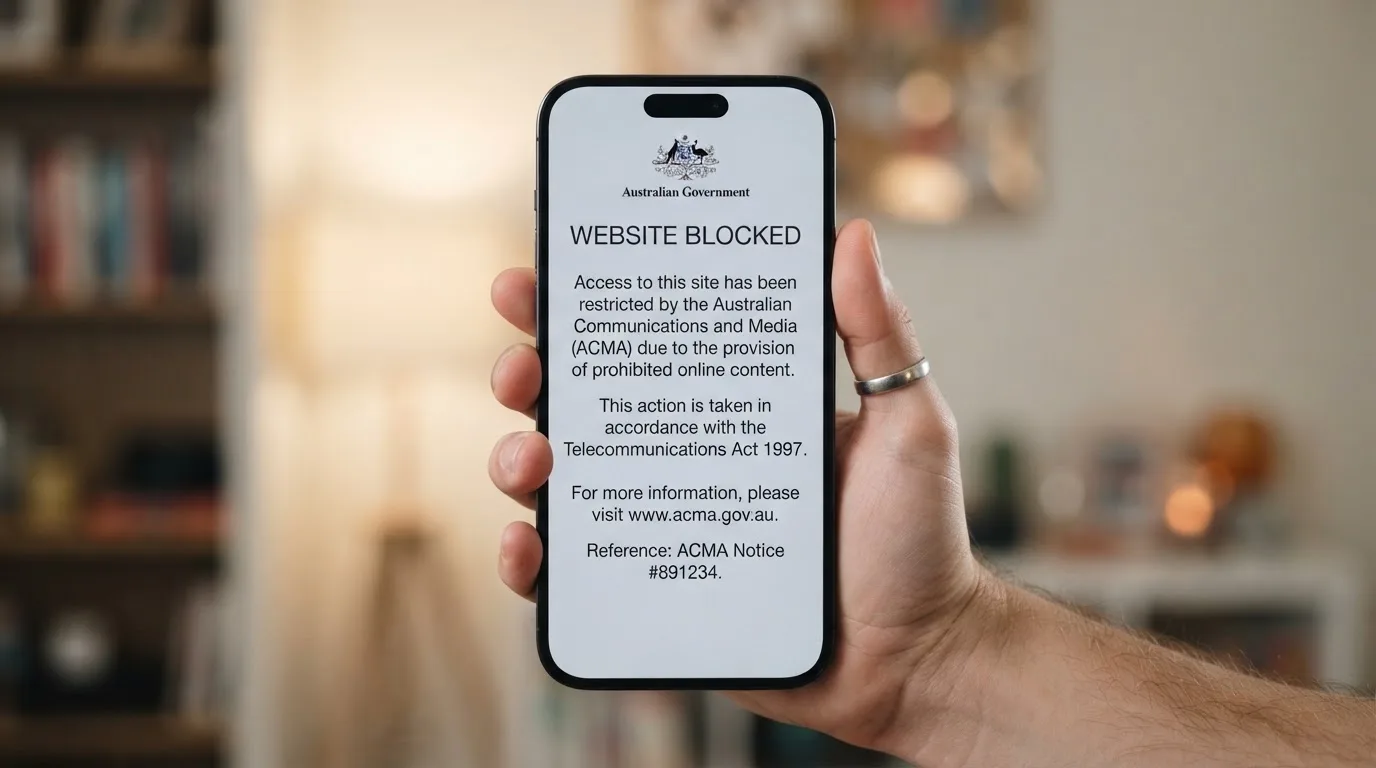
The ACMA’s published record is the empirical picture. As of the round reported in June 2026, the ACMA had asked Australian ISPs to block 1,751 illegal gambling and affiliate websites since the first blocking request in November 2019. More than 230 unlicensed gambling services had left the Australian market since enforcement was strengthened in 2017. In the June 2026 round alone, the ACMA asked ISPs to block twelve more: 7Signs, ChromaBet, Donbet, Duospin, Freshbet, Slots Gem, Jacks Club, Lucky Start, Pointsbetz, Spinrise, Vinyl Casino and Wildsino.
The cost of this trade sits with the player, not the operator. An offshore casino gives no Australian consumer protection, no complaints body with jurisdiction, and no recourse if a withdrawal is refused. The site can be blocked with a balance still on it. The ACMA estimates — citing H2 Gambling Capital’s 2025 report — that Australians lose about A$3.9 billion a year to illegal gambling sites, and that the share of gambling going through legal channels fell from 74% in 2021 to 64%. The phrase “legal channels” is doing real work in that sentence; the 10-point drop is the offshore market growing faster than the regulator can chase it.
The reform agenda is real but not yet in force. The Interactive Gambling Amendment (Gambling Reform) Bill 2026 passed Parliament on 19 August 2026; its advertising and inducement measures commence 1 January 2027. A page read before that date is reading law with a known future start date, not law already operating. The ban itself is operating now. The advertising and inducement rules are the next move, not the current one.
What this means for a reader choosing between the offshore brands in the shortlist and the licensed alternatives is not a question of taste. It is a question of what protections attach. A pre-event wager on Sportsbet sits under Australian consumer law and under BetStop. A spin on an offshore “new pokies” site sits under neither, and the site’s terms are whatever its Curaçao or Anjouan licence requires the operator to provide.
The minimum age for any Australian-licensed gambling product is 18. Offshore operators set their own age floors — most use 18 — but they do not have an Australian-regulator mechanism to enforce them. The offshore operator’s age check is what the offshore operator’s payment processor and KYC vendor decide to do. The Australian-licensed operator’s age check is the regulator’s audit item.
On tax, gambling winnings of a recreational player are not assessable income under section 6-5 of the ITAA 1997 and losses are not deductible, unless the person carries on a business of gambling — a model only, not a general rule. The ATO is the right place for a player with a complicated position. The short version is: a recreational punter’s pokie win is not taxable, but it is also not protected by any consumer framework if the offshore operator declines to pay.
The Tasmania story is worth its own paragraph. Tasmania’s monopoly licence over all of the state’s poker machines was held by the Federal Group from 1968 until legislation in November 2021 ended it, moving oversight to the Tasmanian Liquor and Gaming Commission. Tasmania then planned nation-leading mandatory pre-commitment cards for its poker machines, but implementation was delayed until late 2025. The state that ended a monopoly in 2021 is the state that wrote the country’s strongest pre-commitment policy, and the same state is the one that ran late on rolling it out. Federalism has costs; the Tasmania example is the picture of them.
Responsible Gambling Tools That Actually Bind
The player-protection tools that bind an offshore casino offering prohibited services to Australians are the ones the offshore operator chooses to mirror. The tools that bind the Australian-licensed market are statutorily required. The two systems do not connect.
BetStop — the National Self-Exclusion Register — went live in August 2023 and covers all Australian-licensed online and phone wagering services. A player who registers with BetStop is excluded from those services for a chosen period, from three months up to a permanent exclusion. The register binds Sportsbet, Bet365, Ladbrokes, the NT-licensed bookmakers and every other holder of an Australian wagering licence. It does not bind an offshore casino offering prohibited services to Australians, because that casino is not licensed in Australia and has no obligation to consult the register.
Pre-commitment is the other statutorily-required tool, and it has had a harder road. Tasmania planned nation-leading mandatory pre-commitment cards for its poker machines, with implementation delayed until late 2025. A pre-commitment card is a plastic card a player inserts into a machine before play; the card sets a daily, weekly or monthly limit and the machine enforces it. Tasmania’s plan was, as of July 2024, the strongest in the country. The delay was the implementation issue, not the policy commitment.
State-level support is real but uneven. New South Wales had 87,298 gaming machines outside casinos across 2,195 venues as of June 2023, with player losses of A$8.18 billion in 2022-23. Queensland had 21,122 machines across 351 venues in October 2023. Victoria had 26,380 machines outside Crown Casino across 488 venues in 2021-22 under a statewide cap of 30,000. Western Australia’s pub and club floors carry no machines at all — that ban dates to 1985, when Crown Perth opened, and Crown Perth’s own machine count has since grown from about 200 in 1985 to roughly 2,500, all approved by the state’s Gaming and Wagering Commission. The geography of legal pokies in Australia is the geography of pub carpet and the casino floor, not the offshore homepage.
Registered clubs operated Australia’s first legal poker machines from 1956, in New South Wales. That history is what gives NSW its current floor of 87,298 machines — seventy years of licensed clubs with pokies, accumulating since the first installation. Tasmania’s separate 1968 monopoly arrangement only ended in 2021. These are not interchangeable policy decisions; they are different state histories that left different machine densities behind them.
The 24-hour help line is the National Gambling Helpline on 1800 858 858, free, with chat available through Gambling Help Online. For a reader who has reached this page looking for new online pokies and who is reading it from Australia, the line is one call and it answers. The line is not a marketing channel and it does not pitch.
What offshore operators offer by way of “responsible gambling” varies. Some run their own self-exclusion lists. Some link to GamCare or Gambling Therapy. None of those lists interact with BetStop. None of them are statutorily required. None of them cover a balance the operator is holding when the player decides to stop. The limit on what those tools do is the limit on what an offshore licence requires.
The pattern, for an Australian player who decides they want help, is straightforward. Call 1800 858 858, register with BetStop if the issue is online wagering, and use the licensed-venue self-exclusion schemes for the pubs and clubs. None of those steps touch the offshore casino’s internal list. That is by design. The offshore operator is not part of the Australian system, and the Australian system does not pretend it is.
How Money Moves: PayID, Cards and the Deposit Rules
For an Australian-licensed wagering service, the deposit rules are specific and tight. Credit cards, credit-related products and digital currency have been banned as payment for licensed online wagering since 11 June 2024, with penalties of up to A$247,500 for operators that breach. What remains lawful for an Australian-licensed wagering service is debit card, bank transfer, PayID/Osko and BPAY. A licensed wagering site asking an Australian for a credit card or a crypto deposit is operating outside the Australian rules.
PayID is the Australian instant-payment addressing layer that sits on top of the New Payments Platform (NPP) and is settled through Osko. A PayID is a recognisable address — a phone number, an email, an ABN — linked to a bank account. The transfer is initiated by the address, settled near-instantly through Osko, and the receiving account sees the funds within seconds. BPAY is the older bill-payment system, settled through BECS, with same-day or next-day arrival. Both are legal deposit routes for Australian-licensed wagering.
What “new PayID pokies” actually means in the marketing pages is that the offshore casino accepts a PayID deposit and routes it through to its own operating account. The convenience for the player is real — the deposit lands in seconds — but the protection is not. A PayID deposit to an Australian-licensed wagering service sits under Australian consumer law. A PayID deposit to an offshore casino offering prohibited services to Australians sits under the offshore casino’s terms, the offshore payment processor’s terms, and the offshore licence’s dispute mechanism. None of those are Australian.
The offshore side has its own payment layer. Most of the eleven brands in the shortlist accept cards, e-wallets and a long tail of cryptocurrencies. Some accept PayID. The deposit lands in minutes; the withdrawal is the part that takes the time, and it is the part the offshore operator controls. An Australian-licensed bookmaker’s withdrawal is bound by Australian ePayments Code timings and the operator’s own published payout schedule. An offshore casino’s withdrawal is whatever its terms say it is, and the player has limited Australian-law recourse if the operator declines, delays or quietly closes the account.
The minimum-deposit arithmetic on an offshore site is its own trap. A welcome offer may promise a 100% match up to a headline figure with a deposit floor well below that figure. The wagering requirement is the cost the player pays for the bonus; on a typical offshore pokies offer it runs from 35x to 50x the bonus amount, with a per-spin cap and a list of games that contribute less than 100% of stake to clearing. None of those terms is illegal under Australian law — the IGA targets the provider, not the player — but the marketing page that delivers them is the same page that the ACMA has found to be offering a prohibited service. The “free spins” line in the offer is the one most worth reading twice; the per-spin cap is usually the clause that decides whether the bonus is actually winnable.
The same arithmetic plays out the other way on the licensed side. The minimum deposit on a Sportsbet or Bet365 account is set by the licensed operator, paid through a PayID transfer that lands in seconds, and any bonus the player claims sits under Australian consumer law and the operator’s licence conditions. The deposit speed is comparable; the protection is not.
For a player who runs into a dispute, the comparison is starker. An Australian-licensed operator is answerable to an Australian dispute resolution scheme and, ultimately, to the regulator. An offshore casino offering prohibited services to Australians is answerable to its own complaints process and the body that issued its offshore licence. Neither of those is a process an Australian player can hand to a regulator.
The credit card ban is worth a final note. Banning credit cards as a deposit route is a recognition that credit-funded gambling is debt-funded gambling, and that an Australian-licensed operator should not be running the player a line of credit. The offshore casino that still takes credit cards is doing exactly that, and the player is the one paying the interest.
The Games Behind the New Pokies Names
The titles that the offshore casinos market as “new online pokies” are not new in any Australian-legal sense. They are new releases from offshore developers and shipped globally. The same titles appear on dozens of offshore sites. The novelty is the title’s release date, not the player’s access to it, and access from Australia sits outside the IGA regardless of when the title was first certified.
Two specific games sit behind a large share of the offshore marketing, and both are useful illustrations of what the marketing does not say. Baccarat and blackjack are the two table games most often pitched at “new pokies” readers, even though neither is a pokie. The ACMA’s record does not turn on whether the brand markets pokies, table games or both; it turns on the provision of an online casino game to a person in Australia. A brand cannot escape a warning by relabelling its product.
Baccarat, in its punto banco form, is the variant most often played. Hand totals are taken modulo 10 — cards 2 through 9 at face value, ten and the face cards at zero, aces at one. The casino banks both hands and plays them out by fixed drawing rules. The house edge is 1.06% on the Banker bet, 1.24% on the Player bet and 14.36% on the Tie. The Tie bet is the one the marketing copy sometimes calls “exciting”; the marketing copy does not mention that it loses 14.36 cents of every dollar on average. The Tie bet is the figure that earns the marketing word its deflation.
Blackjack, played with optimal basic strategy, has a house edge of about 0.28% under liberal Las Vegas Strip rules and 0.43% under Atlantic City rules. Both games have variants — Spanish 21 played without 10s, Double Exposure with both dealer cards up, Blackjack Switch with cards swapable between two hands, Super Fun 21 with up to four splits — and the variants change the house edge by moving rule subtleties. A 0.28% house edge is not a “0% house edge”, and the marketing pages that frame blackjack as a “beat the dealer” challenge do not always say which rule set the offshore version is running.
The history is the part the marketing never tells you. Baccarat’s origins are disputed — some accounts place it in 19th-century France, others point to Italy at the end of the 15th century during the reign of King Charles VIII, with writer David Parlett considering the game Macao its immediate precursor. Punto banco was developed in Havana in the 1940s. The player-side alternative, chemin de fer — French for “railway” — emerged from baccarat banque in the late 19th century and is named for being quicker to play than the original game. Blackjack’s predecessor is the English game vingt-un; a related game, veintiuno, appears in Miguel de Cervantes’ Rinconete y Cortadillo, written around 1601-02, and formal rules were published in Britain in 1800. The name “blackjack” came in around 1899, with prospectors during the Klondike Gold Rush of 1896-99 credited with the modern label.
What Australian players can play legally is baccarat and blackjack at the land-based casinos — Crown Melbourne runs three baccarat variants, Traditional Baccarat, Crown Baccarat and 2-to-1 Baccarat, all approved by the Victorian Gambling and Casino Control Commission, which replaced the VCGLR as Victoria’s casino regulator on 1 July 2022. Under section 66 of the NSW Casino Control Act 1992, a casino operator must not permit a game such as baccarat to be played unless the game and its rules are approved by the regulator, and the operator must make a copy of the approved rules available to patrons on request. The legal version is the version with approved rules and a regulator behind it. The offshore “new pokies” version is the version without either.
The same licensed-versus-offshore split holds for the slot games themselves. Australian-licensed floors run approved games with a published RTP and a state-by-state floor. Offshore “new pokies” titles run under whatever test certificate the developer publishes, with no Australian regulator to check the math. The title may be identical to one on a licensed floor elsewhere; the protection is not.
For the player trying to evaluate any new pokie title, the licensed version gives them the paytable, the RTP and the regulator’s audit trail. The offshore version gives them the marketing page. The two are not interchangeable, and the comparison a player needs to make is between what they get to verify and what they are being asked to take on trust.
Operator Write-ups: Each Brand on the ACMA’s Record
Each of the eleven brands below is on the ACMA’s published record of formal warnings for offering prohibited interactive gambling services to people in Australia. The brands are presented in the order the ACMA record appears in, not in any ranking. None carries an Australian licence for online casino games. The verdict at the end of each write-up is the read of what the warning means for an Australian reader.
RocketPlay: Two Warnings, One Brand
The ACMA warned Pulsup Ltd over Rocketplay in March 2026 — and Dama N.V. over the same brand, with five others, back in May 2022. Two formal warnings, four years apart, to two different corporate parents, for the same Australian-facing product. The brand’s only stable feature is the URL; the entity behind it has changed. The verdict for an Australian player is that a brand’s continuity is the marketing, not the protection. The protection is the licence, and there is no Australian one to inherit.
Level Up Casino: The 2022 Dama N.V. Cohort
Level Up was one of six brands named in the ACMA’s May 2022 warning to Dama N.V. — alongside Bambet, Dazard, Rocketplay, Wild Tornado and Cobra Casinos. BGaming’s own website lists Level Up as a partner casino, which is what the available developer-side listings show; on its own it does not establish the brand’s legal status in Australia. The verdict is that a brand can sit on a developer’s partner page and still be the subject of an ACMA formal warning. The two facts coexist, and the ACMA fact is the one that matters for an Australian reader.
Woo Casino: A March 2025 Warning
The ACMA warned Dama N.V. over Woo Casino in March 2025, part of a separate round from the 2022 cohort. Woo Casino does not appear on the partner pages the available sources list for new-pokies content, which is a thin claim either way. The verdict is that the warning is current, the brand is on the ACMA’s record, and the marketing copy telling an Australian player to “join now” sits behind that record. The marketing word “new” does less work here than the regulator’s date stamp.
Spirit Casino: A May 2025 Warning
The ACMA warned Dama N.V. over Spirit Casino in May 2025. The brand is recent in the ACMA’s published record. The verdict is that a current ACMA warning and a current marketing pitch aimed at Australian players are not contradictions — they are the same finding, looked at from the regulator’s side and the operator’s side. The closer the dates sit, the more clearly that reads.
National Casino: The Consolutetish S.R.L. Roster
The ACMA warned Consolutetish S.R.L. over National Casino in July 2025, alongside Bizzo Casino. Wikipedia’s coverage of gambling in Australia lists National Casino among the operators discussed, which is what the available encyclopaedia coverage names. The verdict is that being discussed in an encyclopaedia is not the same as being licensed under Australian law. National Casino is on the ACMA’s record; the rest is positioning.
Bizzo Casino: Warned Twice, by Two Different Owners
Bizzo Casino sits on the ACMA’s record twice — once in 2022, when TechSolutions (CY) Group Limited and TechSolutions Group N.V. were the named operators, and again in July 2025, when Consolutetish S.R.L. took the formal warning. Two warnings, two corporate parents, the same product aimed at Australian players. The verdict is that a brand warning does not travel with a brand sale. An Australian player arriving at the site today sees a marketing page; the ACMA’s record shows the same URL twice, in two different corporate hands. The continuity the player sees in the homepage is the continuity the regulator saw across two separate enforcement rounds.
Ignition Casino: Bamboo Media’s Only Brand on This List
The ACMA warned Bamboo Media over Ignition Casino in July 2025. The brand is the only one on this shortlist with Bamboo Media as the named operator. The verdict is that the size of the offshore portfolio is not the size of the protection. One brand on the ACMA’s list or eleven, the Australian licence is still absent. A single-brand operator is not safer than a multi-brand one; both are outside the Australian system.
Instant Casino: A February 2025 Warning
The ACMA warned EOD Code SRL over Instant Casino in February 2025. Instant Casino is the most recently-named brand in the ACMA’s record before the April 2025 round. The verdict is the same shape as the other 2025 warnings: a formal finding, no Australian licence, and the marketing message that prompted the warning still running. The brand is recent in the regulator’s record; that is its distinguishing feature, and it does not work in the player’s favour.
Jackbit: Paired With CasinOK
The ACMA warned Ryker B.V. in April 2026 over Jackbit and CasinOK in the same notice. Two brands, one operator, one warning — the most recent Ryker B.V. entry on the ACMA’s record. The verdict is that a paired warning is no softer than a single-brand warning. The IGA does not grade warnings by portfolio size; it grades them by whether the service is being offered to a person in Australia. CasinOK did not appear in the shortlist because research did not return an independent listing of new-pokies content for it, but the warning it shares with Jackbit is the same warning.
Casino Intense: The Sterplay Holding Brand
The ACMA warned Sterplay Holding Ltd over Casino Intense in April 2025. ABC News coverage, the ACMA register and Crown Melbourne’s own site all reference Casino Intense in different contexts, which is what the available cross-source listings show. The verdict is that cross-source coverage is not the same as Australian-licence coverage. A brand can be referenced in news, regulator and casino-industry sources and still be the subject of a formal warning for offering prohibited services in Australia. The presence of a brand in a regulator’s news feed does not imply endorsement; it implies enforcement.
Sky Crown: One of Hollycorn N.V.’s Two Warnings
The ACMA warned Hollycorn N.V. over Sky Crown and Blue Leo in the same notice, published in September 2022. The pair is the longest-standing Dama N.V. / Hollycorn N.V. cohort on this list. The verdict is that a 2022 warning is still a warning. The ACMA’s record does not expire. The marketing page that prompted it is still aimed at Australian players, and the four years between the warning and now have not changed what the warning says.
The Block Rate: How Fast the ACMA Is Closing Sites
The ACMA’s enforcement record gives the reader a working number. Since the first blocking request in November 2019, the ACMA has asked Australian internet service providers to block 1,751 illegal gambling and affiliate websites. The period from November 2019 to the June 2026 report is roughly 79 months, which puts the average at about 22 blocked domains a month — a band of 22 to 23 per month, depending on whether November 2019 is counted from the first blocking request’s effective date or from the first day of the month.
Over a full year, the same arithmetic works out to between roughly 263 and 275 blocked domains per year on average. The figure assumes only that the ACMA’s published running total is accurate and that the months between November 2019 and the June 2026 report are counted inclusively. It does not assume a steady monthly pace — some months the ACMA publishes a long blocking list, others publish none — but it does give a reader a sense of how fast the perimeter is moving.
The same 1,751 number, set against the figure from H2 Gambling Capital’s 2025 report that Australians lose about A$3.9 billion a year to illegal gambling sites, gives the second half of the picture. The block rate is what the regulator can do; the loss figure is what the player pays while the regulator works through its queue. A player reading this page is reading it on the regulator’s clock, not on the operator’s. A$3.9 billion across roughly 26 million Australians works out to about A$150 per head per year on average, before any weighting by who actually plays.
The estimate is a statistical average. It promises no specific block next week, no specific operator ceasing service and no specific site disappearing from a player’s bookmarks. It does give a player who is choosing between an offshore site and a licensed alternative a sense of what kind of perimeter they are betting across.
For an Australian reader choosing today, the practical read is that the regulator’s perimeter moves faster than any one player’s bookmark list, but slower than any one marketing campaign. The 22 blocked domains a month on average is what the regulator has managed since 2019. The A$3.9 billion a year to illegal sites is what has been lost in parallel. The two numbers are the same picture, taken from the regulator’s side and the player’s side.
Frequently Asked Questions
What’s the annual cost of pokies losses to Australian players?
Australians bet almost A$150 billion on gaming machines in 2020-21 and lost A$12.18 billion on them. New South Wales alone ran A$8.18 billion of those losses in 2022-23 across 87,298 machines outside casinos. Australia holds about 3% of the world’s pub and club poker machines against 0.3% of the global population.
How does a “new” pokies release differ from an established one?
A “new” release is one the developer has put on the market recently — a follow-up title, a new mechanic, a new branded tie-in. “Established” covers titles with a track record long enough for the return-to-player and volatility profile to be widely reported. Recency is a marketing claim; a track record is what gives a player a basis for comparison.
Can an offshore casino legally offer new pokies to Australians?
No. The Interactive Gambling Act 2001, as amended in 2017, makes it an offence to provide online casino games, including online pokies, to anyone physically in Australia. The ACMA enforces the prohibition through formal warnings, infringement notices and ISP-level blocking. An offshore licence displayed by the operator does not change the position.
Is a PayID deposit enough to claim a new pokies bonus?
For an Australian-licensed wagering service, PayID is a legal deposit route, settled near-instantly through Osko. For an offshore casino offering prohibited services to Australians, the operator may accept PayID but the deposit sits outside Australian consumer law and outside BetStop. The convenience of the deposit is not matched by protection of it.
Why does Australia carry so much of the world’s poker machine stock?
Registered clubs ran Australia’s first legal poker machines from 1956, in New South Wales. Tasmania’s monopoly licence was held by the Federal Group from 1968 until legislation in November 2021 ended it. The density is the legacy of state-level decisions made over decades — Western Australia’s 1985 pub-and-club ban, Victoria’s 30,000-machine cap — not a single national policy choice.