
Best Pokies in Perth 2026: Where the Real Machines Are, and What the Online Alternatives Are Not
Current as of 29 October 2026 · Licence and blocking data verified against the Australian Communications and Media Authority (ACMA) public register.
A punter searching for the best pokies in Perth in 2026 is doing something the marketing pages will not acknowledge: there is no online answer. Western Australia is the only Australian state that has never allowed poker machines in pubs or clubs, which means the licensed venue count comes down to one building — Crown Perth, in Burswood — and that is the only floor the law recognises. Every offshore “online pokies” site that names Perth in its banner is offering a product the Interactive Gambling Act 2001 prohibits, and the regulator’s enforcement record is now long enough to read like a slow drumbeat.
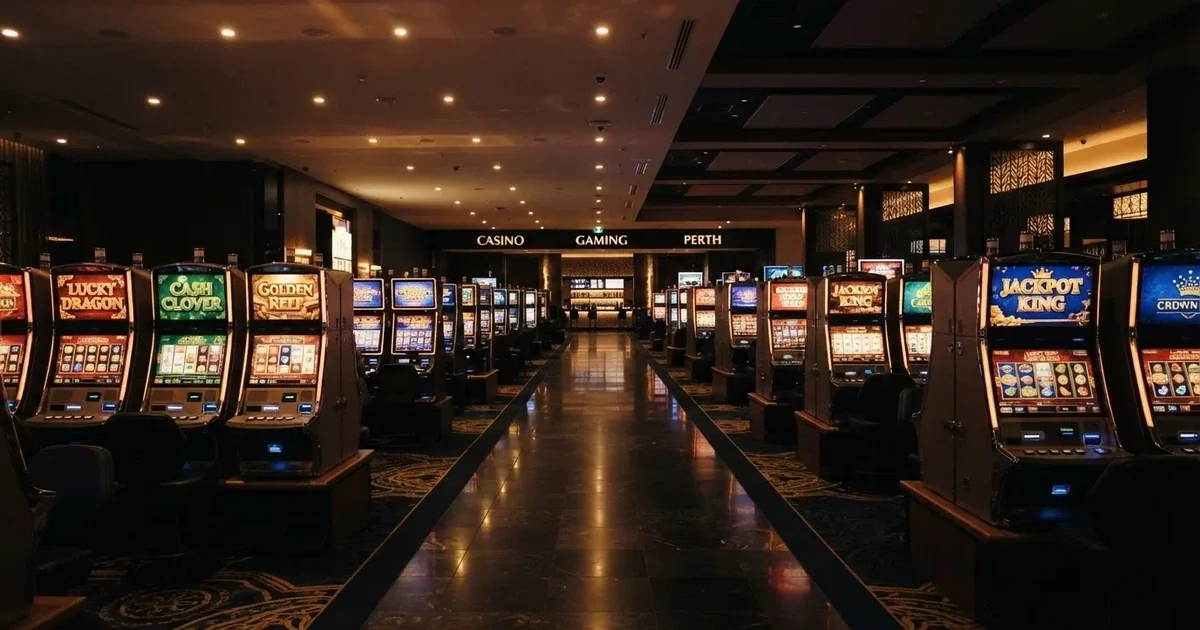
The page below lays out what that means for someone who wants to play electronic gaming machines in and around Perth: which venue is actually licensed, how the payout and bet rules compare with what other Australian jurisdictions allow, why the credit-card and crypto ban matters even when an offshore site claims otherwise, and what the ACMA has been doing to the brands that keep advertising anyway. The ranking section that closes the analytical work is not a recommendation list — Australian law does not let it be one for online casino games. It is a record of which operators the regulator has named, in date order, and what that record tells a player about where the legal floor sits.
Table of Contents
- How payments and payout speed actually work on the licensed floor in Perth
- The games themselves: paytables, mechanics, and the cashless card shift at the Burswood floor
- Ranking the ACMA warning list: how offshore “pokies” brands compare on the regulator’s record
- The legal shape of the Australian market in 2026
- Responsible gambling in a market where the only lawful floor is in Burswood
- The licensed venue: Crown Perth in Burswood
- Other Australian venues a Perth punter compares the Burswood floor against
- The blocking arithmetic: how fast the ACMA has run the rule
- A note on what the ACMA has named, and what the formal warnings record
- How a Perth punter uses this page
- Frequently asked questions
How payments and payout speed actually work on the licensed floor in Perth
Pokies venues in Perth come down to Crown Perth, and the way money moves on that floor is governed by Western Australian law and by Crown’s own house procedures. Cash is the default: a player loads a card or voucher at a change machine on the floor, plays, and cashes the residual back to a ticket at the same terminal. The cycle from card to machine to ticket is minutes, and the machine itself prints the residual the moment the player presses “collect”. There is no separate “withdrawal” stage for in-house play — the residual is on a ticket, redeemable at the cashier or at another machine on the floor.
Players who want to set a fixed spend use a pre-loaded card rather than notes and coins. Crown’s responsible-gaming signage makes the system visible: cards can be capped at the change machine, and the cashier can issue a card that holds any denomination up to the venue’s ceiling. A punter who loses the card before the balance is empty can present the same card at the cashier with photo ID and have the residual reissued. That is the practical “payout speed” question for the in-person floor in Perth: it is sub-minute for the ticket, sub-five-minute for the cashier reissue, and the whole exercise is over before most offshore sites would have completed a withdrawal queue.
The harder arithmetic lives elsewhere. Western Australia sets a minimum long-term return-to-player (RTP) rate of 90 per cent for gaming machines — the highest threshold among Australian states — and applies a 12.42 per cent flat-rate casino tax on gross gaming revenue plus a 2 per cent Burswood Park Levy on top. The 90 per cent RTP floor is the number that matters for a player: it means every machine on the licensed floor in Burswood is required by regulation to return at least 90 cents in the long run for every dollar wagered. South Australia, by comparison, sets its minimum at 87.5 per cent. The Western Australian figure is not a marketing promise; it is a regulator-set minimum that the Department of Racing, Gaming and Liquor audits.
For punters who ask about “best paying pokies in Perth” — a phrasing that turns up constantly in search traffic — the honest answer is that the machines on the Crown Perth floor are bound by the same 90 per cent floor, and the within-floor difference between one title and another is well below the 2.5-point gap that separates WA from SA. A punter who wants a meaningfully higher RTP than the Burswood floor is asking for something Western Australia has not licensed.
Maximum cash payouts on the floor are governed by the venue’s own procedures and by the cash-handling rules under the Casino Control Act. The specific per-machine payout cap is set by Crown’s own configuration and is visible on each machine’s paytable. The player-facing rule is simpler: a residual is paid, by ticket or by cashier, and any large win triggers the venue’s identification and payout procedure. There is no separate maximum-cash-payout limit published for the Burswood floor that is more restrictive than the ordinary ticket ceiling, and no “online pokies perth no deposit bonus” framing is going to translate to it — that product does not exist under Australian law.
A note on the wording punter traffic uses. Phrases like “online pokies perth no deposit” and “online pokies perth no deposit bonus” are search-engine artefacts of offshore affiliate marketing, not descriptions of a product Australians can lawfully claim. The credit-card and crypto ban that took effect on 11 June 2024 — discussed in the legality shelf below — makes even the deposit channel moot for any site pretending to be a licensed Australian wagering service.
The games themselves: paytables, mechanics, and the cashless card shift at the Burswood floor
The licensed floor in Burswood runs the standard Australian electronic-gaming-machine format: a video reel configuration with a fixed number of paylines displayed on the paytable, a denomination selectable at the machine, and a residual printed as a ticket at the end of play. Machines are configured by the venue under WA regulator supervision, and the paytable — including the long-term RTP, the maximum line win, and any feature-trigger thresholds — is shown on-screen on each unit. A punter who wants to compare titles reads the paytable on the machine in front of them.
Western Australia’s cashless card system is the most consequential mechanic shift on the licensed floor. Crown Perth operates a card-based system that loads notes and coins onto a player card at a change machine, then debits the card for each spin. The system has two effects that matter for play. First, the player can set a pre-load cap at the change machine, which makes a hard budget cap a one-time decision rather than a constant one. Second, the residual on a lost card is recoverable: present the card and photo ID at the cashier, and the balance is reissued. That is the floor’s practical answer to the “payout” question — the residual never goes missing, only the card.
On specific game mechanics, the regulator does not publish title-by-title RTP breakdowns — the 90 per cent minimum is the published number, and individual machines are configured within that ceiling. A punter who wants to compare two titles on the floor reads the paytable screen on each. The within-floor differences are small enough that most casual players will not feel them across a single session. The bigger mechanical variation is stake size: machines accept a range of denominations, and the per-spin ceiling at Crown Perth is governed by the same Western Australian rules that allow machines elsewhere in the country to cap bets at A$5 in jurisdictions that impose that limit. WA itself does not impose a state-wide A$5 cap, and Crown’s machine configuration sets its own denomination grid.
On the “24 hour pokies perth” question: Crown Perth’s gaming floor runs 24 hours, and the casino is the only venue in Western Australia licensed for unrestricted pokies. That makes the “24 hour” framing accurate for Burswood and inaccurate as a description of anywhere else in the state — Perth CBD pubs and clubs do not have machines, because the state has never permitted them.
On “perth cashless pokies” specifically: yes, the card system is the default. A punter who turns up with a wallet full of notes and no card buys one at the change machine on the floor. The mechanic is the same one that most Australian venues have moved to over the last decade; the Burswood version is governed by the WA regulator and by Crown’s own gaming operations.
What is not available on the licensed floor, despite the marketing language that surrounds it, is a live-dealer or table-poker product that meets the “perth casino online” framing some affiliate pages use. Crown Perth operates table games on the floor, but they are in-person table games, not live-streamed, and the “online pokies perth” product simply does not exist as a licensed offering. Searches that land on offshore sites for those terms are being routed around Australian law.
Ranking the ACMA warning list: how offshore “pokies” brands compare on the regulator’s record
There is no licensed online pokies product for Australian players, so a ranking cannot compare offers on wagering terms or payout speed — the product itself is prohibited under the Interactive Gambling Act 2001. What a reader comparing these brands gets instead is a comparison of their standing with the regulator: each brand’s ACMA action, the date the formal warning was published, the operator named in the ACMA’s notice, and whether independent listings corroborate the operator identity. The table below records the eleven brands the ACMA has acted against in this space, in date order. It is not a recommendation; it is the regulator’s own enforcement history.
| Brand | ACMA action and date | Operator named by the ACMA | Subject support (per independent listings) |
|---|---|---|---|
| Sky Crown | Formal warning, September 2022 | Hollycorn N.V. | Listings cite Hollycorn N.V. (en.wikipedia.org) |
| Level Up Casino | Formal warning, May 2022 | Dama N.V. | Listings cite Dama N.V. (en.wikipedia.org, vgccc.vic.gov.au) |
| Woo Casino | Formal warning, March 2025 | Dama N.V. | Listings cite Dama N.V. (en.wikipedia.org) |
| Spirit Casino | Formal warning, May 2025 | Dama N.V. | — |
| Instant Casino | Formal warning, February 2025 | EOD Code SRL | — |
| Casino Intense | Formal warning, April 2025 | Sterplay Holding Ltd | Listings cite Sterplay Holding Ltd (Abc.net.au, Asgam.com, cbs.sa.gov.au) |
| Ignition Casino | Formal warning, July 2025 | Bamboo Media | — |
| National Casino | Formal warning, July 2025 | Consolutetish S.R.L. | Listings cite Consolutetish S.R.L. (Abc.net.au, infrastructure.gov.au) |
| Bizzo Casino | Formal warning, July 2025 (earlier 2022) | Consolutetish S.R.L. (earlier TechSolutions) | — |
| Jackbit | Formal warning, April 2026 | Ryker B.V. | — |
| RocketPlay | Formal warning, March 2026 (earlier May 2022) | Pulsup Ltd (earlier Dama N.V.) | — |
Three of the eleven brands have been named twice by the ACMA in this window: Level Up Casino and RocketPlay were warned over Dama N.V. in May 2022 and (RocketPlay only) re-warned over Pulsup Ltd in March 2026; Bizzo Casino was warned over TechSolutions in 2022 and over Consolutetish S.R.L. in July 2025. A re-warning is the regulator telling the operator that the first letter did not change the offering — the brand moved to a new corporate vehicle but kept advertising the same prohibited product to Australians. That is the most informative single column on this table: a brand that has been warned twice in three years is telling the reader that enforcement has not changed its offering.
The dates cluster in 2026 more than in any other year of the window: March, April, June and July 2026 all carry at least one warning. The ACMA’s enforcement tempo has been steady through 2026, with the most recent round in this set published in April 2026 over Ryker B.V.’s Jackbit and CasinOK brands. The June 2026 blocking round — twelve sites added to the Australian internet-service-provider block list — sits alongside, not on, this warning list, because a blocking instruction is a different mechanism from a formal warning, and several of the brands blocked in that round do not appear here.
The “operator named by the ACMA” column is doing more work than the casual reader will see. The brand at the top of an offshore casino’s homepage is rarely the legal entity that holds the licence. Hollycorn N.V., Dama N.V., Consolutetish S.R.L. and the rest are the corporate names that actually appear on the ACMA’s notices. Where independent listings corroborate that corporate name, the third column carries it; where the listings carry only the brand and not the corporate operator, the column is left blank. A reader who wants to know whether the brand they recognise matches the entity the regulator named reads both columns together.
The “Subject support” column is intentionally narrow. It records only whether independent listings name the same corporate operator the ACMA names, because that is the verifiable bridge between a brand the reader sees in an ad and the entity the regulator has acted against. The column deliberately does not record RTP, payout speed, wagering terms or game count: the product is prohibited in Australia, and any number carried for an offshore brand would be a marketing claim. A comparison that rated these brands on payout speed would be measuring a metric the regulator has already declared unlawful to offer.
What a reader comparing these eleven brands actually learns is that they share one feature: each has been told by Australia’s internet regulator, by name and on the record, that what they offer Australians is unlawful. The brands differ on whether the warning is recent (April 2026 over Jackbit) or years old (September 2022 over Sky Crown), whether the same operator has been re-warned after reincorporating (RocketPlay, Bizzo), and whether independent listings corroborate the corporate name the ACMA used. None of those differences makes any of them a place a Perth player should hand over money. The differences tell the reader how persistent the offering has been in the face of enforcement.
The legal shape of the Australian market in 2026
The product the search terms describe — “pokies” offered as an online casino game to an Australian — is unlawful under the Interactive Gambling Act 2001, as strengthened by the Interactive Gambling Amendment Act 2017. The IGA prohibits the supply of online casino games, online pokies and in-play betting to a person in Australia. No state or territory licenses that supply. What is licensable is wagering on races and sports placed before the event, lotteries and keno — in practice licensed by the Northern Territory, where the Northern Territory Racing and Wagering Commission regulates 52 of Australia’s online bookmakers, including Sportsbet, Bet365 and Ladbrokes. The commission has no full-time staff and meets once a month in Darwin; it is a de facto gambling regulator for Australia’s wagering industry, and it has no jurisdiction over online casino games.
The IGA targets the provider, not the player. An Australian who logs in to an offshore casino is not committing an offence under the IGA. The provider is. The consequence for the player is on the consumer-protection side: an offshore site gives no Australian complaint body, no recourse if a withdrawal is refused, and no protection if the site disappears with the balance. The Australian Communications and Media Authority (ACMA) investigates, issues formal warnings, and can direct Australian internet service providers to block illegal sites. As of June 2026 the ACMA had asked ISPs to block 1,751 illegal gambling and affiliate-marketing websites since the first blocking request in November 2019, and more than 230 unlicensed gambling services had left the Australian market since enforcement was strengthened in 2017.
The pace of blocking has been accelerating. In the round reported on 26 June 2026 the ACMA asked ISPs to block 12 more illegal gambling websites: 7Signs, ChromaBet, Donbet, Duospin, Freshbet, Slots Gem, Jacks Club, Lucky Start, Pointsbetz.com, Spinrise, Vinyl Casino and Wildsino. Each blocking round compresses the route an Australian player can take to reach an offshore site, but does not end it — offshore operators rotate domains, the ACMA rotates the block list, and the warning record above is the longer-lasting regulatory artefact.
The credit-card and crypto ban that took effect on 11 June 2024 closes another channel. The ban prohibits credit cards, credit-related products and digital currency as a payment method for licensed online wagering, with penalties up to A$247,500 for operators. Legal deposit routes for licensed wagering are debit card, bank transfer, PayID/Osko and BPAY. An offshore casino that asks an Australian for a credit-card deposit or a Bitcoin wallet is operating outside the Australian rules on a second axis at the same time: the IGA prohibits the product, and the payment ban prohibits the channel.
Player protection has its own regulator-built limits. BetStop, the National Self-Exclusion Register, has been live since August 2023, but it binds only Australian-licensed online and phone wagering services. An offshore casino is not connected to BetStop. A punter who self-excludes through BetStop is protected from licensed Australian wagering products and from nothing else. The National Gambling Helpline is 1800 858 858 — free, 24/7, with chat at Gambling Help Online — and it is the one support line that operates regardless of which product a punter is using.
The forward calendar is concrete. The Interactive Gambling Amendment (Gambling Reform) Bill 2026 passed Parliament on 19 August 2026; its advertising and inducement measures commence on 1 January 2027. That is a law with a start date, not a law in force on a 2026 page, and a reader comparing brands now reads the regulator’s enforcement record rather than the new rule.
The tax side is the part most punter pages do not carry. Gambling winnings of a recreational player are not assessable income (section 6-5 ITAA 1997), and losses are not deductible, unless the person carries on a business of gambling. The model caveat is honest: check with the ATO. The point that does not depend on the caveat is that an Australian punter who lands a big win at an offshore site has no Australian tax office to declare it to and no Australian consumer protection to complain to if the operator does not pay.
Responsible gambling in a market where the only lawful floor is in Burswood
Responsible gambling in Western Australia is anchored to the Department of Racing, Gaming and Liquor, the state regulator that administers the Casino Control Act and the Gaming and Wagering Commission Act. The Commission has its own membership and its own meeting calendar; the Department handles the licensing and compliance work. Crown Perth operates under a Crown Casino licence granted to Burswood Nominees Pty Ltd, and in July 2025 the Gaming and Wagering Commission of Western Australia recommended that Crown keep its gaming licence after Crown made remedial efforts to become compliant with government gaming regulations.
The visible responsible-gaming infrastructure on the licensed floor is the cashless card system itself: a pre-load cap at the change machine is the most direct way a punter can set a hard ceiling, and venue signage on the floor reminds players of the support services that sit behind it. The venue also offers a self-exclusion process that operates on the Burswood floor only — a punter who self-excludes at Crown Perth is excluded from Crown Perth, not from a national register, because there is no national self-exclusion register that binds a casino venue.
BetStop, the National Self-Exclusion Register, is the larger national instrument. It has been live since August 2023 and binds Australian-licensed online and phone wagering services. A punter who registers with BetStop is excluded from licensed Australian wagering, not from licensed Australian casinos — the casino channel is not bound by BetStop in the same way the wagering channel is. A punter who wants both exclusions applies twice, once to BetStop for the wagering channel and once to the venue for the casino channel.
The support services are straightforward. The National Gambling Helpline is 1800 858 858, free, 24/7, with chat at Gambling Help Online. Gambling Help Online is the same service with an online chat interface. The helpline is the one number a punter can call regardless of which product they have been using, which operator they have been dealing with, and whether the product was licensed or offshore. A punter who has been playing at an offshore site and wants help does not need to call the offshore operator to get it.
The Western Australian context gives the responsible-gambling shelf a sharper edge than it has in other states. The state has never permitted poker machines in pubs or clubs, and Crown Perth is the only venue in the state where they are legal. That makes the Burswood floor the entire land-based pokie market in WA, and it concentrates responsible-gaming policy on a single venue. The state’s 90 per cent minimum RTP is itself a responsible-gaming instrument: a regulator-set floor on what a machine must return in the long run is the most direct way the state reduces the per-spin take on a player. Other states run their own floors; Western Australia runs the highest.
A note on the offshore brands the ACMA has named. None of the eleven brands in the ranking above is bound by BetStop, by the National Gambling Helpline, by the Western Australian Department of Racing, Gaming and Liquor, or by any Australian consumer-protection law. A punter who loses money at one of those brands and asks the regulator for help is asking an Australian regulator with no jurisdiction over the operator. The remedy is the ACMA blocking list and the formal-warning record, both of which work on the supply side; the player-side remedy is the helpline at 1800 858 858.
The licensed venue: Crown Perth in Burswood
Crown Perth is in Burswood, on the Swan River, about five kilometres east of the Perth CBD. It opened on 30 December 1985 as Burswood Island Casino and was the largest casino in Australia at the time. Publishing and Broadcasting Limited acquired control of the casino in 2004 and vested its gaming interests, including Burswood, into Crown Limited in 2007 — a company controlled by James Packer. The resort precinct now carries three hotels — Crown Metropol (405 rooms), Crown Promenade (291) and Crown Towers (500, opened December 2016) — plus a convention centre and over thirty restaurants and bars.
The Western Australian context makes the venue larger than its name suggests. Because the state has never permitted poker machines in pubs or clubs, Crown Perth is the only venue in the state where electronic gaming machines are legal. That is the regulatory fact a search for “best pokies venue in perth” or “pokies in perth cbd” is looking for: there is no CBD venue, because the state does not license CBD venues, and Burswood is the floor. The Perth CBD pubs and clubs that turn up in casual conversation do not have machines on them, and the Perth casino the search terms reference is in Burswood, not in the CBD.
The current licence posture is stable. In July 2025 the Gaming and Wagering Commission of Western Australia recommended that Crown keep its gaming licence after Crown made remedial efforts to become compliant with government gaming regulations. That recommendation followed the Australian casino inquiries of 2021-2022 and Crown’s subsequent remediation program, and it is the live regulator statement on the venue’s standing. Crown’s licence is held by Burswood Nominees Pty Ltd, and the venue operates under the Casino Control Act as administered by the Department of Racing, Gaming and Liquor.
The Burswood Park Levy — a 2 per cent levy on top of the 12.42 per cent flat-rate casino tax — funds the surrounding Burswood Park. That is the visible return: the precinct’s gardens, walkways and event spaces are funded from the venue’s own tax. The combination of the highest RTP minimum in the country, the cashless card system, the 24-hour gaming floor, and the single-venue concentration makes the Burswood floor the most regulator-bounded pokie product a Perth punter can actually play.
The practical reader takeaway: a Perth punter who wants to play pokies lawfully has one licensed venue, and it has the highest regulator-set RTP floor in the country. A Perth punter who wants a different product is being routed by affiliate pages to offshore sites that the ACMA has warned, blocked and warned again, on a product the Interactive Gambling Act prohibits. The marketing language around “online pokies perth” is the marketing language around a product that does not legally exist.
Other Australian venues a Perth punter compares the Burswood floor against
Perth’s licensed floor sits alone in Western Australia, and that makes comparisons with other Australian capitals more informative than comparisons within Perth. Three venues are the natural reference points: Adelaide Casino in South Australia, The Star Brisbane at Queen’s Wharf in Queensland, and Casino Canberra in the ACT. Each carries a different regulatory and operational profile, and each gives the Burswood floor a different kind of contrast.
Adelaide Casino, commercially known as SkyCity Adelaide, sits in the heritage-listed Adelaide railway station building on North Terrace. It has 90 gaming tables and 950 gaming machines, and it is the sole licensed casino in South Australia under the Casino Act 1997. The casino opened on 12 December 1985 under South Australia’s state-owned Lotteries Commission, was sold to SkyCity Entertainment Group in June 2000, was renamed SkyCity Adelaide in April 2001, then reverted to the Adelaide Casino name in 2009. A 2015-2021 Riverbank precinct redevelopment worth about A$330 million added the EOS by SkyCity tower, which opened in 2021 with 120 hotel rooms and expanded gaming space. Adelaide Casino’s table-game monopoly in South Australia was extended to 30 June 2035 under a licence formalised on 11 October 2013, which also allows the casino to expand to up to 200 gaming tables and 1,500 gaming machines subject to redevelopment.
The South Australian regulatory profile is the useful comparison. South Australia sets a minimum gaming-machine RTP rate of 87.5 per cent and a general maximum bet of A$5.00 outside the casino, while Adelaide Casino itself has no maximum-bet limit. That gives a Perth punter two calibration points: the per-spin ceiling is governed by the venue’s own configuration on the Burswood floor (no state-wide A$5 cap in WA), and the per-spin return is governed by WA’s 90 per cent minimum rather than SA’s 87.5 per cent. South Australian gaming-machine losses outside Adelaide Casino totalled about A$0.92 billion in 2022-23, equivalent to about A$497 per adult — the comparable WA figure is concentrated entirely on Burswood because there are no off-casino machines.
Brisbane’s Treasury Casino, operated by Star Entertainment Group, closed on 25 August 2024 to make way for the new Star casino at Queen’s Wharf. The Star Brisbane began a staged opening at the A$3.6 billion Queen’s Wharf Brisbane precinct on 29 August 2024, with the main casino floor and premium gaming rooms opening first. Queen’s Wharf opened amid concerns about the licence position of its lead partner, Star Entertainment Group. Treasury Casino, in Brisbane’s historic Treasury Building, had opened refurbished as a casino in April 1995 and, before its August 2024 closure, occupied a three-level gaming emporium of 80 gaming tables and over 1,300 gaming machines, plus a hotel, six restaurants, five bars and a nightclub. The Star Brisbane at Queen’s Wharf was developed jointly by Star Entertainment Group and Hong Kong-based Chow Tai Fook Enterprises.
The Queensland context gives a Perth punter the contrast that matters most. In late 2022 the Queensland Government, acting on an independent review by former Court of Appeal judge Robert Gotterson, found Star Entertainment unsuitable to hold its Queensland casino licences after concluding it had misled regulators and failed its anti-money-laundering duties. Star was fined $100 million on 9 December 2022, with a 90-day suspension of the Treasury Brisbane and Star Gold Coast licences deferred to 1 December 2023 to allow remediation. The Gotterson findings were the highest-profile regulator action against an Australian casino operator in the window, and they are the reason The Star Brisbane opened in 2024 with a more conditional regulatory posture than Crown Perth carries today. Queensland had 21,122 gaming machines operating in 351 venues in October 2023 — the bulk of them in pubs and clubs outside the casino, on a regulatory footprint WA does not have.
Casino Canberra, in the Canberra CBD, was the first legal casino in the ACT, built on land excised from Glebe Park under a 99-year lease. It has no hotel, theatres or retail. The Canberra venue is the structural opposite of Burswood on most dimensions: smaller floor, no resort precinct, no 24-hour offering, no machine count worth comparing. Its role in a Perth punter’s reference set is to show what a regulator-bounded, single-venue floor looks like at the small end — which is the configuration Perth has, just at the larger end.
The pattern that runs through the three reference venues is that the regulator with the strongest per-spin return floor (Western Australia, 90 per cent) is paired with the smallest total machine count (Crown Perth’s floor only, no off-casino machines). South Australia has a lower per-spin return floor (87.5 per cent) and a larger machine count outside the casino. Queensland has a still-broader regulatory footprint (more machines in more venues) and a venue whose licence is conditional. A Perth punter reading this comparison reads the regulatory trade-off between floor-level return and venue-level breadth — and Western Australia has chosen the first over the second.
The blocking arithmetic: how fast the ACMA has run the rule
The ACMA’s blocking work has been steady, not episodic. The cumulative count of blocked sites reached 1,751 in the June 2026 round, against a first blocking request in November 2019. That is roughly seven years of enforcement, working out to about 250 blocked sites a year on average — though the pace has been uneven, with the early years leaner and the recent years heavier. The June 2026 round alone added twelve sites, all of them named in the public notice. Each round adds new domains and the regulator rotates the block list as offshore operators reappear at new addresses.
The arithmetic that matters for a reader is the band. Over the seven-year window from November 2019 to June 2026, the ACMA has asked ISPs to block an average of about 250 sites per year, with the actual annual count ranging from the low hundreds in the early years to multiple round-driven spikes in the recent ones. In 2026 alone, the April round (Jackbit, CasinOK and others), the June blocking round (12 sites including 7Signs, ChromaBet and Vinyl Casino), and the March round (Rocketplay.com.au) have all been published. The cumulative figure is a band rather than a single point because each blocking round adds new sites, but the regulator does not unblock sites once added — so the 1,751 is a running total that grows monotonically, and the rate at which it grows is the metric the regulator itself tracks.
This rate is the page’s key finding. A blocking rate that has held at roughly 250 sites a year for seven years, with no year of zero activity, tells a reader that the regulator has not declared victory and walked away. The warning record above is the same story told on a per-brand axis: eleven brands named in this window, three of them named twice. The blocking record is the same story told on a per-domain axis: 1,751 sites blocked since November 2019, with twelve added in the most recent reported round. The two records converge on the same conclusion — enforcement is continuous, not occasional.
The honest reading of the cumulative figure is that the ACMA has not ended offshore supply. New domains appear, the regulator adds them, the operators rebrand and rotate. The total of 1,751 blocked sites is a count of routes closed, not a count of operators gone. The “more than 230 unlicensed gambling services had left the Australian market” figure sits beside it: 230 services have withdrawn entirely, against 1,751 sites blocked. The ratio is informative — most enforcement closes routes, a smaller share closes operators.
For a Perth punter the practical reading is that the offshore “online pokies perth” route is, at any given moment, partially blocked. The site a punter sees in an ad this week may be on the block list by next month; the brand may reappear at a new domain. The blocking arithmetic does not end the offering, but it does compress it, and it does mean that any offshore brand a punter has used is more likely than not to have appeared on a block list at some point.
A note on what the ACMA has named, and what the formal warnings record
The formal warnings recorded in the ranking table are not the full ACMA record — they are the formal warnings over online casino and pokies brands that this page carries. The ACMA also issues blocking notices (recorded separately), infringement notices, and other actions that do not appear here. The eleven brands in the table are the subset of formal warnings over brands that an Australian player searching for “pokies” is most likely to encounter in affiliate marketing.
The dates in the table are the dates the ACMA published the warnings. The operator names are the legal entities named in the ACMA’s notice, which is the corporate parent rather than the brand. The brand is what the player sees; the operator is what the regulator names. Where independent listings corroborate the operator-brand pairing, the “Subject support” column carries it; where they do not, the column is blank.
A reader comparing two brands in the table reads three things. First, the date tells them how recent the regulator’s attention has been. Second, the operator column tells them whether the brand has been re-warned under a new corporate vehicle, which is the clearest signal that the offering has not stopped. Third, the listings column tells them whether independent observers agree with the operator-brand pairing the regulator named. The brands with both a recent date and a corroborated corporate name are the brands the regulator has named most recently and most authoritatively; the brands with neither are the ones a reader has the least cross-verified information about.
The table is deliberately narrow in what it compares. It does not compare RTP, payout speed, game count, wagering terms or bonus size, because none of those are legal products for an Australian to consume. A table that rated the eleven brands on payout speed would be rating them on a metric the regulator has declared unlawful to offer. The table is the regulator’s own enforcement record, recorded for a reader who wants to know which brands have been told they cannot do what they are doing.
How a Perth punter uses this page
A Perth punter who lands on this page from a search for “pokies in perth” or “best pokies in perth cbd” reads the page as a sequence of answers rather than as a recommendation. The first answer is the venue question: Crown Perth in Burswood is the only licensed venue in Western Australia, and it is the only place electronic gaming machines are legal in the state. The second answer is the regulator question: Western Australia’s Department of Racing, Gaming and Liquor sets a 90 per cent minimum RTP and licenses Crown under the Casino Control Act. The third answer is the offshore question: online casino games are prohibited under the Interactive Gambling Act, the ACMA has named eleven brands in this window, and the ACMA has blocked 1,751 sites since November 2019.
A punter who reads the page for a different reason — who is curious about what “online pokies perth no deposit bonus” actually means in the Australian regulatory frame — reads the same sequence and arrives at the same conclusion: there is no licensed product behind that phrasing, and the brands offering it are the brands the ACMA has been warning and blocking throughout the window.
A punter who reads the page for a comparison with another Australian capital reads the reference-venue shelf and gets a calibration on per-spin return (90 per cent in WA against 87.5 per cent in SA) and on venue breadth (one licensed venue in WA against 471 venues outside Adelaide Casino in SA and 351 venues in Queensland). A punter who wants the responsible-gaming contacts reads the support shelf: the National Gambling Helpline at 1800 858 858, Gambling Help Online, and BetStop for the wagering channel.
The page does not rank Crown Perth against offshore sites on a metric the regulator has declared unlawful. The page does rank the eleven ACMA-named brands on the regulator’s own record, because that record is the verifiable answer to the question a Perth punter is asking when they compare what the marketing pages show.
Frequently asked questions
Which venues in Perth are licensed to operate pokies?
Crown Perth, in Burswood, is the only venue in Western Australia licensed to operate pokies. Western Australia has never permitted poker machines in pubs or clubs, and Crown Perth operates under a casino licence granted by the state’s Gaming and Wagering Commission. Pubs and clubs in Perth CBD and across the metropolitan area do not have machines, by state-law design rather than by accident. The venue runs the standard Australian electronic-gaming-machine floor, with a regulator-set minimum long-term RTP of 90 per cent — the highest such floor among Australian states.
Are pokies in Perth available around the clock?
The Crown Perth gaming floor runs 24 hours, and the casino is the only venue in the state licensed for unrestricted pokies. “24 hour pokies perth” is therefore accurate for Burswood and not accurate as a description of anywhere else in Western Australia, because there is no elsewhere. A punter looking for an off-casino 24-hour pokie venue in Perth is looking for something the state does not licence. The cashless card system on the floor makes a 24-hour session practical to budget in advance by setting a pre-load cap at the change machine.
What identification do venues in Perth require before letting someone play pokies?
Crown Perth requires photo ID for the cashier’s residual reissue process and for any large-payout procedure; the change machine itself does not require identification for a pre-load. The state’s minimum age for gaming is 18, and the venue enforces it at the entrance. There is no national identification requirement for play on the floor in the way the credit-card ban is a national requirement for licensed online wagering — the in-person rules are venue and state-specific. A punter who has self-excluded at the venue cannot re-enter during the exclusion period, and the venue’s own identification system enforces that exclusion at the door.
Can visitors to Perth use self-exclusion schemes at local pokies venues?
A visitor who has registered with BetStop, the National Self-Exclusion Register, is excluded from Australian-licensed online and phone wagering services — not from a casino venue. Casino exclusion in Western Australia is venue-specific, applied through Crown Perth’s own process. A visitor who has registered with BetStop and wants to be excluded from the Burswood floor needs to apply through Crown Perth directly. BetStop has been live since August 2023; the casino exclusion process at Crown is independent and operates on the floor’s own systems. The National Gambling Helpline at 1800 858 858 (24/7, with chat at Gambling Help Online) is the support line that works regardless of which channel a punter needs.
How does the payout percentage on Perth pokies compare with other Australian cities?
Western Australia sets a minimum long-term RTP of 90 per cent for gaming machines — the highest such floor among Australian states. South Australia sets its minimum at 87.5 per cent, with a general maximum bet of A$5.00 outside the casino. Queensland had 21,122 gaming machines in 351 venues in October 2023, mostly outside the casino, under the state’s own return-to-player rules. The Burswood floor’s 90 per cent is a regulator-set minimum that the Department of Racing, Gaming and Liquor audits; the venue’s specific per-title RTP is shown on each machine’s paytable. The 2.5-point gap between WA’s 90 per cent and SA’s 87.5 per cent is the meaningful comparison for a punter who is thinking of crossing state borders to play.
Is it legal for an online casino to advertise “pokies” in Perth the same way a pub or club does?
No. The Interactive Gambling Act 2001, as strengthened by the Interactive Gambling Amendment Act 2017, prohibits the supply of online casino games and online pokies to a person in Australia, and no state or territory licenses them. The ACMA has issued formal warnings over eleven brands in this window and has asked ISPs to block 1,751 illegal gambling and affiliate-marketing websites since November 2019. The credit-card and crypto ban that took effect on 11 June 2024 prohibits credit cards, credit-related products and digital currency as a payment method for licensed online wagering, with penalties up to A$247,500 for operators. The Interactive Gambling Amendment (Gambling Reform) Bill 2026 passed Parliament on 19 August 2026; its advertising and inducement measures commence on 1 January 2027. A pub or club that displays pokies signage in Perth is doing something the state does not allow; an offshore site that displays the same signage is doing something the IGA does not allow.