
Casinos that accept PayID in Australia in 2026: what the deposit screen does, and what the regulator has done about it
Current as of 29 October 2026 · verified against the ACMA register of formal warnings and blocking requests, plus AP+ and the Reserve Bank of Australia.
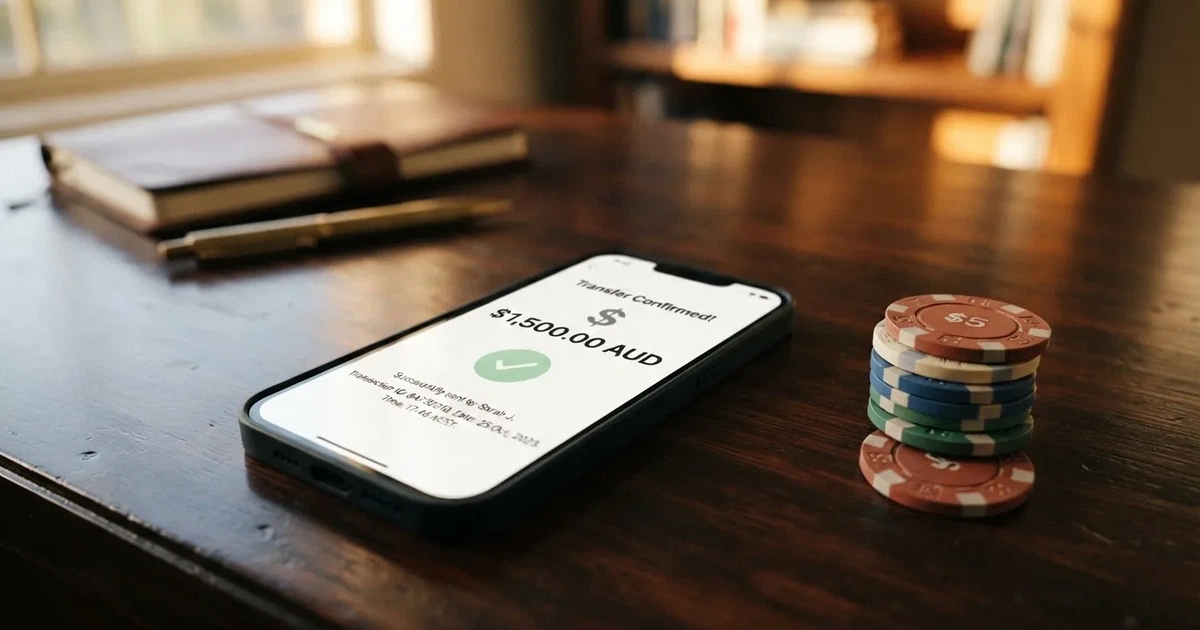
PayID is built into the online banking of more than 100 Australian financial institutions. Every one of those banks runs the same identifier scheme, every one of them lets the payer check the receiving name before sending, and every one of them warns the user when the PayID on the other end is connected to an illegal gambling site. The deposit screen at an offshore casino is the same screen those warnings are aimed at, and the warnings are there because the regulator and the payments industry have spent years watching people tap “confirm” on it anyway.
This page walks that screen the way a player meets it. It names eleven offshore brands that the ACMA has issued formal warnings over for offering prohibited interactive gambling services to Australians. It explains how PayID itself works, why it does not make a site legal, what the bank can and cannot block, and what a player should do before tapping “send” on a transfer to any PayID a casino supplies.
Table of Contents
- The legality frame every PayID casino sits inside
- The responsible-gambling layer a PayID casino does not connect to
- How PayID itself works at the casino cashier
- The brands the ACMA has formally warned
- How the ACMA’s blocking pile has built up
- How a PayID deposit actually arrives at an offshore casino
- What a player should do before sending the transfer
- Why the picture keeps changing
- What a player who has decided not to play has instead
- A closer look at the ACMA register
- Where this leaves a reader who came here looking for the best PayID casino
- Frequently asked questions about PayID at Australian online casinos
The legality frame every PayID casino sits inside
The Interactive Gambling Act 2001, as tightened by the Interactive Gambling Amendment Act 2017, makes it an offence to provide online casino games, online pokies or in-play betting to a person physically in Australia. No state or territory licences online casino games — full stop. What the Northern Territory Racing and Wagering Commission does licence is wagering on races and sport, lotteries and keno, and only when the bet is placed before the event. The NT regulator is the same body that authorises Sportsbet, Bet365 and Ladbrokes, and it does the work with a part-time commission that meets once a month in Darwin.

Two consequences fall out of that frame, and they reach every brand on this page in the same way.
First, an offshore casino licence — Curaçao, Anjouan, Costa Rica — has no standing in Australia. The ACMA’s position is that what those licences authorise is not what Australian law forbids. The site can display a badge, the site’s footer can claim oversight by some regulator, and none of that changes the underlying prohibition. Treating an offshore licence as evidence of safety is a misreading of what a licence actually is, and the regulator has spent the last several years saying so in writing.
Second, the prohibition runs at the provider, not the player. The IGA targets the company taking the bet, not the person placing it. That is why enforcement looks the way it does: ACMA formal warnings against operators, and ACMA-directed ISP blocking of the domains themselves. It is also why a player’s only real protection is choosing not to play at an unlicensed site in the first place — there is no Australian complaints body, no local dispute resolution, and no recourse if a withdrawal stalls.
A player who wants a legal alternative has a much narrower set of options than a search engine suggests. The legal Australian gambling market is land-based casinos plus state-regulated club and pub pokies, plus the online wagering services the NTRWC licences for sport and racing. None of those offer an online pokie product. The gap between what a player is searching for and what the law actually allows is the gap this page sits inside.
What the ACMA does about an unlicensed site
The ACMA’s toolbelt has three tools, and a given brand can end up on the receiving end of all three.

The first is a formal warning under the Interactive Gambling Act. The warning names the operator behind the brand and the Australian-facing URL, sets out the relevant section of the Act, and gives the operator a deadline to come into compliance. The warning sits in the ACMA’s register once it is published. Several of the brands on this page carry more than one, because warnings issued to an earlier operator do not bind a successor.
The second is a blocking request to Australian internet service providers. Once an ISP receives a request under section 313 of the Telecommunications Act 1997, the named domains become unreachable for Australian customers on that ISP. The block is hard to reverse and it can catch a player with a balance still inside the account.
The third is referral to the Department of Infrastructure or to international counterparts, and on rare occasions civil penalty proceedings. Penalties for offering a prohibited interactive gambling service run into the hundreds of thousands of dollars per breach, and the 2026 reform package increases the ceiling further.
What the ACMA does not do is chase players, and that asymmetry is part of why offshore casinos keep reaching Australian customers. The cost of a single warning is small compared to the revenue a brand earns from the audience the warning is read by. Several of the operators on this page have absorbed more than one.
What the 2026 reform actually changes
The Interactive Gambling Amendment (Gambling Reform) Bill 2026 passed Parliament on 19 August 2026. Its centre of gravity is advertising and inducements — the kind of marketing that leads a player to an offshore site in the first place. The advertising and inducement measures commence on 1 January 2027, so on a 2026 page the bill is law with a start date, not yet in force. The reform does not change what is or is not a prohibited service. It changes what an operator can say about one.
The responsible-gambling layer a PayID casino does not connect to
BetStop, the National Self-Exclusion Register, has been live since August 2023. A player who signs up binds every Australian-licensed online and phone wagering service to refuse their bets. A self-excluded player trying to deposit at Sportsbet, Ladbrokes or any other NT-licensed bookmaker will be blocked at the cashier. That protection is real, and it is the most useful responsible-gambling tool available to an Australian.
BetStop does not bind offshore casinos. The register is built on Australian-licensed services, and the offshore brand is not part of it. A self-excluded player who signs up at a Curaçao-licensed casino will find the cashier takes their PayID like any other. The only block in that path is the one the player’s own bank can put on the card or wallet being used, not the regulator’s.
The National Gambling Helpline — 1800 858 858 — is free, 24/7 and reachable by chat at Gambling Help Online. It is staffed by counsellors who know what offshore gambling looks like from the player’s side of it. The helpline is the right first call for anyone who has tried to stop, has not been able to, and has not yet decided whether to talk about it.
A offshore casino’s own responsible-gambling page — deposit limits, time-outs, self-exclusion at the site level — is set inside a product that the regulator does not oversee. The limits can be set, and they can be raised again the next day, and there is no Australian body that will hear a complaint about either.
What the bank can block, and what it cannot
Three of the big four Australian banks now offer a gambling transaction block that works at the card or wallet level. The block is a setting inside the banking app, and it refuses authorisation of any transaction that carries the merchant category code “Betting/Casino Gambling”. ANZ’s block catches digital wallet payments as well as the card itself; once the block is on, turning it off again requires a 48-hour cooling-off period. Westpac’s block sits at the card level on eligible personal credit and debit cards. The bank warns in plain language that the block is best-effort: not every gambling transaction will be caught, and some non-gambling transactions will be rejected in error.
PayID is not a card transaction. A PayID transfer is an NPP payment from one Australian bank account to another, and it carries no merchant category code at all. The bank’s card-level gambling block does not see a PayID transfer, and a PayID transfer made to a casino-supplied PayID will go through unless the player has separately arranged for their account to refuse such payments. The gambling transaction block is useful, and it is not a substitute for not sending the transfer in the first place.
What the bank can see is the destination PayID. The name attached to the PayID is shown to the payer before the transfer is sent. If the PayID resolves to a trading name that looks nothing like the casino on the brand’s homepage — and offshore operators do sometimes route deposits through a payment-services entity with a different name — that mismatch is the only signal the bank will give the player before the money leaves.
How PayID itself works at the casino cashier
PayID is an easy-to-remember identifier — a mobile number, an email address, an ABN or an Organisation Identifier — linked to an Australian bank account. It is run by Australian Payments Plus, the domestic payments industry body, and the regulator and overseer of the underlying platform is the Reserve Bank of Australia. PayID is a standard feature of online banking at over 100 Australian financial institutions, and as of April 2025 there were more than 25 million registered PayIDs in Australia.
The transfer mechanism is Osko by BPAY, which is the real-time settlement layer that runs on the New Payments Platform. NPP launched in February 2018 to make simply-addressed, near-real-time payments possible 24 hours a day. A PayID-to-PayID transfer between participating banks arrives in under a minute, including weekends, and the Reserve Bank’s Fast Settlement Service moves the underlying funds between banks on the same timescale. The “instant” part of an instant PayID transfer is real and is not a marketing claim — it is what the platform does.
The casino cashier side of it looks like this. The casino supplies a PayID — typically a mobile number or an email — and a dollar amount. The player opens their banking app, enters the PayID, sees the name linked to it, and sends. The deposit is credited to the casino account within seconds on the payments side; the casino’s own internal crediting is a separate step and can take longer.
The withdrawal side is slower, and that gap is where most of the friction lives. The PayID transfer itself, once the casino releases it, arrives in seconds. What comes before that is the casino’s own manual checks: identity verification, anti-money-laundering review, source-of-funds questions if a withdrawal is large enough to trigger them. The casino’s internal process can run from a few hours to several business days, and the PayID transfer only begins once the casino pushes the “send” button on its side. A PayID withdrawal that arrives in under a minute on the second leg of its journey can still take three working days on the first leg. That is the speed the player actually feels.
What minimum deposit looks like across the offshore set
The deposit floor at the brands reviewed here tends to sit at A$10 or A$20 for most payment methods, with a small handful setting A$30 as the minimum for PayID specifically. The lower end of that range — the A$10 PayID minimum — is the figure search results are usually chasing. It is also the figure that lands a player at an unlicensed offshore site with a small bankroll, and the dollar amount does not change what kind of site they are sitting at.
A PayID deposit does not add an extra fee at any of the sites reviewed here. The fee structure is the same as for a regular bank transfer: the player’s bank does not charge for outgoing NPP payments, and the casino does not charge for incoming ones. What the player pays for is the gambling, in the form of the house edge on every spin, and the deposit fee story is not where the cost is.
What the name-check is for
Every PayID transfer shows the name of the account holder before the player confirms the send. That prompt is not a formality. Australian Payments Plus warns directly that being asked to transfer funds to a PayID on an illegal gambling site “is almost certainly a scambling website” — their term for an illegal online gambling platform advertised on social media and messaging apps that tricks people into gambling on a scam site. The warning is on Payid.com.au and on the AP+ scam page, and it sits there because the industry has watched enough fake casino branding get caught at this exact prompt.
If the name shown does not match the casino brand, or if it resolves to a trading name the player has never heard of, that mismatch is the moment to stop. A PayID with no recognisable name behind it, or one that resolves to a payment-services entity, is the strongest signal a player will get from the banking app. It is the one prompt the bank has put in the path on purpose.
The brands the ACMA has formally warned
Eleven offshore brands make up this review. Every one of them has been the subject of an ACMA formal warning for offering a prohibited interactive gambling service to Australians. The order below follows the order the ACMA register lists them in; it is not a ranking and it is not a recommendation. The site, the operator the ACMA named, and the date of the warning are what research carries. PayID acceptance for each brand is recorded only as the listings the research consulted state it — not as a property of the operator itself, because no operator publishes a PayID-only payments page.
A comparison table covers what research backs. A column whose value research does not cover is dropped; a column repeating one value down most of its rows carries no information and fails the page.
| Brand | ACMA action and date | Operator named by the ACMA | PayID support (as listings report) |
|---|---|---|---|
| RocketPlay | Formal warning, March 2026; earlier Dama N.V. warning, May 2022 | Pulsup Ltd (Rocketplay.com.au) | — |
| Level Up Casino | Formal warning, May 2022 | Dama N.V. | Westpac listings reference |
| Woo Casino | Formal warning, March 2025 | Dama N.V. | — |
| Spirit Casino | Formal warning, May 2025 | Dama N.V. | — |
| National Casino | Formal warning, July 2025 | Consolutetish S.R.L. | AUSTRAC and Wikipedia listings |
| Bizzo Casino | Formal warning, July 2025; earlier TechSolutions warning, 2022 | Consolutetish S.R.L. (later warning); TechSolutions (CY) Group Ltd and TechSolutions Group N.V. (2022) | — |
| Ignition Casino | Formal warning, July 2025 | Bamboo Media | — |
| Instant Casino | Formal warning, February 2025 | EOD Code SRL | ecoPayz and PayID listings |
| Jackbit | Formal warning, April 2026 | Ryker B.V. | — |
| Casino Intense | Formal warning, April 2025 | Sterplay Holding Ltd | AUSTRAC, ITnews and NAB listings |
| Sky Crown | Formal warning, September 2022 | Hollycorn N.V. | — |
The shape of the table tells its own story. Every brand has at least one formal warning, and three of them — RocketPlay, Level Up and Bizzo — have absorbed a second warning from a successor operator after the ACMA’s first action against an earlier one. The PayID column is sparse because listings pages, not operators, are the only sources that name it; an empty cell there means research could not back a positive claim, not that the brand does not take PayID. A reader who wants to know whether a specific brand takes PayID should look at that brand’s own cashier page, with the caveat that the brand’s own cashier page is the least trustworthy source on the page.
RocketPlay
RocketPlay was the subject of an ACMA formal warning issued in March 2026 to Pulsup Ltd over the Australian-facing Rocketplay.com.au domain. The earlier operator, Dama N.V., received a warning in May 2022 that covered six of its brands. The brand has cycled through operators since, and the ACMA has cycled through the corresponding warnings. The PayID support field is blank because no listing research consulted named a payment-method set for the brand’s current Australian-facing site.
The pattern this brand illustrates is the substitution one. A warning against an operator does not bind a successor. A new company takes over the same domain or registers a near-identical one, and the ACMA starts again from the top of the formal-warning process. From a player’s point of view, the brand looks like the same brand it was before; from the regulator’s, it is a new matter.
Level Up Casino
Level Up Casino sits on the original Dama N.V. warning from May 2022, alongside Bambet, Dazard, Rocketplay, Wild Tornado and Cobra Casinos. The warning is one of the older ones in this set, and the brand has stayed live. PayID support is reported only in a Westpac listings reference — that is, a Westpac page mentions the brand in the context of its merchant category rather than as a confirmed PayID-accepting operator. The clearance between “mentioned on a bank’s merchant list” and “the casino actually takes PayID from Australian players” is wide.
Woo Casino
Woo Casino is the first of two 2025 warnings against Dama N.V. The ACMA formally warned Dama N.V. over Woo Casino in March 2025, then warned it again in May 2025 over Spirit Casino. Two warnings against the same operator in two months is unusual. It reflects the ACMA’s view that the previous warning was not effective, and the regulator’s willingness to act again on the same operator without waiting for the first matter to wind through.
PayID support for Woo Casino is not recorded in research. The brand’s own payment page is the only place a positive claim can be sourced, and that page is the source the reader should treat with the most caution.
Spirit Casino
Spirit Casino carries the May 2025 Dama N.V. warning, the second in the same pair as Woo Casino. The warning history is short — the brand is younger than the May 2022 cohort — and the brand has not yet been the subject of a second warning from a successor operator. That is the shape of a brand in the early part of the ACMA’s enforcement cycle. The PayID field is blank for the same reason as the others in this part of the table.
National Casino
National Casino was the subject of a July 2025 formal warning to Consolutetish S.R.L. The warning is shared with Bizzo Casino, and the ACMA named both brands in the same matter. PayID support appears in listings at AUSTRAC and on a Wikipedia page, which is a thin evidentiary base for a payment-method claim and the strongest possible argument for treating operator-published cashier pages as the only meaningful source.
Bizzo Casino
Bizzo Casino has the longest warning history on the page. The ACMA issued a formal warning in 2022 to TechSolutions (CY) Group Ltd and TechSolutions Group N.V. over Bizzo Casino, then issued a second formal warning in July 2025 to Consolutetish S.R.L. — the operator that took over the brand in the meantime. Two warnings to two operators over the same brand is the ACMA at its most explicit about the substitution problem. PayID support is not recorded in research.
Ignition Casino
Ignition Casino was the subject of a July 2025 formal warning to Bamboo Media. The brand is poker-and-casino, with the casino product running on a Curaçao-licensed platform. PayID support is not recorded in research. The warning was issued alongside National Casino and Bizzo in the same matter, but to a different operator — Bamboo Media rather than Consolutetish S.R.L. — which is the ACMA naming two different corporate groups over the same enforcement round.
Instant Casino
Instant Casino carries the February 2025 formal warning to EOD Code SRL. PayID support appears in listings at ecoPayz and at Payid.com.au itself. ecoPayz is an e-wallet rather than a direct payment-method confirmation, so the listing shows that the brand sits in a payment-processor directory rather than that the brand lists PayID on its own cashier. The Payid.com.au reference is the industry body’s general warning page rather than a brand endorsement.
Jackbit
Jackbit was the subject of an April 2026 formal warning to Ryker B.V., shared with CasinOK in the same matter. PayID support is not recorded in research. The brand is one of the newer names in this set, and the ACMA moved against it within the same year the brand appeared on the Australian-facing market.
Casino Intense
Casino Intense was the subject of an April 2025 formal warning to Sterplay Holding Ltd. PayID support appears in listings at AUSTRAC, ITnews and NAB — three references, none of which is the brand’s own cashier. The AUSTRAC reference is the Australian Transaction Reports and Analysis Centre, the financial intelligence unit; ITnews is a trade publication; NAB is a major Australian bank. The fact that the bank itself appears in a list referencing the brand is not the same as the bank processing a PayID deposit on the brand’s behalf.
Sky Crown
Sky Crown carries the September 2022 formal warning to Hollycorn N.V., shared with Blue Leo. Hollycorn is one of the longer-standing offshore operator groups on the ACMA’s list, and the warning predates most of the others in this set. PayID support is not recorded in research. Hollycorn’s portfolio extends beyond the two brands named in the warning, and the ACMA’s action against one operator group usually implies a wider audit of that group’s brands.
How the ACMA’s blocking pile has built up
The blocking-rate calculation provides context on the scale of recent enforcement actions. It rests on the cumulative count of blocked sites and the date the ACMA first asked Australian ISPs to start blocking them.
In November 2019 the ACMA made its first blocking request under section 313 of the Telecommunications Act 1997. By the time the round reported on 26 June 2026 was completed, the ACMA had directed ISPs to block 1,751 illegal gambling and affiliate marketing websites. That is a span of just over six and a half years from the first block to the most recent count, and the rate is not uniform. Early rounds blocked dozens per request; later rounds have blocked hundreds, and the most recent ones — including the 26 June 2026 round, which added 12 more domains in a single request — sit on top of an already-substantial pile.
Stated as a band, the blocking rate runs from roughly 1 site every three or four days across the whole enforcement period down to a much faster pace in the most recent reporting period, where a single round adds a dozen sites in one decision. The right way to read the figure is not “X sites per year” but “the rate of blocking has accelerated as the ACMA’s blocking tool has become more efficient, and the cumulative total reflects both the early learning curve and the present throughput.”
A reader who wants to think about what the rate means for a brand they have already signed up at: the ACMA’s blocking requests are not retroactive, but they are cumulative. A site blocked last week stops being reachable for new players, and a balance left inside an account at that moment has no path back through the Australian banking system except via the casino’s own withdrawal queue — which the player may or may not be able to access once the site is unreachable.
The losses to illegal gambling, for context, are estimated at A$3.9 billion a year. H2 Gambling Capital’s 2025 report puts the legal channel share at 64%, down from 74% in 2021. The illegal share has grown, and the ACMA’s blocking programme is the regulator’s primary tool for pressing it back. The cumulative blocked count is the headline number for that programme; the rate at which the count is growing is the more useful figure for a player trying to read the trend.
How a PayID deposit actually arrives at an offshore casino
The deposit path is the part of the experience the player sees, and it is worth walking step by step because the speed is real and the protections are thin.
The player opens the cashier on the casino site. The cashier shows PayID as a deposit method — usually under a heading like “Instant Bank Transfer” or “PayID”. The player clicks PayID, enters the deposit amount, and the cashier displays a PayID — typically a mobile number or an email — and a name. The player opens their banking app, selects “Pay someone” or “PayID”, pastes the identifier, and the banking app resolves the PayID to the name on the account. The player checks the name. If the name looks right — and here is the warning the AP+ has put on this exact prompt — the player confirms the send.
The transfer leaves the player’s account on Osko by BPAY, settles through NPP, and arrives in the receiving account in under a minute. The casino’s cashier receives a notification from its payment processor, the casino’s internal system credits the player’s account, and the player sees the balance inside the casino’s lobby. The whole chain, end to end, is typically under five minutes.
Three points matter for a reader of this page. First, the speed is genuine. NPP settlement is real-time and PayID addressing is built in; this is not marketing. Second, the name-check prompt is the only thing standing between the player and a transfer to a scam-branded PayID, and the AP+ has put its gambling-scam warning on that prompt because it works. Third, the casino’s internal crediting is the variable step. Some sites credit in seconds; some take minutes; some batch credits at hourly intervals. The PayID transfer itself is not where the delay lives.
How a PayID withdrawal comes back
The withdrawal path is where most of the friction enters. The player requests a withdrawal from the casino cashier, and the casino’s internal process begins.
Identity verification runs first if the player has not already passed it. Most offshore casinos require a photo ID, a proof of address, and sometimes a proof of the deposit method. The PayID withdrawal is the trigger that brings the verification question to the front, because the casino needs to confirm that the PayID resolves to an account in the same name as the account holder. If the casino’s verification system flags a name mismatch — and offshore operators are stricter on this than the payments industry — the withdrawal stalls at the verification step until the player supplies additional documentation.
Anti-money-laundering review runs next. The casino’s payments team checks the deposit history against the withdrawal request. Large withdrawals, or withdrawals that follow a pattern of deposits followed by short play sessions, can trigger source-of-funds questions. Those questions are usually answered by sending bank statements; the casino reviews them, and the withdrawal is released.
Source-of-funds review for a smaller withdrawal — the kind of size a player with a small bankroll is making — is unusual. The casino’s threshold for that review varies, but for amounts below a few hundred Australian dollars the typical path is identity verification, an AML flag check, and release. The whole process from request to release can run from a few hours to several business days.
Once the casino releases the withdrawal, the PayID transfer itself is fast — under a minute, on Osko. The player’s banking app receives the funds as a regular NPP payment, and the balance lands in the player’s everyday account. The delay the player feels is the casino’s internal queue, not the PayID transfer.
The fee question
PayID transfers themselves do not carry a fee on the Australian banking side. The player’s bank does not charge for outgoing NPP payments; the casino does not charge for incoming ones. What the player pays for is the gambling, and the fee structure of the deposit is not where the cost lives.
There is a separate question about surcharges on deposits made by card, which is regulated by the Reserve Bank of Australia’s July 2025 review. The RBA proposes removing surcharges on eftpos, Mastercard and Visa transactions, and explicitly leaves American Express outside the proposed ban. Amex runs as a three-party scheme rather than the four-party model Visa and Mastercard use, which is the structural reason the RBA treats it differently. None of this changes the PayID fee position — PayID is not a card transaction — but it is the framework the reader will encounter if they ask about surcharges at the cashier.
Apple Pay, Google Pay and Samsung Pay collectively accounted for around 45% of all card payments in Australia by number at the end of 2025. Apple does not charge consumer fees for Apple Pay use; the merchant’s card-processing costs are the source of any surcharge. The transaction limits and PIN requirements for Apple Pay purchases are set by the card issuer or the merchant, not by Apple itself.
None of that changes what an offshore casino does at the cashier, but it is the surrounding fee-and-surcharge frame a reader searching on this topic will encounter in adjacent pages.
What a player should do before sending the transfer
The decision is the player’s. What follows is the kind of pre-deposit checklist the AP+ warning and the ACMA register both point at, written for a player who has already decided to look closely at the screen before tapping “send”.
Read the PayID name-check prompt. If the name on the receiving end is not a recognisable casino trading name, that mismatch is the strongest signal the banking app will give. A PayID resolving to a payment-services entity, or to a name unrelated to the brand on the casino homepage, is the moment to stop and check.
Check the ACMA register. The ACMA publishes formal warnings and blocking requests on its website. A brand that appears in either list is one the regulator has already acted against. The register is searchable by brand name and by domain.
Read the bank’s gambling block settings. ANZ, Westpac and others offer a gambling transaction block at the card or wallet level. Turning it on does not block PayID transfers — PayID is not a card transaction — but it does block card-based deposits at the same brand and at any other. The block is best-effort and the bank warns in plain language that some non-gambling transactions will be rejected in error.
Be aware of the substitution pattern. A formal warning against an operator does not bind a successor. The brand can carry the same name with a different corporate group behind it, and the ACMA starts again. The register shows the current operator, not the brand’s history.
Think about the legal status of the site before signing up. The Interactive Gambling Act 2001 prohibits online casino games and online pokies for Australian players. No state or territory licences them. The NTRWC licences sport and racing wagering, not casino games. There is no Australian-licensed online casino that offers pokies. The gap between what a player is searching for and what is legal is the gap this page sits inside.
If the answer to “is this site legal for me?” is “no”, the right next step is to leave the cashier screen and pick one of the legal alternatives — land-based casinos, state-regulated club and pub pokies, or licensed online wagering on sport and racing. The legal market is narrower than the search results suggest, and it is the only market that gives an Australian player the protections an Australian player would expect.
If gambling has become more than the player wants it to be, the National Gambling Helpline — 1800 858 858 — is free, 24/7 and reachable by chat. BetStop binds licensed Australian wagering services to a self-exclusion request, but it does not bind offshore casinos. The helpline is the right first call regardless of which market the gambling has been happening in.
Why the picture keeps changing
The ACMA’s blocking requests are accelerating. The first blocking request was in November 2019; by mid-2026 the cumulative total was 1,751 websites blocked. More than 230 unlicensed gambling services have left the Australian market since enforcement was strengthened in 2017. The warnings the ACMA publishes against operators are accumulating faster than the operators are leaving the market, and the substitution pattern — operator A warned, operator B takes over the brand — is the engine of that accumulation.
The 2026 reform package — the Interactive Gambling Amendment (Gambling Reform) Bill 2026, passed 19 August 2026 — adds advertising and inducement measures that commence on 1 January 2027. The reform does not change what is or is not a prohibited service. It changes what an operator can say about one. The bill is law with a start date, not yet in force, and the advertising restrictions are the part of the reform that affects the search results a player sees from this month forward.
The payments side is changing too. Apple Pay, Google Pay and Samsung Pay collectively account for around 45% of card payments in Australia by number at the end of 2025. PayID itself has more than 25 million registered identifiers in Australia as of April 2025, and it is offered by more than 100 Australian financial institutions. PayID is now the default instant payment mechanism between Australian bank accounts, and an offshore casino that does not accept it is at a competitive disadvantage against one that does. The market pressure to accept PayID runs in the opposite direction from the regulator’s pressure to block the sites that do.
The two pressures do not cancel out. The PayID industry body warns directly that a PayID transfer to an illegal gambling site is “almost certainly a scambling website” — their term for an illegal gambling platform advertised on social media and messaging apps. The bank’s name-check prompt is the protection the industry has put in the path. The ACMA’s blocking requests are the regulator’s protection, at the ISP level. Neither protection reaches a player who has decided to send the transfer anyway.
What a player who has decided not to play has instead
The legal Australian gambling market is narrower than the search results suggest. The categories that are licensed for an Australian player are:
Land-based casinos, in each state and territory under its own casino control regime. Pokies on the casino floor are legal and the casino operator is Australian-licensed.
State-regulated club and pub pokies, in New South Wales, Victoria, Queensland and other states where the legislation permits them. The machines are Australian-licensed, the venues are Australian-licensed, and the player protections sit inside the state regime.
Licensed online wagering on sport and racing, authorised by the NTRWC and its state-level counterparts. Sportsbet, Bet365 and Ladbrokes are the brands most players already know. The product is pre-event betting, not casino games or in-play betting.
Lotteries and keno, licensed at state level. The products are not casino games.
What is not licensed anywhere in Australia is online casino games and online pokies. The brand on this page are all offshore operators that have been warned by the ACMA for offering exactly that. The “best PayID casino” framing that drives a lot of search traffic assumes a market that does not exist. The honest answer is that the licensed market offers sport, racing, lotteries and venue-based pokies — none of which is the product the offshore PayID casino is selling.
A player who wants to play casino-style games has the legal option of a venue-based casino or a state-regulated pub or club with pokies. A player who wants to bet on the Melbourne Cup or on a Saturday afternoon of football has the legal option of an NT-licensed bookmaker. A player who wants to send a PayID transfer to an offshore casino does not have a legal option, and the casino’s own payments page is not a substitute for one.
A closer look at the ACMA register
The ACMA publishes three things a player searching for a brand should check: formal warnings, blocking requests, and investigations in progress. The register is searchable by brand name and by domain.
A formal warning names the operator behind the brand and the date. It is published after the ACMA has given the operator a chance to come into compliance and the operator has not done so. The warning is a public document and remains on the register after it is issued.
A blocking request names the domains the ACMA has directed ISPs to block. The block takes effect for Australian customers on the major ISPs within days of the request. A site that has been blocked once is unlikely to be the same site a player reaches a month later — the operator either registers a new domain or moves to a new operator group. The blocking programme is cumulative, and the register shows the history.
An investigation in progress is rarely public until it produces a warning or a blocking request. The absence of a brand from the warnings list is not the same as a clean record. A brand that has not yet been warned may be the subject of an investigation that has not yet concluded.
The register is the regulator’s own record, and the regulator’s own record is the source a player should use. Operator pages, affiliate listings, and casino comparison sites are not the regulator’s record and they do not speak for it.
Where this leaves a reader who came here looking for the best PayID casino
There is no best PayID casino for an Australian player. The market the search results describe is the offshore market, and the offshore market is the market the ACMA has spent the last several years moving against. The PayID industry body warns directly about PayID transfers to illegal gambling sites, the regulator blocks the sites, and the legal alternatives are narrower than the search results suggest.
What a reader of this page takes away is the screen at the cashier and the prompts the banking app shows. The PayID name-check is the moment to stop if the name does not match. The bank’s gambling transaction block is the closest thing to a hard wall between the player and an offshore cashier. The ACMA register is the place to look a brand up before signing up. The National Gambling Helpline is the place to call if the play has stopped being fun.
Eleven brands on this page carry formal warnings. Eleven is a sample of the broader pattern, not the whole of it — the ACMA’s blocking requests cover 1,751 websites, and the warning register covers a wider set of operators than the eleven named here. The substitution pattern — operator A warned, operator B takes over the brand — is the reason the warnings keep accumulating. The PayID payment method is the reason the deposits keep arriving.
The deposit screen is a familiar interface, integrated into the online banking systems of more than 100 Australian financial institutions. The protections on that screen are real, and they are aimed at exactly the path this page describes.
Frequently asked questions about PayID at Australian online casinos
Is it legal for an online casino to accept PayID from a player in Australia?
No. The Interactive Gambling Act 2001 prohibits providing online casino games and online pokies to a person physically in Australia, and no state or territory licences them. An offshore casino accepting PayID from an Australian player is offering a prohibited service, regardless of the licence the casino displays.
What is the smallest deposit a PayID casino site usually asks for?
The deposit floor at most offshore sites sits at A$10 or A$20 for most payment methods, with a small handful setting A$30 for PayID specifically. The lower end of that range is the figure search results usually chase, but the dollar amount does not change what kind of site the player is sitting at.
Does a PayID withdrawal clear any faster than a card withdrawal at these sites?
The PayID transfer itself arrives in under a minute once the casino releases it. The delay is the casino’s internal process — identity verification, anti-money-laundering review, source-of-funds checks — which can run from a few hours to several business days. PayID is faster than a card on the second leg of the journey, not on the first.
Can PayID be used at every offshore pokies-style site, or only some of them?
Most offshore pokies-style sites list PayID as a deposit method, because it is built into more than 100 Australian banks and is free for the player to send. Acceptance varies by brand; the operator’s own cashier page is the only source for a positive claim, and that page is the source a player should treat with the most caution.
Does depositing with PayID add an extra fee at these casino sites?
No. PayID transfers do not carry a fee on the Australian banking side, and the casinos reviewed here do not charge for incoming PayID deposits. What the player pays for is the gambling itself, in the form of the house edge on every spin, and the deposit fee story is not where the cost lives.
What should a player do if a PayID deposit does not appear in a casino account?
The first step is to check the player’s own banking app: if the transfer shows as completed on the bank side, the funds have left the account and the delay is on the casino’s internal crediting. Contact the casino’s support, keep the bank transfer reference, and be prepared for the casino to ask for it. If the brand on the ACMA register has been blocked in the meantime, the casino’s support channels may be unreachable, and that is itself information about the brand.