
Gambling casino sites and online slots in Australia in 2026
Data current as of 29 October 2026, cross-checked against the Australian Communications and Media Authority’s formal-warning register and public blocking notices.

An Australian who types “gambling casino sites Australia slots” into a search bar in 2026 is not asking a single question. Three sit underneath it: which sites actually take Australian players, whether doing so is legal, and how the games themselves work. The honest answer to the first one is that every site on a “best Australian online casino” list sits outside Australia, and the regulator has been warning the same operators by name for years. The honest answer to the second is that online casino games cannot be licensed here at all, while sports and race wagering can. The honest answer to the third is that a slot is a slot — the reel layout varies, the maths underneath does not — and that the offshore sites, crypto-funded or otherwise, run those same maths.
This page is built around that split. The ranking that follows names eleven offshore brands the ACMA has acted against and explains what the regulator’s action actually consisted of. The sections that follow lay out the legal frame, the responsible-gambling tools that work inside that frame and the ones that do not reach offshore sites, what changes when the deposit is a coin instead of a card, and how the slot and pokies experience differs in reel count, paylines and bonus features rather than in how a spin is decided. The closing section works through the calculation the regulator’s blocking pace implies — the only piece of arithmetic on the page — and ends with answers to the questions readers most often bring to a page like this.
Table of Contents
- Eleven offshore casino sites the ACMA has named
- How the Australian online casino and slots market is shaped in 2026
- The legal frame: what Australia actually licenses, and what it does not
- Responsible gambling tools that work inside Australia, and tools that do not reach offshore sites
- Crypto, anonymity and offshore sites: what the wallet swap actually changes
- Slots and pokies: how the games themselves work, and where the differences sit
- The pace of regulator action: what the blocking rate implies
- What it costs the Australian punter: a closing read
- Frequently asked questions about Australian casino sites and slots
Eleven offshore casino sites the ACMA has named
The eleven brands below are not a “top eleven” in the ordinary review sense. Each one appears because the Australian Communications and Media Authority itself issued a formal warning naming the brand’s operator for offering prohibited interactive gambling services to people in Australia. A formal warning is a step the regulator takes before asking an Australian internet service provider to block the site, so the list doubles as a near-current picture of which offshore brands the regulator considers worth acting on. None of the eleven holds an Australian licence for casino games, because none can; no state or territory in Australia issues one.
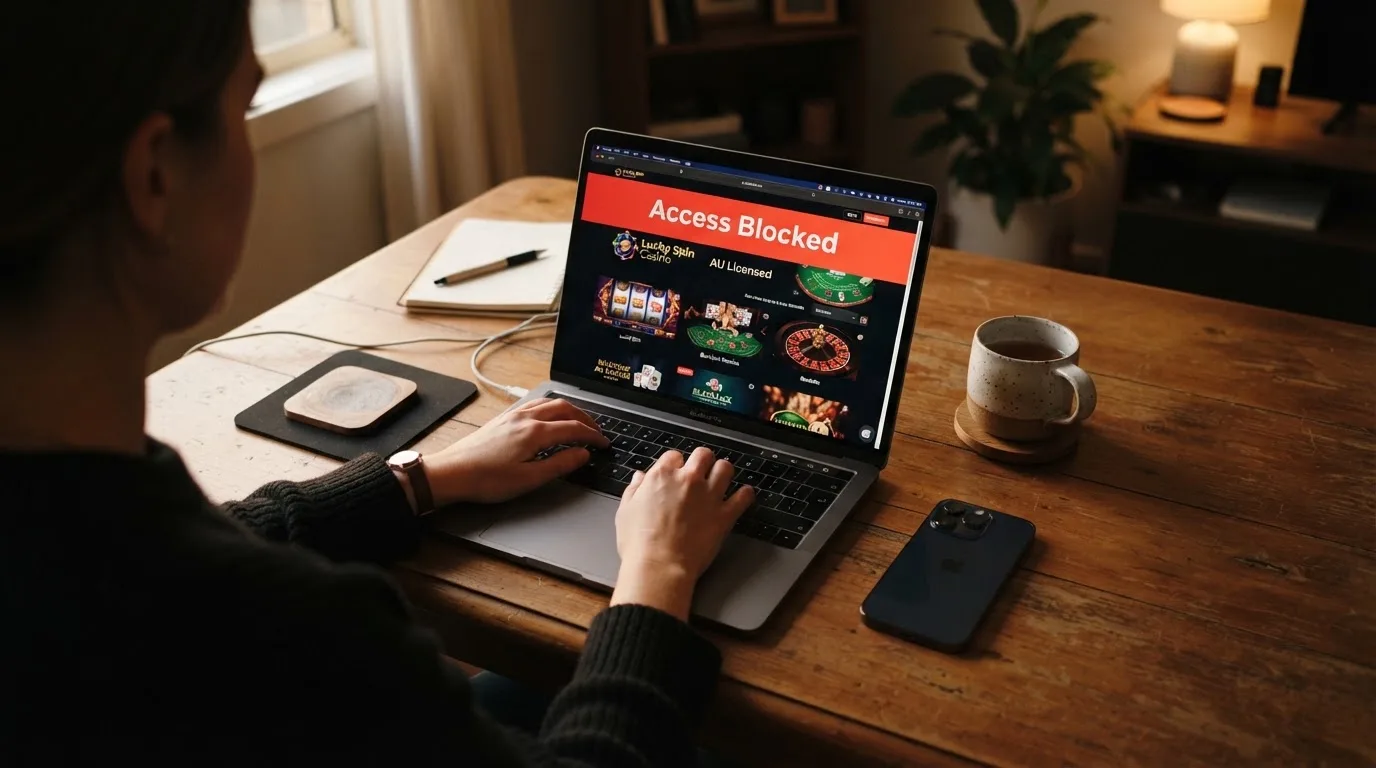
A licence the site displays from Curaçao, Anjouan or a similar offshore regulator is a licence to operate from that jurisdiction, not a licence to take Australian customers. The Interactive Gambling Act 2001 (IGA), as tightened by the Interactive Gambling Amendment Act 2017, makes it an offence to provide online casino games, online pokies or in-play betting to a person physically in Australia; the prohibition lives with the provider, not the player. That is why every operator card below carries the same closing line: online casino games cannot be licensed anywhere in Australia, whatever licence the site displays.
The table below records, for each brand, the operator the ACMA named, the date of the warning and what each entry tells a reader beyond the warning itself.
| Brand | ACMA action and date | Operator named by the ACMA | Subject support |
|---|---|---|---|
| RocketPlay | Formal warning, March 2026 | Pulsup Ltd | — |
| Level Up Casino | Formal warning, May 2022 | Dama N.V. | listings-only |
| Woo Casino | Formal warning, March 2025 | Dama N.V. | — |
| Spirit Casino | Formal warning, May 2025 | Dama N.V. | — |
| National Casino | Formal warning, July 2025 | Consolutetish S.R.L. | listings-only |
| Bizzo Casino | Formal warning, July 2025; prior 2022 action | Consolutetish S.R.L. | — |
| Ignition Casino | Formal warning, July 2025 | Bamboo Media | — |
| Instant Casino | Formal warning, February 2025 | EOD Code SRL | — |
| Jackbit | Formal warning, April 2026 | Ryker B.V. | — |
| Casino Intense | Formal warning, April 2025 | Sterplay Holding Ltd | listings-only |
| Sky Crown | Formal warning, September 2022 | Hollycorn N.V. | — |
The shape of the table tells most of the story already. Seven of the eleven warnings name operators that appear more than once on the list — Dama N.V. on three, Consolutetish S.R.L. on two, with Hollycorn N.V., Ryker B.V., Sterplay Holding Ltd, EOD Code SRL, Bamboo Media and Pulsup Ltd each on one. Two of the operators, Dama N.V. and TechSolutions, have collected warnings across years: the regulator warned Dama N.V. once in 2022 and twice more in 2025, and the same brand surfaced under a different holding company for Bizzo Casino between those dates. The pattern is closer to a regulator working through a small group of operators than to a regulator chasing new entrants.
The “subject support” column, where it carries a value, points to listings pages rather than to the operator’s own statements. A listings-only entry on Level Up Casino, for instance, reflects a third-party directory’s mention of the brand alongside BGaming’s catalogue, not a verified endorsement of the brand by BGaming or anyone else. Where the column is empty, the research that fed this page turned up no listing of the brand by a recognised game supplier or aggregator, which is not the same as confirmation that the brand runs no recognised software.
RocketPlay
Pulsup Ltd, the operator the ACMA named on a formal warning dated March 2026, is the same holding company that already sat on the regulator’s list under Dama N.V. for a 2022 warning covering six brands. A reader who has watched the offshore market will read the name change for what it is: a corporate wrapper around a continuing operation, not a fresh entrant. The site markets itself to Australian players through affiliate pages despite that history.

The ACMA’s action sequence is itself informative. A first formal warning is the regulator’s lightest enforcement step; further warnings on the same operator, and blocklisting the brand with Australian ISPs, follow when the warning is not heeded. RocketPlay has now collected two warnings across different corporate vehicles, and the 2022 set of brands that included Rocketplay was blocklisted in 2023 — the brand name has resurfaced, the operator network has not. That trajectory is the part worth carrying forward from this entry, more than any single offer.
The verdict, then, is not about the brand: it is about the reader situation the brand now occupies. A punter who chooses RocketPlay is choosing an operator the Australian regulator has already had to name twice for the same conduct. The site’s own licence does not change that, because the licence is for a different jurisdiction and a different question. The page is not directing the reader away from the site; it is recording what the regulator has on the public file.
Level Up Casino
Dama N.V. is one of the larger Curaçao-licensed holding companies in the offshore market, and Level Up is one of six brands the ACMA named in a single May 2022 warning. The warning is on the public file; the brand itself continues to operate. A separate listing, on a third-party directory that tracks BGaming’s catalogue, places Level Up alongside other BGaming-titled casinos, which is the most that listings-only evidence tells a reader: the brand appears on a directory, and the directory appears next to a known supplier.
A reader looking at Level Up today is not looking at a fresh entry on the regulator’s list — the 2022 warning is now several years old — but is also not looking at a brand the ACMA has cleared. The same holding company has since collected two further warnings, in March and May 2025, for two of its other brands, which tells a reader how the regulator treats the wider corporate group. For a player who treats the regulator’s name-checks as the floor and not the ceiling, the Level Up entry is a brand that has stayed quiet long enough to age off the front page; for one who treats the operator network as the unit of analysis, the same entry looks like one corner of an active file.
The verdict, then, sits on that choice. The page records the warning and the listing it has, and leaves the reader to weigh a quiet brand against a busy operator.
Woo Casino
Dama N.V. picked up its second warning on the regulator’s list in March 2025, this time over Woo Casino specifically, having already covered six brands under the May 2022 warning. A second warning inside three years is a regulatory signal that the operator’s response to the first one did not satisfy the regulator. The site is one of the better-marketed Dama brands, which is partly why the warning is the kind of step a regulator only takes when an operator has become conspicuous enough to be worth naming again.
For an Australian punter, the Woo Casino entry is the cleanest example on this page of a brand the ACMA has named, then named again when the first warning was not enough. The 2025 action is what separates the Woo entry from the Level Up entry: both belong to the same holding company, but only Woo carries a 2025 action in its own name. A reader comparing the two on that single axis gets a different answer than a reader comparing them on offer or catalogue.
The verdict, in that light, is sharper than the brand’s marketing. Woo Casino is the Dama N.V. brand a regulator has had to warn twice; the page records that and lets it stand.
Spirit Casino
The other half of Dama N.V.’s 2025 pair is Spirit Casino, warned in May 2025 — two months after Woo Casino and on the same holding-company finding. A reader who arrived at the regulator’s formal-warning register after the Woo warning would have found Spirit’s name there within weeks. The pattern is the regulator working through a small group of operators in order, and Spirit’s entry belongs to that pattern.
For a reader comparing Spirit Casino to the other Dama N.V. brands, the May 2025 date is the most current evidence the regulator has published about any brand on this list. The brand is recent enough that the warning is still the freshest fact about it. The site’s own claims are the only thing newer, and a regulator’s name on a warning is the part that has a public file.
The verdict, then, is the brand’s age: a regulator’s 2025 name on a brand the regulator’s 2022 name has already covered is the brand’s clearest published fact.
National Casino
Consolutetish S.R.L., the operator the ACMA named in July 2025, picked up its first formal warning that month, over National Casino and Bizzo Casino together. The pair warning is the regulator’s standard practice when two brands share an operator, and it tells a reader that the holding company is now on the regulator’s list at the level of the operator, not the brand. National Casino carries a third-party listing under its subject-support line, which places the brand alongside other casinos in a directory that catalogues online operators.
For a reader who tracks the offshore market, the National Casino entry is the second of a pair on the same operator; for one who tracks the brand, it is a July 2025 warning on the public file. The two readings do not conflict, but they lead to different conclusions. The page records both.
The verdict is that National Casino is a brand the regulator has named by way of its operator, not by way of a brand-specific finding, and that the directory entry is the only thing beyond the warning.
Bizzo Casino
Bizzo Casino has now collected two formal warnings across two operators. The first, in 2022, named TechSolutions (CY) Group Limited and TechSolutions Group N.V.; the second, in July 2025, named Consolutetish S.R.L. Two operators, two findings, one brand. A reader who treats the operator as the unit of analysis sees a brand that has cycled through wrappers; a reader who treats the brand as the unit sees a brand the regulator has had to warn twice.
The cycle is itself the entry’s point. Holding-company changes are common in the offshore market, and the regulator’s register is built around operators rather than brands, so a brand-level warning can read like a fresh start until the new operator is named in turn. Bizzo Casino is the clearest example of that pattern on this page.
The verdict, then, sits on whether the reader treats the brand or the operator as the unit. The page records both name-checks and the wrapper change between them; the conclusion is the reader’s to draw.
Ignition Casino
Bamboo Media is the operator the ACMA named in its July 2025 warning over Ignition Casino, alongside the Consolutetish S.R.L. action that covered National Casino and Bizzo Casino in the same month. Three brands, two operators, one warning round — that is the regulator working through a slice of the offshore market in a single publication. Ignition Casino is the third of the three, and the only one under Bamboo Media.
For a reader who arrived at Ignition Casino through poker or Bitcoin-friendly marketing, the July 2025 entry is what the regulator’s file now records about the brand. The brand’s own pages, including any licence displayed, are not part of that file. A reader who treats the regulator’s register as the floor finds the Bamboo Media name there; a reader who treats the brand’s licence as the ceiling does not, because the licence is from elsewhere.
The verdict is the brand’s position on the regulator’s register: a brand the regulator has named once, through its operator, in a warning round that also covered two other offshore brands.
Instant Casino
EOD Code SRL is the operator the ACMA named in its February 2025 warning over Instant Casino. The warning is one of several the regulator issued across early 2025 as part of its ongoing enforcement under the IGA, and Instant Casino is the only brand the February warning covered. A reader who compares dates across the table will notice that Instant Casino’s warning precedes the Woo and Spirit warnings by a month, and the Ignition, National and Bizzo warnings by five months — the regulator’s 2025 work moved through the operator list in stages.
For an Australian punter, the Instant Casino entry is a single formal warning on a single operator in a single month. The brand’s own pages continue to advertise to Australian traffic; the regulator’s action continues to sit on the public file. Those two facts coexist on this page without contradiction, because the page is describing the brand, not directing the reader.
The verdict is the warning’s date and operator. The page records both.
Jackbit
Ryker B.V. is the operator the ACMA named in April 2026 over Jackbit and CasinOK together. The April 2026 warning is the most recent operator-level action on this list, and Jackbit is the more visible of the two brands in the warning pair. A reader who follows the regulator’s monthly updates will have seen Ryker B.V. added in the April round; a reader who arrived at Jackbit through a crypto-casino affiliate page will not have.
The brand’s crypto-friendly positioning is what makes a regulator’s 2026 warning worth recording on the same page as the section on crypto and anonymity further down. Jackbit sits at the intersection: a brand marketed to crypto users, named by the regulator for offering prohibited services to Australians. That overlap is the entry’s point.
The verdict, then, is the warning’s recency and the brand’s crypto-marketing posture. The page records both, and a reader who reads both sections finds the same name twice.
Casino Intense
Sterplay Holding Ltd is the operator the ACMA named in April 2025 over Casino Intense. The warning is one of the more quietly-published entries on this list — single brand, single month, no operator overlap with any other brand here. A reader who compares the Casino Intense entry to the Woo or Spirit entries will see a smaller regulatory footprint: one warning, one operator, one date.
The brand carries a listings-only entry that places it alongside several Australian-facing references in the research that fed this page, including the ABC News coverage of the Northern Territory Racing and Wagering Commission and the ACMA’s own register. That is the most a listings-only entry says: the brand appears in third-party contexts alongside Australian regulators’ public work, which is where its subject support ends.
The verdict is the smallest of the eleven: a single 2025 warning on a single operator, with the listings that go alongside it on the public file.
Sky Crown
Hollycorn N.V. is the operator the ACMA named on its formal warning covering Sky Crown and Blue Leo together, published in September 2022. The warning is the oldest operator-level action on this list; Hollycorn N.V. has not resurfaced on a 2025 or 2026 warning round. A reader who treats the regulator’s register as live will read the absence of a follow-up warning as the brand having aged off the regulator’s active list, which is what 2022-dated entries look like.
The brand’s own pages continue to operate, and the absence of a follow-up is itself information. A regulator that warns an operator in 2022 and finds the operator has stopped offering to Australians by 2026 does not need to warn again. A regulator that warns in 2022 and finds the operator has continued, by contrast, issues further warnings — which is what the Dama N.V. and Consolutetish S.R.L. entries show. The Hollycorn N.V. entry, by sitting alone, is its own kind of evidence.
The verdict is the warning’s age and the absence of a follow-up. The page records both.
How the Australian online casino and slots market is shaped in 2026
The Australian online casino market is shaped by a single line that runs through the regulator’s register: every site on a “best Australian casino” list sits offshore, and the regulator’s response to that fact is the work that fills the register. The line is not new — the Interactive Gambling Act 2001, tightened in 2017, has been in place for years — but it has hardened. The ACMA’s blocking requests, formal warnings and named-operator findings have moved from occasional to monthly. The Australian punter who searches for casino sites in 2026 is searching across a market the regulator has been steadily working through.
The numbers carry the scale. By June 2026, the ACMA had asked Australian internet service providers to block 1,751 illegal gambling and affiliate-marketing websites since the first blocking request in November 2019, and more than 230 unlicensed gambling services had left the Australian market since enforcement was strengthened in 2017. The June 2026 round alone added twelve sites: 7Signs, ChromaBet, Donbet, Duospin, Freshbet, Slots Gem, Jacks Club, Lucky Start, Pointsbetz, Spinrise, Vinyl Casino and Wildsino. None of those twelve sits on the table above, because the ACMA’s table of formal warnings and the regulator’s table of blocked sites are separate documents; the first names operators, the second names domains. The market they describe is the same market, viewed through two registers.
The H2 Gambling Capital 2025 estimate, the most-cited current figure for what this market costs Australian players, puts losses to illegal gambling sites at about A$3.9 billion a year and reports that the share of gambling going through legal channels fell from 74% in 2021 to 64%. The first number says where the money is going; the second says it is moving further offshore over time, not less. A reader who hears that the ACMA has been working through the offshore market for years and that the offshore market is still growing will hear those two figures as one story.
The shape of the offshore market itself is mostly familiar to anyone who has watched it: Curaçao-licensed operators dominate the formal-warning register, with Anjouan and other jurisdictions showing up less often; holding companies rebrand their brands every few years and the regulator’s register follows them under new names; crypto-funded deposits sit alongside card deposits on the same brand pages. None of that is a hidden mechanism. The hidden part is the gap between what the brand’s own licence says and what an Australian regulator says about the brand’s right to take Australian customers.
The legal frame: what Australia actually licenses, and what it does not
Australia’s gambling law is split, and the split runs along the line between casino games and wagering. The Interactive Gambling Act 2001 (IGA), as tightened by the Interactive Gambling Amendment Act 2017, makes it an offence to provide online casino games, online pokies or in-play betting to a person physically in Australia. No state or territory issues a licence for those services; that is why no brand on the table above can name an Australian licence for casino games, and why the regulator’s warnings list the same conduct under the same statute every time.
What is licensable is wagering on races and sport placed before the event, lotteries and keno. In practice, most of Australia’s online bookmakers — Sportsbet, Bet365 and Ladbrokes among them — are licensed in the Northern Territory through the Northern Territory Racing and Wagering Commission, for tax reasons. The commission has no full-time staff and meets once a month in Darwin. A reader who wants to verify an Australian licence for wagering is verifying, in practice, a Northern Territory licence; a reader who wants to verify an Australian licence for online casino games is verifying that one does not exist.
Enforcement runs through the ACMA. The regulator investigates, issues formal warnings and directs internet service providers to block illegal sites, and it publishes its blocking requests and warnings as monthly notices. The individual player is not prosecuted; the IGA targets the provider. An offshore site, by the same token, gives an Australian player no Australian consumer protection, no complaints body and no recourse if a withdrawal is refused. A site can be blocked while a balance still sits on it, and the player has no Australian body to call.
The 2026 reform picture is narrow. The Interactive Gambling Amendment (Gambling Reform) Bill 2026 passed Parliament on 19 August 2026, with its advertising and inducement measures commencing on 1 January 2027. The bill is law with a start date, not yet in force on a 2026 page. A reader who searches for it before the commencement date is reading law that has been passed but not yet operative; a reader who searches after that date is reading it under the new measures.
On tax: gambling winnings of a recreational player are not assessable income under section 6-5 of the Income Tax Assessment Act 1997, and losses are not deductible, unless the person carries on a business of gambling. The model answer the ATO gives in practice is “check with the ATO,” and the page records that without going further.
Responsible gambling tools that work inside Australia, and tools that do not reach offshore sites
The Australian responsible-gambling frame is built around licensed wagering, because that is where the regulator’s tools connect. BetStop, the National Self-Exclusion Register, has been live since August 2023 and binds Australian-licensed online and phone wagering services. An offshore casino is not connected to it; a punter who self-excludes through BetStop has excluded themselves from licensed Australian bookmakers and nothing else. The same applies to the deposit limits and time-out tools the licensed Australian bookmakers publish on their sites: those tools exist because the licence requires them, and they exist only on the sites the licence covers.
The tools that do reach the player are national, not licence-bound. The National Gambling Helpline, 1800 858 858, is free, runs 24/7 and connects to Gambling Help Online, which carries chat and counselling. A punter playing on an offshore site that does not advertise any responsible-gambling tools at all — and the offshore sites do not advertise many — still has those national services available. The page records both, because the offshore brand’s silence on responsible gambling is not the same as a player’s silence about it.
A site marketed as “trusted” or “safe” is making that claim about itself, and the claim sits on the site’s own pages rather than on a regulator’s register. The independent limits are the ones that bind the player whether or not the site cooperates: a written budget before the first deposit, a self-imposed time limit, and a refusal to chase a loss by raising the next deposit. Those limits work on any site the player chooses, including the offshore ones, and the page returns to them in the FAQ.
Crypto, anonymity and offshore sites: what the wallet swap actually changes
Crypto-funded gambling, including Bitcoin and Litecoin, runs on the same slot software as card-funded sites. A blockchain wallet sits where a Visa or Mastercard would, the deposit clears in coin instead of in dollars, and the slot catalogue is the same catalogue. The mechanism underneath — the random number generator that decides the result of each spin — is unchanged. That is the most important sentence in this section, because most of the marketing around crypto gambling casinos claims something the maths does not deliver.
What the wallet swap does change is the regulatory frame. Since 11 June 2024, credit cards, credit-related products and digital currency have been banned as payment for licensed online wagering in Australia, with penalties up to A$247,500 for operators. Legal deposit routes for licensed wagering are debit card, bank transfer, PayID/Osko and BPAY. A crypto-funded deposit, on a licensed Australian bookmaker, is illegal under Australian rules. On an offshore site, the crypto deposit is the same deposit the site has been taking in fiat, with the regulator’s view of the brand unchanged.
A site asking an Australian for a credit card or a crypto deposit is operating outside the Australian rules. The sentence is the same for both payment types, and the reason is the same: the prohibition lives with the provider, and a payment method the regulator has named is the one a reader can name back. The crypto-friendly branding on the offshore sites — and several of the brands in the table above sit at this intersection, with Jackbit the clearest example — does not change the regulator’s view of the brand. The regulator’s register is brand-agnostic about payment method, and the warning is the warning whether the deposit clears in dollars or in coin.
Slots and pokies: how the games themselves work, and where the differences sit
A slot machine, whether it lives in a Crown Melbourne back room or on an offshore site’s HTML5 frontend, decides the result of each spin with a random number generator. The generator produces a number for every reel stop on every spin, the number maps to a symbol, the symbols form a combination and the combination pays according to the paytable. The mechanism has not changed since Charles Fey’s late-19th-century three-reel machine, with five symbols per reel and a top prize of ten nickels for three bells in a row. Modern video slots use five or more reels and fifty or more symbols per reel, producing odds as high as 300 million to one against the top combination; the math has scaled up, the architecture has not.
The Australian pokies tradition adds a layer on top. New South Wales legalised slot machines in 1956; by 2010 Australia operated an estimated 97,103 gaming machines outside casinos, a per-capita rate about five times that of the United States. The state-by-state count, as of late 2023, was 87,298 in New South Wales, 26,380 in Victoria, 21,122 in Queensland, 11,672 in South Australia and 3,587 in the ACT. The pokies machine a punter sits down at in a Sydney pub is one of those 87,298, and it runs the same random-number-generator architecture as the offshore site’s online version. The differences between an online slot and a pub pokies machine sit on the surface — reel count, paylines and bonus features — rather than in how the spin is decided.
Some of the architecture’s history is worth knowing. Bally’s “Money Honey,” released in 1963, was the first slot with a bottomless hopper and automatic payout of up to 500 coins without an attendant. The first video slot was developed in 1976 by Fortune Coin Co. in Kearny Mesa, California. The video slot is what makes the modern five-reel, fifty-payline game possible, and the offshore sites run those video slots as a matter of course. A reader who compares the modern online slot to a pub pokies machine on the basis of reel count is comparing the right thing; a reader who compares them on the basis of how the spin is decided is comparing two versions of the same mechanism.
The house edge on the table games the offshore sites run is published and stable. Baccarat’s house edge is 1.06% on the Banker bet, 1.24% on the Player bet and 14.36% on the Tie; blackjack’s edge is about 0.28% under liberal Las Vegas Strip rules and about 0.43% under Atlantic City rules; craps’ Pass/Come bet runs at 1.41%, Don’t Pass/Don’t Come at 1.36% and Any Craps at 11.11%. The numbers are the regulator-neutral baseline, and they are the numbers the punter’s bankroll interacts with whether the game is dealt in a Melbourne back room or in an offshore site’s live-dealer studio.
The legal frame for the table games differs from the frame for slots. Under section 66 of the NSW Casino Control Act 1992, a casino operator must not permit a game such as baccarat to be played unless the game and its rules are approved by the regulator, and the operator must make a copy of the approved rules available to patrons on request. In Victoria, the Casino Control Act 1991 requires the Victorian Gambling and Casino Control Commission (VGCCC) to approve any rules for table games, including blackjack, and any change to those rules, before they are introduced at the Melbourne casino. The VGCCC, which replaced the VCGLR as Victoria’s casino regulator on 1 July 2022, publishes a public log of approved changes — including renaming the “Perfect Pairs” blackjack side bet to “Crown Pairs” on 23 December 2024 and introducing a “Free Bet” option with a new “Pot of Gold” side bet on 25 March 2024. Crown Melbourne offers three baccarat variants — Traditional Baccarat, Crown Baccarat and 2 to 1 Baccarat — as approved table games under the same regime.
Those rules apply inside the Australian casinos. They do not apply to the offshore sites, where the games run under the operator’s own house rules and the regulator’s register, and the regulator’s role is to warn the operator off, not to approve the games. A reader who treats the offshore site’s blackjack ruleset as a Las Vegas Strip or Atlantic City ruleset is reading the game correctly; a reader who treats them as VGCCC-approved is reading a different document.
The pace of regulator action: what the blocking rate implies
The ACMA’s blocking work has a running total and a starting date, and the arithmetic between them is the only piece of calculation on the page. By June 2026, the regulator had asked Australian internet service providers to block 1,751 illegal gambling and affiliate-marketing websites since the first blocking request in November 2019. From November 2019 to June 2026 is roughly 79 months, which gives a blocking rate of about 22 sites per month on average — somewhere between 20 and 25 sites per month across the full period, with the rate varying as the regulator’s monthly notices vary. The June 2026 round alone added 12 sites, so the running total is moving in bursts rather than at a flat pace.
The estimate is a band, not a single figure. The blocking work has not been steady across the seven years since the first blocking request: early rounds added fewer sites as the regulator established its process, later rounds added more as the offshore market grew and affiliate pages multiplied. A reader who treats the rate as flat is averaging across uneven months. A reader who treats the most recent month as the rate is reading one month’s notice as a trend.
The same caveat applies to the market-size estimate. H2 Gambling Capital’s 2025 figure — about A$3.9 billion a year in losses to illegal sites — is an industry estimate, not an audited number, and it sits alongside the regulator’s own observation that the share of gambling going through legal channels fell from 74% in 2021 to 64%. Both figures point in the same direction; both are estimates rather than audits. The arithmetic on the page, like the figures it works from, is a band with its conditions.
The band represents the most reliable estimate available: a regulator working through roughly 22 offshore and affiliate sites per month, on average, since November 2019, and continuing to publish monthly blocking notices. The pace is what a reader can plan around, and the band is the honest way to state it.
What it costs the Australian punter: a closing read
A punter reading this page in 2026 is reading it because a search returned eleven “best Australian casinos” and the regulator’s register returned eleven formal warnings. The two lists are not the same list — one is curated by affiliate pages, the other by the regulator — and they cover the same offshore market. The page’s job is to put both in front of the reader and to leave the choice where it belongs.
The legal frame is the clearest part. Online casino games cannot be licensed in Australia. The licensed wagering market runs through the Northern Territory for tax reasons, the regulator’s enforcement runs through the ACMA, and the responsible-gambling tools run through BetStop and the National Gambling Helpline. The crypto-funded deposits that several of the brands in the table above advertise are not a path through the legal frame; they are a payment method the regulator has banned for licensed Australian wagering, and an unregulated route on offshore sites.
The maths is the next clearest part. A slot is a slot, whether it sits in a Crown Melbourne back room, a Sydney pub or an offshore site’s HTML5 frontend, and the random-number-generator architecture is the same across all three. The baccarat, blackjack and craps house edges are the same edges whether the game is dealt by a Crown dealer under VGCCC rules or by an offshore live-dealer studio under its own house rules. The marketing language around “trusted,” “safe” and “crypto-friendly” does not change the edge; it changes the language the punter reads while the edge takes its cut.
The regulator’s pace is the last part. Roughly 22 sites per month blocked since November 2019, monthly warnings continuing into 2026, and an offshore market that has grown in parallel rather than shrinking. The pace tells a reader how fast the regulator is moving; the parallel growth tells a reader the regulator is moving on a market that is still moving. Neither figure is a forecast. Both are estimates with conditions.
The choice, then, is the reader’s, and the page’s job ends at having put the choice in front of them with the figures the regulator and the math have given.
Frequently asked questions about Australian casino sites and slots
Is real-money online casino gambling legal for someone based in Australia?
No. The Interactive Gambling Act 2001, as tightened by the Interactive Gambling Amendment Act 2017, makes it an offence to provide online casino games, online pokies or in-play betting to a person in Australia. The prohibition lives with the provider; an Australian player is not prosecuted for using an offshore site. What is licensable is wagering on races and sport placed before the event, lotteries and keno, licensed in practice through the Northern Territory. Offshore casino brands accept Australian deposits without an Australian licence, and the ACMA responds with monthly blocking notices and formal warnings to the operator.
How does a slot machine’s random number generator decide the result of a spin?
A random number generator produces a number for every reel stop on every spin, the number maps to a symbol, the symbols form a combination and the combination pays according to the paytable. The architecture has not changed since Charles Fey’s late-19th-century three-reel machine. Modern video slots use five or more reels and fifty or more symbols per reel, producing odds as high as 300 million to one against the top combination. The mechanism is the same on a pub pokies machine and on an offshore site’s online version; the differences sit in reel count, paylines and bonus features, not in how the spin is decided.
Do crypto gambling casinos use the same slot software as card-funded sites?
Yes. A crypto-funded offshore casino runs the same slot catalogue as its card-funded competitors, with a blockchain wallet in place of a Visa or Mastercard and the same random-number-generator underneath. Since 11 June 2024, credit cards, credit-related products and digital currency have been banned as payment for licensed online wagering in Australia. A crypto deposit on a licensed Australian bookmaker is illegal under those rules; on an offshore site, the deposit is the same deposit the site has been taking in fiat, and the ACMA’s view of the brand is unchanged by the payment method.
What is the difference between an online slot and a pub or club pokies machine?
The mechanism is the same — both use a random number generator to decide the result of each spin — and the differences sit on the surface. An online video slot typically uses five or more reels and fifty or more symbols per reel, with multiple paylines and bonus features layered on top. A pub pokies machine, of which New South Wales alone had 87,298 outside casinos in June 2023, runs a similar architecture but with a fixed cabinet, fixed paylines and a fixed stake. Both are subject to the same house edge the paytable encodes; both run the same random-number-generator logic; neither pays out at a rate the venue or operator sets per spin.
Does a site calling itself trusted or safe mean it has been independently checked?
No. A “trusted” or “safe” claim is the brand’s own claim, posted on its own pages. Independent checks live elsewhere: the ACMA’s formal-warning register names operators that have offered prohibited services to Australians, and the regulator’s monthly blocking notices name the domains the ACMA has asked ISPs to block. A punter who treats the brand’s own claim as evidence is reading the brand’s marketing; a punter who treats the regulator’s register as evidence is reading the regulator’s file. The two documents disagree on most of the eleven brands in the table above, and the disagreement is the page’s reason for printing both.
What tools can help someone track and limit time spent playing online slots?
BetStop, the National Self-Exclusion Register, has been live since August 2023 and binds Australian-licensed online and phone wagering services, but not offshore casinos. The National Gambling Helpline, 1800 858 858, is free, runs 24/7 and connects to Gambling Help Online, which carries chat and counselling. A written budget before the first deposit, a self-imposed time limit and a refusal to chase losses by raising the next deposit are the limits that work on any site the punter chooses, including the offshore ones. The licensed Australian bookmakers also publish deposit-limit and time-out tools, but those tools exist because the licence requires them, and they exist only on the sites the licence covers.