
What an “Instant Payout” Casino Promises an Australian Reader — and What It Can’t Legally Offer
The phrase “instant payout” sits at the top of countless affiliate landing pages aimed at Australian readers. It sounds mechanical — a wire fires, a balance clears, money lands. Read it closely and it stops being a technical description and becomes a marketing word sitting on top of a market that the Interactive Gambling Act 2001 closes to the very audience chasing it. The page below takes that gap seriously. It walks through what “instant” means in Australian payments, why no Australian licence backs any of the brands advertising it, what the Australian Communications and Media Authority has done to the operators who claim it, and what a player in Australia actually has access to — which is licensed wagering, land-based venues and BetStop, not online casino games. What an “Instant Payout” Casino Promises an Australian Reader — More on this topic at casino vip .

Data current as of 29 October 2026 · cross-checked against the ACMA’s published formal-warning register.
Table of Contents
- The Australian Shortlist — Read Backwards
- How the ACMA Record Reads in 2026
- What “Instant” Means in Australian Money Rails
- Why the Banks Have Built Their Own Block Layer
- Crypto and the “Instant Withdrawal” Pitch
- Responsible Play, and What BetStop Actually Covers
- What an Australian Reader Can Actually Do
- A Closer Look at Each Brand
- The 2026 Reform Window
- Tax, Briefly
- Calculation — The Blocking Rate
- Frequently Asked Questions
The Australian Shortlist — Read Backwards
Payment Methods in Australia
| Method | Typical Speed | Best Used For |
|---|---|---|
| Osko | Under 1 minute | Fast bank transfers |
| PayID | Under 1 minute | Instant transfers via phone number |
| BPAY | Next banking day | Bill payments |
| Card | 1–3 business days | General transactions |
The Landscape at a Glance
Eleven brands sit below, each pulled onto the page because the ACMA itself published a formal warning over it for serving Australians. They are not ranked by payout speed or bonus size. They share a property: none of them is licensed to offer online casino games in Australia, and the ACMA’s warnings record the regulator’s own view that offering those games here is prohibited. Read in that order, the table tells a reader what is actually on offer in this market — and what isn’t.

| Brand | ACMA action and date | Operator named by the ACMA | Crypto support |
|---|---|---|---|
| RocketPlay | Formal warning, March 2026 | Pulsup Ltd (RocketPlay); earlier Dama N.V., May 2022 | Listings only |
| Level Up Casino | Formal warning, May 2022 | Dama N.V. | — |
| Woo Casino | Formal warning, March 2025 | Dama N.V. | — |
| Spirit Casino | Formal warning, May 2025 | Dama N.V. | — |
| National Casino | Formal warning, July 2025 | Consolutetish S.R.L. | Listings only |
| Bizzo Casino | Formal warning, July 2025; earlier 2022 | Consolutetish S.R.L.; earlier TechSolutions | Listings only |
| Ignition Casino | Formal warning, July 2025 | Bamboo Media | — |
| Instant Casino | Formal warning, February 2025 | EOD Code SRL | Listings only |
| Jackbit | Formal warning, April 2026 | Ryker B.V. | — |
| Casino Intense | Formal warning, April 2025 | Sterplay Holding Ltd | Listings only |
| Sky Crown | Formal warning, September 2022 | Hollycorn N.V. | — |
Crypto support is reported as listings only where third-party directory pages link the brand to a coin option; an em dash where nothing reliable was found. The claim itself is never carried over from a marketing page onto the operator’s standing, because marketing pages are precisely what the ACMA has acted against.
How the ACMA Record Reads in 2026
The Blocking Run, in Context
A blocking rate is the right way to measure how the regulator has used this power. The first blocking request went to Australian ISPs in November 2019; by the round reported on 26 June 2026 the running total stood at 1,751 illegal gambling and affiliate marketing websites blocked, with more than 230 unlicensed services having left the Australian market since enforcement was strengthened in 2017. Over the roughly 79 months from November 2019 to June 2026 that works out to a band of roughly 22 blocked sites per month — not a steady drip, but a continuing cadence in which a handful of brands sit at the centre, reappearing under new company names after earlier warnings.
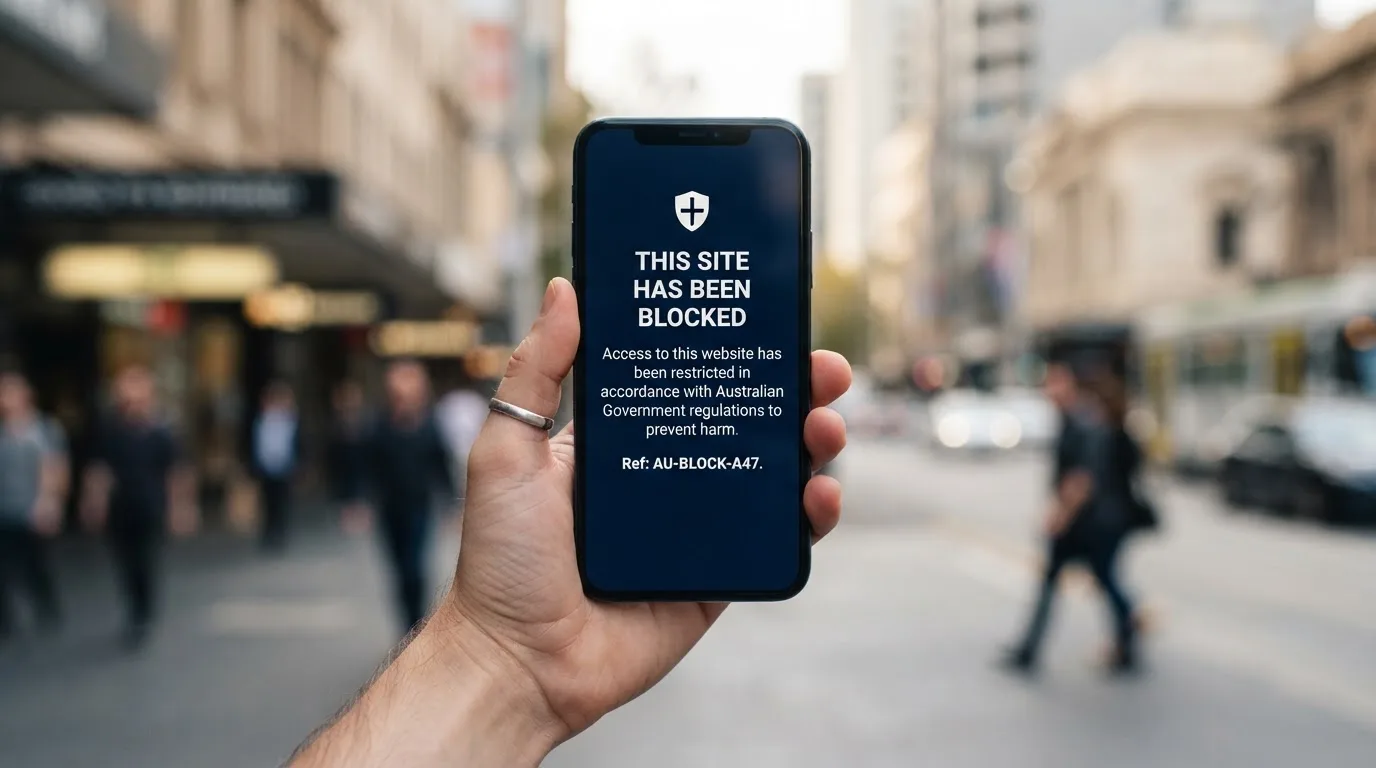
The 26 June 2026 round alone added 12 names: 7Signs, ChromaBet, Donbet, Duospin, Freshbet, Slots Gem, Jacks Club, Lucky Start, Pointsbetz, Spinrise, Vinyl Casino and Wildsino. Read alongside the formal-warning register, the picture is one of a regulator working two levers at once — warning letters to the operating company, and blocking requests to the ISPs — and getting enough compliance that more than 230 services have walked away from the Australian market entirely.
Why the Brand Recurs Under a New Operator Name
RocketPlay’s entry above carries two ACMA dates. May 2022 is the warning to Dama N.V. — at that point covering six brands including Rocketplay, Bambet, Dazard, Level Up, Wild Tornado and Cobra Casinos. March 2026 is a separate warning to Pulsup Ltd over RocketPlay specifically. The brand did not leave the market after the first warning; it resurfaced under a different operating company and was warned again. The same shape sits behind Woo Casino and Spirit Casino — both Dama N.V. properties, warned in March 2025 and May 2025 respectively — and behind National Casino and Bizzo Casino, where Consolutetish S.R.L. drew a July 2025 warning and Bizzo had already been warned back in 2022 to TechSolutions. The pattern is the regulator’s main frustration: warning one company does not close the brand, because the brand sits behind a string of operators.
H2 Gambling Capital’s Estimate of the Leakage
H2 Gambling Capital’s 2025 report put Australian losses to illegal gambling sites at roughly A$3.9 billion a year, and tracked the share of gambling going through legal channels falling from 74% in 2021 to 64%. The first figure is a leakage number — money leaving the regulated perimeter — and the second is the share moving the other way. Read together they describe a market where the legal share has shrunk by ten percentage points in four years, and the absolute spend outside it has stayed large enough to fund a constant rotation of offshore brands.
What “Instant” Means in Australian Money Rails
Osko and PayID — the Genuinely Fast Layer
If “instant” is to mean anything in Australia, it runs over the New Payments Platform, which became accessible to the public on 13 February 2018 and is owned by New Payments Platform Australia Ltd, a non-profit with the Reserve Bank of Australia and the major banks among its 13 shareholders. Two products sit on it. Osko sends a bank-to-bank transfer between participating Australian banks in under a minute, 24/7 including weekends, whether addressed to a BSB and account number or to a PayID. PayID resolves a phone number, email or ABN to a name before the transfer is sent — and the operator of PayID warns that being asked to transfer money to a PayID on an illegal gambling site almost certainly means a scam site. The platform itself enforces a strict service-level: monthly outages of no more than two minutes. By April 2025 more than 25 million PayIDs had been registered, and PayID-based instant transfers were available at over 100 Australian financial institutions.
For a reader wondering what “instant” actually maps to, that is the answer. Anything offshore that claims “instant” settlement into an Australian bank account is, at the receiving end, an Osko transfer or a PayID transfer — and the speed is the rail’s, not the casino’s.
BPAY — the Bill-Payment Layer That Isn’t Built for Speed
BPAY has run in Australia since 1997 and is owned equally, via parent Cardlink Services Limited, by ANZ, Commonwealth Bank, National Australia Bank and Westpac. It is built for bill payment: the payer enters a Biller Code and a Customer Reference Number printed on the bill. It is available in the online banking of over 140 institutions and is offered by over 95,000 businesses. It is not a real-time rail. Any site pitching “instant payout” via BPAY is misdescribing the system — a BPAY instruction settles the next banking day in the typical case, sometimes later if the biller batches. Where the page says “instant”, BPAY is the wrong word.
Digital Wallets and the Card Ban
By the end of 2025, Apple Pay, Google Pay and Samsung Pay together accounted for around 45% of all card payments in Australia by number. The fact matters because, since 11 June 2024, the Interactive Gambling Act has also constrained these wallets for Australian-licensed wagering: Australian-licensed online wagering services cannot accept payment by credit card or other credit-related products, and the wording reaches linked digital wallets. Apple itself does not surcharge consumers for Apple Pay — any surcharge comes from the merchant’s card-processing fees — and Apple states that transaction limits and PIN requirements are set by the card issuer or merchant, not by Apple. The Reserve Bank of Australia’s July 2025 review proposes removing surcharges only on eftpos, Mastercard and Visa, leaving American Express outside the proposed ban; American Express’s three-party network, where the issuer is also the processor, is structurally different from Visa and Mastercard’s four-party model.
For an Australian player, the takeaway is that the fastest domestic rails — PayID and Osko — are open, and that the legal wagering market already runs on them. They are not open for online casino games because no Australian licence covers online casino games.
Why the Banks Have Built Their Own Block Layer
The Card-Level Gambling Block
The big four Australian banks have, over the last few years, added gambling blocks at card level. Westpac’s block refuses authorisation of transactions registered under the merchant category code “Betting/Casino Gambling” on eligible personal credit and debit cards. Commonwealth Bank lets customers apply a gambling lock to eligible cards in the CommBank app, automatically blocking most gambling transactions, with the same caveat the other banks carry: not all gambling-related purchases will be stopped. ANZ’s gambling transaction block, activated in the ANZ app, also blocks gambling transactions made through a digital wallet such as Apple Pay on an eligible card, not just the physical card. Once turned on, ANZ’s block requires a 48-hour waiting period to remove, and the bank warns that not all gambling transactions will be blocked and that some non-gambling transactions might be blocked in error.
These are not warnings to the player. They are switches the player can throw. Their existence narrows the room in which “instant” remains meaningful — the bank decides, at the authorisation step, whether the transaction reaches the merchant at all.
AUSTRAC’s Reporting Threshold, and Why It Doesn’t Bite Here
AUSTRAC’s threshold-transaction-report rule, which requires reporting of transfers of A$10,000 or more, applies only to physical cash. Ordinary electronic bank transfers are not subject to that per-transaction reporting requirement, regardless of the amount sent. A reader who has worried that a large withdrawal will trigger an automatic report can set that worry aside for the electronic path. The rule bites cash, not wires.
Crypto and the “Instant Withdrawal” Pitch
What Crypto Actually Does to Settlement Time
The honest answer is that the rail itself can be near-instant — a transaction confirmed on a major blockchain settles in minutes once broadcast, and on layer-2 networks faster still. The dishonest part is what follows: confirmations at the casino end, manual treasury reviews, and the off-ramp into an Australian bank account, which goes back through PayID or Osko and is bounded by Australian banking hours. The crypto leg is fast. The bank leg is the same fast rail everyone else uses. “Instant” still ends at the same door.
Why Crypto Is the Wrong Path for an Australian Reader
Two reasons. First, since 11 June 2024 the Interactive Gambling Act has banned digital currency as a payment method for Australian-licensed online wagering, alongside credit cards and credit-related products. A licensed operator cannot accept crypto from an Australian. Second, an unlicensed operator is offshore and unregulated by anyone with Australian jurisdiction; a withdrawal refused is a withdrawal the player has no Australian complaint body to chase. The speed is real; the recourse is not.
Responsible Play, and What BetStop Actually Covers
BetStop — the National Self-Exclusion Register
BetStop, the National Self-Exclusion Register, has been live since August 2023 and binds Australian-licensed online and phone wagering services. An offshore casino is not connected to it. A player who has registered with BetStop and then signs up at one of the brands in the table above is still able to deposit, play and lose — the offshore operator does not consult the register. BetStop is the right tool for someone staying inside the licensed perimeter; it is not the right tool for someone who isn’t.
Help Lines That Don’t Care Which Path You Took
The National Gambling Helpline — 1800 858 858 — is free, runs 24/7 and offers chat at Gambling Help Online. The line and the chat service do not restrict themselves to licensed channels. A reader worried about their own play, or about a family member’s, gets the same service regardless of whether the spending happened at a licensed bookmaker, a pokies venue or an offshore site.
What an Australian Reader Can Actually Do
The Legal Set, Briefly
Wagering on races and sport placed before the event, lotteries and keno are licensable in Australia — in practice licensed by the Northern Territory Racing and Wagering Commission, which regulates 52 of Australia’s online bookmakers including Sportsbet, Bet365 and Ladbrokes, and which has no full-time staff and meets once a month in Darwin. Minimum age is 18. Online casino games, online pokies and in-play betting are not licensed anywhere in Australia. The individual player is not prosecuted — the IGA targets the provider — but an offshore site gives no Australian consumer protection, no complaints body and no recourse if a withdrawal is refused, and it can be blocked while a balance is still on it.
The Practical Moves
For someone who wants to keep their spending inside Australian oversight: pick a wagering operator licensed by the NTRWC, deposit via PayID or Osko, set a bank-level gambling block on the card that backs any digital wallet, and register with BetStop if self-exclusion is wanted. For someone who wants to play casino games specifically: there is no Australian-licensed option. Land-based casinos and licensed pokies venues are the only legal channels. The phrase “best instant payout online casino australia” describes a market the Interactive Gambling Act closes, and the page below is honest about that.
A Closer Look at Each Brand
RocketPlay — Two Warnings, Same Brand
The ACMA warned Dama N.V. in May 2022 over six casino brands, with Rocketplay among them. The same brand surfaced again in March 2026 under Pulsup Ltd and was warned a second time. Directory listings carry RocketPlay with crypto payment options. For a reader, the relevant fact is not the directory entry but the recurrence: a brand that has been warned twice under two operators has had every chance to step back from the Australian market and has chosen not to. The site is one to avoid for anyone reading this from Australia.
Level Up Casino — A 2022 Warning That Has Aged into Persistence
Dama N.V. drew the May 2022 warning that covered Level Up Casino along with five sibling brands. Four years later, the brand is still listed in directories and still accepting Australian-facing traffic. The age of the warning is itself the signal: a regulator’s formal warning letter carries no Australian consumer-protection weight and the offshore operator has had time to absorb the cost of it. For a reader, this is a brand the ACMA has named, and nothing has changed.
Woo Casino and Spirit Casino — Dama N.V.’s 2025 Pair
The ACMA issued further formal warnings to Dama N.V. over Woo Casino in March 2025 and over Spirit Casino in May 2025. The two sit close together in time and under the same operator, which suggests a coordinated pattern rather than two isolated oversights. No payment-method detail has been confirmed by an independent source for either brand. The honest line on both is that they have been named by the regulator this year and that they remain outside any Australian protection.
National Casino and Bizzo Casino — A Two-Step Warning History
Consolutetish S.R.L. drew a July 2025 warning over both National Casino and Bizzo Casino. Bizzo’s history goes back further: the ACMA issued a formal warning to TechSolutions (CY) Group Limited and TechSolutions Group N.V. over Bizzo Casino in 2022. Two operating companies, three warnings, one brand. The pattern is the same one the regulator’s enforcement record describes overall. Directory listings continue to list National Casino with PayID and BetStop-visible operator data, but those signals do not change the legal status of the brand in Australia.
Ignition Casino — Bamboo Media’s July 2025 Warning
Bamboo Media drew a July 2025 warning over Ignition Casino. No reliable payment-method detail has been confirmed. The brand sits in the same shape as the rest of the table — an offshore operator warned by the ACMA and continuing to list Australian-facing pages.
Instant Casino — EOD Code SRL, February 2025
EOD Code SRL drew a February 2025 warning over Instant Casino. Directory listings carry Instant Casino with PayID and an ecoPayz option listed at directory level; that is what those listings report, and it is not the operator’s own statement. The brand name reads like a description of the page’s own subject, which is the marketing word the regulator has acted against. A reader who arrived at Instant Casino via an affiliate link has arrived at exactly the kind of page the ACMA has been blocking.
Jackbit — Ryker B.V., April 2026
Ryker B.V. drew an April 2026 warning over Jackbit and CasinOK together. The most recent warning on the table, and the one closest to the date the ACMA’s blocking record was last refreshed. No payment-method detail has been confirmed. The brand sits in the same shape as the rest.
Casino Intense — Sterplay Holding, April 2025
Sterplay Holding Ltd drew an April 2025 warning over Casino Intense. Directory listings carry the brand with AUSTRAC and BetStop references at directory level. The references do not change the legal status: an offshore operator is not bound by AUSTRAC’s reporting rules in the same way an Australian-licensed one is, and an offshore operator is not connected to BetStop.
Sky Crown — Hollycorn N.V., September 2022
Hollycorn N.V. drew a September 2022 warning over its Sky Crown and Blue Leo casino services. Sky Crown is the older warning on the table, which makes it the test of whether time changes anything: it hasn’t. The brand is still listed in directories, still serving Australian-facing pages, still outside any Australian protection regime. For a reader, this is the clearest illustration of what a formal warning from the ACMA does and does not do — it does not close the brand.
The 2026 Reform Window
The Interactive Gambling Amendment (Gambling Reform) Bill 2026
The Interactive Gambling Amendment (Gambling Reform) Bill 2026 passed Parliament on 19 August 2026. Its advertising and inducement measures commence on 1 January 2027. The phrasing matters — a law with a start date is not yet in force on a 2026 page. For an Australian reader, the relevant reading is that the regulatory perimeter around advertising is about to tighten, not that it has already tightened. The blocking regime, the formal-warning regime, and the bank-level blocks all sit ahead of that start date.
Tax, Briefly
Gambling winnings of a recreational player are not assessable income under section 6-5 of the ITAA 1997, and losses are not deductible. The exception is a person carrying on a business of gambling, which is a different category and a different return. For a casual reader the rule is simple: keep records if a win is large enough to bother recording, but don’t expect a refund on losses. The ATO is the right source for a borderline case.
Calculation — The Blocking Rate
Inputs from the ACMA’s published record: 1,751 illegal gambling and affiliate marketing websites blocked in total as reported in June 2026; the first blocking request went to Australian ISPs in November 2019. That span covers roughly 79 months. Dividing gives a band of around 22 blocked sites per month on average. The right way to read the figure is as a cadence rather than a rate per regulator action — the ACMA does not block 22 sites every month, it runs batches of roughly a dozen at a time, several times a year, and the months between batches carry no blocks at all. The blocking rate is a long-run average over months in which the regulator chose to act, not a per-month flow.
What the figure is information for: it tells an Australian reader that the ACMA has used this lever continuously since 2019, and that more than 230 unlicensed services have left the market entirely over the longer arc from 2017. The blocking rate is one part of that longer record; the other part is the formal-warning register that names the operating companies behind the brands. Together they describe a regulator that has been working the same problem for the better part of a decade, with measurable effect at the exit end and a continued rotation at the entry end.
Frequently Asked Questions
Does instant payout mean the money is truly available immediately?
No — at the Australian end it means the receiving bank credits the account in under a minute via Osko or PayID. The casino side still has to approve the withdrawal, and offshore operators are not bound by the New Payments Platform’s two-minute outage cap.
Which Australian payment rail is built for near-instant transfers?
Osko and PayID, both sitting on the New Payments Platform. PayID-based instant transfers are available at over 100 Australian financial institutions, and more than 25 million PayIDs had been registered by April 2025.
Is it legal for an online casino to advertise instant payouts to Australians?
No. The Interactive Gambling Act 2001 prohibits offering online casino games to anyone in Australia, and the ACMA has issued formal warnings over multiple operators doing exactly that. The Advertising Reform provisions of the 2026 Bill tighten this further from 1 January 2027.
Can a cryptocurrency withdrawal really be instant?
The blockchain leg can be near-instant. The off-ramp into an Australian bank account goes back through PayID or Osko and is bounded by the same receiving-bank rules as any other transfer. Crypto is also banned as a payment method for Australian-licensed online wagering since 11 June 2024.
What verification steps can delay an otherwise instant payout?
Know-your-customer checks at first withdrawal, source-of-funds reviews above thresholds, and the casino’s own anti-fraud queue. Each of these can sit on a withdrawal for hours or days. The “instant” claim is the time after those checks pass, not the time from the player clicking withdraw. See also Instant withdrawal casinos in Australia .
Should a claimed instant payout change how much someone trusts a site?
It should change it the other way. “Instant payout” on a brand the ACMA has warned is a marketing word sitting on top of an unregulated operator. The honest signal is the brand’s absence from any Australian register, not the speed at which it claims to send money.