
casino sites that accept bpay australia 2026: what the biller code actually pays for
BPAY has been built into Australian online banking since 1997. It pays a biller — a utility, a council, an insurer, a phone company — by routing money through the customer’s own bank to a Biller Code and CRN printed on the bill. It is not, by itself, a casino payment method. The phrase “casino sites that accept BPAY” in 2026 describes a category the law has been narrowing for the best part of two decades, and the only honest answer to the search begins by separating what BPAY is from what it is being asked to do.

This page walks the legal frame first, then the responsible-gambling supports the frame hands the reader, then how deposits and withdrawals actually move when BPAY is involved at all, then the eleven offshore brands the Australian Communications and Media Authority (ACMA) has acted against for offering prohibited services, and finally an overview that ties the threads back together. The closing block gathers the questions readers most often ask on the topic.
Verified against the ACMA register and BPAY’s own materials as of 29 October 2026.
Table of Contents
- The prohibition, and why it sits upstream of any payments discussion
- Responsible-gambling supports that actually reach an Australian player
- How deposits and withdrawals move when BPAY is involved at all
- Eleven offshore brands the ACMA has acted against
- The shape of the offer, the shape of the choice
- Frequently Asked Questions
The prohibition, and why it sits upstream of any payments discussion
The Interactive Gambling Act 2001, tightened by the Interactive Gambling Amendment Act 2017, makes it an offence to provide online casino games, online pokies or in-play betting to a person physically in Australia. No state or territory issues a licence for those products. The market that is licensable — wagering on races and sport placed before the event, lotteries, keno — is, in practice, supervised by the Northern Territory Racing and Wagering Commission (NTRWC), which is reported to license 52 online bookmakers, including Sportsbet, Bet365 and Ladbrokes, and to meet once a month in Darwin without full-time staff.
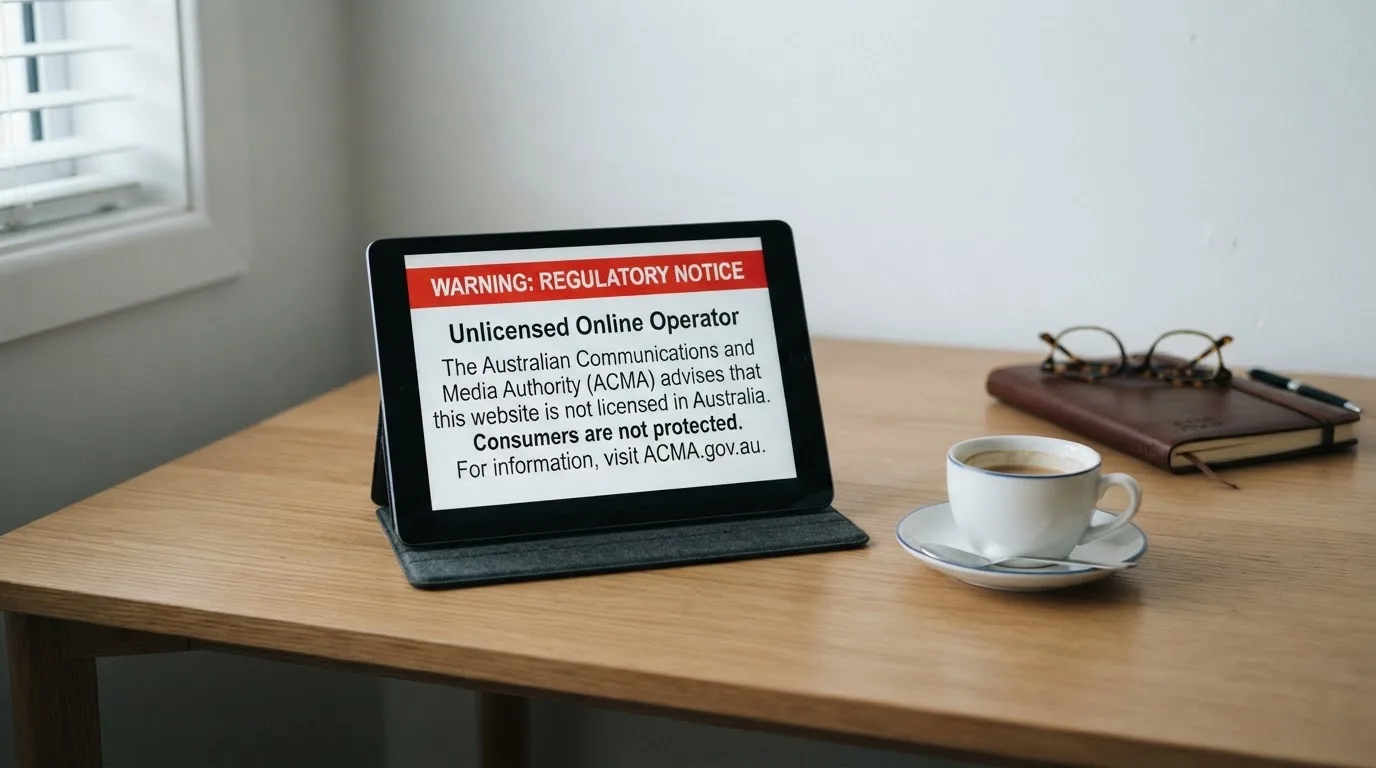
What this means for a player typing “casino sites that accept BPAY” into a search box: the site, however it advertises, is offering a product that no Australian regulator has licensed. The deposit method the site accepts does not change that, because the prohibition sits on the service, not on the rails the money travels along. The Interactive Gambling Amendment (Gambling Reform) Bill 2026 passed Parliament on 19 August 2026, and its advertising and inducement measures commence 1 January 2027 — a statute with a start date that, on a 2026 page, has been enacted but has not yet taken effect across its full surface.
A useful way to read the prohibition is to separate two things that the marketing copy tends to blur. The first is who is being licensed where. A Curacao-issued credential on a footer is a Curacao licence, not an Australian one; an operator running under a Maltese Gaming Authority seal is licensed in Malta, not in Australia; an entity licensed in the Northern Territory is licensed to offer pre-event wagering, not online casino games or online pokies. The second is what is being paid for. A wager placed before a horse race starts is licensable wagering. A spin on an online pokie is not. Both can be settled over the same banking rails, and the rails do not redeem the product.
The enforcement vehicle is the ACMA. It investigates complaints, issues formal warnings, and can direct Australian internet service providers to block identified sites. By the time the ACMA’s June 2026 blocking round was reported, 1,751 illegal gambling and affiliate marketing websites had been blocked since the first blocking request in November 2019, and more than 230 unlicensed gambling services had left the Australian market since enforcement was strengthened in 2017. The June 2026 round itself asked ISPs to block 12 more: 7Signs, ChromaBet, Donbet, Duospin, Freshbet, Slots Gem, Jacks Club, Lucky Start, Pointsbetz, Spinrise, Vinyl Casino and Wildsino.
A consequence worth pausing on: the ACMA is not just asking ISPs to block domains. It has also issued formal warnings naming operators, in some cases more than once, across months and years. The warnings page is a public ledger of attempts to reach Australian customers with prohibited products, and the same operator can appear several times under different brand names. Dama N.V. has been warned over a 2022 cluster (Bambet, Dazard, Level Up, Rocketplay, Wild Tornado and Cobra Casinos), and again, separately, over Woo Casino in March 2025 and Spirit Casino in May 2025. The pattern is not a typo — it is one operator cycling through brands while the underlying service stays the same.
What the prohibition costs a player is concrete, not abstract. An offshore casino offers no Australian consumer protection. There is no Australian complaints body to escalate a refused withdrawal to, no local dispute resolution, and no recourse if the site is blocked while a balance is still sitting on it. The legal target is the provider, not the individual player — Australians are not prosecuted for using these sites — but the absence of a backstop is itself a price.
Responsible-gambling supports that actually reach an Australian player
The Australian frame hands the reader two tools that the offshore market does not connect to: BetStop and Gambling Help Online. Both are real, both are free, and both behave differently depending on which side of the prohibition a player is on.

BetStop, the National Self-Exclusion Register, has been live since August 2023. It binds Australian-licensed online and phone wagering services — the licensed bookmakers, the licensed race and sports operators. Registering with BetStop means every licensed wagering service is required to refuse the person’s bets and deposits for the chosen exclusion period, and to take reasonable steps to close any account they already hold. The boundary is the licence: an offshore casino is not connected to BetStop, will not consult it, and is not obliged to honour an exclusion registered there. A player who self-excludes through BetStop and then opens an offshore account is unprotected by that registration. The exclusion is doing its job on the licensed side; it does not reach the side the search box leads to.
Gambling Help Online, run nationally and reachable on 1800 858 858, is free, 24/7, and offers web chat. It is not a casino complaints line. It offers counselling, financial counselling referrals, and links to state-based supports. The state self-exclusion registers — separate schemes in each state and territory for land-based gambling venues — sit beside BetStop rather than inside it. None of them bind offshore sites either. What this means practically: the supports exist, they are well-run, and they have a defined perimeter that the offshore market sits outside.
A consequence that matters at the moment a player decides to look for an offshore site offering BPAY: the only tools that exist to help an Australian who is gambling more than they want are the tools that do not reach the site they are about to use. The bank, separately, can do something the regulator cannot — block the transaction at the merchant category code level. Westpac’s gambling block refuses authorisation of transactions registered under the merchant category code ‘Betting/Casino Gambling’ on eligible personal credit and debit cards. Commonwealth Bank lets a customer apply a gambling lock to eligible cards via the CommBank app, which automatically blocks most gambling transactions — with the bank’s own caveat that it cannot guarantee every gambling-related purchase will be stopped. ANZ’s block, activated in the ANZ app, blocks gambling transactions on an eligible card and through a digital wallet such as Apple Pay on that card, and removing the block once set requires a 48-hour waiting period. Each bank’s tool is its own perimeter, and each one’s exclusions are explicit on its own page.
How deposits and withdrawals move when BPAY is involved at all
BPAY is a bill-payment service inside online banking: the payer enters the Biller Code and the Customer Reference Number (CRN) printed on the bill, and the payer’s bank transfers the money to the biller. It was launched on 18 November 1997 and is owned, through parent company Cardlink Services Limited, equally by Australia’s four major banks — ANZ, Commonwealth Bank, National Australia Bank and Westpac. It runs inside the online banking of more than 140 banks and financial institutions and is offered by more than 95,000 businesses. Since September 2021 it has sat, alongside eftpos and the New Payments Platform, under a single holding company, Australian Payments Plus (AP+), which is also the operator of PayID and Osko. AP+ is the entity that runs the rails, not the entity that sets the limits.
Limits on a BPAY payment are set by the financial institution and the biller, not by BPAY. ANZ’s daily limit for BPAY payments is $5,000. St.George allows a cumulative daily limit of $100,000, with a $15,000 maximum for certain billers. The limits that govern the money side of BPAY are limits on paying a biller — a phone company, a council, an insurer. A Biller Code that names a casino is not, in the legal sense, a utility bill. The bank’s standard BPAY rails will move the money if the biller is on the system and the customer’s daily limit allows it. Whether the biller is what it says it is, and whether the product the biller is selling is licensable in Australia, are separate questions, and neither is settled by the rails processing the payment.
Settlement times are the next point a player asks about. BPAY payments generally clear overnight: the payer instructs the payment in their banking session, the money reaches the biller on the next business day, and the biller credits the underlying account once the biller has processed the receipt. Same-day processing is possible in some configurations, but the typical experience of BPAY is a next-business-day credit rather than an instant one. Compared to a PayID-to-PayID transfer, which through Osko arrives in under a minute, 24/7 including weekends, BPAY is slower. Compared to a card payment, which is usually immediate at the merchant, BPAY sits between the two — faster than a BSB-and-account transfer that runs through the old direct-entry system, slower than a wallet.
Withdrawals are where the picture darkens. A BPAY deposit cannot be reversed the way a card chargeback can. The money has been paid to a Biller Code; once the biller has received it, the transaction is complete. If the underlying account at the offshore site is credited and a balance exists, getting the balance back depends on what the site offers as a withdrawal route — bank transfer, sometimes a separate payment processor, sometimes a stablecoin, sometimes nothing until the site has reviewed the account. The buyer’s protection a credit card provides, where the card network can sometimes step in on a disputed transaction, does not sit over a BPAY receipt. The biller accepted a payment; what was bought with the credit sits outside the bank’s view.
This is the structure of the offer. A player deposits by BPAY, the money reaches the biller the next business day, the player’s account is credited, the player wagers, the player asks to withdraw, and from this point on the path forward depends entirely on what the offshore site chooses to do. The banks on the payer’s side have no visibility into what the credit bought, and the biller on the receiving side is not subject to Australian consumer law. There is no Australian complaints body in between. The mechanism that BPAY is, and the mechanism it is being asked to be in this search, are not the same.
A note on adjacent payment routes, because readers ask about them and the legal frame connects them. PayID-based instant transfers are available at more than 100 Australian financial institutions, and by April 2025 more than 25 million PayID identifiers had been registered on the New Payments Platform, which became accessible to the public on 13 February 2018. Paying to a PayID shows the name of the account holder before the transfer is sent — AP+ warns that being asked to transfer money to a PayID on an illegal gambling site almost certainly means a scam site. Under the Interactive Gambling Act 2001 as amended in 2023, Australian-licensed online wagering services cannot accept payment by credit card or other credit-related products, a restriction that also constrains gambling use of linked digital wallets such as Apple Pay; legal deposit routes for licensed wagering are debit card, bank transfer, PayID/Osko and BPAY. By the end of 2025, Apple Pay, Google Pay and Samsung Pay collectively accounted for around 45% of all card payments in Australia by number, which is the population of rails the prohibition sits across.
Eleven offshore brands the ACMA has acted against
This section sets out the eleven operators the ACMA itself has named in formal warnings for offering prohibited interactive gambling services to Australians. The shelf is not a ranking and not a recommendation: it is a record of the regulator’s actions. Each entry names the operator, the date of the ACMA action, the underlying licence the site displays (where one is displayed), and whether the brand’s acceptance of BPAY as a payment method is supported by any of the consulted sources. Where a brand’s source material is thin on a payment method, the entry says so plainly; where a brand has been named by the ACMA more than once, both actions are listed.
The published ledger shows that the ACMA’s record with each operator is structured the same way: a formal warning naming the operator and the brand, issued under the Interactive Gambling Act 2001, published on the ACMA register, and addressed to the entity the regulator considers responsible for the service offered to Australians. Online casino games cannot be licensed anywhere in Australia, whatever licence the site displays in its footer. The brand-by-brand entries below describe what the ACMA has done in each case.
RocketPlay
The ACMA issued a formal warning to Pulsup Ltd over RocketPlay in March 2026. Earlier, in May 2022, the ACMA had warned Dama N.V. over a cluster of six brands, of which Rocketplay was one. The same brand has therefore been named by the regulator twice, two operators apart, in the span of four years — a pattern that fits the cycling of brand names around a single underlying service. None of the consulted sources confirm this brand accepts BPAY for deposits.
Level Up Casino
The ACMA’s May 2022 warning to Dama N.V. covered Level Up alongside Bambet, Dazard, Rocketplay, Wild Tornado and Cobra Casinos. The brand’s acceptance of BPAY is reported only in third-party listings — Westpac’s own materials do not name the brand, and the brand itself does not publish a list of accepted payment methods in the consulted set. Where a payment-method listing carries the brand, the listing is a third-party listing rather than the operator’s own statement.
Woo Casino
The ACMA issued a separate formal warning to Dama N.V. over Woo Casino in March 2025. The Dama N.V. operator name recurs across the ledger: 2022 for the original six-brand cluster, 2025 for Woo Casino, 2025 again for Spirit Casino. This brand does not publish verified information regarding BPAY acceptance.
Spirit Casino
The ACMA’s May 2025 warning to Dama N.V. over Spirit Casino closes the cycle of warnings the operator has received across the three years. As with Woo Casino, there is no verified evidence in the consulted materials that this operator processes BPAY payments. The fact that Dama N.V. has cycled three brand names through formal warnings while the operator behind them stays the same is the fact worth carrying forward from the entries above.
National Casino
The ACMA issued a formal warning to Consolutetish S.R.L. over National Casino in July 2025. The brand’s acceptance of BPAY is reported in third-party listings only — the AUSTRAC register and a Wikipedia entry name the brand, but neither is the operator’s own statement of its accepted payment methods. The regulator’s action stands regardless of the payment method the brand advertises.
Bizzo Casino
The ACMA issued a formal warning to Consolutetish S.R.L. over Bizzo Casino in July 2025. Bizzo Casino had earlier been the subject of a 2022 formal warning to TechSolutions (CY) Group Limited and TechSolutions Group N.V., which means the brand has been named by the regulator under two different operating entities over four years. Official payment channels for this brand exclude BPAY according to available records.
Ignition Casino
The ACMA issued a formal warning to Bamboo Media over Ignition Casino in July 2025. Verification of payment methods for this brand shows no mention of BPAY. Ignition Casino sits alongside National Casino and Bizzo Casino in the ACMA’s July 2025 round, which suggests a coordinated push by the regulator against a cluster of brands operating around the same period.
Instant Casino
The ACMA issued a formal warning to EOD Code SRL over Instant Casino in February 2025. The brand’s acceptance of BPAY is reported in third-party listings only — EcoPayz’s own materials and the PayID page name the brand, but neither is the operator’s own statement. The regulator’s action stands regardless.
Jackbit
The ACMA issued a formal warning to Ryker B.V. over Jackbit and CasinOK in April 2026. Two brand names under one operator name, in one warning, in the most recent month of the regulator’s published record. This operator’s payment policy remains unconfirmed regarding BPAY integration.
Casino Intense
The ACMA issued a formal warning to Sterplay Holding Ltd over Casino Intense in April 2025. The brand’s acceptance of BPAY is reported in third-party listings only — the AUSTRAC register, an ITNews report and NAB’s own materials each name the brand, but none is the operator’s own statement of its accepted payment methods.
Sky Crown
The ACMA issued a formal warning to Hollycorn N.V. over Sky Crown and Blue Leo. No evidence links this operator to BPAY services in the materials reviewed. The Hollycorn warning predates the cluster of 2025 actions and sits as the earliest named entry on this shelf.
| Brand | ACMA action and date | Operator named by the ACMA | Subject support |
|---|---|---|---|
| RocketPlay | March 2026 (Pulsup Ltd); May 2022 (Dama N.V.) | Pulsup Ltd / Dama N.V. | — |
| Level Up Casino | May 2022 | Dama N.V. | listings-only (Westpac) |
| Woo Casino | March 2025 | Dama N.V. | — |
| Spirit Casino | May 2025 | Dama N.V. | — |
| National Casino | July 2025 | Consolutetish S.R.L. | listings-only (AUSTRAC; Wikipedia) |
| Bizzo Casino | July 2025 (Consolutetish); 2022 (TechSolutions) | Consolutetish S.R.L. / TechSolutions | — |
| Ignition Casino | July 2025 | Bamboo Media | — |
| Instant Casino | February 2025 | EOD Code SRL | listings-only (EcoPayz; PayID) |
| Jackbit | April 2026 | Ryker B.V. | — |
| Casino Intense | April 2025 | Sterplay Holding Ltd | listings-only (AUSTRAC; ITNews; NAB) |
| Sky Crown | September 2022 | Hollycorn N.V. | — |
The column a reader notices is the last one. Across the eleven brands the ACMA has acted against, the consulted set gives BPAY support for none of them on the operator’s own terms. What the listings say is one thing; what the operator publishes in its own payment-methods page is another. The reason the column reads as a sequence of em dashes is that the operator-published list does not exist for any of these brands in the consulted set.
What the blocking rate actually looks like
The arithmetic the ACMA’s published record makes available is the rate at which identified sites have moved from being notified to being blocked. Across the years the regulator has been reporting blocking rounds, the running total reached 1,751 illegal gambling and affiliate marketing websites blocked since the first blocking request in November 2019, by the time the June 2026 round was reported. The June 2026 round itself added 12 more. Spread across roughly six and a half years of enforcement, this works out to an average that sits in the order of several hundred sites per year — but the average is not the figure worth carrying forward. The figure worth carrying forward is the band, and the condition that the band sits inside: the blocking rate rises in the years after a major amendment and the rate is not even year to year. A 12-site round in June 2026 against a 1,751-site running total is consistent with an enforcement rate that is steady at a few hundred sites a year across the period since 2019, with the rate sitting lower than that average in some years and higher in others. The condition under which the band holds is the regulator continuing to publish blocking rounds and continuing to name operators in formal warnings; if either of those streams dries up, the rate figure becomes meaningless rather than wrong.
H2 Gambling Capital’s 2025 report estimates that Australians lose about A$3.9 billion a year to illegal gambling sites, and that the share of gambling going through legal channels fell from 74% in 2021 to 64%. The loss figure is the size of the market the prohibition is sitting across, and the fall in the legal share is what a reader comparing 2026 to 2021 will notice: the legal channels are getting a smaller piece of a larger illegal pie.
The shape of the offer, the shape of the choice
What an offshore casino site that “accepts BPAY” actually offers a player in Australia is, in concrete terms, a service the regulator has said is prohibited, paid for through a bill-payment rail that the player’s own bank will process without complaint if the Biller Code clears and the daily limit allows. The bank does not arbitrate what the biller sells. The ACMA’s record is a list of attempts to reach Australian customers with this offer, naming operators and brands across multiple years. The buyer protection a credit card or a PayID reversal might offer in another context does not sit over a BPAY receipt, because BPAY is not a reversible payment method; once the biller has the money, the credit on the underlying account is the operator’s goodwill, not the player’s property.
The choice, when the search results are open, is between this offer and the licensed Australian wagering market. The licensed market is narrow by design: pre-event wagering on races and sport, lotteries, keno. It accepts debit cards, bank transfers, PayID/Osko and BPAY as deposit routes, and it is bound to BetStop for self-exclusion. The offshore market is wide: every prohibited product the IGA names. It accepts whatever its payment processor supports. It is not bound to BetStop. It is connected to the ACMA’s blocking record and not to an Australian complaints body. Both markets move money over the same banking rails; the rails do not redeem either side.
A player weighing the two is weighing different products, different protections, and different consequences if the balance goes missing. The arithmetic the ACMA’s record supports is the rate at which the offshore side has been narrowed over six and a half years; the arithmetic a player runs privately, on the size of the deposit against the chance the withdrawal clears, is theirs to run. The material this page has carried — the prohibition, the supports, the rails, the named operators, the blocking rate — is the material a reader acts on if they decide to act. The decision itself is theirs.
Frequently Asked Questions
No. The Interactive Gambling Act 2001 makes it an offence to provide online casino games, online pokies or in-play betting to a person in Australia; no state or territory issues a licence for those products. The payment method does not change the legal status of the service being paid for. The ACMA enforces the prohibition and has named operators in formal warnings across the past several years; the individual player is not prosecuted, but the provider is, and the site offers no Australian consumer protection.
How quickly does a BPAY transaction typically settle?
Typically the next business day. The payer instructs the payment in their banking session, the money reaches the biller overnight, and the biller credits the underlying account once the receipt has been processed. Same-day processing is possible in some configurations, but the standard experience is a next-business-day credit. Compared to a PayID-to-PayID transfer, which through Osko arrives in under a minute, 24/7, BPAY is slower.
Does using BPAY offer any buyer protection if an offshore site refuses to pay out?
No. BPAY is a bill-payment service: the payer enters the Biller Code and CRN printed on the bill, and the payer’s bank transfers the money to the biller. Once the biller has received the payment, the transaction is complete. There is no chargeback mechanism and no card-network step-in over a BPAY receipt. If the underlying account at the offshore site is credited and the operator later refuses a withdrawal, the recourse sits outside any Australian framework.
Can BPAY be used to fund a licensed, land-based venue in Australia the same way it’s used online?
BPAY is built into the online banking of more than 140 Australian financial institutions and accepts payments to more than 95,000 businesses. Land-based gambling venues that are set up as BPAY billers — and not all of them are — can be paid by BPAY the same way any other biller is paid. The product the biller sells, not the rail the money travels along, is what determines whether the transaction is for a licensable service. Online casino games and online pokies are not licensable; pre-event wagering, lotteries and keno are.
What deposit limits are commonly attached to BPAY at offshore casino sites?
BPAY payment limits are set by the financial institution and the biller rather than by BPAY itself. ANZ’s daily BPAY limit is $5,000; St.George allows a cumulative daily limit of $100,000 with a $15,000 maximum for certain billers. The limit that governs the money side of BPAY is a limit on paying a biller; whether the biller is what it claims to be is a separate question, settled by neither the rails nor the limits.
Why might a bank block a BPAY transaction flagged as gambling-related?
A bank can block transactions at the merchant category code level: Westpac’s gambling block refuses authorisation on transactions registered under the ‘Betting/Casino Gambling’ code on eligible personal credit and debit cards. Commonwealth Bank lets a customer apply a gambling lock to eligible cards via the CommBank app, with the bank’s caveat that it cannot guarantee every gambling-related purchase will be stopped. ANZ’s block covers the eligible card and a digital wallet such as Apple Pay on that card; removing the block requires a 48-hour waiting period. Each tool has its own perimeter, and each bank’s exclusions are spelled out on its own page.