
What the phrase “best low volatility slots” means in Australia this year, and why the shortlist you were hoping for does not exist
A punter who searches for a list of the best low volatility slots in Australia wants something an Australian publication cannot honestly give them: a ranked shortlist of online casinos running low-volatility pokie-style games, with bonus terms and payout speeds. The Interactive Gambling Act 2001, tightened by the 2017 amendments and left unchanged on this point by the 2026 reform package, prohibits offering online casino games — including online pokies — to anyone physically in Australia, and no state or territory issues a licence for the activity. A “best of” list, with stars and welcome offers, would describe operators that the regulator itself has told to stop. So this page does not produce that list. It walks through what low volatility actually means, why the gambling landscape here makes that shortlist impossible, what the ACMA has done about it through 2026, and where a player who wants a low-volatility experience can actually sit down to one.
Data current as of 29 October 2026, verified against the Australian Communications and Media Authority’s published register of formal warnings and blocking actions.
Table of Contents
- The legal landscape for low volatility slots in Australia
- How the ACMA has been enforcing the prohibition
- Responsible gambling for someone who was about to search for low volatility slots
- The shape of a low volatility slot
- What is actually available to an Australian reader who wants a low-volatility session
- Operators the ACMA has warned — what each record actually says
- What the absence of a low-volatility shortlist actually means for the reader
- Frequently asked questions
The legal landscape for low volatility slots in Australia
Australia’s online gambling market is split down the middle, and the split sits exactly where most readers expect a list to appear. The Interactive Gambling Act 2001 makes it an offence for a provider to offer interactive gambling services to a person who is physically in Australia — online casino games, online pokies and in-play betting all sit on the prohibited side. Wagering on races and sporting events placed before the event, lotteries and keno sit on the licensable side, and in practice the Northern Territory Racing and Wagering Commission handles most of those licences: fifty-two of Australia’s online bookmakers — Sportsbet, Bet365, Ladbrokes among them — are licensed in Darwin for tax reasons, and the commission itself runs with no full-time staff and meets once a month. That is the entire licensable online market. Every online casino pitching low volatility slots to an Australian reader is operating outside it, whether the footer of its website claims a Curaçao licence, a Kahnawake registration, or an Anjouan approval.

The practical consequences flow downhill from that single fact. An individual player is not prosecuted — the IGA targets the provider, not the punter — but an offshore site gives the player no Australian consumer protection, no Australian complaints body, and no recourse if a withdrawal is refused. The site can be blocked by the regulator while a balance still sits in the account. The 2024 ban on credit cards and crypto as payment methods for licensed wagering does not reach these sites at all, because they are not licensed wagering; if a site is asking an Australian for a credit card deposit or a Bitcoin transfer, it is by definition operating outside the Australian rules. And BetStop, the National Self-Exclusion Register that has been live since August 2023, binds only Australian-licensed services, so the self-exclusion tool a player thinks they are using is not connected to the casino they think they have excluded themselves from.
That is why no publication operating in Australia, and no publication writing for Australian readers, should produce a ranked shortlist of online casinos for low volatility slots. The regulator’s own record makes the case.
How the ACMA has been enforcing the prohibition
The Australian Communications and Media Authority enforces the Interactive Gambling Act. Two of its tools are visible to the public: formal warnings to operators, and requests to Australian internet service providers to block domains. Both have been busy.
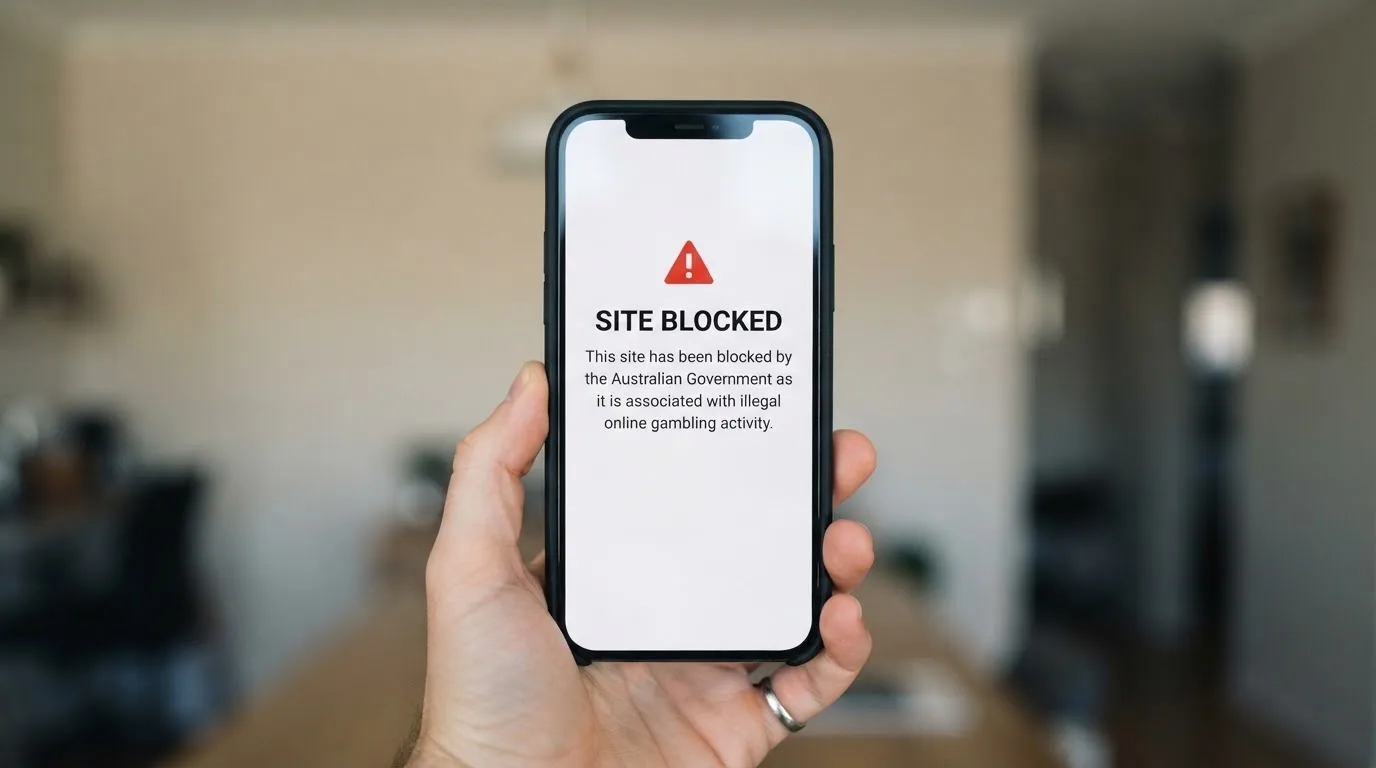
According to the ACMA as reported in June 2026, a total of 1,751 illegal gambling and affiliate marketing websites had been blocked since the first blocking request in November 2019, and more than 230 unlicensed gambling services had left the Australian market since enforcement was strengthened in 2017. The June 2026 round alone added twelve more: 7Signs, ChromaBet, Donbet, Duospin, Freshbet, Slots Gem, Jacks Club, Lucky Start, Pointsbetz.com, Spinrise, Vinyl Casino and Wildsino. The blocking rate is the arithmetic that sits behind those headlines.
Blocking rate calculation
The ACMA’s blocking programme began with the first blocking request in November 2019. From November 2019 through the end of the June 2026 round, the regulator had directed ISPs to block 1,751 illegal gambling and affiliate marketing websites. That works out to roughly 26 to 27 sites blocked every month across the seven-and-a-bit-year window — a band, not a single figure, because the per-month rate has been uneven: heavier in the early months of 2017-era enforcement and lighter in some intervening periods, with the June 2026 batch of twelve among the larger single-round totals on record. The point is the order of magnitude. A prohibition whose enforcement rate is in the dozens per month is not a prohibition that has stopped biting, and the rate at which unlicensed services keep leaving the market — 230 since 2017 — sits beside it.
H2 Gambling Capital’s 2025 report estimated that Australians lose about A$3.9 billion a year to illegal gambling sites, and that the share of gambling going through legal channels fell from 74% in 2021 to 64%. The fall matters more than the headline figure: even with enforcement running at twenty-six-plus sites blocked per month, more than a third of Australian gambling spend still leaks to offshore operators.
The warning register, in detail
The blocking tool catches the public-facing site. The formal warning catches the company behind it, and the ACMA publishes each one. The register is the cleanest picture of which operators have been told, in writing, that what they are doing is prohibited.
| Brand | ACMA action and date | Operator named by the ACMA | Subject support |
|---|---|---|---|
| RocketPlay | Formal warning, March 2026 | Pulsup Ltd | — |
| Level Up Casino | Formal warning, May 2022 | Dama N.V. | — |
| Woo Casino | Formal warning, March 2025 | Dama N.V. | — |
| Spirit Casino | Formal warning, May 2025 | Dama N.V. | — |
| National Casino | Formal warning, July 2025 | Consolutetish S.R.L. | — |
| Bizzo Casino | Formal warning, July 2025; earlier 2022 | Consolutetish S.R.L.; TechSolutions | — |
| Ignition Casino | Formal warning, July 2025 | Bamboo Media | — |
| Instant Casino | Formal warning, February 2025 | EOD Code SRL | — |
| Jackbit | Formal warning, April 2026 | Ryker B.V. | — |
| Casino Intense | Formal warning, April 2025 | Sterplay Holding Ltd | — |
| Sky Crown | Formal warning, September 2022 | Hollycorn N.V. | — |
The table is not a ranking and not a recommendation. Every brand on it is on it because the ACMA itself published a formal warning over it for offering prohibited services to Australians. The “subject support” column is empty because research carries no data confirming any of these brands specifically curates low volatility slots — listings pages on a few of them appear in third-party catalogues but that is not the same as confirmation, and an offshore operator’s marketing claim about its slot library is not a fact a reader can lean on.
The pattern across the warnings is worth noticing. Dama N.V. appears five times across different brand names — RocketPlay, Level Up, Woo Casino, Spirit Casino, and a May 2022 warning covering Bambet, Dazard, Level Up, Rocketplay, Wild Tornado and Cobra Casinos. Consolutetish S.R.L. appears twice for two brands, with Bizzo Casino’s earlier 2022 warning naming TechSolutions as the prior operator of record. A reader looking at the table should understand that an offshore operator simply rebrands; the warning follows the company, not the website.
Responsible gambling for someone who was about to search for low volatility slots
Responsible gambling protections
| Feature | Licensed Australian venue | Offshore casino |
|---|---|---|
| Consumer protection | Yes, Australian law | No |
| BetStop access | Yes | No |
| Payment methods | Debit, Bank, PayID | Often credit/crypto |
| Regulator oversight | State/Territory | None (Australia) |
The first responsible-gambling step is the one that makes the rest possible: recognizing that the product a player came looking for is not legally available from an Australian-facing site, and that the sites offering it are operating outside the law. From there, the protection tools available split cleanly between what reaches an Australian-licensed service and what does not.
BetStop — the National Self-Exclusion Register, live since August 2023 — lets a player exclude themselves from every Australian-licensed online and phone wagering service in a single registration. A player who has signed up for BetStop cannot place a bet with Sportsbet, Ladbrokes, Bet365 or any other Northern Territory-licensed bookmaker, and the exclusion can run for periods of three months, six months, twelve months, or longer. BetStop does not reach offshore casinos. A self-excluded player who logs into one of the operators in the warning table above will not be stopped.
The National Gambling Helpline — 1800 858 858 — is free, runs around the clock, and connects to Gambling Help Online for chat-based support. State-based services sit beside it. Gambler’s Help in Victoria, Gambling Help NSW, the Gambling Help service in Queensland and their equivalents in South Australia, Western Australia, Tasmania and the ACT are all staffed by counsellors who know the local landscape, including the legal position.
The financial protections are just as one-sided. The June 2024 ban on credit cards, credit-related products and digital currency as payment for licensed online wagering has no offshore equivalent. A licensed Australian bookmaker cannot accept a credit card deposit or a crypto transfer; an offshore casino can. That asymmetry is the clearest single-sentence test of whether a site is operating under Australian rules: ask how it wants to be paid.
For a player who wants the low-volatility experience on a legal footing, the Australian alternative is a licensed pokies venue — a pub or club with gaming machines, or one of the land-based casinos in Melbourne, the Gold Coast, Sydney, Perth, Cairns or Darwin. The games on those floors include plenty of low-volatility titles, the venues are regulated by state and territory authorities, and a player’s deposit and withdrawal protections run through Australian consumer law.
The shape of a low volatility slot
The terminology cuts across both halves of this page, so it is worth being exact about what the phrase means before reaching the lawful alternatives.
Volatility in a slot machine is the variance of its payout structure — how heavily the returns are weighted toward a few large wins or spread across many small ones. A low volatility slot returns more often and pays smaller amounts on average per spin; a high volatility slot pays less often and concentrates its return into larger payouts when they hit. The maths underneath is the maths of any distribution with a long tail: a low-volatility title is closer to the centre of that distribution on every spin, while a high-volatility title spends most of its spins below the average and uses the rare big hit to drag the long-run return back toward it.
Charles Fey of San Francisco developed the first automatic slot mechanism in the late nineteenth century — a three-reel machine with five symbols (horseshoes, diamonds, spades, hearts and the Liberty Bell), where three bells in a row paid the top prize of ten nickels. By 2010 Australia operated an estimated 97,103 gaming machines outside casinos, a per-capita rate about five times that of the United States. New South Wales legalised slot machines in 1956. The modern video slot can run five or more reels with fifty or more symbols per reel, producing odds as high as 300 million to one against the top combination — a useful contrast with the original three-reel machine’s roughly 1,000 possible combinations. The first automatic payout without an attendant came with Bally’s “Money Honey” in 1963, and the first video slot was developed by Fortune Coin Co. in Kearny Mesa, California, in 1976. None of those historical data points changes the volatility question, but they show how the genre has been engineered to scale variance up rather than down.
A player who wants a low-volatility experience — frequent small wins, a long session on a small bankroll, fewer stretches of dead spins — is asking for a specific shape of paytable. That shape exists in licensed Australian venues, where regulators approve the rules of each game before it goes on the floor. The Victorian Gambling and Casino Control Commission publishes a public log of approved changes to Crown Melbourne’s blackjack variants, including the renaming of the “Perfect Pairs” side bet to “Crown Pairs” on 23 December 2024 and the introduction of a “Free Bet” option with a new “Pot of Gold” side bet on 25 March 2024 — the same kind of approval process applies to pokie-style games in every Australian jurisdiction.
How often low volatility slots pay out
The short answer is the same as the long one: more often, and less. The mechanics are simple enough to state in one breath. The paytable on a low-volatility slot is built around a high hit frequency — the percentage of spins that return any win at all — and a low top prize. A player will see the reels light up often. The wins will rarely cover more than the stake of a single spin. The session feels busy because it is busy. A high-volatility slot works the other way: fewer winning spins, and the rare win is large enough that it carries the long-run return.
The vocabulary the industry uses to describe this is honest, and it should be used honestly. Return to player is the long-run percentage of stake returned to players across millions of spins; it is not a guarantee of any single session’s outcome. Hit frequency is the share of spins that produce a win of any size. Volatility is the spread of those wins. Two slots with the same RTP can feel completely different at the table because the volatility is different. A player who wants the busy feeling should choose low volatility knowingly; a player who wants the long-shot feeling should choose high volatility knowingly. Neither is a path to a guaranteed return — the house edge sits underneath both.
In the United States, state regulation sets minimum payout percentages that vary by jurisdiction — Nevada requires at least 75%, Mississippi at least 80%, and New Jersey at least 83% — but those are American floors and do not apply to an Australian player or to an offshore casino. Australian state regulators approve the rules of each game before it goes on a venue floor, and the approval process is what makes the RTP figure a number the player can rely on rather than a marketing claim.
What is actually available to an Australian reader who wants a low-volatility session
If the online shortlist is off the table, the lawful alternative is the gaming floor. New South Wales had 87,298 pokies-style machines outside casinos as of June 2023, Victoria had 26,380 in 2021–22, Queensland 21,122 in October 2023, South Australia 11,672 in September 2023 and the ACT 3,587 in November 2023. The Australian total of pokies-style machines outside casinos is over 150,000 by those figures — among the highest per-capita densities of gaming machines in the world, and a long way from the picture the offshore marketing paints of an “untapped” market.
Crown Melbourne offers three baccarat variants — Traditional Baccarat, Crown Baccarat and 2 to 1 Baccarat — as approved table games regulated by the VGCCC, which replaced the Victorian Commission for Gambling and Liquor Regulation as Victoria’s casino regulator on 1 July 2022. The point of mentioning baccarat in a piece about slots is not that baccarat is a slot machine; it is that the regulator’s approval process the baccarat variants went through is the same one that approves the pokie-style games on the same floor, and that process is the one that makes a low-volatility claim verifiable. Under section 66 of the NSW Casino Control Act 1992, a casino operator must not permit a game such as baccarat to be played unless the game and its rules are approved by the regulator, and the operator must make a copy of the approved rules available to patrons on request. The In Victoria, the Casino Control Act 1991 requires the VGCCC to approve any rules for table games before they are introduced at the Melbourne casino, and the same applies to gaming machines. The chain of approvals is what separates an Australian-licensed gaming machine from an offshore slot whose RTP is whatever its operator says it is.
Blackjack sits beside the slots on those floors, with optimal strategy reducing the house edge to about 0.28% under liberal Las Vegas Strip rules and about 0.43% under Atlantic City rules. Craps, baccarat, roulette — the table games are all there. None of those numbers is the answer to “where do I find a low volatility slot in Australia this year,” but they are the answer to “what can I play on a legal Australian floor this year.”
A note on the 2026 reform package
The Interactive Gambling Amendment (Gambling Reform) Bill 2026 passed Parliament on 19 August 2026. Its advertising and inducement measures commence on 1 January 2026 — law with a start date, not yet in force on a 2026 page. The bill does not change the prohibition on offering online casino games to Australians. What it does, when it commences, is tighten the rules around advertising licensed wagering services and the inducements that can be offered. For a reader looking at this page in 2026, the prohibition is the same one that has been in force since 2017; the advertising controls are coming. A reader looking at the same page a year later will see the advertising controls in operation. A reader looking at it five years from now will not, on the basis of this bill alone, see online casino games licensed. The shape of the Australian market on this point is a prohibition, not a market waiting to be opened.
Operators the ACMA has warned — what each record actually says
Each of the eleven operators below is on the warning register for the same reason: the ACMA published a formal warning over it for offering prohibited interactive gambling services to people in Australia. The descriptions below are not recommendations and are not comparisons of which casino is “best.” They are short statements of what the warning record says, what is known from research, and what the limitation of that knowledge means for a reader.
RocketPlay
The ACMA published a formal warning in March 2026 naming Pulsup Ltd as the operator of Rocketplay.com.au. That was the second warning the RocketPlay name had drawn: Dama N.V. was warned over Rocketplay in May 2022. Two warnings, four years apart, two different operators of record. The pattern is the rebranding pattern that runs across the whole register — the company behind a brand moves on and the brand resurfaces, while the regulator’s correspondence follows the new operator. The verdict on RocketPlay is the same as the verdict on the whole table: it is a brand the regulator has told, in writing and twice, that what it does is prohibited in Australia, and a reader who treats it as an Australian-facing casino is reading from a source the regulator has already answered.
Level Up Casino
Dama N.V. drew a formal warning in May 2022 that covered Level Up alongside five other brand names. Level Up appears in third-party listings as a casino with a pokies catalogue, but research carries no confirmation that any of its titles are specifically curated as low volatility. The verdict is the same as RocketPlay’s, minus the second warning.
Woo Casino
Dama N.V. drew another formal warning in March 2025 covering Woo Casino. The warning followed the May 2022 round by almost three years, which is the gap during which Dama N.V. restructured several of its brands under new names. It is impossible to verify the game catalogue of Woo Casino through objective research, and the claims on its own marketing pages are not reliable evidence.
Spirit Casino
Dama N.V. drew a formal warning in May 2025 covering Spirit Casino — the second Dama N.V. warning in 2025 alone, after the March 2025 one over Woo Casino. Same company, two months apart, two brand names. Nothing in the official warning record details the specific slot volatility of this casino.
National Casino
Consolutetish S.R.L. drew a formal warning in July 2025 covering National Casino. National Casino appears in third-party listings as a casino with a pokies catalogue, but again research carries no specific confirmation of its low-volatility offerings. The underlying operator is a different company from the Dama N.V. cluster, which is the only meaningful distinction on the register; the regulatory status is identical.
Bizzo Casino
Consolutetish S.R.L. drew a formal warning in July 2025 covering Bizzo Casino. Bizzo Casino is unusual on the register because it had already been the subject of a 2022 formal warning to TechSolutions (CY) Group Limited and TechSolutions Group N.V. — a third operator of record, on the same brand, in three years. The pattern is the clearest version of the rebranding phenomenon: the brand stays, the company changes, the regulator’s correspondence follows.
Ignition Casino
Bamboo Media drew a formal warning in July 2025 covering Ignition Casino. Ignition Casino is positioned in some third-party marketing material as a poker-and-casino brand rather than a pokie-focused one, but research carries no specific confirmation either way. The warning is the same shape as every other warning on the register: a company told in writing that offering interactive gambling services to people in Australia is prohibited.
Instant Casino
EOD Code SRL drew a formal warning in February 2025 covering Instant Casino. Earlier in 2025 than the Dama N.V. warnings, earlier than the Consolutetish S.R.L. warnings — one of the early data points in the 2025 enforcement cycle. Whether this operator offers low-volatility titles remains an unproven assertion without independent verification.
Jackbit
Ryker B.V. drew a formal warning in April 2026 covering Jackbit and CasinOK on the same notice. The warning is one of the more recent data points on the register. This operator’s slot library is essentially opaque, with no verifiable data confirming its volatility profile.
Casino Intense
Sterplay Holding Ltd drew a formal warning in April 2025 covering Casino Intense. Casino Intense appears in third-party listings referenced by mainstream Australian reporting, but the appearance is a listing rather than a confirmation of any specific slot offering. The warning record is the same shape as the rest.
Sky Crown
Hollycorn N.V. drew a formal warning — published in a September 2022 PDF — covering its Sky Crown and Blue Leo casino services. Hollycorn is a frequent name on offshore-licence lists and the formal warning is the only data point on Sky Crown’s Australian status. Research carries no specific data on Sky Crown’s slot catalogue.
What the absence of a low-volatility shortlist actually means for the reader
The reader came to this page for a ranked list of casinos running low volatility slots with welcome offers and withdrawal speeds. That list does not exist in Australia for a reason that sits at the top of this page. The legal position, backed by the arithmetic of A$3.9 billion in annual losses to illegal sites and a persistent blocking rate of twenty-six-plus sites per month, is what makes the reality of the market clear to an Australian reader rather than a piece of abstract law.
A reader who wanted a low-volatility slot session has three lawful paths. They can play the licensed pokies-style machines at a pub or club — over 150,000 of them across Australia by the latest state counts, many of them low-volatility titles approved by state regulators. They can play the gaming machines at one of the land-based casinos, with the same regulator approval behind the catalogue. They can sign up for BetStop if the question is whether to play at all. They cannot get the offshore shortlist they searched for, and the ACMA’s warning register is the most concise statement of why.
The 2026 reform package, when its advertising measures commence on 1 January 2027, will tighten the rules around inducements offered by licensed wagering services — but it will not change the prohibition on offering online casino games to Australians. That prohibition has been in force since 2017. It is in force on this page. It will be in force next year.
Frequently asked questions
What does low volatility mean for a slot machine?
Low volatility means the slot’s paytable is built around frequent, small wins rather than rare, large ones. A low-volatility title returns some payout on a higher share of spins, but those payouts rarely exceed a single stake. The session feels busy because it is busy. The long-run return to player percentage sits underneath the volatility shape and is set by the game’s design, not the player’s session.
How does low volatility differ from high volatility in slot design?
The maths underneath both is the maths of a payout distribution with a long tail. Low volatility spreads the return across many small wins close to the centre of the distribution. High volatility concentrates the return into a few large wins further out in the tail. Two slots with the same return-to-player percentage can feel completely different because of the volatility difference — the RTP is the long-run average, the volatility is the spread around that average on any given session.
Is it legal to play low volatility slots at an online casino from Australia?
No. The Interactive Gambling Act 2001, tightened by the 2017 amendments, prohibits offering online casino games — including online pokies, low volatility or otherwise — to anyone physically in Australia. No state or territory issues a licence for the activity. The Australian Communications and Media Authority enforces the prohibition through formal warnings and by requesting ISPs to block offending sites; more than 230 unlicensed services have left the market since 2017 and over 1,750 sites have been blocked since November 2019. The individual player is not prosecuted, but an offshore site gives no Australian consumer protection and the balance can be stranded by a blocking order.
Are low volatility pokies-style machines common in Australian pubs and clubs?
Yes. New South Wales alone had 87,298 pokies-style machines outside casinos as of June 2023, with Victoria, Queensland, South Australia and the ACT adding tens of thousands more. Many of those machines are low-volatility titles approved by state regulators before they go on the floor. The Australian per-capita rate of gaming machines outside casinos is several times that of the United States, so the selection is broad; what an Australian player cannot do is replicate that experience on an offshore site.
Does volatility affect how often a slot machine pays out, not just how much?
Yes. Volatility is the spread of the payout distribution, and the spread runs through both frequency and size. A low-volatility slot pays out more often and pays less per win; a high-volatility slot pays out less often and pays more per win. Hit frequency and volatility are not the same thing — hit frequency is the share of spins that return any win at all, and two slots with similar hit frequencies can have different volatility shapes because the size of the average win differs.