
Real money online pokies for Australian readers — what the law actually permits in 2026
Every search for “real money online pokies Australia” arrives at the same locked door. The Interactive Gambling Act 2001, tightened by the Interactive Gambling Amendment Act 2017, makes it an offence to provide online casino games — including online pokies — to a person physically in Australia. No state or territory issues a licence for them. The Australian Communications and Media Authority has spent the last several years translating that rule into formal warnings, monthly blocking rounds and an audit trail that any reader can check.

Data current as of 29 October 2026, verified against the ACMA’s published register of formal warnings and blocking requests.
So the page below is not a shortlist of the “best” real money pokie sites for Australians, because no such shortlist can be honestly assembled — the product itself is prohibited. What follows is the working alternative: how the law actually works, which offshore brands the ACMA has formally warned, what is licensable in Australia and how it differs, how money moves through PayID for the licensed products that are allowed, what a phone experience of licensed wagering looks like, and the responsible-gambling scaffolding around all of it.
Table of Contents
- Mobile and app experience for real money wagering in Australia
- Specific games, providers and the live table question
- How the ACMA’s blocking rate has built up since 2019
- Operators the regulator has acted against
- Overview: what “real money online pokies” actually means in Australia
- Legality and regulation: the Interactive Gambling Act 2001 in plain terms
- Responsible gambling: BetStop and the limits that actually bind
- Payments and payout speed: PayID and how money actually moves
- What this page is for, and what it is not
- Frequently asked questions
Mobile and app experience for real money wagering in Australia
The phone-first question for any Australian punter is whether a dedicated real money pokies app exists for local players. The honest answer is that no Australian-licensed app offers real money online pokies, because no Australian licence covers them. What the licensed market does offer on a phone is wagering apps for sport and racing — Sportsbet, Bet365, Ladbrokes, and the other bookmakers licensed by the Northern Territory Racing and Wagering Commission. Those apps handle real money stakes from an Australian bank account, run PayID and Osko deposits, and connect to BetStop, the National Self-Exclusion Register.

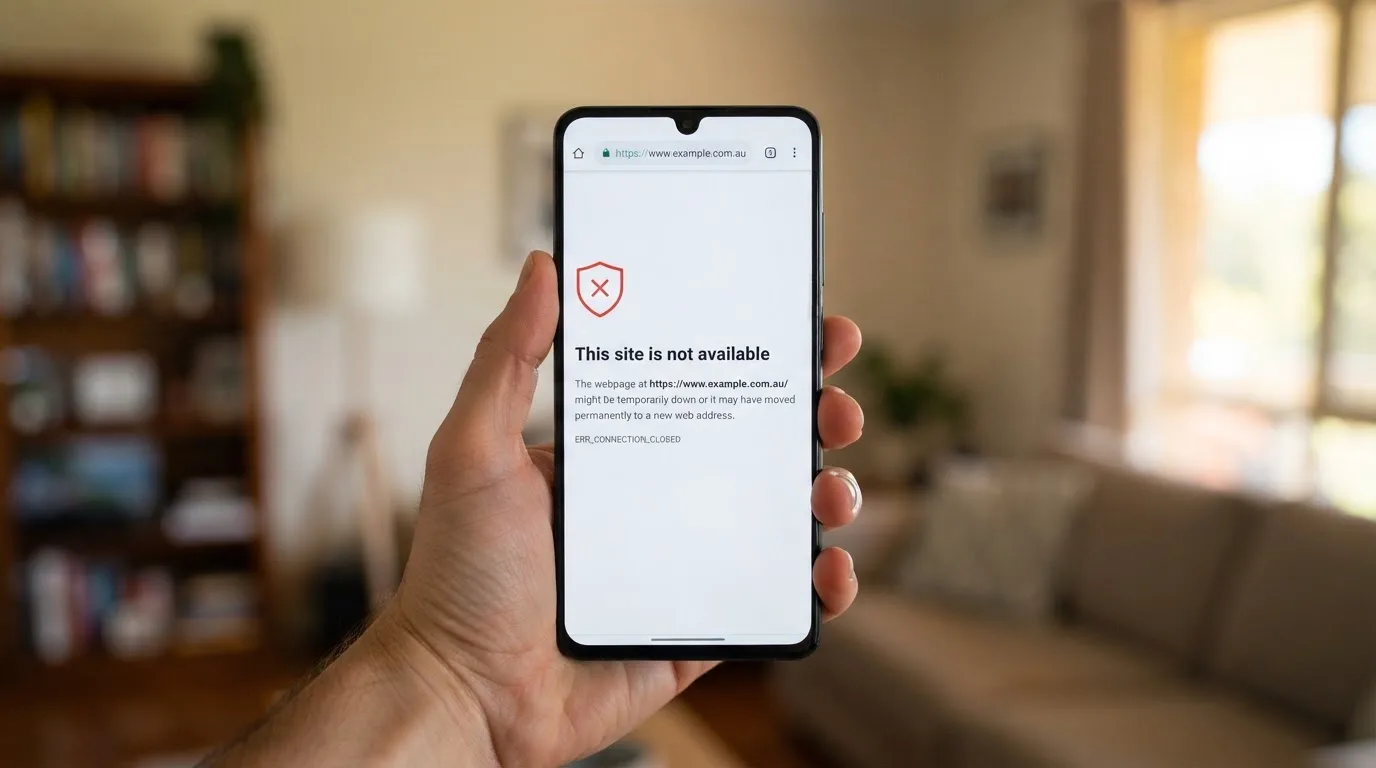
Offshore sites that target Australian players from Curaçao or another overseas jurisdiction sometimes wrap their casino in an installable web app, sometimes in a downloaded APK outside the official stores. Those wrappers do not change the underlying product: an online pokie played through an iPhone web view is still a prohibited interactive gambling service to a person in Australia. The ACMA’s March 2026 formal warning to Pulsup Ltd over Rocketplay.com.au was issued precisely because a brand presented itself in Australian-facing marketing while running from offshore.
The practical distinction for a reader is between two different phone experiences. A licensed wagering app from one of the 52 Northern Territory bookmakers runs inside the rules: it accepts PayID and debit card, blocks credit and crypto, connects to BetStop, and pays Australian tax. An offshore casino app does none of those things, even when the brand’s splash screen suggests it does. The interface may look indistinguishable; the regulatory perimeter around it is not.
A note on app-store availability: Google Play and the Apple App Store do not list real money casino apps for Australian accounts. A reader who finds one through a search has been routed around the official channels, and the app in question is the kind the ACMA moves against in its blocking rounds. The June 2026 round, for example, asked Australian ISPs to block 12 sites including 7Signs, ChromaBet, Donbet and Wildsino — several of which had their own downloadable clients.
Specific games, providers and the live table question
A reader who has played online pokies offshore will recognise the studio names: BGaming, Pragmatic Play, Evolution for live tables, plus a long tail of smaller suppliers. The same studios also publish the baccarat and blackjack variants that sit alongside pokies in the same offshore lobby, which is why the ACMA’s enforcement record treats them as one prohibited category.
Baccarat, the closest live-table neighbour to a pokie in feel, has a known mathematical shape. The house edge is 1.06% on the Banker bet, 1.24% on the Player bet and 14.36% on the Tie — numbers the Wizard of Odds catalogue carries for the standard six- or eight-deck shoe. Punto banco, the variant almost universally dealt today, was developed in Havana during the 1940s; cards run from two to nine at face value, with the ten, jack, queen and king counting as zero and the ace as one, and hand totals taken modulo ten. Chemin de fer, the two-player French variant, runs faster but is now largely historical. In Australia, baccarat is played at Crown Melbourne under Victorian Gambling and Casino Control Commission approval, in Traditional, Crown and 2-to-1 formats — not online.
Blackjack runs the same arithmetic differently: optimal strategy brings the house edge to about 0.28% under liberal Las Vegas Strip rules (dealer stands on soft 17, double on any two, double after split, resplit aces, late surrender) and about 0.43% under Atlantic City rules. The Australian legal versions — Crown Melbourne, Crown Perth, the Sydney and Brisbane casino floors — deal under house rules approved by the relevant state regulator, and under section 66 of the NSW Casino Control Act 1992 a casino operator cannot offer a table game such as baccarat or blackjack until both the game and its rules have been approved by the NSW regulator, with a copy of the approved rules available on request.
None of that translates into an online product for Australians. The state-licensed casinos run physical tables, and the offshore live-dealer studios stream from elsewhere to anyone who can reach them. The reader looking for the live-dealer experience has to choose between a Crown floor and an offshore site, and only the Crown option is lawful for a person in Australia.
Pokies themselves, the land-based machines, are the largest gambling product in the country. In 2020–21 Australians bet almost A$150 billion through gaming machines and lost A$12.18 billion on them — a figure the Wikipedia compilation of state and territory data carries, drawn from the gambling regulators themselves. New South Wales alone had 87,298 machines outside casinos across 2,195 venues in June 2023, with player losses of A$8.18 billion in 2022–23. Queensland had 21,122 machines in 351 venues as of October 2023; Victoria had 26,380 outside Crown Casino across 488 venues in 2021–22, sitting under a statewide cap of 30,000.
The legal minimum return-to-player on those machines is set jurisdiction by jurisdiction. It is 85% in New South Wales, the Northern Territory, Queensland and (generally) Victoria, 87% at Crown Melbourne, 87% in the Australian Capital Territory and Tasmania, 87.5% in South Australia, and 90% in Western Australia. Western Australia is the standout — poker machines were banned in pubs and clubs when Crown Perth opened in 1985, and Crown Perth’s own machine count has since grown from about 200 in 1985 to roughly 2,500, all approved by the state’s Gaming and Wagering Commission. Tasmania, after November 2021 legislation ended the Federal Group’s monopoly, planned mandatory pre-commitment cards but pushed implementation back to late 2025. The minimum return-to-player is a hard floor: the machines on Australian floors cannot legally pay out less than those figures, and the rule is enforced by the state regulators, not by the manufacturer.
The point is not which game pays back the most. The point is that the games Australians can actually play for real money — the EGMs in clubs, the tables at Crown — sit under a state-by-state regulatory framework that the offshore online market does not replicate. A 90% return-to-player floor in Western Australia is a stat a reader can verify. An RTP printed on an offshore pokie’s help screen is a number the operator can change between game versions, and there is no Australian body to complain to if it does.
How the ACMA’s blocking rate has built up since 2019
The arithmetic that makes this page useful is the ACMA’s blocking rate over time. The first blocking request was issued in November 2019; by the figure reported in June 2026, the ACMA had asked Australian internet service providers to block a running total of 1,751 illegal gambling and affiliate marketing websites, and more than 230 unlicensed gambling services had left the Australian market since enforcement was strengthened in 2017. State the result as a band, because the running total is a moving figure that updates each time the regulator publishes a new round: in the order of several hundred blockings a year at the current pace, with the running total sitting between roughly 1,700 and 1,800 sites as of mid-2026.
The June 2026 round alone added 12 names: 7Signs, ChromaBet, Donbet, Duospin, Freshbet, Slots Gem, Jacks Club, Lucky Start, Pointsbetz.com, Spinrise, Vinyl Casino and Wildsino. Earlier rounds did the same for other brands — the rate is steady rather than spiking, which suggests the ACMA is operating on a publishable cadence rather than chasing individual sites case by case.
The comparison that earns the figure its weight is against the licensed wagering side. The Northern Territory Racing and Wagering Commission regulates 52 Australian online bookmakers, including Sportsbet, Bet365 and Ladbrokes. The commission itself has no full-time staff and meets once a month in Darwin — a small body sitting on a small licensed population, against a regulator that has moved against more than 230 unlicensed services in roughly the same period. The contrast is not in the headcount; it is in the asymmetry between a closed licensed list and a long, shifting offshore tail.
Operators the regulator has acted against
The 11 brands below are not a recommendation. They are a working list of operators the ACMA itself has formally warned under the Interactive Gambling Act 2001 for offering prohibited services to Australians. The legal point each line makes is the same: online casino games cannot be licensed in Australia, whatever licence the brand’s footer displays. The reader value is in seeing who the regulator has actually moved against, and when, on a single page.
| Brand | ACMA action and date | Operator named by the ACMA | Subject support |
|---|---|---|---|
| RocketPlay | March 2026 (also May 2022 under a predecessor operator) | Pulsup Ltd (Rocketplay.com.au); earlier Dama N.V. | — |
| Level Up Casino | May 2022 | Dama N.V. | BGaming listings (third-party) |
| Woo Casino | March 2025 | Dama N.V. | — |
| Spirit Casino | May 2025 | Dama N.V. | — |
| National Casino | July 2025 | Consolutetish S.R.L. | Wikipedia mentions (third-party) |
| Bizzo Casino | July 2025 (also 2022) | Consolutetish S.R.L.; earlier TechSolutions (CY) Group Ltd and TechSolutions Group N.V. | — |
| Ignition Casino | July 2025 | Bamboo Media | — |
| Instant Casino | February 2025 | EOD Code SRL | — |
| Jackbit | April 2026 | Ryker B.V. (also CasinOK in the same action) | — |
| Casino Intense | April 2025 | Sterplay Holding Ltd | ABC and ACMA references (third-party) |
| Sky Crown | September 2022 | Hollycorn N.V. (also Blue Leo in the same action) | — |
Two patterns jump out of that table. The first is the recurrence of corporate vehicles — Dama N.V. appears behind four of the brands on the list across three different years, Consolutetish S.R.L. sits behind two of them in the same July 2025 round. The ACMA warns the operator, not the brand, and the same operator frequently runs several brands in parallel. A reader who sees a “new” casino site promoted at them is, in many of the cases above, looking at the same Curaçao company that the regulator has already moved against under a different name.
The second is that the operator name in the ACMA’s record is the useful data, not the brand. A licence badge from Curaçao or another jurisdiction in the site’s footer does not contradict an ACMA formal warning; it tells the reader which offshore regulator issued the licence, and the IGA’s prohibition applies regardless. The brands above are grouped by their corporate operator because that is the unit the regulator acts on, and it is also the unit that survives a rebrand.
Overview: what “real money online pokies” actually means in Australia
The phrase carries two distinct meanings that a search engine does not separate. The first is the offshore online casino product — a pokie played in a browser or an app, run from a server in another country, with the bettor in Australia. That product is prohibited under the Interactive Gambling Act 2001, and the ACMA’s formal-warning list is the regulator’s running audit of who has been caught offering it.
The second meaning is the legal product next to it: real money wagers on electronic gaming machines in licensed Australian venues, and real money wagers on sport and racing through licensed Australian bookmakers. Both are lawful. Both have a return-to-player floor, a state or territory regulator, a complaints path, and a payment method that an Australian bank will process. The licensed wagering market is also where PayID sits as a deposit method, where BetStop self-exclusion binds the operator, and where the National Gambling Helpline (1800 858 858) is the free, 24/7 first call for anyone whose play has stopped being fun.
Gambling Capital’s 2025 report puts Australians’ losses to illegal gambling sites at roughly A$3.9 billion a year, and records the share of gambling going through legal channels falling from 74% in 2021 to 64%. The reading of those two figures is uncomfortable: more money is leaving the licensed system and heading offshore each year, and the regulator’s blocking rate — measured from November 2019 to mid-2026 — is the visible part of the response. The invisible part is the Australian player who loses at an offshore site and has no Australian body to complain to when a withdrawal stalls.
The distinction matters because the rest of this page sits on top of it. The licensed market has PayID deposits, mobile apps in the Australian stores, responsible-gambling scaffolding and a regulator on the operator’s side of the table. The offshore market has none of those. The reader’s question — which of these is the “best real money pokie” — only has an answer inside the licensed half.
Legality and regulation: the Interactive Gambling Act 2001 in plain terms
The Interactive Gambling Act 2001 is the federal statute that closes the door on the offshore product. The Interactive Gambling Amendment Act 2017 sharpened it: from 2017 onwards, offering online casino games, online pokies or in-play betting to a person in Australia is a contravention, and the ACMA has the investigatory and enforcement powers to act on it.
What is licensable is wagering on races and sport placed before the event, lotteries and keno. In practice the bulk of licensed online bookmakers are licensed by the Northern Territory — 52 of them, including Sportsbet, Bet365 and Ladbrokes, regulated by the Northern Territory Racing and Wagering Commission. The commission’s small footprint — no full-time staff, a monthly meeting in Darwin — is the structural reason the IGA’s offshore prohibition matters: the licensed list is short, and anything not on it is, by definition, prohibited.
Enforcement runs through three ACMA levers. The first is the formal warning: a published notice naming the operator and the brand, on the ACMA’s website, that puts the operator on the record. The second is the blocking request, sent to Australian ISPs, that takes a site off the air for Australian customers. The third is the civil penalty proceedings, available for the most serious cases. The June 2026 figure of 1,751 blocked sites and 230-plus services that have left the Australian market since 2017 is the cumulative result of all three.
The individual player is not prosecuted. The IGA targets the provider, not the customer, and there is no record of an Australian being charged for placing a bet at an offshore site. What the player loses in choosing the offshore side is the consumer-protection perimeter: no Australian complaints body, no recourse if a withdrawal is refused, no guarantee the balance is reachable when the ACMA moves to block the site, and no connection to BetStop. Those are not theoretical costs. They are the reason the A$3.9 billion estimate lands where it does.
A separate change closes a payment loophole. Since 11 June 2024, credit cards, credit-related products and digital currency have been banned as a payment method for licensed online wagering in Australia, with penalties up to A$247,500 for operators that breach the rule. Legal deposit routes for licensed wagering are debit card, bank transfer, PayID/Osko and BPAY. A site asking an Australian customer for a credit card or a crypto deposit is, by definition, not running inside the Australian rules.
The forward calendar carries one more change. The Interactive Gambling Amendment (Gambling Reform) Bill 2026 passed Parliament on 19 August 2026; its advertising and inducement measures commence on 1 January 2027. It is law with a start date, not yet in force on a 2026 page, and the relevant reader-side change is that inducements aimed at Australian customers become a more sharply regulated category once the calendar turns.
On tax, the rule is straightforward for a recreational player. Gambling winnings are not assessable income under section 6-5 of the Income Tax Assessment Act 1997, and losses are not deductible, unless the ATO considers the person to be carrying on a business of gambling. That last clause is the one a reader with a serious edge should query, because the ATO’s tests for a gambling business are not loose, and a punter whose winnings cross a threshold can be asked to justify the position. The default reading for an ordinary player is: winnings are not taxed, losses are not deductible, and a tax agent is the right call if the situation stops being ordinary.
Responsible gambling: BetStop and the limits that actually bind
The responsible-gambling scaffold for licensed Australian wagering runs through three channels. BetStop, the National Self-Exclusion Register, has been live since August 2023 and binds every Australian-licensed online and phone wagering service. A punter who registers with BetStop is matched against every licensed operator’s customer database, and the operator is required to refuse the registration, close any existing account and refuse marketing. The minimum exclusion period is three months; longer periods run up to a permanent exclusion. Offshore casinos are not connected to BetStop, which is the structural reason the register does not by itself solve the offshore problem — a self-excluded Australian can still open an account at an offshore site, and the ACMA’s blocking list is what stands between that account and Australian internet traffic.
The National Gambling Helpline on 1800 858 858 is free, runs 24/7, and connects to Gambling Help Online for chat and email counselling. State-level services sit behind it — each state and territory funds its own problem-gambling programme — but the helpline is the single national entry point. A reader who has stopped enjoying the play, or who is chasing losses, or who is hiding the activity from someone close to them, will hear a human voice on the other end of that number within minutes.
The third channel is the deposit and play limits that the licensed operators are required to offer. Under the 2024 credit-card ban and the broader consumer-protection rules, a licensed bookmaker must give customers the ability to set deposit limits, session-time reminders and full self-exclusion. The 11 offshore brands in the table above do not run those tools, and the ACMA’s formal warnings are partly a record of how often those tools were absent from the offer. The Tasmania pre-commitment card, planned as the nation-leading mandatory version of those limits, was delayed to late 2025 — which is to say the most rigorous version of the Australian responsible-gambling regime is still rolling out as of mid-2026.
The credit-card ban itself is a responsible-gambling lever that the reader will notice at the deposit screen. A licensed bookmaker will not accept Visa or Mastercard for wagering; the deposit page offers debit card, PayID, BPAY or bank transfer. An offshore casino will accept whatever its payment processor extends, and the absence of credit-card and crypto rails on a licensed site is itself a marker that the site sits inside the Australian perimeter.
Payments and payout speed: PayID and how money actually moves
PayID is the Australian real-time payments rail, layered on top of the New Payments Platform and operating through Osko. For a licensed wagering operator, PayID is the deposit method that lands instantly in the customer’s account: the punter enters the operator’s PayID (typically a phone number, email or ABN), confirms the amount through their own banking app, and the funds are available to bet within seconds. The reverse path — withdrawal from the operator back to an Australian bank account — runs through the same PayID rail in most cases, with settlement typically inside the same day for a verified account.
For the reader, the practical difference between PayID and a card deposit is the charge. PayID and Osko are zero-cost at the consumer end and zero-cost at the operator end for licensed wagering operators, because the New Payments Platform does not charge an interchange fee. Card deposits carry a merchant fee, which most licensed operators absorb, and which some pass through. Crypto deposits, where an offshore casino accepts Bitcoin or USDT, carry a network fee, a conversion spread and a delay that depends on the coin and the chain. A reader who has ever watched a Bitcoin confirmation crawl for ten minutes has felt the gap between PayID and the offshore alternative.
The IGA’s prohibition does not stop an Australian from reaching an offshore casino’s payment page. What it stops is the offshore operator from being on the licensed rails in the first place. The consequence is that withdrawals from an offshore site typically run through a different mechanism — a bank wire, a card refund, occasionally a crypto refund — and each of those carries a verification step the licensed PayID withdrawal does not. The ACMA’s formal-warning record is full of brands whose withdrawal queues were the customer-complaint trigger before the regulator ever looked at them.
The 11 June 2024 ban on credit cards and crypto for licensed wagering is the cleanest payment-side marker that separates the two markets. A licensed Australian bookmaker’s deposit page will not show Visa, Mastercard or a crypto wallet. An offshore casino’s deposit page will. The reader can use that single check to sort licensed from not, without scrolling through the licence footer or the responsible-gambling page.
What this page is for, and what it is not
This page is for an Australian reader who has typed a search for real money online pokies and is looking for an honest account of what the Australian legal position actually is. The page closes with a short FAQ that answers the recurring follow-up questions in plain language: the difference between free-play and real money play, the PayID position for licensed products, the legal status of the offshore offer, the dedicated app question, the headline Australian wagering figure, and the typical free-spins terms that attach to a real money offer.
The page is not a recommendation of any operator, because the operators above are presented because the ACMA has formally warned them, not because the page endorses them. The reader who arrived looking for a shortlist of the best sites will not find one. The reader who arrived looking for an honest account of what the law allows, and what the regulator has done about what it does not, will.
Frequently asked questions
What is the difference between a free-play pokie and a real money one?
A free-play pokie runs on demo credits and pays out pretend money; the game’s RTP and volatility are the same as the real-money version, but nothing is at stake and nothing can be withdrawn. A real money pokie stakes actual funds, pays out actual funds, and is the version covered by the Interactive Gambling Act 2001 when offered online to a person in Australia. The free-play version is not the prohibited product.
Can real money online pokies be played using PayID in Australia?
PayID is a deposit rail, not a product licence. PayID works on licensed Australian wagering operators for sport, racing, lotteries and keno, but no Australian-licensed operator offers real money online pokies, so there is no licensed site at which PayID would fund a real money pokie session. An offshore casino accepting PayID from an Australian customer is still offering a prohibited interactive gambling service.
Is it legal for an online casino to offer real money pokies to Australians?
No. The Interactive Gambling Act 2001, as amended in 2017, makes it a contravention to provide online casino games, including online pokies, to a person in Australia. The ACMA enforces the rule through formal warnings, blocking requests to ISPs and civil penalty proceedings. The individual player is not prosecuted; the provider is the target.
Is there a dedicated real money pokies app for Australian players?
No Australian-licensed app offers real money online pokies, because no Australian licence covers them. Licensed wagering apps for sport and racing are available from the 52 Northern Territory bookmakers and run PayID deposits, debit card deposits, and BetStop self-exclusion. Offshore casino apps distributed outside the official stores target Australian customers from overseas and are subject to ACMA blocking.
How much did Australians wager on gaming machines in 2020-21?
Australians bet almost A$150 billion through gaming machines in 2020-21 and lost A$12.18 billion on them. Australia has about 3% of the world’s pub and club poker machines with 0.3% of the global population, which gives a sense of how concentrated the machine footprint is.
What free spins terms are typically attached to a real money pokies offer?
A free-spins offer at a licensed or offshore site typically attaches a wagering multiple to any winnings the spins produce, a maximum cashout cap on what the wagered winnings will pay out, and a time window — commonly 7 to 30 days — in which the wagering must be completed. The exact multiple, cap and window vary by operator, and the reader should read the offer’s terms before claiming.