
The Highest-RTP Pokies an Australian Player Can Actually Sit Down To
29 October 2026 · Verified against the Australian Communications and Media Authority register and state gaming commissions.
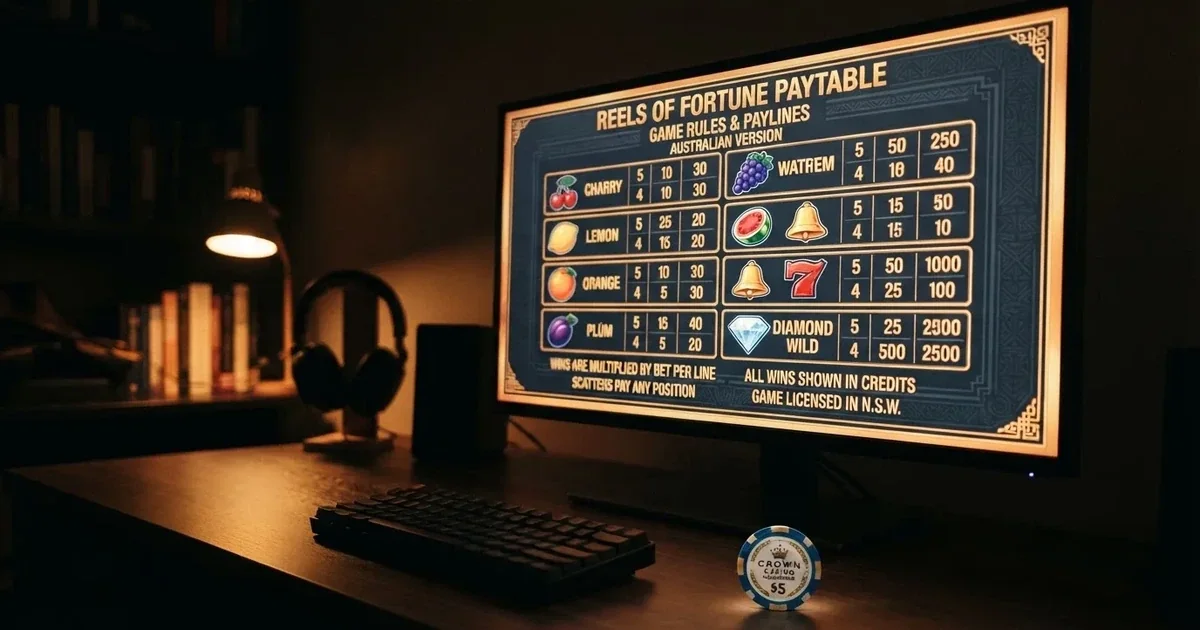
A punter hunting the best RTP pokies Australia is usually after one of two things. Either the highest theoretical return the maths allows, or a return the venue can’t quietly lower once the machine is on the floor. Both goals exist, both are reachable, and neither of them has anything to do with the offshore sites that rank for this search. The advertising claim — “97% RTP, gamble from your phone” — sits outside the Australian regulatory frame entirely. The licensed machine inside an Australian pub, club or casino is a different object, with a different return, a different disclosure regime, and a different ceiling on what the operator can change after install.
What follows walks through what an RTP figure is, where it has to be disclosed, which Australian jurisdictions set the floor, and what the offshore “high RTP” market really is once the marketing copy comes off. The page is built around the consequence of the rules, not the marketing promise — what the numbers actually do once a player is sitting in front of the machine, and what changes when the player is sitting in front of a screen instead.
Table of Contents
- What “RTP” Means on a Pokies Machine, and What It Does Not
- How the Australian Legal Floor Is Set, and Why It Matters at the Machine
- Where a Pokies Machine’s RTP Is Legally Required to Be Disclosed
- The State-by-State Geography of Australian Pokies
- Offshore “High RTP” Sites and the Interactive Gambling Act
- The Blocking Rate: How Often the ACMA Acts, and What That Tells a Player
- Offshore Sites the ACMA Has Formally Warned: The Eleven Brands Behind the Marketing
- What the Blocking Rate Looks Like Next to the Warnings
- How a Shortlist of High-RTP Pokies Is Actually Built
- Volatility and What a High RTP Figure Says About Win Size
- What Happens at the Casino: Baccarat and Blackjack, and Their House Edges
- Responsible Gambling Supports and Where a Player Gets Help
- The Payment Side: Credit Cards, Crypto, and the Australian Rules
- The Reform in Flight: The Interactive Gambling Amendment (Gambling Reform) Bill 2026
- Tax and the Recreational Player
- What the Reader Takes Away
- Frequently Asked Questions
What “RTP” Means on a Pokies Machine, and What It Does Not
Return-to-player is the share of every dollar a machine takes in that it is programmed, across a very long run of spins, to return as winnings. A machine with a 90% RTP keeps, on average, ten cents of every dollar wagered. A machine at 87% keeps thirteen cents. The figure is a long-run average, drawn from the game’s paytable over millions of simulated spins, and the maths is indifferent to the punter holding the card.

RTP is not the chance of winning on any single spin. A machine can return 95% of turnover while paying nothing on 80% of spins and paying very large amounts on a small fraction of them. The volatility profile — how wins are distributed across the long run — sits beside RTP but is a separate setting. Two machines at the same RTP can feel completely different: one pays small wins often, the other pays rarely and heavily. The number on the label is the average; the experience at the machine is set by the distribution.
RTP is also not a guarantee on any session. A punter can sit down at a 95% machine and walk away with nothing. The next punter can sit down at the same machine and hit a feature that returns multiples of the stake. The figure describes the behaviour of the machine across all the spins it will ever play, weighted by stake size, not the behaviour of any individual visit. The house always has an edge, and on Australian pub and club machines that edge is set high enough to be a serious line item in a player’s bankroll over time.
What RTP does tell a punter, fairly read, is the worst-case scenario over a long horizon. A 90% machine, played indefinitely, returns 90 cents on the dollar. A 87% machine returns 87 cents. The difference, over thousands of spins, is not a rounding error — it is the single largest variable a player can choose at the moment of sitting down. Venue choice and machine choice, on a long enough horizon, move more money than any system of staking.
How the Australian Legal Floor Is Set, and Why It Matters at the Machine
Australia does not have one national RTP floor. Each state and territory sets its own minimum, and the figures vary enough that the same machine can be legal in one state and below the line in the next.

The current floors, as published by each jurisdiction’s regulator, sit in a narrow band. New South Wales, the Northern Territory and Queensland set 85% as the minimum return. The Australian Capital Territory and Tasmania sit at 87%. South Australia is 87.5%. Victoria sets 85% generally, with Crown Melbourne’s machines running at a 87% floor. Western Australia is the outlier, at 90% — and Western Australia also bans poker machines outside the one casino, so the 90% floor applies only to Crown Perth’s roughly 2,500 machines, up from about 200 when the casino opened in 1985.
The 85% floor is the lowest in the country and applies to the largest installed base. New South Wales alone had 87,298 gaming machines outside casinos across 2,195 venues in June 2023, with player losses of A$8.18 billion over the 2022–23 financial year. Queensland ran 21,122 machines across 351 venues in October 2023. Victoria held 26,380 outside Crown Casino in 488 venues under a statewide cap of 30,000. Each of those machines can be, and often is, set above the floor — but the floor itself sets a hard minimum the venue cannot go below.
The consequence for a punter choosing between two machines is straightforward. The licensed machine at 90% sits inside a 5% house edge. The licensed machine at 85% sits inside a 15% house edge. The same stake, the same number of spins, the same luck — and one machine returns three times the other to the house. Venue selection is, for a player who plays enough spins to average out, a more meaningful decision than which particular cabinet they sit at.
It is also worth noting what these floors do not do. They do not cap the upper end. A venue can install machines set above 95% if the regulator approves the title. They do not require a single national figure — a machine legal in Perth can be below the floor in Sydney. They do not, on their own, require the venue to disclose the setting to the player standing at the cabinet. Disclosure sits in a different rule, and the rule is partial.
Where a Pokies Machine’s RTP Is Legally Required to Be Disclosed
The disclosure regime in Australia is uneven and not yet uniform. A punter cannot rely on a single rule that applies in every venue and every state.
In New South Wales, the Liquor & Gaming NSW framework requires gaming machines in hotels and clubs to display responsible-gambling information at the machine, including a problem-gambling warning, help-line details, and information about the venue’s player support. RTP is not, as a matter of NSW practice, displayed prominently at the cabinet face — the figure is held in the machine’s configuration and is available to the regulator on inspection. A punter asking a venue staff member for the RTP setting of a particular machine is, in practice, asking a question the staff rarely have the answer to. The information is held, but it is held by the venue and the regulator, not by the player at the machine.
In the casino environment, disclosure is closer to the norm. Crown Melbourne publishes the rules of its approved table games, including the baccarat variants it runs, and a copy of the approved rules must be made available to patrons on request. Under section 66 of the NSW Casino Control Act 1992, a casino operator must not permit a game to be played unless the rules are approved by the regulator, and the operator must make a copy of the approved rules available to patrons on request. The framework exists, the obligation exists, but the obligation is to make the rules available — not to print the RTP figure on the felt.
The consequence for a punter is that the figure is usually not where the punter is. It is held by the venue and the regulator, and the player who wants it has to ask. A player who walks in, sits down, and plays without asking, is playing without knowing the single most important number on the machine.
A high RTP figure, in the Australian onshore market, is therefore not a marketing claim a venue makes to attract play. It is a configuration the venue chooses within the regulator’s band, and the venue is rarely required to put it where the player can see it. The offshore “97% RTP” advertisement is a different act — a marketing claim attached to a product the player cannot verify in Australia, and that the Australian regulator has explicitly acted against.
The State-by-State Geography of Australian Pokies
Poker machines operate in every state and territory. The geography is uneven and historically so. Registered clubs in New South Wales installed the first legal machines in 1956. The Federal Group held a monopoly licence over all of Tasmania’s machines from 1968, until legislation in November 2021 ended that monopoly and moved oversight to the Tasmanian Liquor and Gaming Commission. Western Australia has never allowed machines in pubs and clubs, and the ban has held since Crown Perth opened in 1985.
The footprint today, by state, is large and concentrated in the south-east. New South Wales runs the largest installed base by a wide margin. Queensland and Victoria each operate in the 20,000+ range. The ACT, Tasmania, South Australia and the Northern Territory operate smaller populations of machines under tighter rules. Western Australia is the only mainland jurisdiction where a pub or club patron cannot legally play a poker machine.
The variation matters because the same product behaves differently across borders. A machine title approved at 92% in Sydney can be installed at 92% in Melbourne, or at 90%, or at the jurisdictional minimum, depending on the venue’s choice and the regulator’s approval. Tasmania additionally planned nation-leading mandatory pre-commitment cards for its machines, with implementation delayed until late 2025. A player moving between states is not moving between identical products, even where the cabinet looks the same.
Offshore “High RTP” Sites and the Interactive Gambling Act
The search “best RTP pokies Australia” returns, alongside the licensed-machine content, a long list of offshore casino sites advertising high RTP figures and Australian-dollar banking. None of those sites are licensed to offer online casino games or online pokies to a person in Australia. The Interactive Gambling Act 2001, strengthened by the Interactive Gambling Amendment Act 2017, makes it an offence to provide those products to Australians — no state or territory licenses them, and the only online wagering services licensed in Australia are wagering on races and sport placed before the event, lotteries and keno. The minimum age for any of it is 18.
The operator behind an offshore casino site typically holds a licence issued by a small jurisdiction — Curaçao, Anjouan, the Comoros — and displays that licence prominently. The licence is real, in the sense that a piece of paper exists. It is not an Australian licence, because no Australian licence is available for the product being offered. The site may also display an RTP figure beside a game title, often 96% or higher, sometimes approaching 99%. The figure is also real, in the sense that the game’s paytable specifies it. Neither of those facts changes the legal status of offering the game to a person in Australia.
The Australian Communications and Media Authority, the ACMA, is the body that investigates and acts against these offers. The ACMA issues formal warnings under the IGA, and it can direct Australian internet service providers to block illegal sites. According to the ACMA as reported in June 2026, a total of 1,751 illegal gambling and affiliate marketing websites had been blocked since the first blocking request in November 2019, and more than 230 unlicensed gambling services had left the Australian market since enforcement was strengthened in 2017.
A single blocking round reported on 26 June 2026 named twelve further sites: 7Signs, ChromaBet, Donbet, Duospin, Freshbet, Slots Gem, Jacks Club, Lucky Start, Pointsbetz.com, Spinrise, Vinyl Casino and Wildsino. These are not marginal sites. They are the names that surface in the search results for this search.
H2 Gambling Capital’s 2025 report estimates that Australians lose about A$3.9 billion a year to illegal gambling sites, and that the share of gambling going through legal channels fell from 74% in 2021 to 64%. The offshore market is not a curiosity. It is a multi-billion-dollar flow operating outside the Australian rules.
The consequence for a player using an offshore site is concrete. The IGA does not prosecute the individual player — the offence sits with the provider — but an offshore site gives no Australian consumer protection, no complaints body, and no recourse if a withdrawal is refused. A balance can be held indefinitely. The site can be blocked by an ISP directive while the balance is still on it. The credit-card and crypto ban that took effect on 11 June 2024 (with penalties up to A$247,500 for operators) does not apply offshore, which is why so many of these sites accept credit cards and crypto from Australian customers — because they are not within the regime that would prevent it. The high RTP figure on the game page is, in that context, a number attached to a product the player cannot enforce.
The Blocking Rate: How Often the ACMA Acts, and What That Tells a Player
A reader of this page can ask a fair question: how often does the ACMA actually act, and what does the cadence imply about the offshore market’s behaviour? The arithmetic is simple enough to do in plain prose.
The ACMA’s blocking total reached 1,751 sites as of the June 2026 snapshot. The first blocking request was in November 2019. Between November 2019 and June 2026 is roughly 79 months. The blocking rate is therefore 1,751 ÷ 79, which works out to approximately 22 sites blocked per month on average across the entire enforcement period.
That average conceals two things. The early years were quieter — enforcement was being built, the legal framework was still being tested, the ISP coordination was being negotiated. The 26 June 2026 round alone removed 12 sites in one action. The figure is best read as a band: roughly 15 to 25 sites per month across the full enforcement window, with single rounds capable of clearing a dozen at a time.
The condition attached to the band matters more than the figure. The blocking rate is a rate of removals, not a rate of new arrivals. Sites can be replaced as fast as they are blocked, and the offshore market’s response to a blocking directive is typically to spin up the same product on a fresh domain within days. The rate the ACMA reports is a rate at which known sites exit the Australian-accessible portion of the internet — not a rate at which the underlying market shrinks. A punter searching for a site that was blocked last month may find a sister site with the same games on a new URL this month.
The arithmetic also tells a second-order story. The 1,751 blocked sites include affiliate marketing pages, not only casinos — sites that promoted the casinos without themselves offering a game. The proportion of pure casinos in the total is lower than the headline figure suggests, and the affiliate pages are cheaper for the ACMA to action because they sit on Australian-hosted infrastructure more often. The high-volume, harder-to-reach offshore casinos are over-represented in the warnings list and under-represented in the blocking list, because warnings do not require an ISP directive to take effect.
A player reading this page should hold the band as a steady-state picture. The ACMA acts continuously. The offshore market responds continuously. The current rate — somewhere in the 15-to-25-per-month band — is what the landscape looks like as of the June 2026 snapshot, and there is no signal in the data that the rate is falling.
Offshore Sites the ACMA Has Formally Warned: The Eleven Brands Behind the Marketing
The list below is not a recommendation. It is the set of brands the ACMA itself has issued a formal warning over for offering prohibited online casino services to Australians. Each brand’s “subject support” line, where one is given, comes from a third-party listing rather than the operator’s own materials — and the absence of a subject-support line means the brand carries no listing the research could verify, not that the brand is unverified.
| Brand | ACMA action and date | Operator named by the ACMA | Subject support |
|---|---|---|---|
| RocketPlay | Formal warning — March 2026 (earlier Dama N.V., May 2022) | Pulsup Ltd | — |
| Level Up Casino | Formal warning — May 2022 | Dama N.V. | Listings mention BGaming content |
| Woo Casino | Formal warning — March 2025 | Dama N.V. | — |
| Spirit Casino | Formal warning — May 2025 | Dama N.V. | — |
| National Casino | Formal warning — July 2025 | Consolutetish S.R.L. | Listed on third-party directories |
| Bizzo Casino | Formal warning — July 2025 (earlier TechSolutions, 2022) | Consolutetish S.R.L. | — |
| Ignition Casino | Formal warning — July 2025 | Bamboo Media | — |
| Instant Casino | Formal warning — February 2025 | EOD Code SRL | — |
| Jackbit | Formal warning — April 2026 | Ryker B.V. | — |
| Casino Intense | Formal warning — April 2025 | Sterplay Holding Ltd | Listed on third-party directories |
| Sky Crown | Formal warning — September 2022 | Hollycorn N.V. | — |
A few patterns are visible in the table. Dama N.V. surfaces three times across the list — over Woo Casino, Spirit Casino and Level Up Casino — and was first warned in May 2022 over six brands, including Rocketplay, before the March 2026 escalation over Rocketplay.com.au specifically under Pulsup Ltd. Consolutetish S.R.L. appears twice, over National Casino and Bizzo Casino, both in July 2025; Bizzo had already been warned in 2022 under TechSolutions (CY) Group Limited and TechSolutions Group N.V. The pattern across the eleven entries is one operator entity appearing across multiple brand names, with the ACMA acting on each brand as it surfaces.
The table’s gap — the columns without values — is itself a signal. The brands in this set operate outside the Australian regime and the research could not verify a per-game subject-support claim for most of them. Where a listing exists on a third-party directory or trade publication, the research reports it; where no such listing could be confirmed, the cell carries the no-data marker rather than a fabricated provider. The brands are not less serious for the gap — the ACMA’s formal warnings are the only regulator action that matters here — but a player who wanted to know which games a particular brand offers, and at what RTP, has no Australian source to ask.
What the Blocking Rate Looks Like Next to the Warnings
The blocking rate and the warnings list read the same picture from two angles. The ACMA’s blocking list — 1,751 sites as of June 2026 — names the sites that have already been acted against. The warnings list names the operators behind sites still accessible. The two lists overlap, because a warned operator typically runs multiple sites and the warnings are brand-level while the blocks are domain-level.
A rough consequence: a player who runs this search today and sees a site that is not yet on the block list is still likely seeing a site whose operator has been warned at a sister brand, or whose operator has been the subject of a prior blocking round at a previous domain. The block list is a snapshot. The warning list is a longer history. Reading them together, the offshore market on this search is not a collection of unrelated brands — it is a small number of operators running many brands across many domains, with the ACMA acting on each as it surfaces.
The consequence the reader takes from the table is that the high RTP figure on any of these sites is a number attached to a product the ACMA has, in some form, already acted against. The marketing word “best” sits beside an operator the regulator has named.
How a Shortlist of High-RTP Pokies Is Actually Built
A shortlist — a top-10, a top-11, a comparison — is a judgement, and the judgement is only as good as the criteria. A shortlist built around marketing claims is a shortlist of marketing claims. A shortlist built around regulatory data is something else.
The first criterion is the licence. A licensed machine in an Australian pub, club or casino is regulated by a state or territory authority, sits inside a published RTP band, and is subject to the venue’s regulatory obligations. A title on an offshore site is none of those things. The licence criterion alone removes most of what surfaces for this search.
The second criterion is the RTP figure itself, sourced from the regulator or the venue, not from the operator’s marketing. In New South Wales, the venue holds the figure and is not always required to publish it; in the casino environment, the rules are approved by the regulator and must be made available on request. The criterion is “what the regulator has on file”, not “what the cabinet face says”.
The third criterion is volatility — the distribution of wins across the long run. Two machines at the same RTP can have very different volatility profiles, and a punter who plays a small number of spins per visit will experience volatility more directly than RTP. A shortlist that ignores volatility ranks machines by an average the player will not feel.
The fourth criterion is the venue’s payout ceiling and the machine’s bet denomination. The maximum a single spin can return is a separate setting from RTP, and a low maximum on a high-RTP machine can mean small individual wins even on a long session.
The fifth criterion is the player’s own session length. A punter playing fifty spins is in the volatility regime. A punter playing fifty thousand spins is in the RTP regime. The “best” machine depends on which regime the player is in, and a shortlist built around one regime silently misranks the other.
A shortlist that ignores any of these criteria is built for the marketing page, not for the player. The Australian onshore market, with its published floors and its regulator-held figures, supports a real shortlist. The offshore market, with its advertised figures and its ACMA warnings, does not.
Volatility and What a High RTP Figure Says About Win Size
A high RTP figure does not, on its own, say anything about the size of individual wins. The relationship is the opposite of what a casual reader assumes.
A 99% RTP machine, mathematically, returns nearly all of every dollar over the long run. To hit that figure while still running a house edge, the machine must pay out a very large amount very rarely — small wins, returned often, would drag the figure down toward 95%. The 99% machine is, in practice, a low-frequency, high-payout machine. Most spins lose. A few spins return multiples of the stake. The average is set high by the rarity of the large payouts.
A 90% RTP machine pays out more often and in smaller amounts. The average is lower, but the variance is also lower — the punter sees a steadier stream of small returns, and the session feels more active. The 90% machine is, for a player playing short sessions, often a more engaging experience even though the long-run return is worse.
The consequence is that a player chasing a “high RTP” label without looking at volatility is buying a different experience than the one the label suggests. The 99% machine can sit for hours without paying more than the stake back. The 90% machine pays small wins often enough that the balance moves visibly. A shortlist built only around RTP, with no volatility data, ranks machines by an average that the player will not encounter.
A second consequence is that volatility interacts with stake size. A high-volatility machine at 99% RTP, played at small stake sizes, returns the average slowly and pays its large wins rarely. A high-volatility machine at 99% RTP, played at stake sizes that qualify for the largest payouts, returns the average faster but burns through the bankroll faster on the losing spins in between. The stake-size choice matters as much as the machine choice.
A shortlist that names volatility beside RTP — “X% RTP, high volatility, max payout A$Y” — gives a player what the RTP number alone does not. A shortlist that names only RTP gives a player half the picture and lets the marketing fill in the rest.
What Happens at the Casino: Baccarat and Blackjack, and Their House Edges
The Australian casino floor, where house edges are tightest, runs two table games with mathematical profiles a player can actually work with. The figures below come from the published house-edge tables and from the regulator-approved rules.
Baccarat. The house edge is 1.06% on the Banker bet, 1.24% on the Player bet and 14.36% on the Tie. The Tie bet is, mathematically, a poor choice — the edge is more than ten times the edge on either of the other two. Punto banco, the variant most played today, was developed in Havana in the 1940s. The casino banks the game at all times and plays out both hands by fixed drawing rules, so the player’s only decision is which side to bet. Cards 2–9 count at face value, 10/J/Q/K count as zero and aces count as one, with hand totals taken modulo 10. The game is dealt from a shoe of 6 or 8 decks. Crown Melbourne offers three approved baccarat variants — Traditional Baccarat, Crown Baccarat and 2 to 1 Baccarat — regulated by the Victorian Gambling and Casino Control Commission, which replaced the VCGLR as Victoria’s casino regulator on 1 July 2022.
Blackjack. With optimal strategy, the house edge is about 0.28% under liberal Las Vegas Strip rules — dealer stands on soft 17, double on any two cards, double after split, resplit aces, late surrender — and about 0.43% under Atlantic City rules. Blackjack’s immediate predecessor was the English game vingt-un; a related game called veintiuno appears in Cervantes’ Rinconete y Cortadillo, written around 1601–02. The game was renamed “blackjack” around 1899, with the Klondike prospectors of 1896–99 credited with giving it its modern name. The dealer must keep drawing until reaching a total of 17 or higher; some rule sets also require the dealer to hit on a soft 17. Number cards count at their number, jack/queen/king count as 10, and an ace counts as 1 or 11. The starting two-card total of 21 — a “blackjack” or “natural” — is the strongest hand.
The house-edge figures on these games are tighter than any pokies machine in the country. The Western Australia 90% floor on pokies is a 10% house edge; a blackjack table at 0.28% is a thirtyfold improvement on the maths alone. The trade-off is the stake-size profile and the time at the table — a pokies player can play 600 spins an hour at small stake sizes, while a blackjack player is bound by the dealing pace and the minimum bet on the table.
The consequence for a player comparing the two products is not that blackjack is “better” — the house still has an edge, and the player’s actual return depends on strategy, rules and session length — but that the advertised RTP on a pokies machine sits inside a very different mathematical envelope than the house edge on a casino table. A 95% pokies machine is a 5% house edge; a 0.43% blackjack table is a different proposition, and the comparison deserves the explicit figure on both sides.
Responsible Gambling Supports and Where a Player Gets Help
The onshore Australian market has a published support framework. The offshore market has none of it.
BetStop, the National Self-Exclusion Register, has been live since August 2023. It binds Australian-licensed online and phone wagering services — the wagering services on races, sport, lotteries and keno that are licensed in Australia. An offshore casino is not connected to it. A player who has registered with BetStop and then opens an account with an offshore casino has not excluded themselves from that casino, because the casino is outside the regime. The exclusion applies where the licence sits.
The National Gambling Helpline at 1800 858 858 is free and runs 24/7. Chat support is available through Gambling Help Online. The line is the single point of contact that does not require the player to be inside the licensed market to use it — anyone in Australia can call.
The state-level self-exclusion schemes vary by jurisdiction and apply to land-based venues. A player excluded from NSW pubs and clubs cannot be excluded from an offshore site by the same mechanism, because the offshore site is not within the NSW regulatory frame.
The consequence for a player in difficulty is that the support framework is real on the licensed side and absent on the offshore side. A punter using an offshore casino has access to the helpline — the helpline does not require the player to be on a licensed site — but the casino itself will not enforce an exclusion, will not report to a regulator, will not enter the player’s name into BetStop, and will not be required to act on a complaint. The support system is the difference between the licensed market and the offshore market, and it is the difference the marketing page never names.
The Payment Side: Credit Cards, Crypto, and the Australian Rules
A signal an Australian player can use without leaving the keyboard is the payment methods the site accepts. The rule took effect on 11 June 2024: credit cards, credit-related products and digital currency are banned as payment for licensed online wagering in Australia, with penalties up to A$247,500 for operators who breach it.
Legal deposit routes for licensed wagering are debit card, bank transfer, PayID/Osko and BPAY. A site asking an Australian customer for a credit card or a crypto deposit is, by that act, signalling that it is not operating inside the Australian regime. An offshore site can accept either of those methods because the offshore regime has no such ban. The credit-card and crypto acceptance is therefore not a feature of the offshore site — it is a marker that the site is outside the rules the licensed market has agreed to.
The consequence for a player using an offshore site is twofold. First, the credit-card and crypto routes are the routes the licensed market has explicitly judged as needing a ban for player protection. The offshore site accepts them because the offshore site is not bound by the judgement. Second, an Australian bank may decline the transaction outright, because the bank’s own compliance posture on gambling-related merchant categories often blocks the payment at the bank’s side regardless of the site’s policy. The player is left with a payment that may or may not go through, on a site that may or may not pay out, outside any framework the player can complain to.
A licensed Australian wagering site, by contrast, takes PayID and BPAY because those are the routes the regulator has approved as suitable for the product. The payment method is the simplest single signal the player has on which side of the regime a site sits.
The Reform in Flight: The Interactive Gambling Amendment (Gambling Reform) Bill 2026
The Interactive Gambling Amendment (Gambling Reform) Bill 2026 passed Parliament on 19 August 2026. Its advertising and inducement measures commence on 1 January 2027. A page read before that date sits in a regime where the Bill has been passed but the measures are not yet in force.
The Bill does not change the underlying prohibition on online casino games. The Interactive Gambling Act 2001, as strengthened in 2017, remains the operative prohibition. The 2026 Bill addresses the advertising and inducement layer — the marketing that surrounds the offer — rather than the offer itself. A player reading this page in the second half of 2026 sees a Bill that is law with a future start date, not a regime change that has taken effect.
The consequence is that the offshore market in the second half of 2026 operates in the same legal frame as the offshore market in 2025 — prohibited at the offer, with advertising rules scheduled to tighten from January 2027. The reform is real, the timing is real, and a player reading this page should hold both in mind without treating either as already in force.
Tax and the Recreational Player
The ATO’s position is that gambling winnings of a recreational player are not assessable income (section 6-5 ITAA 1997), and losses are not deductible. The exception is a player who carries on a business of gambling — a professional punter, in the ATO’s sense — for whom the winnings and losses are treated as business income and expenses.
The model’s standing advice on this kind of topic is “check with the ATO”. A player who has a question about their own circumstances should not rely on a page like this one for a tax position. The headline — recreational winnings are not assessable, recreational losses are not deductible — is the rule that applies to the typical player, and the boundary between typical and professional is itself a judgement the ATO makes case by case.
The consequence for a player on a high-RTP pokies machine is that the long-run return is set by the maths, not by the tax treatment. A 95% machine, played long enough to average out, returns 95 cents on the dollar before any tax consideration. The tax treatment sits on top of that, not inside it. The player who treats the long-run return as their net result, ignoring tax, is making the same assumption the marketing makes, and is making it correctly for the recreational case.
What the Reader Takes Away
A player looking for the best RTP pokies Australia has, on this page, two paths and they are not equivalent.
The first path is the onshore machine, licensed by a state or territory, sitting inside a published RTP band of 85% to 90%, with the actual setting held by the venue and the regulator. The player chooses the venue, chooses the cabinet, and plays inside a regime where the support framework is real and the consumer protection applies. The RTP figure is not always visible at the cabinet, but it is held, it is regulator-approved, and the player’s recourse if something goes wrong exists.
The second path is the offshore site, advertising a high RTP figure, accepting credit cards and crypto, operated by a brand the ACMA has named in a formal warning and a domain the ACMA may have already blocked. The RTP figure is visible on the page. The support framework is absent. The recourse if something goes wrong is absent. The marketing word “best” sits beside an operator the regulator has acted against.
The arithmetic the ACMA’s blocking rate gives — somewhere between 15 and 25 sites per month across the enforcement window, with single rounds capable of clearing a dozen at a time — is the steady-state picture of the second path. It is not a market in retreat. It is a market the ACMA acts on continuously, and the action does not shrink the underlying flow.
The choice is not a marketing question. It is a question of which regime the player wants to be inside, and what the player gives up by being outside the one with the support framework.
Frequently Asked Questions
What counts as a “high” RTP figure on an Australian pokies machine?
The legal floor in Australia runs from 85% in New South Wales, the Northern Territory and Queensland up to 90% in Western Australia (and 87% at Crown Melbourne). A “high” RTP figure, in context, sits at or near the top of that band — typically 95% or above — and is set by the venue within the regulator’s approved range. The figure is real and the maths is the maths; the question is whether the venue publishes the setting.
Is RTP the same thing as the chance of winning on any single spin?
No. RTP is the long-run share of turnover the machine returns, averaged across millions of spins. A single spin has no RTP — it has an outcome, which can be a small win, a large win, or a loss. Two machines at the same RTP can feel completely different depending on how wins are distributed, which is the volatility profile.
Where is a pokies machine’s RTP figure legally required to be disclosed in Australia?
The disclosure regime is uneven. In casinos, approved rules must be made available to patrons on request — under section 66 of the NSW Casino Control Act 1992, for example. In pubs and clubs, the figure is held in the machine’s configuration and is available to the regulator on inspection, but is not always displayed at the cabinet face. The figure exists in the regulatory file, but the player at the machine often cannot see it without asking.
Can a venue change a pokies machine’s RTP setting after it’s installed?
A change to an installed machine’s RTP setting requires regulatory approval — the venue cannot quietly lower a machine’s return after it is on the floor. The approval process varies by state and territory, and the regulator holds the configuration. A player who wants to verify a particular cabinet’s setting is asking the venue and the regulator, not the marketing.
Does a high RTP figure mean smaller or larger individual wins?
It depends on the volatility profile, which sits beside RTP. A 99% RTP machine, mathematically, must pay out a very large amount very rarely — small wins would drag the figure down. A 95% RTP machine pays out more often and in smaller amounts. The high-RTP label, on its own, says nothing about the size of any individual win.
How does the number of pokies machines vary between Australian states?
New South Wales runs the largest installed base — 87,298 machines outside casinos across 2,195 venues in June 2023. Queensland had 21,122 across 351 venues in October 2023. Victoria held 26,380 outside Crown Casino in 488 venues under a 30,000 statewide cap. Western Australia has no pub or club machines — Crown Perth runs the only legal machines in the state, around 2,500 in total. Tasmania, the ACT and South Australia each operate smaller populations under tighter rules.