
The video slots question an Australian reader is actually asking in 2026
A punter searching for the best video slots in Australia this year is rarely looking for a list of offshore casino sites. They are usually trying to decide what kind of game they want to play, where it is legal to play it, and whether the glossy version advertised online is even something an Australian adult can sit down to. That is the question this page answers — and the answer is not the one the offshore marketing wants you to hear.
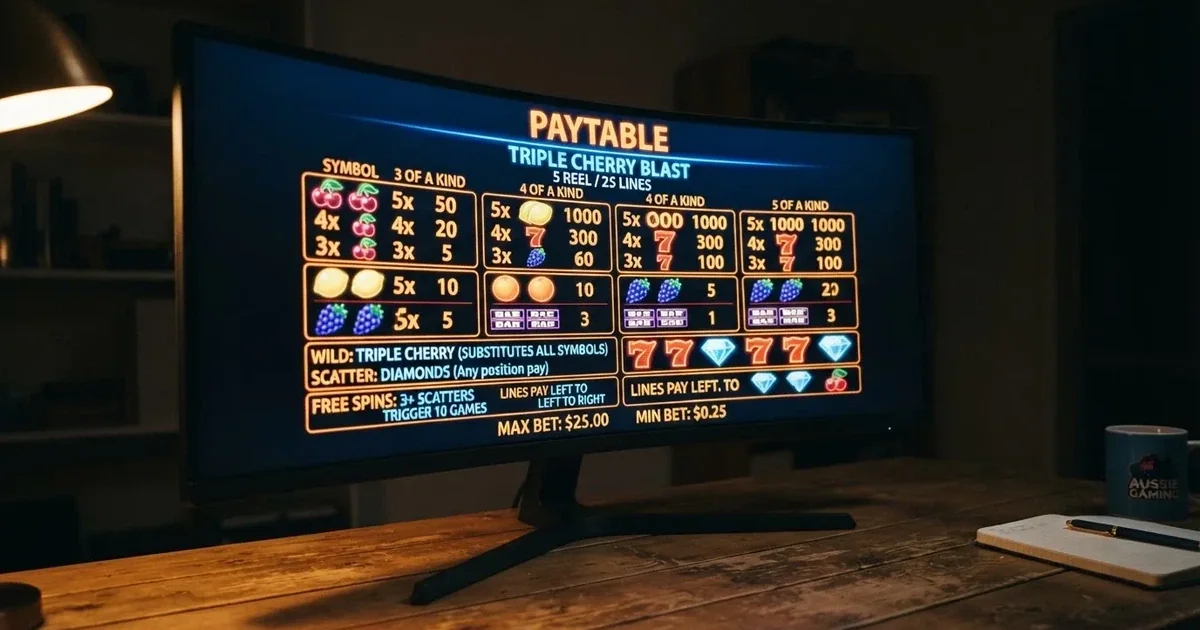
Data current as of 29 October 2026, checked against the ACMA register and state gaming-machine counts.
The short version: modern video slots, the five-reel, multi-payline, animated-bonus kind, are abundant at Australian pubs, clubs and casinos in their licensed electronic gaming machine form. The same product, offered as an online casino game to someone in Australia, is prohibited under the Interactive Gambling Act 2001. The ACMA has spent 2026 shutting those offers down: 1,751 illegal gambling and affiliate sites blocked since November 2019, with twelve more added in a single June 2026 round. The eleven brands reviewed below are not a recommendation. They are the names the regulator itself has called out, because each was offering something an Australian cannot lawfully buy.
The longer version takes the rest of the page.
Table of Contents
- Mobile and app: how a video slot actually plays on a phone
- Specific games and providers: what a video slot actually is
- Top eleven: how this shortlist is built, and why these are the names
- Overview: the Australian video slots landscape in 2026
- Legality: what the Interactive Gambling Act actually prohibits
- Responsible gambling: what the licensed system actually offers
- Bonuses and free spins: what an offer on an offshore site actually does
- The eleven brands in detail
- What an Australian adult’s actual choice looks like in 2026
- The choice, stated plainly
- Frequently asked questions
Mobile and app: how a video slot actually plays on a phone
A modern video slot is a touchscreen object first and a desktop object second. That is the single most useful thing to know before picking a game, and it shapes everything else on this shelf.

The five-reel, fifty-plus-symbol layout that defines the format was designed for a screen wider than a thumb, but the games that survived the move to mobile are the ones whose bonus rounds, free-spin triggers and pick-a-prize screens translate cleanly to a portrait touchscreen. Tap-to-spin replaces a pull-lever; paylines are drawn as fixed patterns on the reels themselves rather than as numbered lines crossing them; the spin button lives at the bottom-right of the screen rather than under a hand. None of that is a feature, and none of it is optional — a video slot that does not behave well in a phone browser is a game fewer people actually play.
A dedicated app is rarer in this category than in sports betting. The reason is regulatory. Australian-licensed wagering operators publish apps because they can lawfully take bets; they do not publish casino apps because they cannot lawfully offer casino games online. The brands whose apps you can find in the Australian app stores are overwhelmingly wagering products (Sportsbet, bet365, Ladbrokes) with a casino tab that either redirects to the browser or simply does not exist. A reader who wants a “video slots app” that genuinely opens on an Australian IP is, in practice, looking at an offshore brand — which is the legal territory covered in the next section.
What the page can usefully say about mobile play is therefore narrow but specific:
- The licensed machines in pubs and clubs run on dedicated cabinet hardware, not on the patron’s phone. There is no “app” version of a Crown Melbourne or Star Sydney video slot.
- The licensed machines in Australian casinos use player cards and account-based play, with limits and session data tracked through the venue’s own system. Mobile is not part of that picture.
- Browser-based play at an offshore site gives a full game on a modern phone, but the site itself is the thing the ACMA has been blocking since 2019. A smooth mobile experience is not a reason to use one.
The trade-off is honest and short: the best mobile video slots experience is at a site you cannot lawfully reach from Australia; the lawful option is a venue, not a screen in your hand.
Specific games and providers: what a video slot actually is
A video slot is not a vague term. It refers to a defined format that took shape between the mid-1970s and the mid-1990s, and understanding the format is what lets a player read a paytable rather than be impressed by it.

The lineage matters because marketing copy treats every animated slot as a “video slot,” which collapses the distinction the term was built to make. The first automatic slot mechanism, developed by Charles Fey in San Francisco in the late nineteenth century, used three mechanical reels with five symbols each — horseshoes, diamonds, spades, hearts and the Liberty Bell — and three bells in a row paid the top prize of ten nickels. That machine had about 1,000 possible combinations. The bottomless hopper arrived in 1963 with Bally’s Money Honey, which paid out up to 500 coins without an attendant. The first true video slot was the 1976 Fortune Coin, developed in Kearny Mesa, California, which replaced physical reels with a screen displaying simulated ones.
What modern video slots added was combinatorial depth. A contemporary game uses five or more reels with fifty or more symbols per reel, producing odds as high as 300 million to one against the top combination. That is the single fact that separates the format from the older three-reel machines Australians call pokies: the paytable is not a list of cherry-and-bar combinations, it is a probability map covering thousands of symbol positions per reel. The bonus rounds — free spins, pick-a-prize screens, expanding wilds, cascading reels — exist because the underlying reel structure is rich enough to support them.
A second axis sits beside reels: paylines. A classic three-reel machine has one horizontal line in the middle, or three. A modern video slot has anywhere from twenty to several hundred, configured as fixed patterns rather than adjustable lines — a design choice that means the player bets across all lines at a fixed denomination rather than choosing which lines to activate. Reading a paytable for a modern game is therefore a different exercise from reading one for a classic machine: what matters is the line configuration, the symbol frequency on each reel, and the trigger conditions for the bonus feature, not the headline jackpot number, which is almost always the rarest possible outcome.
Providers organise their catalogues around volatility — the variance of a game’s payout distribution — and this is where two slots from the same studio can behave nothing like each other. A low-volatility game pays small amounts often; a high-volatility game pays rarely and in larger sums; both can carry the same theoretical return to player percentage. The reason is that RTP is an average across millions of spins, while volatility describes the shape of the distribution around that average. Two ninety-six-percent games can feel entirely different to a player sitting at one for an hour.
Two games from the same provider running different volatility ratings is, in other words, not a contradiction. It is the catalogue doing its job: giving a venue a spread of player experiences from a single integration.
Top eleven: how this shortlist is built, and why these are the names
Eleven names appear in the table below, and a reader who came looking for “the best video slots in Australia” deserves to know why these eleven rather than the obvious offshore shortlist.
Every brand in the table has been the subject of a formal warning from the Australian Communications and Media Authority under the Interactive Gambling Act 2001, because each offered online casino games — including video slots — to people in Australia. That is the only criterion. The table is not a recommendation; it is a record. The same record is what the ACMA itself publishes, and reproducing it here is the most useful thing this page can do for a reader weighing which sites are even reachable in the first place.
The brands, the operator behind each as named by the ACMA, and the dates of action are:
| Brand | ACMA action and date | Operator named by the ACMA | Subject support |
|---|---|---|---|
| RocketPlay | Formal warning, March 2026 | Pulsup Ltd | — |
| Level Up Casino | Formal warning, May 2022 | Dama N.V. | Listed in third-party catalogues |
| Woo Casino | Formal warning, March 2025 | Dama N.V. | — |
| Spirit Casino | Formal warning, May 2025 | Dama N.V. | — |
| National Casino | Formal warning, July 2025 | Consolutetish S.R.L. | Listed in third-party catalogues |
| Bizzo Casino | Formal warning, July 2025 | Consolutetish S.R.L. | — |
| Ignition Casino | Formal warning, July 2025 | Bamboo Media | — |
| Instant Casino | Formal warning, February 2025 | EOD Code SRL | — |
| Jackbit | Formal warning, April 2026 | Ryker B.V. | — |
| Casino Intense | Formal warning, April 2025 | Sterplay Holding Ltd | Listed across Australian reporting |
| Sky Crown | Formal warning, September 2022 | Hollycorn N.V. | — |
Three brands appear in third-party listings as video slots catalogues; the rest do not, which matters for the specific-game question and matters less for the legal one. The ACMA action is the same in every row: a formal warning under the IGA, after which the named operator is meant to stop offering prohibited services to Australian customers. The pattern across the list is that operators move — Dama N.V. is named over three different brands across four years, Hollycorn N.V. and the TechSolutions group reappear under new brand names — which is itself a fact about the offshore market, not a coincidence.
No row carries a “subject support” rating above “listings-only” because no brand in the table is lawfully available to an Australian reader. The cell shows what third-party catalogues say, not what the operator itself confirms for an Australian IP. A reader using any of these sites does so outside the Australian regulatory frame.
What the offshore market actually costs an Australian
H2 Gambling Capital’s 2025 report puts annual Australian losses to illegal offshore gambling at about A$3.9 billion, and the share of gambling going through legal channels fell from 74 percent in 2021 to 64 percent by 2025. Those two figures together describe the gap this page is trying to close: more than a third of Australian gambling spend now leaves the country, through operators with no Australian licence, no Australian complaints body and no obligation to honour a withdrawal request.
A reader who treats the eleven names above as a comparison list is reading the wrong list. They are a record of where Australians have already tried to play, and where the regulator has already acted.
Overview: the Australian video slots landscape in 2026
The shape of the Australian market is determined by the Interactive Gambling Act 2001 and the 2017 amendments that strengthened it. The Act makes it an offence to provide online casino games, online pokies or in-play betting to a person in Australia. No state or territory licenses those products. What is licensed is wagering on races and sport placed before the event, lotteries and keno — in practice licensed by the Northern Territory Racing and Wagering Commission, which regulates 52 of Australia’s online bookmakers, including Sportsbet, bet365 and Ladbrokes, and which has no full-time staff and meets once a month in Darwin.
The distinction matters because the same Australian player can lawfully place a bet with a Northern Territory-licensed bookmaker and cannot lawfully play an online video slot with any operator, Australian or otherwise. The licensed wagering market is large, sophisticated and Australian-regulated. The licensed video slots market is land-based, venue-based, and run through state and territory regulators, not the ACMA.
Electronic gaming machines — the land-based form of the same product — are heavily distributed. New South Wales leads with 87,298 machines outside casinos as of June 2023. Victoria has 26,380 across 2021–22; Queensland 21,122 as of October 2023; South Australia 11,672 as of September 2023; and the ACT 3,587 as of November 2023. Those numbers describe where a player can sit down at a real video slot today, and they have done so since New South Wales legalised the machines in 1956. By 2010 Australia operated an estimated 97,103 gaming machines outside casinos — a per-capita rate about five times that of the United States. The product is familiar and widespread. The online version of it is not.
State-level casino regulators govern what runs inside the licensed casino floors. Crown Melbourne’s baccarat and blackjack variants, for example, are approved by the Victorian Gambling and Casino Control Commission, which replaced the VCGLR as Victoria’s casino regulator on 1 July 2022. The same pattern applies in NSW under the Casino Control Act 1992, which requires approved rules for any table game. A player at a Crown Melbourne or Star Sydney machine is playing under a regulator-approved configuration, with a player-card system that tracks session spend and a venue-level responsible-gambling framework. None of that infrastructure exists offshore.
What an Australian reader is choosing between in 2026 is therefore not “which offshore casino has the best video slots.” It is “which licensed venue, which machine, which denomination, and which session-length budget.” That is a different kind of decision, and the rest of this page is structured around it.
Legality: what the Interactive Gambling Act actually prohibits
The Interactive Gambling Act 2001 prohibits the supply of “prohibited interactive gambling services” to customers physically present in Australia. Online casino games — including video slots, table games and live dealer products — are prohibited interactive gambling services. In-play betting on sport is also prohibited. What is not prohibited, and is licensed in Australia, is wagering on races and sport placed before the event, lotteries and keno.
The 2017 amendments strengthened enforcement. The ACMA now has the power to issue formal warnings, to direct Australian internet service providers to block illegal sites, and to refer persistent offenders for civil penalty proceedings. The individual player is not prosecuted under the Act — the offence sits with the provider — but an Australian using an offshore site has no Australian consumer protection. There is no local complaints body, no local recourse if a withdrawal is refused, and no guarantee the site will still be reachable next week. The blocking regime means an offshore site can disappear with a player balance still on it.
Payment rules add a second layer. Since 11 June 2024, credit cards, credit-related products and digital currency cannot be used to fund licensed online wagering in Australia; the penalty for an operator accepting them is up to A$247,500. Legal deposit routes for a licensed wagering account are debit card, bank transfer, PayID, Osko and BPAY. A site asking an Australian customer for a credit card or a crypto deposit is operating outside the Australian rules, regardless of what licence it claims to hold.
The Interactive Gambling Amendment (Gambling Reform) Bill 2026 passed Parliament on 19 August 2026 and its advertising and inducement measures commence on 1 January 2027. As of 2026 that reform is law with a start date, not yet in force. A reader looking at affiliate marketing of offshore casinos in 2026 is looking at content produced under the older rules.
On minimum age: the threshold across the country is 18. There is no carve-out for offshore sites, and there is no Australian operator that lawfully takes an under-18 customer.
On tax: gambling winnings of a recreational Australian player are not assessable income under section 6-5 of the ITAA 1997, and losses are not deductible, unless the person carries on a business of gambling. The “business of gambling” test is the ATO’s, not the player’s, and the position is best checked with the ATO directly.
Responsible gambling: what the licensed system actually offers
The Australian licensed wagering and casino system has three pieces of player-protection infrastructure an offshore site does not. They are worth knowing by name, because they are the difference between playing under a regime and playing outside one.
BetStop, the National Self-Exclusion Register, has been live since August 2023. It binds every Australian-licensed online and phone wagering service: register once, exclude yourself from every licensed operator at once. The exclusion periods range from three months to a permanent block. An offshore casino is not connected to BetStop — self-excluding through BetStop does nothing at an unlicensed site — which is the cleanest single illustration of the gap between the two markets.
The National Gambling Helpline is 1800 858 858, free and available 24 hours a day, with online chat at Gambling Help Online. The helpline is the right first call regardless of whether the gambling in question was at a licensed venue or an offshore site; the support it offers does not depend on where the gambling happened.
State and territory casino regulators run venue-level frameworks: player-card tracking of session spend, mandatory break periods, intervention by trained staff when play patterns change, and on-floor self-exclusion. These are not online tools — they sit with the venue — but they are the infrastructure an Australian adult actually has when they sit down at a video slot in a casino, club or pub.
Player-protection limits on licensed wagering are statutory. Credit cards cannot be used. Deposit limits are operator-set and visible in the account. Time-out and self-exclusion tools are mandatory under each state and territory’s responsible-gambling code. An offshore site has no obligation to offer any of them, and most do not.
The trade-off for a player is clear. BetStop excludes you from licensed operators and does not touch offshore ones; the helpline works regardless of where you played; venue-level protections apply at the venue and nowhere else. None of these tools replace a player’s own decision to stop, but they are the formal scaffolding around that decision, and they exist only inside the licensed market.
Bonuses and free spins: what an offer on an offshore site actually does
The bonus mechanic is the inducement layer the 2026 reform is designed to constrain, and it is worth understanding on its own terms before any reader looks at an offshore offer.
A “free spins” bonus at an offshore video slots site gives the player a fixed number of spins at a fixed stake on a named game. The winnings from those spins are credited as bonus money, not as cash, and the bonus money carries a wagering requirement — typically expressed as a multiple of the bonus amount — before it can be withdrawn. A “deposit match” bonus works the same way: the operator matches a percentage of the player’s deposit with bonus money, which then has to be turned over a stated number of times before withdrawal.
The wagering requirement is the cost. A 40x requirement on a A$100 bonus means A$4,000 of qualifying bets before the bonus money becomes withdrawable cash. The games that count toward that turnover usually exclude some table games and weight slot play at 100 percent, but the requirement still has to be met. A player who treats the bonus as “free money” has not read the offer.
The maximum cashout cap is the second cost. Many offshore bonuses cap the amount that can be withdrawn from bonus-derived winnings, sometimes at a few hundred dollars, regardless of how much the player actually wins during the playthrough. A reader who hits a large payout during a bonus round and then discovers the cap will see most of it stay on the site.
Game restrictions are the third cost. A bonus tied to a single named slot — usually one the operator wants to promote — does not transfer to other games, and the qualifying bets that count toward the wagering requirement are usually limited to that game or a small list.
For a reader in Australia, the inducement question has a structural answer: under the 2026 reform, the advertising and inducement rules that govern how licensed wagering operators market bonuses commence on 1 January 2027. In 2026 those rules are not yet in force. Offshore sites are not bound by them. The bonuses they offer are designed to recruit Australian customers into a market the regulator is actively shutting down, which is the fact that makes the inducement structure itself the relevant piece of information.
The eleven brands in detail
Each of the brands below is presented as a record of the ACMA’s action against it. None is recommended. Each carries a verdict grounded in what the ACMA record and the operator’s own listing position actually establish.
RocketPlay
RocketPlay is the most recent ACMA action on this list: a formal warning under the IGA was issued to Pulsup Ltd in March 2026 over the Rocketplay.com.au service. The same brand had earlier drawn a formal warning to Dama N.V. in May 2022. The pattern is the one this page has already named — a brand moves between operators, and each new operator draws its own warning. The licensed Australian wagering system does not reach it, and the ACMA’s blocking regime is the only mechanism that has acted against it in 2026.
The verdict here is straightforward. An Australian reader cannot lawfully use RocketPlay, the regulator has already named it twice, and there is no Australian consumer protection framework behind it. The only reason to mention it on a page about the best video slots in Australia is the record itself.
Level Up Casino
Level Up Casino was the subject of a Dama N.V. formal warning in May 2022, one of six casino brands covered in the same ACMA action. The brand is listed in third-party catalogues as a video slots site, which is what the listings-only support tag means: third parties describe the catalogue, and the operator does not confirm it for an Australian audience. The same warning covered Bambet, Dazard, Rocketplay, Wild Tornado and Cobra Casinos, which is how widely the same operator spreads its brands.
The verdict on Level Up is the same shape as RocketPlay’s. The site has been on the ACMA’s record for four years, the warning has not produced a return to the licensed market, and the catalogue descriptions come from listings rather than from the operator.
Woo Casino
Woo Casino drew a formal warning to Dama N.V. in March 2025. The brand does not appear in the third-party catalogue coverage this page relies on, which means the page can say only what the ACMA record says. A reader who encounters Woo Casino through affiliate marketing is encountering a brand the regulator has already addressed in 2026.
Spirit Casino
Spirit Casino drew a formal warning to Dama N.V. in May 2025 — two months after Woo Casino and through the same operator. The two warnings, two months apart, are the clearest illustration of the pattern of one operator running multiple brands and the regulator addressing each in turn.
National Casino
National Casino drew a formal warning to Consolutetish S.R.L. in July 2025. The brand appears in third-party catalogue listings, which puts it in the same position as Level Up: third parties describe it, the operator does not confirm it for an Australian audience, and the regulator has acted against it in the last twelve months.
Bizzo Casino
Bizzo Casino drew a July 2025 formal warning to Consolutetish S.R.L., the same operator and the same date as National Casino. The brand had already drawn a 2022 formal warning to TechSolutions (CY) Group Limited and TechSolutions Group N.V., which means it has crossed operators and crossed warnings. The site does not appear in third-party catalogue coverage. The repetition across operators is the relevant fact: the brand has been warned, moved, and been warned again.
Ignition Casino
Ignition Casino drew a formal warning to Bamboo Media in July 2025. No third-party catalogue coverage applies. The site is a US-facing product, which is the structural reason it does not feature in catalogues focused on the Australian market — a detail the ACMA’s action against it for offering to Australians makes clear is not the operator’s choice but the regulator’s.
Instant Casino
Instant Casino drew a formal warning to EOD Code SRL in February 2025. The brand is not in third-party catalogue coverage. The February 2025 date is the earliest formal warning on this list, which is not a recommendation — it is the order in which the regulator named each brand.
Jackbit
Jackbit drew a formal warning to Ryker B.V. in April 2026, alongside CasinOK. Jackbit is a crypto-focused operator, which is relevant because the credit-card and digital-currency ban that took effect on 11 June 2024 for Australian-licensed wagering makes the payment rail itself a flag: a site asking for crypto is operating outside the Australian rules regardless of its claimed licence.
Casino Intense
Casino Intense drew a formal warning to Sterplay Holding Ltd in April 2025. The brand appears in Australian reporting coverage, which is what the listings-only tag captures — third-party Australian sources have mentioned it, the operator does not confirm an Australian-facing service.
Sky Crown
Sky Crown drew a formal warning to Hollycorn N.V. in September 2022, alongside Blue Leo. The warning is the oldest on this list, which is not a recommendation: it is the order of the ACMA’s published actions. The brand has not returned to the licensed Australian market, and the Hollycorn N.V. pattern of running multiple brands under a single operator is the same one Dama N.V. exemplifies higher on the list.
What an Australian adult’s actual choice looks like in 2026
The arithmetic the ACMA’s record supports is not a calculation of expected loss at a particular offshore site. It is a calculation of how the regulator’s blocking programme has run.
The first blocking request under the IGA was issued in November 2019. By June 2026, the ACMA had directed Australian ISPs to block 1,751 illegal gambling and affiliate marketing websites, and more than 230 unlicensed gambling services had left the Australian market since enforcement was strengthened in 2017. The June 2026 round alone added twelve sites: 7Signs, ChromaBet, Donbet, Duospin, Freshbet, Slots Gem, Jacks Club, Lucky Start, Pointsbetz.com, Spinrise, Vinyl Casino and Wildsino.
The blocking rate, taken across the period from November 2019 to June 2026, is therefore in the band of roughly 200 to 270 sites per year, with the year-on-year rate varying as enforcement rounds cluster around particular offshore operators. That band is the headline number. The condition on it is that it counts sites the regulator has acted against, not sites an Australian reader is currently attempting to reach — an offshore site can be reachable one week and blocked the next, which is what makes the band the right shape for the answer rather than a single figure.
The implication for a reader is structural. The offshore market an Australian reader would be choosing from in 2026 is being thinned, not expanded. The list of available sites shrinks faster than new ones appear, which is what “230 services have left the Australian market” describes in practical terms.
The licensed alternative is a venue. A Crown Melbourne machine, a Star Sydney machine, a club or pub machine in NSW, Victoria, Queensland, South Australia or the ACT, with a player card and a session budget and a venue-level responsible-gambling framework. That is the choice the IGA draws, and the ACMA’s blocking record is the regulator’s enforcement of it.
The choice, stated plainly
A reader who came to this page for “the best video slots in Australia in 2026” has reached a fork in the road that the offshore marketing does not draw for them.
The offshore fork leads to one of the eleven brands above, each of them on the ACMA’s formal-warning list, each of them reachable only outside the Australian regulatory frame, each of them offering bonuses that convert to bonus money with wagering requirements and cashout caps, and each of them subject to blocking at any time the ACMA acts. The licensed fork leads to a venue with a machine, a player card, a session budget and BetStop if the reader wants it. The two forks do not connect.
The arithmetic of the regulator’s blocking programme says the offshore fork is shrinking. The licensed fork has been in place since 1956 in NSW and is the only legal one. That is the choice, and this page has tried to give a reader enough to make it on the evidence rather than the marketing.
Frequently asked questions
How is a modern video slot different from the classic three-reel pokies machine?
The format change is structural. A classic three-reel machine has about 10 symbols per reel and roughly 1,000 possible combinations; a modern video slot uses five or more reels with 50 or more symbols each, producing odds as high as 300 million to one against the top combination. The bonus rounds, free-spin triggers and animated paylines that define modern video slots exist because the underlying reel structure is rich enough to support them.
Do video slots include bonus rounds that classic machines don’t have?
Yes. The bonus round — free spins, pick-a-prize, expanding wilds, cascading reels — is the structural feature that distinguishes a video slot from a classic machine, and it is supported by the larger reel and symbol configuration of the modern format. Classic three-reel pokies do not have bonus rounds because their reel structure does not support them.
Are video slots on a mobile browser the same game as the desktop version?
In the offshore market, yes — a video slot on a mobile browser is the same game as on a desktop, with the paytable, RTP and bonus features unchanged. In the Australian licensed market, the question does not apply: the licensed video slot is a venue-based machine, not a browser product. A reader looking for “video slots on a phone” inside Australia is, in practice, looking at an offshore site.
How many paylines does a typical modern video slot use?
Modern video slots use anywhere from 20 to several hundred paylines, configured as fixed patterns on the reels rather than as adjustable lines. The player bets across all lines at a fixed denomination, and the line structure is what determines the game’s hit frequency, which is separate from its volatility and from its RTP.
Why do video slots vary in volatility even within the same provider’s catalogue?
Because RTP is an average across millions of spins and volatility describes the shape of the distribution around that average. Two games with the same RTP can feel entirely different to a player at one for an hour — one pays small amounts often, the other pays rarely and in larger sums. Providers use the catalogue to give venues a spread of player experiences from a single integration.
Where in Australia are licensed video slot machines most concentrated outside casinos?
New South Wales leads by a wide margin: 87,298 machines outside casinos as of June 2023, with Victoria at 26,380 across 2021–22, Queensland at 21,122 as of October 2023, South Australia at 11,672 as of September 2023, and the ACT at 3,587 as of November 2023. The same product is approved inside Crown Melbourne and Star Sydney under state casino regulators.