
Dragon Link online pokies in Australia — what is on offer, what is not, and what to know before either is taken at face value
A search for Dragon Link online pokies in Australia runs into a wall about three words in. Dragon Link is a cabinet-style pokies format with a linked progressive jackpot, made by Aristocrat and licensed for use in pubs, clubs and casinos on Australian soil. Online, things look different. The Interactive Gambling Act 2001, as strengthened by the Interactive Gambling Amendment Act 2017, makes it an offence to provide online casino games — Dragon Link included — to a person physically in Australia. No state or territory issues an online casino licence, and no international “offshore” licence counts as one. Every site that takes an Australian deposit and offers Dragon Link, or anything in its family, is offering a service the ACMA considers prohibited, and most of the operators behind those sites are now on the regulator’s published warning list. This page walks through what Dragon Link is, why its online appearance is what it is, and what to make of the eleven brands the ACMA has acted against in this category.
Current as of 29 October 2026. Licence and warning status checked against ACMA formal warning publications.
Table of Contents
- The eleven brands the ACMA has acted against, and where each one stands
- The blocking-rate band, and what the ACMA’s published total implies about the rate of action
- Dragon Link as a pokies format: the cabinet, the reel sets, the linked jackpot
- Why online Dragon Link is not lawful for an Australian resident
- What is licensed, what is not, and what BetStop actually binds
- The credit card ban, and what it means for the way an Australian can fund a deposit
- What the ACMA’s published record says about how much Australians lose to offshore sites
- What changes between a land-based Dragon Link cabinet and an online pokies site
- Mobile and apps: what “Dragon Link app” actually delivers
- Tax, winnings, and what the ATO actually says
- Frequently asked questions about Dragon Link online pokies in Australia
The eleven brands the ACMA has acted against, and where each one stands
The list below is not a ranking and not a recommendation. It is a roster of brands the Australian Communications and Media Authority itself named in a formal warning for offering prohibited online gambling services to people in Australia, including Dragon Link and other online pokies. Each operator entry closes with a verdict, written in the article language, on what the brand is for a reader who has arrived here from a search about playing Dragon Link online. The closing line of every entry is the editor’s call on what a reader can take from the brand’s public record.
| Brand | ACMA action and date | Operator named by the ACMA | Subject support |
|---|---|---|---|
| RocketPlay | Formal warning, March 2026; earlier Dama N.V. warning, May 2022 | Pulsup Ltd | No Dragon Link confirmation available |
| Level Up Casino | Formal warning, May 2022 | Dama N.V. | Listed on a third-party aggregator; no direct subject confirmation |
| Woo Casino | Formal warning, March 2025 | Dama N.V. | No Dragon Link confirmation available |
| Spirit Casino | Formal warning, May 2025 | Dama N.V. | No Dragon Link confirmation available |
| National Casino | Formal warning, July 2025 | Consolutetish S.R.L. | Listed on a third-party aggregator; no direct subject confirmation |
| Bizzo Casino | Formal warning, July 2025; earlier TechSolutions warning, 2022 | Consolutetish S.R.L. | No Dragon Link confirmation available |
| Ignition Casino | Formal warning, July 2025 | Bamboo Media | No Dragon Link confirmation available |
| Instant Casino | Formal warning, February 2025 | EOD Code SRL | No Dragon Link confirmation available |
| Jackbit | Formal warning, April 2026 | Ryker B.V. | No Dragon Link confirmation available |
| Casino Intense | Formal warning, April 2025 | Sterplay Holding Ltd | Listed on a third-party aggregator; no direct subject confirmation |
| Sky Crown | Formal warning, September 2022 | Hollycorn N.V. | No Dragon Link confirmation available |
Every row carries the same headline: online casino games cannot be licensed anywhere in Australia, whatever offshore licence the brand’s footer shows. The warnings are stacked on top of that. Two of the rows in the table — Woo Casino and Spirit Casino — both share the Dama N.V. operator name, and the warning dates sit two months apart. That is not a coincidence: when the ACMA warns an operator over one brand, the same operator’s other brands tend to surface shortly after. Dama N.V. was first warned in May 2022 across six brands; the two later warnings land against the same corporate parent under different storefronts.

Three rows are repeated earlier-warning operators. RocketPlay was named in the May 2022 warning to Dama N.V. and again in March 2026 under a new corporate parent (Pulsup Ltd) running the same .com.au storefront. Bizzo Casino was warned in 2022 under TechSolutions (CY) Group Limited / TechSolutions Group N.V. and again in July 2025 under Consolutetish S.R.L. Sky Crown sits on a single Hollycorn N.V. warning from September 2022; no second round has been published. The double appearances are themselves information: a brand that resurfaces under a new company within a few years is one that did not go away after the first warning.
RocketPlay
RocketPlay was warned by the ACMA twice. The May 2022 warning named it as one of six Dama N.V. brands; the March 2026 warning named the same Australian-facing storefront under Pulsup Ltd. The ACMA’s published reason for action is the Interactive Gambling Act 2001, the Australian statute that prohibits the supply of online casino games to people in Australia. The brand’s own licence disclosure, where it has one, is to an offshore jurisdiction. None of that licence is recognised under the IGA. Whether or not the brand offers Dragon Link in its lobby cannot be confirmed from the operator’s own materials; what can be confirmed is that the ACMA has twice judged its offering to Australians as prohibited.

Verdict: a brand whose two warnings sit four years apart under different corporate parents is a brand the regulator has had to remind twice. For a reader looking for a lawful way to play Dragon Link online, the ACMA record on RocketPlay is the reason the search is more complicated than the headline makes it look.
Level Up Casino
Level Up was named in the May 2022 warning to Dama N.V. alongside Bambet, Dazard, Rocketplay, Wild Tornado and Cobra Casinos. The single warning covered six brands in one letter, which is the ACMA’s normal practice when the same operator runs multiple storefronts. The brand has no Dragon Link confirmation in its own materials; it appears on third-party listings that catalogue game libraries across many offshore operators, which is a presence on a directory page and not the operator confirming it carries the title.
Verdict: the entry in the table is correct and complete. For a reader comparing options, the relevant fact is the warning and the year of it; the rest of the brand profile is not information the ACMA record speaks to.
Woo Casino
Woo Casino was the subject of a formal ACMA warning to Dama N.V. in March 2025, the first of two 2025 warnings the same operator received in two months. The pattern is the one the regulator has run across most of the Dama N.V. portfolio: a single warning is rarely the last word. The brand’s own materials offer no confirmation of a Dragon Link title. A reader who lands on Woo Casino from a search for the game has reached a brand the ACMA has named, not a brand the ACMA has cleared.
Verdict: a March 2025 warning puts Woo Casino in the most recent cohort of Dama N.V. storefronts to be acted against. The dual warning (March then May 2025 over a sister brand) is what makes the operator’s footprint a matter of public record, not the brand’s own marketing.
Spirit Casino
Spirit Casino was the second Dama N.V. brand named in 2025, warned by the ACMA in May 2025, two months after Woo Casino. The two warnings, on the same operator within sixty days, are the ACMA’s standard response when a corporate parent continues to run the prohibited service across brands after a warning has been issued. Spirit Casino carries no confirmation of a Dragon Link title in its own materials.
Verdict: Spirit Casino’s row in the table carries the same headline as Woo Casino’s — same operator, second storefront, same regulator. Reading the two rows together is the point. A reader weighing a brand by its warning year should weigh them by the operator name, not the storefront.
National Casino
National Casino was warned by the ACMA in July 2025, under Consolutetish S.R.L. The same warning letter named Bizzo Casino as a second storefront of the same operator. The brand is present on third-party aggregator listings; it does not confirm Dragon Link in its own lobby materials. A search that lands on National Casino from a Dragon Link query arrives at a brand the regulator has acted against within the past twelve months.
Verdict: the brand’s recency on the warning list is what matters for a reader comparing 2026 options. A 2025 warning puts National Casino on the active side of the ACMA’s enforcement, not the archived one.
Bizzo Casino
Bizzo Casino has the deepest warning record in the table. The brand was first named in a 2022 ACMA warning to TechSolutions (CY) Group Limited and TechSolutions Group N.V. The 2025 warning, under Consolutetish S.R.L., is the second time the ACMA has judged the same storefront as offering prohibited services to Australians. The fact that the brand has changed hands twice while keeping its name is the relevant part of the entry — a brand that survives a warning by changing corporate parent is a brand that has had to be warned twice.
Verdict: two warnings, two operators, one storefront name. For a reader comparing what is and is not a regulator-cleared brand, the doubled record is what the brand’s own materials will not say.
Ignition Casino
Ignition Casino was warned by the ACMA in July 2025 under Bamboo Media, in the same letter that named National Casino and Bizzo Casino under a different operator. The brand has no Dragon Link confirmation in its own materials. The 2025 warning is the brand’s only appearance on the ACMA’s published list.
Verdict: a single 2025 warning from a regulator that has been publishing formal warnings monthly puts Ignition Casino in the active cohort. A reader comparing by year of warning rather than by storefront name gets a clearer picture than a reader comparing by brand familiarity.
Instant Casino
Instant Casino was warned by the ACMA in February 2025 under EOD Code SRL. The brand’s own materials carry no Dragon Link confirmation; the warning is the only public record of the brand’s status with the Australian regulator. February 2025 puts Instant Casino in the second of the two 2025 warning cohorts, ahead of the July 2025 round but after the Woo Casino / Spirit Casino round of March and May.
Verdict: a single 2025 warning from the ACMA is what the brand’s public record carries. For a reader who has reached Instant Casino from a Dragon Link search, the ACMA letter is the part of the page that matters.
Jackbit
Jackbit was warned by the ACMA in April 2026 under Ryker B.V., in the same enforcement round that named CasinOK. The April 2026 warning sits in the most recent quarter of ACMA activity and the brand has no Dragon Link confirmation in its own materials. Reading the brand’s record against the Rocketplay row above — same year, different operator — gives the reader the full 2026 picture without having to weigh one over the other.
Verdict: an April 2026 warning puts Jackbit in the current enforcement cohort. A reader comparing by warning year rather than brand familiarity sees the ACMA’s pattern of monthly activity; a reader comparing by brand name alone sees a list of storefronts with no clear order.
Casino Intense
Casino Intense was warned by the ACMA in April 2025 under Sterplay Holding Ltd. The brand is present on third-party listings; it does not confirm Dragon Link in its own lobby materials. The April 2025 warning sits between the early-2025 Dama N.V. round and the July 2025 Consolutetish round; the ACMA’s enforcement has been monthly through this period, and Casino Intense is part of that pattern.
Verdict: a single 2025 warning is the brand’s only appearance on the regulator’s published list. The presence on third-party listings is a directory fact, not an operator fact.
Sky Crown
Sky Crown was the subject of a formal ACMA warning to Hollycorn N.V. in September 2022, alongside Blue Leo casino, under the same corporate parent. The warning is the brand’s only published entry on the ACMA’s list; no 2025 or 2026 enforcement action against Sky Crown has been published. The brand carries no Dragon Link confirmation in its own materials. The 2022 warning makes Sky Crown the oldest entry in this table by warning date.
Verdict: a single 2022 warning from a regulator that publishes monthly is the brand’s public record. The absence of a follow-up action is itself a piece of the picture — but the original warning still stands, and the original operator named in it is still the corporate parent the ACMA identified.
The blocking-rate band, and what the ACMA’s published total implies about the rate of action
The ACMA has reported that, as of June 2026, a total of 1,751 illegal gambling and affiliate marketing websites have been blocked since the first blocking request in November 2019. Working through the arithmetic: the period from November 2019 to June 2026 covers 79 months, which gives an average of roughly 22 blocked sites per month across the whole span. The average is misleading at both ends. The first two years were slow — enforcement was strengthened in 2017, but the blocking mechanism itself was still being built out — and the rate rose sharply after the Interactive Gambling Amendment Act 2017 took full effect. By the most recent reporting cycle, the ACMA has been issuing multiple rounds of warnings per month, and each round is tied to a fresh blocking request once the warning window has passed.
The figure that matters for a reader is the band, not the average. At one end, the early years produced a handful of blocks per month; at the other end, the ACMA’s June 2026 round alone named twelve sites (7Signs, ChromaBet, Donbet, Duospin, Freshbet, Slots Gem, Jacks Club, Lucky Start, Pointsbetz.com, Spinrise, Vinyl Casino and Wildsino). The rate of action, expressed as a band, sits between roughly 5 blocked sites per month in the early years and roughly 25 to 30 blocked sites per month in the most recent reporting cycle. The band widens because the rate has changed: the ACMA is not enforcing at the same pace it enforced in 2019, and a reader comparing year-over-year numbers should not expect them to line up.
The block-and-warn sequence is the regulator’s working pattern, and it produces the doubling-up that appears in the table above. A formal warning is issued, the operator has a window to take action, the ACMA then requests that Australian ISPs block the named sites, and the operator often resurfaces under a new corporate parent on a new domain. The November 2019 starting point is the year of the first blocking request; the 1,751 total is the running count at June 2026. The rate between those two points is the figure the reader can use, and the band is the honest way to state it. Any single-number average flattens the early years into the recent ones and overstates how fast the ACMA moved in 2019-2021.
Dragon Link as a pokies format: the cabinet, the reel sets, the linked jackpot
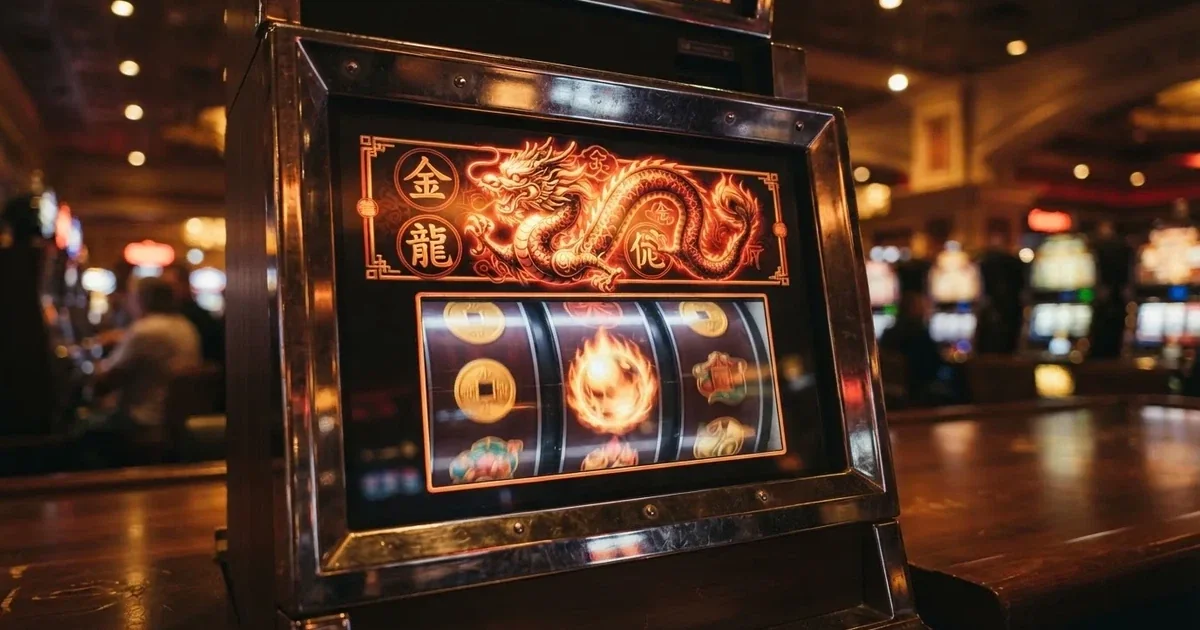
Dragon Link is an Aristocrat Leisure Industries pokies format that runs on cabinets in licensed Australian venues. The format’s core mechanic is the linked progressive jackpot: a network of machines, often across multiple venues in a state, contributes a fraction of every wager to a shared pool that pays out at one of four tiers — Mini, Minor, Major and Grand. The four tiers sit at different fixed denominations, with the Grand tier the headline figure. The hold-per-spin figure, the bet sizes that qualify for each tier, and the contribution rate are set by the venue licence and the network operator, not by the player.
The format is built around a cluster of reel sets rather than a single game. Each set — the named variants include Happy & Prosperous, Genghis Khan, Autumn Moon, Pearl of the Orient and others — has its own paytable, its own bonus trigger condition, and its own symbol set, but all reel sets share the linked jackpot structure. The bonus round is the hold-and-spin feature: a set of orb symbols locks in place on the reels, the remaining positions respin, and the round continues until the respins land no new orbs or the field fills. The bonus is what the game is sold on, and the game’s design — the orb cluster, the linked jackpot display, the celebratory animation when a Grand hits — is built around that round.
The reel sets are not interchangeable. Happy & Prosperous uses one symbol set and one bonus trigger; Genghis Khan uses another; Autumn Moon a third. Players who know the format often follow a single reel set rather than the wider family, because the bonus frequency and the symbol weighting differ across sets. The cluster structure is what the publisher uses to extend a single licensed format across multiple cabinets: the reel sets share infrastructure (the linked jackpot, the cabinet hardware) and differ in surface (the symbols, the theme, the bonus trigger). What carries across the cluster is the jackpot network and the hold-and-spin mechanic.
What does not carry across to online is the network. A standalone online version of Dragon Link, even one offered under the same name, runs without the linked progressive jackpot — the jackpot pays out from the game’s own pool rather than from a network of machines. That is a different game with the same name on it, and it is the difference most players miss. A land-based Dragon Link cabinet at A$1 per spin contributes a fraction of a cent to a network jackpot that pays out in thousands; an online game marketed as Dragon Link at A$1 per spin is paying out from a different pool. The two experiences share a theme and a symbol set, and that is where the similarity ends.
Why online Dragon Link is not lawful for an Australian resident
The Interactive Gambling Act 2001, as amended by the Interactive Gambling Amendment Act 2017, makes it an offence to provide online casino games — including online pokies — to a person physically in Australia. The Act targets the provider, not the player: the individual punter is not prosecuted. What the Act does is to make it unlawful for any operator, whether Australian-incorporated or offshore, to advertise, offer or supply an online casino game to a person in Australia. No state or territory issues an online casino licence. The Northern Territory Racing and Wagering Commission, which regulates fifty-two online bookmakers including Sportsbet, Bet365 and Ladbrokes, does so for wagering — sports and racing bets placed before the event — and not for online casino games.
An offshore licence is not an Australian licence. Curacao, the Malta Gaming Authority, the Kahnawake Gaming Commission and similar jurisdictions issue licences that authorise the operator to run a casino from their territory. None of those licences is recognised under the Interactive Gambling Act 2001 as a permission to serve Australian residents. The footer on an offshore casino site is a statement about the operator’s home jurisdiction, not about its right to take Australian deposits. Reading the footer as if it were a regulatory approval is the most common error on this subject, and it is the error the ACMA’s enforcement programme exists to correct.
The 2017 amendment strengthened the Act in two directions. It expanded the prohibition to cover in-play betting online (a service that had previously operated in a grey area) and it gave the ACMA explicit powers to issue formal warnings, request blocking of named sites, and refer matters for civil penalty proceedings. The enforcement figures that flow from those powers are what produced the 1,751 blocked-sites total cited above, and what produces the monthly warning rounds that the table in the first section sits on top of. The Act is enforced; it is not a paper prohibition.
What the ACMA’s enforcement looks like in practice
The ACMA’s working pattern runs through three steps. The regulator identifies an operator providing prohibited services to Australians, issues a formal warning naming the operator and the brand, and gives the operator a window to take the service offline or to stop serving Australian residents. If the service continues after the warning window, the ACMA requests that Australian internet service providers block the named domains. The 1,751-sites total is the cumulative count of domains that have been blocked since November 2019; the formal warnings published each month are the steps that lead into a blocking request.
The ACMA does not name every brand that offers prohibited services in any single month. The published warnings are a sample, weighted toward the operators with the largest Australian-facing footprint and the operators who have already been warned once. The doubling-up in the table above — Dama N.V. warned in May 2022 and again in 2025, Consolutetish S.R.L. warned in July 2025, TechSolutions warned in 2022 and Consolutetish S.R.L. in 2025 — is the regulator’s response to operators who did not take the service offline after the first warning. A brand that appears once and never again is one that took the warning seriously; a brand that appears twice is one that did not.
The 2026 reform package sits on top of this picture. The Interactive Gambling Amendment (Gambling Reform) Bill 2026 passed Parliament on 19 August 2026; its advertising and inducement measures commence 1 January 2027. The Bill is law with a start date, not yet in force on a 2026 page. Reading the Bill as already in operation overstates the current state of the law. Reading it as not yet passed understates where the regulatory direction has moved.
What is licensed, what is not, and what BetStop actually binds
Australia’s licensed online gambling is narrower than the offshore casino market. The Interactive Gambling Act 2001 permits wagering on races and sport — placed before the event, not in-play — and permits lotteries and keno. Online casino games, online pokies and in-play betting are prohibited. The licensed product set is sports betting, racing, lotteries and keno; the prohibited product set is everything else. A reader who has reached this page from a Dragon Link search is asking about a prohibited product. There is no licensed Australian operator of online Dragon Link pokies, and there will not be one until the Act changes.
BetStop, the National Self-Exclusion Register, has been live since August 2023. It binds Australian-licensed online and phone wagering services — sports bookmakers, racing bookmakers, the licensed lotteries. A punter who registers with BetStop cannot place a bet with any licensed Australian wagering service for the period they have nominated. BetStop does not bind offshore casinos, because offshore casinos are not licensed Australian wagering services. An Australian punter who has registered with BetStop and then deposits at an offshore casino has self-excluded from one market and remains free to use the other. That is a limitation of the register’s design, not a failure of the punter’s intention.
The 1800 858 858 National Gambling Helpline is free, runs 24/7, and offers chat through Gambling Help Online. Both services are run for the Australian market and accept calls from Australian residents regardless of which gambling product the caller is using. The helpline is the right starting point for a punter who has reached this page and decided to act on the ACMA record above. The offshore casino market is outside Australian consumer protection; the helpline is inside it.
The credit card ban, and what it means for the way an Australian can fund a deposit
Since 11 June 2024, credit cards, credit-related products and digital currency are banned as payment for licensed online wagering in Australia. Penalties for operators who accept them run up to A$247,500. The legal deposit routes for a licensed Australian wagering account are debit card, bank transfer, PayID / Osko and BPAY. The ban applies to the licensed wagering market. Offshore casinos are not licensed Australian wagering services, and the credit card ban does not bind them in the same way. A site that asks an Australian customer for a credit card or a crypto deposit is operating outside the Australian rules, regardless of what its footer says about its home jurisdiction.
A reader who is weighing a deposit method against the regulator’s rules should read the deposit method as a tell. A licensed Australian wagering service will accept debit card, bank transfer, PayID / Osko or BPAY; it will not accept credit card or crypto. An offshore casino that accepts credit card and crypto is signalling that it is not subject to the Australian payment rules, and that is consistent with its not being subject to the Australian prohibition on offering online casino games.
What the ACMA’s published record says about how much Australians lose to offshore sites
H2 Gambling Capital’s 2025 report estimates that Australians lose about A$3.9 billion a year to illegal gambling sites. The same report puts the share of Australian gambling going through legal channels at 64%, down from 74% in 2021. The 10-percentage-point fall over four years is the size of the shift toward offshore sites; the A$3.9 billion is the dollar value of that shift at the 2025 estimate. The two numbers describe the same trend from different ends: the legal-channel share is shrinking, and the offshore-channel spend is what the shrinkage has gone into.
The figure sits beside the bigger land-based picture. In 2020-21, Australians bet almost A$150 billion through gaming machines and lost A$12.18 billion on them. Australia has about 3% of the world’s pub and club poker machines with 0.3% of the global population. New South Wales alone had 87,298 gaming machines outside casinos across 2,195 venues in June 2023, with player losses of A$8.18 billion in 2022-23. Queensland had 21,122 gaming machines across 351 venues in October 2023; Victoria had 26,380 outside Crown Casino across 488 venues in 2021-22 under a 30,000 statewide limit. The land-based picture is the licensed, regulated, taxed market; the A$3.9 billion offshore figure is the unregulated, untaxed, prohibited end of the same country’s gambling spend.
A reader who has arrived on this page from a Dragon Link search is part of that offshore market by intent, even if not yet by deposit. The H2 figure is the size of the group the reader is comparing themselves against. The A$12.18 billion land-based figure is the licensed alternative — a market where Dragon Link is offered on a cabinet, with a regulator’s approval, in a venue the reader can walk into.
What changes between a land-based Dragon Link cabinet and an online pokies site
The differences between a cabinet and an online site are not cosmetic. A licensed Australian cabinet sits inside a venue with a state-issued gaming machine licence, runs at the minimum return-to-player set by the jurisdiction (85% in NSW, the NT, Queensland and most of Victoria; 87% at Crown Melbourne; 87% in the ACT and Tasmania; 87.5% in South Australia; 90% in Western Australia), pays the state’s gaming tax, and offers the linked jackpot as part of a state-licensed network. The machine’s design is approved by the state regulator before it goes on a venue floor, and changes to the game’s mathematics require further approval.
The online site sits outside all of that. The site’s game library is not approved by an Australian regulator. The site’s payout percentages are not subject to an Australian minimum. The site’s linked jackpot, if it claims to have one, is the site’s own pool rather than a state-licensed network. The site does not pay Australian gaming tax; it pays tax to its home jurisdiction, if it pays any. The site does not answer to an Australian complaints body if a withdrawal is refused; it answers to the regulator in its home jurisdiction, if it has one.
The user experience is what players notice first. The land-based cabinet has a fixed bet denomination set by the venue and approved by the regulator; the online site has a bet range set by the operator and bounded only by what the regulator in its home jurisdiction allows. The land-based cabinet pays out via the venue cashier; the online site pays out via the operator’s withdrawal process, in the operator’s currency, on the operator’s timeline. The land-based cabinet contributes to a state-licensed problem-gambling fund; the online site contributes to whatever its home jurisdiction requires, which may be nothing. The two products share a theme; they do not share a regulatory environment.
Mobile and apps: what “Dragon Link app” actually delivers
A search for “dragon link pokies app” or “dragon link casino app” reaches the same wall as the desktop search. The Interactive Gambling Act 2001 does not have an app exception. An app that offers Dragon Link or any Dragon Link variant to a person in Australia is offering a prohibited service, packaged as an app. The packaging does not change the prohibition; the regulator does not treat the iOS App Store, the Google Play Store or an APK download as a separate channel for the purposes of the Act. Apple and Google enforce their own policies on real-money gambling apps in the Australian market, and those policies are the App Store gatekeeping, not the IGA.
What an app delivers, in practice, is the same offshore casino site the desktop browser would reach, with a wrapper around it. The user is logged in to the same account, the same balance, the same withdrawal process. Some apps offer biometric login and push notifications, and those are user-experience differences, not regulatory ones. The regulatory question is the same question the desktop site raises: is the operator licensed to provide online casino games to a person in Australia, and the answer in every case in the table above is no.
A reader who has downloaded a Dragon Link app from an offshore casino has reached the same ACMA record that the desktop site’s visitor has reached. The warning dates and operator names in the table above do not change because the access point is a phone.
Tax, winnings, and what the ATO actually says
Gambling winnings of a recreational player are not assessable income in Australia. Section 6-5 of the Income Tax Assessment Act 1997 treats recreational gambling as a windfall, and losses are not deductible. The position changes only if the punter carries on a business of gambling, which is a different question with a different answer and is not the position of any reader who has reached this page from a Dragon Link search. The model the ATO uses is “check with the ATO” — gambling income and deduction treatment is a fact-specific question, and the ATO’s published guidance is the right starting point for any reader with a tax question that has come out of a gambling outcome.
The tax position does not change the legal position. A punter who has won money at an offshore casino still cannot deduct the losses, and still cannot treat the winnings as assessable income, and the offshore operator still cannot lawfully offer online casino games to Australians. The two questions are independent. A reader who has reached this page with a tax question has reached the wrong page; the ATO’s guidance is the right starting point.
Frequently asked questions about Dragon Link online pokies in Australia
Is it legal to play Dragon Link online pokies for real money in Australia?
No. The Interactive Gambling Act 2001, as amended in 2017, prohibits the supply of online casino games — including online pokies — to a person physically in Australia. No state or territory issues an online casino licence, and an offshore licence is not recognised under the Act. The prohibition targets the provider, not the individual player, but an Australian resident who deposits at an offshore casino is using a service the regulator has judged prohibited.
What triggers the bonus round on a Dragon Link pokies machine?
The bonus round is a hold-and-spin feature. A set of orb symbols locks in place on the reels when six or more land in a single spin, the remaining reel positions respin, and the round continues until a respin lands no new orbs or the field fills. The orb count at the end of the round sets the bonus payout, with the linked jackpot tiers — Mini, Minor, Major, Grand — paid on orb-filling outcomes rather than on the standard paytable.
Is Dragon Link available at regulated land-based venues in Australia?
Yes. Dragon Link is a cabinet format licensed for use in pubs, clubs and casinos by state and territory gaming regulators. The minimum return-to-player on these machines varies by jurisdiction — 85% in NSW, the NT, Queensland and most of Victoria; 87% at Crown Melbourne; 87% in the ACT and Tasmania; 87.5% in South Australia; 90% in Western Australia. The linked jackpot network is run inside the state’s licensing framework, not by an offshore operator.
How does the linked jackpot feature on Dragon Link differ from a standalone jackpot?
A linked jackpot pools a fraction of every wager across a network of machines — often across multiple venues — into a shared prize pool, with four fixed tiers (Mini, Minor, Major, Grand). A standalone jackpot pays out from the machine’s own pool and does not network with other cabinets. The Dragon Link linked jackpot is part of the format’s licensing arrangement with the state regulator; an online version marketed as Dragon Link does not have access to that network.
Does a Dragon Link app on a phone offer a different game to the desktop version?
No. A Dragon Link app is a wrapper around the same offshore casino site the desktop browser reaches, with the same account, balance and game library. The packaging — biometric login, push notifications, a phone-shaped interface — is a user-experience difference, not a regulatory one. The Interactive Gambling Act 2001 does not have an app exception, and the ACMA treats an app offering Dragon Link to Australians the same way it treats a desktop site offering Dragon Link to Australians.
What separates the different Dragon Link reel sets from each other?
Each reel set has its own paytable, bonus trigger condition and symbol set. Happy & Prosperous, Genghis Khan, Autumn Moon and Pearl of the Orient are distinct reel sets within the Dragon Link format; they share the linked jackpot network and the hold-and-spin bonus mechanic, and differ in theme, symbols and bonus frequency. Players who know the format often follow a single reel set rather than the wider family.