
Mines casino game in Australia: the real shape of the offer in 2026
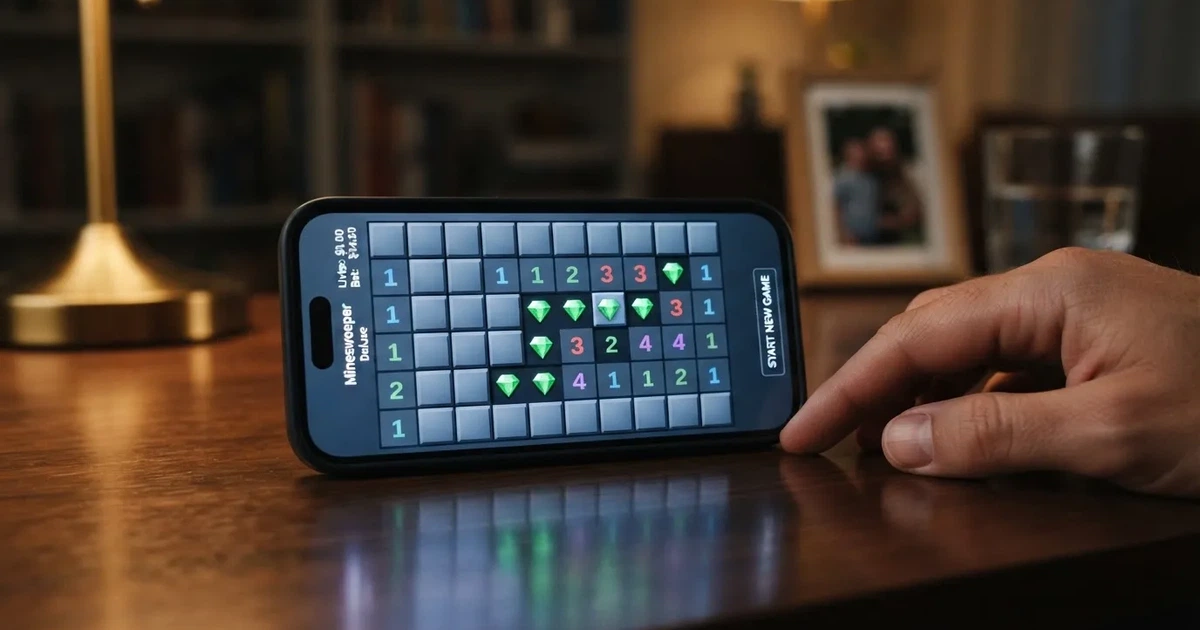
The Mines casino game is a staked, cash-wagered remake of the tile-revealing Minesweeper puzzle: a player picks a number of hidden mines on a grid, then uncovers tiles one at a time. Each safe tile lifts a running multiplier; the next mine ends the round and forfeits the stake. The format is simple enough that it travels well on a phone screen, and that portability is exactly why the product has been marketed hard at Australian punters. The product those sites are pitching is not, however, a product an Australian can lawfully play for real money. Online casino games — Mines very much included — fall under the prohibition the Interactive Gambling Act 2001 (IGA) sets out, and no state or territory issues a licence to provide them. What the IGA does licence, wagering on sport and racing before the event, is a different product from what Mines sites sell.
Data and operator actions referenced below were checked against the ACMA’s public register and licensed-wagering framework as at 29 October 2026.
Table of Contents
- Why Mines keeps showing up in Australian promotions
- How a Mines round actually works
- The licence picture for Mines in Australia
- The payment stack a Mines site will try to push on you
- The promo layer wrapped around Mines
- Spribe and the game underneath the offer
- How Mines stacks up against the casino games a regulator does license
- The brands the ACMA has formally warned over Mines and similar products
- Self-exclusion and the limit on what an offshore site can offer
- How the blocking rate breaks down over time
- How a Mines session actually plays out, step by step
- What to read on any Mines offer before claiming it
- Making a decision in the offering you actually face
- Where an Australian reader who wants to gamble can place a bet lawfully
- Where to get help
- The mines casino game in Australia, in plain terms
- Frequently asked questions
Why Mines keeps showing up in Australian promotions
Mines sits inside a wider push by offshore casino operators into the Australian market. A 2025 industry report estimated that Australians lose about A$3.9 billion a year to illegal gambling sites, and that the share of gambling going through legal channels fell from 74% in 2021 to 64%. Mines is one of the formats being used to chase that spend — small stake sizes, fast rounds, and a single-tap interface that runs comfortably inside a sportsbook-style app. The game’s standout trait is its pacing: a round can resolve in well under a minute, which makes it easy to stack promotions around it.
The Australian arm of the response is the ACMA. Since the first blocking request in November 2019, the ACMA has coordinated the blocking of 1,751 illegal gambling and affiliate marketing websites as of June 2026, and more than 230 unlicensed gambling services have left the Australian market since enforcement was strengthened in 2017. A blocking request adds a site to the list ISPs are directed to filter; it does not in itself change the offshore operator’s product, but it does make access harder and removes the site from the visible shelf where most Australian search traffic would otherwise meet it.
How a Mines round actually works
A round starts with two player choices: the stake and the number of mines hidden under the grid. The grid is fixed in size, and the same grid sits behind every round; what changes is how many of its tiles carry a mine. Picking more mines means a higher multiplier per safe tile, but a smaller safe-tile count to clear; picking fewer mines inverts that trade. From there the round is a sequence of clicks. Each revealed safe tile lifts the multiplier by a set amount determined by the grid size and the mine count. The player can stop at any point and bank the displayed multiplier, or push further.
Three points are worth holding onto before any stake is set:
- The payout curve is not linear. The first safe tile revealed typically adds the smallest increment, and each additional safe reveal moves the multiplier up by a smaller proportional step than the last. Losing everything on the next click costs the full stake regardless of how many safe tiles preceded it.
- The previous outcome has no influence on the next round. Mines does not “heat up” — every round begins from the configured mine count, with no carryover from the round that ended just before.
- The player has one decision that earns its keep: where to stop. Everything else is animation.
That is why the game is sold on a “cash out at any time” framing. The cash-out button is the only tool a player has for risk management, because every tile after the first is a fresh bet of the entire stake against the next hidden mine.
The licence picture for Mines in Australia
What the IGA prohibits
The Interactive Gambling Act 2001, as tightened by the Interactive Gambling Amendment Act 2017, makes it an offence to provide online casino games, online pokies and in-play betting to a person physically in Australia. Mines, as an online casino game, sits squarely inside that prohibition. Lotteries, keno and pre-event wagering on sport and racing remain licensable; online casino games do not, in any state or territory. Min age for the licensable products is 18.
Who regulates the licensable side
Where wagering is licensed, the Northern Territory Racing and Wagering Commission (NTRWC) is the regulator most operators sit under. The NTRWC regulates 52 of Australia’s online bookmakers, including Sportsbet, Bet365 and Ladbrokes, all licensed in the Territory for tax reasons. The commission meets once a month in Darwin and has no full-time staff. That body regulates wagering services, not Mines sites, and the distinction is what keeps the offer pitched by an offshore casino outside the local licensing frame.
The enforcement channel
The ACMA investigates suspected breaches, issues formal warnings, and can direct Australian internet service providers to block offending sites. Enforcement targets the provider, not the individual player, so an Australian who plays at an offshore casino site is not personally exposed to prosecution. The trade-off sits elsewhere: an offshore site gives no Australian consumer protection, no local complaints body and no recourse if a withdrawal is refused, and a balance can be stranded on a site that gets blocked mid-round.
What the ACMA has named in 2026
A single 26 June 2026 blocking round named 12 sites: 7Signs, ChromaBet, Donbet, Duospin, Freshbet, Slots Gem, Jacks Club, Lucky Start, Pointsbetz, Spinrise, Vinyl Casino and Wildsino. Earlier 2026 action includes a March 2026 formal warning to Pulsup Ltd over Rocketplay and an April 2026 formal warning to Ryker B.V. covering Jackbit and CasinOK. The pattern is one of repeated action against the same handful of operators under changing company names.
The payment stack a Mines site will try to push on you
Payments at unlicensed Mines sites sit outside the Australian regime that came into force on 11 June 2024. Credit cards, credit-related products and digital currency are banned as payment for licensed online wagering, with penalties of up to A$247,500 for the operator side. The legal deposit routes for licensed wagering are debit card, bank transfer, PayID/Osko and BPAY. A site that asks an Australian player for a credit card or a crypto deposit is operating outside the Australian rules from the moment it asks.
For an Australian reaching an offshore casino, the practical mechanics look different. Deposits are usually routed through international cards, e-wallets or crypto, with the cashier in some currencies other than A$. Withdrawals run back through the same rails, usually with a KYC check the licensed side would have run on sign-up. That is where delays stack up: a withdrawal that gets held for missing documents on first cash-out can sit pending for the days or weeks the document review takes. None of that is overseen by an Australian body, and the consumer-protection avenues that exist for licensed wagering are not available.
The promo layer wrapped around Mines
What the marketing says, what the terms actually do
Mines bonuses are sold the way any online casino bonus is sold: with a headline number, a promo code, and a column of small-print conditions few players scroll past. Three terms matter more than the headline figure does.
- Wagering requirement, the multiplier applied to bonus funds before they become withdrawable. A “40x” requirement on a A$50 bonus means A$2,000 of qualifying turnover must be run before any part of that bonus can be cashed.
- Maximum cash-out cap, often expressed as a multiple of the bonus or as a flat ceiling, which trims the upside of any bonus-funded win to whatever the cap sets.
- Game weighting, the percentage of each stake that counts toward the wagering requirement. Mines is usually weighted 100% on welcome bonuses, but may be weighted down or excluded on free-spin packages, which is why a free-spin offer on “Mines” is worth reading row by row.
Those three terms sit on top of the legal point made earlier: the offer is being pitched by an operator the ACMA has acted against, and it is being pitched for a product that cannot be licensed in Australia. The promo is real to the player who claims it. The recourse is not.
What a Mines no-deposit bonus still goes through
A Mines no-deposit bonus removes the first deposit, but it does not remove the wagering requirement, the cash-out cap, or the verification step before any withdrawal is processed. The no-deposit framing exists because the conversion rate from no-deposit to deposit is high enough that operators can afford the bonus. The verification step is the one that catches most first-time players: a no-deposit win that has to be withdrawn is paid through the same KYC pipeline as a real-money win.
Why “promo code” matters less than the terms do
Promo codes are largely a tracking convention. The bonus size, the wagering multiple and the cash-out cap do not change when a code is typed in; the code tells the operator which campaign attributed the signup. Mines sites will publish a different code per affiliate channel, which is why a search for “mines bonus code” returns a different string on every result page. The economics of the bonus sit in the terms, not in the code.
Spribe and the game underneath the offer
The Mines casino title is built by Spribe, a studio founded in 2018 whose flagship product is the crash-style game Aviator, which launched in January 2019. Spribe sells the Mines title as a single integration that operators drop into their cashier, alongside Aviator and a small number of other instant-format games. From the player’s perspective, what changes between operators is the wrapper: the cashier, the bonus terms, the brand name on the page footer. The grid under the cashier is the same product on most of these sites.
Spribe has had regulatory run-ins that shape which markets the title sells into. On 30 October 2025 the UK Gambling Commission suspended Spribe OÜ’s UK remote gambling software licence on suitability grounds, after finding the company had been hosting casino games without the separate remote casino game host licence its business model required. The Commission’s public register continues to list Spribe’s Gambling Software Remote licence (number 057302-R-333085-003) as active since 8 December 2020, with a separate Game Host (Casino) Remote licence application shown as in progress. For an Australian player the line that matters is shorter: the studio behind Mines has been found not to hold the licence its own business model required in another regulated market.
How Mines stacks up against the casino games a regulator does license
A Mines round reads as a fast, single-player, browser-driven game, and the natural comparison set is the table games the Australian licensed casinos actually offer. The house-edge comparison brings the framing into focus.
| Game / bet | House edge | Notes |
|---|---|---|
| Blackjack, optimal strategy | about 0.28% (liberal Las Vegas Strip rules) or about 0.43% (Atlantic City rules) | dealer stands on soft 17; double on any two, double after split, resplit aces, late surrender |
| Baccarat, Banker bet | 1.06% | punto banco is dealt from a 6- or 8-deck shoe |
| Baccarat, Player bet | 1.24% | same shoe |
| Baccarat, Tie | 14.36% | the bet the floor staff steer new players toward |
| Craps, Pass / Come | 1.41% | come-out roll wins on 7 or 11, loses on 2, 3 or 12 |
| Craps, Don’t Pass / Don’t Come | 1.36% | the dark-side line |
| Craps, Any Craps | 11.11% | a one-roll proposition |
These edges describe the licensed table games on Australian casino floors. Crown Melbourne in Victoria, for instance, offers baccarat variants under rules approved by the Victorian Gambling and Casino Control Commission (VGCCC), which replaced the VCGLR as Victoria’s casino regulator on 1 July 2022. The relevant NSW provision, section 66 of the Casino Control Act 1992, says a casino operator must not permit a game to be played unless the game and its rules are approved by the regulator, and a copy of the approved rules must be made available on request. What those regimes regulate is the licensed floor product.
Mines does not sit inside that framework. The published RTP for the game is set by Spribe, not by an Australian regulator, and is presented as a percentage return to player over a long-run simulation, not as a house-edge line item any casino operator publishes. The closest comparable is the volatility profile: Mines pays small amounts often, with a tail risk that wipes the stake on a single click — closer to a prop bet on craps than to a blackjack hand. The house keeps its share the way the table games above keep theirs, but the lever is a multiplier that the player resets after every round, not a fixed edge per dollar staked.
The brands the ACMA has formally warned over Mines and similar products
The list below is not a recommendation. Every brand on it has been the subject of an ACMA formal warning under the Interactive Gambling Act 2001 for offering prohibited services to Australians, and every brand on it is offering a product that cannot be licensed in Australia. The brand behind each entry is the operator named on the ACMA’s own warning publication, with the date of that warning alongside.
| Brand | ACMA action and date | Operator named by the ACMA | Subject support |
|---|---|---|---|
| RocketPlay | formal warning, March 2026 (Pulsup Ltd); prior warning, May 2022 (Dama N.V.) | Pulsup Ltd, then Dama N.V. | — |
| Level Up Casino | formal warning, May 2022 | Dama N.V. | BGaming list it (listings-only) |
| Woo Casino | formal warning, March 2025 | Dama N.V. | — |
| Spirit Casino | formal warning, May 2025 | Dama N.V. | — |
| National Casino | formal warning, July 2025 | Consolutetish S.R.L. | en.wikipedia.org mentions it (listings-only) |
| Bizzo Casino | formal warning, July 2025; prior warning, 2022 | Consolutetish S.R.L., then TechSolutions | — |
| Ignition Casino | formal warning, July 2025 | Bamboo Media | — |
| Instant Casino | formal warning, February 2025 | EOD Code SRL | — |
| Jackbit | formal warning, April 2026 | Ryker B.V. | — |
| Casino Intense | formal warning, April 2025 | Sterplay Holding Ltd | ABC News and Crown Melbourne reference it (listings-only) |
| Sky Crown | formal warning, September 2022 | Hollycorn N.V. | — |
RocketPlay
RocketPlay sits on the ACMA’s list twice: a March 2026 warning to Pulsup Ltd over Rocketplay, and a May 2022 warning to Dama N.V. over a bundle of six brands including Rocketplay. The brand is run out of Curaçao-affiliated operators and offers a cashier stacked with crypto and e-wallets that are not part of the Australian licensed deposit rails. As a Mines-accessible brand, what it offers a player is precisely what every brand on this list offers: the game, a bonus ladder, an offshore cashier.
Level Up Casino
Level Up is one of the original Dama N.V. six-pack that took a formal warning in May 2022 — Bambet, Dazard, Level Up, Rocketplay, Wild Tornado and Cobra Casino. The brand surfaces in BGaming’s game distribution listings, which is the most that can be said about any third-party integration confirmation. Under Australian law, the warning is on the ACMA’s record; the brand’s product is online casino games, which cannot be licensed locally.
Woo Casino
Woo Casino is the Dama N.V. site that took a fresh formal warning in March 2025, more than two years after the original 2022 warning covering its sister brands. A renewed warning inside that window is the ACMA’s way of saying the previous warning was not treated as a stopping point. The Dama portfolio returned to the register again in May 2025 over Spirit Casino.
Spirit Casino
Spirit Casino sits on the May 2025 Dama N.V. warning, the second brand-specific action on Dama in three months after Woo Casino. For an Australian player the relevant fact is that the operator’s name on the page is a moving target: the licence on display says one thing, the company behind it has changed hands, and the ACMA’s record keeps adding entries.
National Casino
Consolutetish S.R.L. took the July 2025 ACMA warning covering National Casino and Bizzo Casino. National surfaces in third-party reference material like Wikipedia, which is the level of confirmation any third-party coverage of an offshore site tends to produce. The licence display on the cashier page is a separate matter, and an offshore one.
Bizzo Casino
Bizzo is the most-pinged brand on this list. The ACMA warned Consolutetish S.R.L. over it in July 2025, and earlier warned TechSolutions (CY) Group Limited and TechSolutions Group N.V. over it in 2022 — two different operator entities, the same brand, in three years. For an Australian player looking for any pattern at all in the ACMA’s list, Bizzo is the clearest example of a brand that the regulator keeps acting against without the brand itself disappearing.
Ignition Casino
Ignition Casino is the Bamboo Media brand named in the July 2025 warning. Ignition is one of the better-known offshore casino brands in the Australian search market, and the ACMA’s record on it is short and clear: a single 2025 warning.
Instant Casino
Instant Casino is the EOD Code SRL brand warned in February 2025. The site operates as a single wallet, and its cashier is built around the same international deposit rails as the rest of the list.
Jackbit
Jackbit was named in the April 2026 warning to Ryker B.V. alongside CasinOK. Ryker is a more recent entry on the ACMA’s list than the older Dama or TechSolutions names, but the pattern is identical: an offshore operator, a casino cashier, and a Mines integration.
Casino Intense
Casino Intense is the Sterplay Holding Ltd brand that took an April 2025 warning. The brand appears in mainstream Australian news coverage and on Crown Melbourne’s reference list at the boundary of the licensed market — the same coverage pattern most long-running offshore brands in Australia produce.
Sky Crown
Sky Crown is the Hollycorn N.V. brand named in the September 2022 formal warning covering Sky Crown and Blue Leo. Hollycorn runs a wider portfolio, and Sky Crown is the one that surfaces most often under the same operator in Australian-facing marketing.
Self-exclusion and the limit on what an offshore site can offer
BetStop and what it actually covers
BetStop, the National Self-Exclusion Register, has been live since August 2023. It is the Australian register a player can add their name to in order to be denied service across Australian-licensed online and phone wagering. BetStop binds licensed operators, and an offshore casino is not licensed and is not connected. Self-excluding through BetStop does not stop an offshore Mines site from accepting a deposit; the operator is not part of the system, and the system cannot reach it.
The equivalent help that does work outside the BetStop frame is the National Gambling Helpline, 1800 858 858, free and 24/7, with chat through Gambling Help Online. BetStop is the enforced exclusion route for licensed wagering; the helpline is the immediate one for anything else.
Deposit limits and the offshore gap
Deposit limits on the Australian side are set by the same licensed-wagering framework that bans credit cards and crypto. A licensed bookmaker will enforce default deposit ceilings, slowdowns on rapid increases, and compulsory pre-commitment for some accounts. None of those structures bind an offshore casino cashier. The cap a player hits at an offshore Mines site is the one the site sets itself, and that cap can change with the marketing department’s view of the player’s lifetime value.
Advertising and inducement rules heading into 2027
The Interactive Gambling Amendment (Gambling Reform) Bill 2026 passed Parliament on 19 August 2026. Its advertising and inducement measures commence on 1 January 2027, which makes the new law not yet in force on a page being read in 2026. The shape of the rules will be familiar from other Australian gambling reform: tighter restrictions on bonus offers, sign-up incentives and the kind of “free spins, no deposit” hook used to acquire new accounts. Reading the page in the years ahead, those rules are the ones the inducement language changes against.
How the blocking rate breaks down over time
Between the first blocking request in November 2019 and the June 2026 figure of 1,751 sites blocked, the ACMA’s blocking pace runs at roughly 268 sites per year as a six-and-a-half-year average. The growth has not been linear. The early years carried the smaller numbers, the post-2017 enforcement build-up moved the figure upward, and the 2024-2026 stretch of coordinated monthly blocking rounds has pushed the annual rate closer to 400 sites per year. As a band, the ACMA is currently directing ISPs to block between 250 and 400 illegal sites per year, with single rounds now naming a dozen brands at a time. The economic figure underneath the blocking — that A$3.9 billion a year is still flowing through illegal channels according to a 2025 industry report — tells the reader what the blocking work is against: a market the legal frame has not absorbed.
How a Mines session actually plays out, step by step
The round format is short, but the steps inside it do not always run in the order the marketing copy suggests.
- The cashier loads. The deposit rail is e-wallet, card, or crypto, depending on the operator. Most sites ask for KYC documents at this stage, but several defer the document request to first withdrawal.
- The bonus is claimed. A welcome bonus typically applies on first deposit; a “Mines no-deposit bonus” attaches to a registered account that has not yet funded. The wagering terms start ticking from the moment the bonus is credited.
- The round starts. The player picks the grid size, the mine count and the stake. Most sites default to a 5×5 grid with the mine count set by a slider.
- Each click either reveals a safe tile and lifts the multiplier, or hits a mine and ends the round at zero. The cash-out button banks the displayed multiplier against the stake.
- The outcome is settled. A winning round adds the stake times the multiplier to the bonus or cash balance, depending on which balance the stake came from. The wagering contribution is credited at the game’s weighting on the bonus T&Cs — usually 100% on welcome offers, sometimes less on free-spin offers.
- The withdrawal request is the pinch point. Most stalling happens here, at the KYC document request that the cashier did not run on signup. A withdrawal waiting on documents can sit pending for the days or weeks the review takes. Once approved, payment runs in the method that deposited, or in a rail the cashier has been configured to for that account.
The sequence above is what the marketing copy skips over. The bonus ladder and the tile grid are the front of the product. The document review is the back.
What to read on any Mines offer before claiming it
Three documents carry the most weight, in this order:
- The bonus terms: wagering multiple, game weighting on Mines, maximum cash-out cap, time limit on the bonus, any minimum odds or stake restrictions.
- The general T&Cs: the operator’s withdrawal rules, KYC requirements, account dormancy rules, and any clause about “irregular play” that might void a bonus.
- The payment page: which methods are listed, which currencies are accepted, and what the published withdrawal time is for each rail. A site with crypto-only deposit options is one the Australian licensed-payment framework would not service.
A first-time claim on any of these brands ends with the document review described above. The reader who skips that step is the reader most likely to discover it the hard way, on a withdrawal that has been pending long enough to look stuck.
Making a decision in the offering you actually face
The marketing copy on a Mines offer is built to move quickly. The reader-side defence is to slow down.
- The headline bonus number is a starting point, not a payout. The wagering multiple is the one that decides what the bonus is worth after playthrough, and Mines is the kind of game the wagering clears fastest in because it has the smallest stake-per-spin ratio.
- The cash-out cap is the single most under-read term on a bonus. A 5x cash-out cap on a A$50 bonus caps a no-deposit win at A$250 regardless of how many tiles a player clicked through.
- The site license is what it is. Offshore Curaçao, Kahnawake, Anjouan, Costa Rica — none of these are Australian, and none of them carry Australian consumer-protection obligations.
- The offer-pitch copy is a marketing line. The terms set the actual economics; the document review is where the cash actually leaves.
A reader who wants to play Mines is being asked to play a game whose legal status in Australia is settled, on a site whose regulatory status is not. That is the core of the choice, and the operator write-ups above do not change it.
Where an Australian reader who wants to gamble can place a bet lawfully
Where Mines is not a licensable product, pre-event wagering on racing and sport is. The NTRWC-licensed operators (Sportsbet, Bet365, Ladbrokes and 48 others) are the legal route for an Australian wager. They take bets in A, take deposits through PayID/Osko, BPAY and debit card, refuse credit cards and crypto, and feed into BetStop for self-exclusion. They are not the Mines experience; they are the licensed route. The figure that hints at the gap between the two is a 2025 industry estimate that 36% of Australian gambling spend runs outside the licensed channels.
Where the offer on the table is an Australian casino-floor game, the licensed route is Crown Melbourne in Victoria, the Sydney casino in NSW, the Treasury Brisbane and the Gold Coast casino in Queensland, the Adelaide casino in South Australia, the Crown Perth in Western Australia, and the SkyCity Darwin. The Casino Control Act 1992 in NSW and the Casino Control Act 1991 in Victoria are two of the statutes that frame those floors. Mines does not appear on those floors as a table game; the table games there are baccarat, blackjack, craps, roulette, and a small number of approved variants.
Where to get help
If a Mines session has crossed from entertainment into something that is causing harm:
- National Gambling Helpline, 1800 858 858, free, 24/7. Chat at Gambling Help Online.
- BetStop, the National Self-Exclusion Register, live since August 2023. Self-exclusion is enforced across Australian-licensed online and phone wagering services.
- Financial counselling through the National Debt Helpline, 1800 007 007.
- Lifeline, 13 11 14, for crisis support not specific to gambling.
Help is not conditional on being willing to stop. The first conversation is the one that opens the route to the rest.
The mines casino game in Australia, in plain terms
A Mines casino offer in Australia is being pitched for a product that cannot be licensed under the IGA, by an operator whose name on the page is the operator the ACMA has acted against. The game itself is honest about its design: small stake, fast round, a multiplier that grows and a single click that takes it all away. The wrapper around the game is where the issues stack. Reading the bonus terms, the cashier rail, the operator name on the ACMA’s record, and the deposit rails the licensed Australian framework permits — those four steps are what separate the offer being pitched from the offer a player should accept. A reader who does all four steps before clicking through the bonus is the reader who has done what the marketing copy is built to skip over.
Frequently asked questions
Is it legal to play the Mines casino game for real money in Australia?
No. The Interactive Gambling Act 2001 prohibits providing online casino games — Mines included — to a person in Australia, and no Australian state or territory licenses them. The prohibition targets the provider, not the individual player, but the legal status of the product is settled.
How does the payout on Mines increase as more safe tiles are revealed?
Each safe tile lifts a running multiplier by a set amount determined by the grid size and the number of mines hidden under it. The player can bank the multiplier at any point; one more click can either lift it further or wipe the round to zero. There is no carryover between rounds.
What determines how many hidden mines are placed on a Mines grid?
The player picks the mine count before the round starts, usually through a slider on a fixed-size grid. More hidden mines means a higher multiplier per safe tile but a smaller safe-tile count to work through. The grid is the same on every round; what changes is the number of tiles it carries a mine.
What conditions usually apply before a Mines no-deposit bonus can be withdrawn?
A wagering requirement applied to bonus funds, a maximum cash-out cap on bonus wins, and a KYC document review at first withdrawal are the three conditions on every no-deposit offer pitched at Australian punters. The no-deposit framing removes the first deposit; it does not remove any of those three steps.
Is the Mines app a separate product from the browser-based version of the game?
No. The Mines app is a wrapper around the same Spribe game that runs in the browser, served from the same operator cashier. The deposit rails, bonus terms and KYC pipeline are the same on both sides of the wrapper. The label on the home screen is the only thing that changes.
What is a sensible way to decide a stop point before starting a round of Mines?
Pick the multiplier at which you will cash out before the first tile is clicked, and stop there when the round reaches it. The single biggest source of Mines losses is riding a winning run one tile past a stop that was never set. The cash-out button does what the player decides before play, not what the round suggests mid-play.