
Real Money Online Pokies With No Deposit in Australia — The Consequence of Chasing an Offer That Should Not Exist
29 October 2026 data, cross-checked against the Australian Communications and Media Authority’s register of formal warnings and blocking requests.

The phrase “real money online pokies no deposit” does a particular kind of work on a search-results page. It stitches three promises together — a real payout, a casino game, and a zero-cost entry — and the page a punter lands on tends to cash the third promise while the first two quietly relocate. In Australia, the third promise is the only one with nothing behind it, and the first two are governed by law. This page reads what the offers actually deliver, what the ACMA has done about them, and what falls on the punter when the offer stops looking like its marketing.
Table of Contents
- The legal fact that sits behind every no-deposit pokies claim
- Responsible gambling in a market the offer says does not exist
- Settlement times and the PayID promise
- What the ACMA has formally warned — and what that means for the comparison
- How a no-deposit pokies claim is actually built
- The land-based pokie context
- What an Australian punter actually controls
- Frequently asked questions
The legal fact that sits behind every no-deposit pokies claim
Online casino games, including the online version of the poker machine — the “pokie” — cannot be lawfully supplied to a person in Australia. The Interactive Gambling Act 2001, as strengthened by the Interactive Gambling Amendment Act 2017, makes the supply of those services an offence. No state or territory issues a licence for them. What can be licensed is wagering on races and sport placed before the event, lotteries and keno; in practice that wagering is licensed by the Northern Territory, where the Northern Territory Racing and Wagering Commission oversees 52 of Australia’s online bookmakers, including Sportsbet, Bet365 and Ladbrokes, and meets once a month in Darwin to do so.

The Interactive Gambling Amendment (Gambling Reform) Bill 2026 passed Parliament on 19 August 2026. Its advertising and inducement measures commence on 1 January 2027, which means the law is enacted but not yet in force. Reading this page in 2026, the rule that applies is the existing IGA, not the 2027 advertising regime.
What that means for the offer on a banner is straightforward. An offshore site asking an Australian to register, accept a bonus, and play pokies for real money is supplying a prohibited interactive gambling service. The site may display a Curaçao, Anjouan or Kahnawake licence in its footer. None of those licences authorises the supply to Australia, and the footer is not an Australian licence. Every “no deposit” headline on such a site is attached to a product that is, in Australian law, unlawful to provide.
What the ACMA does about it
The ACMA investigates complaints, issues formal warnings to operators, and can direct Australian internet service providers to block offending sites. The individual punter is not the target of the law — the IGA aims at the provider — but the practical consequence for the punter is that an offshore site gives no Australian consumer protection. There is no complaints body, no recourse if a withdrawal stalls, and the site can be blocked with a balance still sitting on it. A formal warning, once issued, is published on the ACMA’s website with the operator’s name, the brand name and the date. As of a round reported on 26 June 2026, the ACMA had asked Australian ISPs to block 1,751 illegal gambling and affiliate marketing websites since the first blocking request in November 2019, and more than 230 unlicensed services had left the Australian market since enforcement was strengthened in 2017.
The blocking rate, measured from the first request in November 2019 to the 1,751-site running total in June 2026, runs at roughly 263 sites per year — a band of around 250 to 275 depending on which month of 2026 the page is read in, and on whether any given year’s enforcement intensity sits at the round-number reports the ACMA publishes or above them. The figure is the ACMA’s own running total, not a derived statistic; it is a measure of how fast the Australian regulator has been removing the storefront, not of how fast new ones appear. Sites are blocked, leave voluntarily, or rebrand under a new domain, and the running total counts only the blocks and the exits the ACMA has recorded. In the round reported on 26 June 2026 alone, twelve more sites went on the list: 7Signs, ChromaBet, Donbet, Duospin, Freshbet, Slots Gem, Jacks Club, Lucky Start, Pointsbetz, Spinrise, Vinyl Casino and Wildsino. The brand the punter sees on a banner is a moving target.
Where the credit-card and crypto ban lands
Since 11 June 2024, licensed Australian wagering services cannot accept credit cards, credit-related products or digital currency as payment. The penalty for an operator that does is up to A$247,500. Legal deposit routes for a licensed Australian wagering account are debit card, bank transfer, PayID/Osko and BPAY. A site that asks an Australian punter for a credit card or a crypto deposit is therefore not operating inside the Australian rules at all — the deposit channel itself signals the regulatory status of the operator.
This is the place where the marketing usually does its work. An offshore site will advertise PayID deposits, which sound indistinguishable from a licensed Australian bookmaker, and will sometimes process a PayID payment through a partner that fronts a bank account in a different jurisdiction. The deposit, when it clears, is not regulated by the ACMA and not protected by BetStop. The punter who reads “PayID” and infers Australian licensing has read correctly about the payment rail and incorrectly about the operator. Both can be true at once.
Responsible gambling in a market the offer says does not exist
The most consequential sentence on this page is also the shortest. If a punter decides to play anyway — and this page does not recommend that — the Australian support services exist whether or not the operator is connected to them.
BetStop and the offshore gap
BetStop, the National Self-Exclusion Register, has been live since August 2023. It binds every Australian-licensed online and phone wagering service, which means a punter who registers with BetStop cannot open new accounts with Sportsbet, Bet365, Ladbrokes or any of the 52 NT-licensed bookmakers, and existing accounts are closed. It does not bind an offshore casino. Self-excluding through BetStop closes the legal door and leaves the offshore door open, which is the structural shape of the Australian market in 2026: the protection exists; it just does not extend to the operator the no-deposit banner is selling.
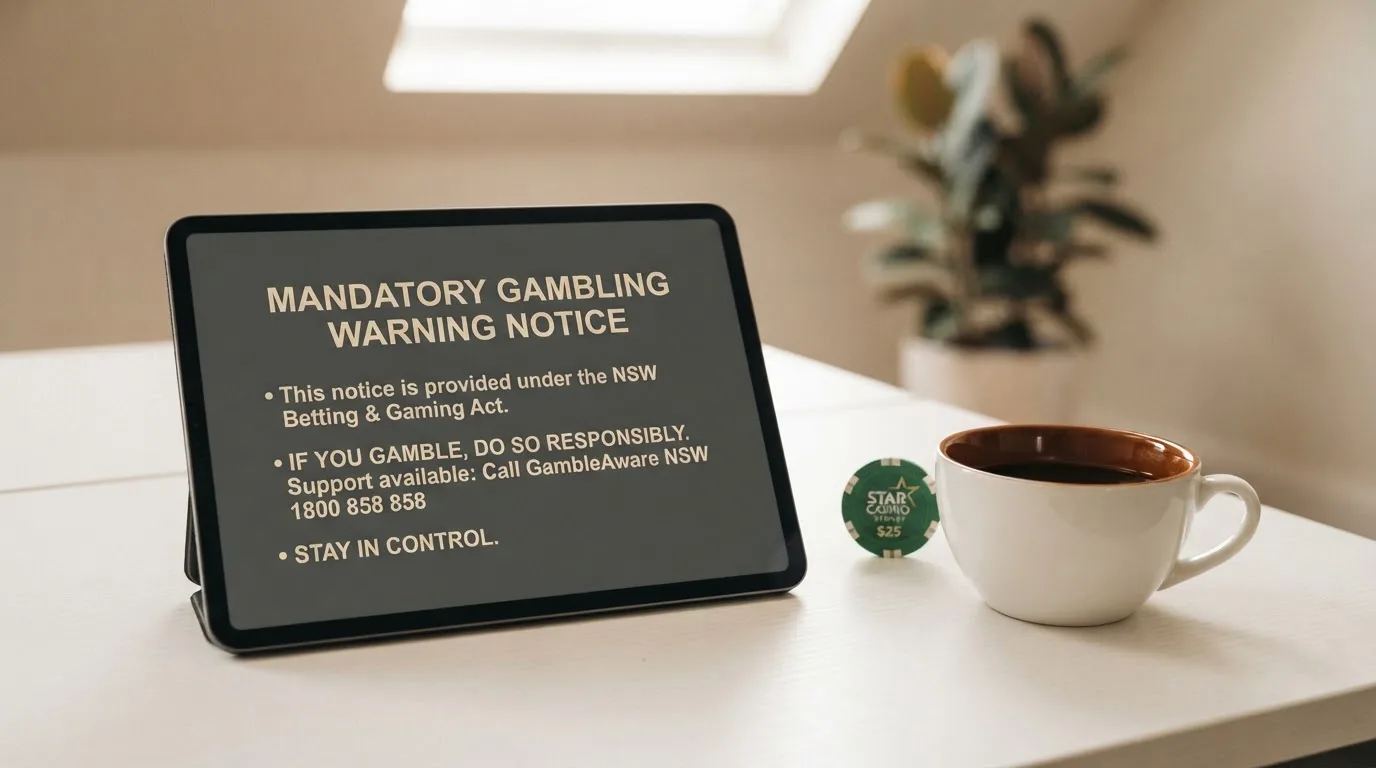
The Gambling Help Online service and the National Gambling Helpline on 1800 858 858 are free, 24/7 and reachable regardless of which operator the punter is using. They are funded independently of any casino licence and are the right contact whether the account is with a licensed Australian bookmaker, an offshore site or a pub poker machine. Tasmania’s mandatory pre-commitment card reform, once planned as nation-leading, was delayed into late 2025 and now operates only in Tasmania. For an Australian punter on an offshore site, none of the pre-commitment machinery applies.
What a no-deposit offer does to harm-minimisation
A no-deposit bonus is, by construction, the offer with the lowest financial barrier. It is also the offer with the highest number of frictionless re-entries, because the punter who did not deposit the first time can usually claim the bonus again on a new account or a new brand — until a Know Your Customer check at withdrawal closes that door. The punter sitting at a kitchen table with a laptop, scrolling a search-results page full of those offers, is being shown a product designed to maximise account openings per person. From a harm-minimisation standpoint, the Australian support services are the appropriate destination, not a comparison of which offer has the friendliest terms.
Settlement times and the PayID promise
Settlement times for offshore no-deposit offers are stated on affiliate pages rather than by the operator. The pattern is consistent: deposits clear in minutes via PayID or crypto, and withdrawals are processed in a window ranging from “instant” to several business days, depending on which page is read. None of these claims is enforceable in Australia.
A licensed Australian wagering operator, by contrast, processes withdrawals through the Australian banking system under the ePayments Code and the operator’s own published terms. The withdrawal is a regulated transaction. The withdrawal from an offshore casino is whatever the operator’s cashier page says it is on the day, and the punter has no Australian body to complain to if the cashier changes its mind. A punter who treats the two as equivalent has confused a payment rail with a regulator.
The PayID element of an instant-payid no-deposit pokies claim, in particular, deserves to be read separately from the no-deposit element. PayID is the payment rail; no-deposit is the marketing term. An instant-PayID claim promises a fast deposit on a rail that already exists in Australian banking. A no-deposit claim promises a bonus that does not cost the punter anything at signup. The two are different promises with different mechanics, and an offer can deliver the first while being unable to deliver the second. A bonus credited without a deposit is a credit relationship between the punter and the operator; it is the part that triggers wagering requirements, withdrawal caps and the eventual question of whether a payout is paid.
What the ACMA has formally warned — and what that means for the comparison
The comparison below covers every brand the ACMA has issued a formal warning over in connection with prohibited online casino services supplied to Australians. Each row carries the operator and brand the ACMA named, the date of the warning, and the status of any information that an offshore listings aggregator carries about the brand’s pokies coverage. The comparison is descriptive, not a ranking. The brands are not interchangeable: the ACMA’s records treat each operator as a separate matter, and the consequence of dealing with any one of them is the same prohibition the IGA attaches to the supply.
| Brand | ACMA action and date | Operator named by the ACMA | Subject support |
|---|---|---|---|
| RocketPlay | Formal warning, March 2026 | Pulsup Ltd (Rocketplay.com.au) | — |
| Level Up Casino | Formal warning, May 2022 | Dama N.V. | BGaming lists the studio |
| Woo Casino | Formal warning, March 2025 | Dama N.V. | — |
| Spirit Casino | Formal warning, May 2025 | Dama N.V. | — |
| National Casino | Formal warning, July 2025 | Consolutetish S.R.L. | en.wikipedia.org mentions the brand |
| Bizzo Casino | Formal warning, July 2025 (and earlier 2022 to TechSolutions) | Consolutetish S.R.L. | — |
| Ignition Casino | Formal warning, July 2025 | Bamboo Media | — |
| Instant Casino | Formal warning, February 2025 | EOD Code SRL | — |
| Jackbit | Formal warning, April 2026 | Ryker B.V. | — |
| Casino Intense | Formal warning, April 2025 | Sterplay Holding Ltd | Abc.net.au, acma.gov.au, Crownmelbourne.com.au reference coverage |
| Sky Crown | Formal warning (formal warning publication, September 2022) | Hollycorn N.V. | — |
The spread here is not a quality gradient. It is a list of matters the ACMA has opened, with the operator name the regulator attached and the date the warning was published. Several brands share an operator: Dama N.V. covers Level Up, Woo and Spirit; Consolutetish S.R.L. covers National and Bizzo. The ACMA’s process treats each brand as a separate matter even where the operating company is the same, because each brand is a separate storefront and each warning is a separate publication. The practical consequence for the punter is that a brand rebrand within the same operator group is not a fresh start; the regulator’s records already name the operator.
The subject-support column is the column the comparison can carry. Most cells are blank because most listings aggregators carry no specific pokies coverage for these particular brands, and what aggregators do carry is not the operator’s own fact. The entries that exist are reported as the listings report them, not as a statement by the operator. Where a studio like BGaming or a reference work mentions a brand, the comparison shows that reference; where no reference exists, the cell is empty.
What the table does not say is as informative as what it does. It does not carry bonus amounts, wagering multiples, withdrawal caps, game lists, payout times or jackpot figures, because the only sources for those figures were affiliate marketing pages — the same kind of page the punter would have clicked through to reach the offer. The comparison below is the comparison the regulator’s own file supports. A punter who needs the marketing details can find them; a punter who needs the legal status has them here.
RocketPlay — most recent escalation
RocketPlay sits at the top of the list because its warning is the most recent. The ACMA published a formal warning to Pulsup Ltd over Rocketplay.com.au in March 2026, and the same brand had earlier been the subject of a May 2022 warning to Dama N.V. as one of six brands in that round. The combination — same brand, different operator entity, four years apart — is the shape the offshore market takes when one operator exits and another acquires the domain or the brand. From a consequence standpoint, RocketPlay is the clearest example on the list of a brand that has been the subject of regulatory action in successive corporate forms, and the ACMA’s published record reflects each step.
Level Up Casino — the Dama N.V. cluster origin
Level Up Casino was one of six brands the ACMA named in its May 2022 warning to Dama N.V., alongside Bambet, Dazard, Rocketplay, Wild Tornado and Cobra Casinos. That round was the moment the Dama N.V. cluster entered the ACMA’s published record, and the cluster has stayed there. Woo Casino and Spirit Casino, both also in this comparison, are later Dama N.V. matters from 2025. Treating any of them as a fresh brand misses the cluster structure: the operator is the recurring subject, and the brand is the storefront.
Woo Casino — the March 2025 escalation
Woo Casino’s warning was published in March 2025 and named Dama N.V. as the operator. The brand had not previously appeared in the ACMA’s formal warnings to that operator, which means the brand is a separate matter even within the same operator group. For a punter, the practical reading is that the Woo Casino brand did not become lawful to use in March 2025 by being warned about; it became unlawful in a more public way, because the warning itself is the ACMA’s notice that the service is prohibited.
Spirit Casino — the May 2025 follow-on
Spirit Casino’s warning followed Woo Casino’s by roughly two months, also against Dama N.V., in May 2025. The two warnings, taken together, show the ACMA’s practice of issuing one formal warning per matter rather than collapsing related matters. For the punter, the read is the same as for Woo Casino: a brand the regulator has named in a formal warning, in an operator group the regulator has named before.
National Casino — a Consolutetish S.R.L. matter
National Casino entered the ACMA’s formal warnings in July 2025, with Consolutetish S.R.L. named as the operator. The brand had not previously appeared in a formal warning publication the ACMA had issued, which makes the matter a first entry for the brand. National Casino’s presence in encyclopaedic references to the offshore market reflects the brand’s reach rather than its legitimacy; the regulator’s record is what governs an Australian punter.
Bizzo Casino — the repeat matter
Bizzo Casino was the subject of a 2022 formal warning to TechSolutions (CY) Group Limited and TechSolutions Group N.V., and again of a July 2025 formal warning to Consolutetish S.R.L. Two warnings, two different operators, three years apart, the same brand. The ACMA’s record treats the second warning as a new matter because the operator changed. For a punter, the read is that the brand has been through at least one corporate transition and has not become lawful in the process.
Ignition Casino — a Bamboo Media matter
Ignition Casino entered the ACMA’s record in July 2025 with Bamboo Media named as the operator. The brand is one of the more recognisable names in the offshore-affiliate comparison set, and the warning is the ACMA’s formal notice that supplying the service to Australians is prohibited. From a consequence standpoint, recognisability does not affect the regulator’s treatment.
Instant Casino — the February 2025 escalation
Instant Casino’s warning was published in February 2025 with EOD Code SRL as the operator. The matter is a first entry for the brand in the ACMA’s published warnings. The earlier date relative to most of the cluster means the regulator’s process on Instant Casino has had longer to develop than on the 2025–2026 escalations, but a formal warning is itself the regulator’s published finding, and the consequence for the punter is unchanged by how long the matter has been open.
Jackbit — a Ryker B.V. matter
Jackbit’s warning was published in April 2026 with Ryker B.V. named as the operator, alongside CasinOK in the same matter. The brand is among the most recent on the list, and the ACMA’s process treats Jackbit and CasinOK as one matter because the operator is the same. For a punter, the read is that the brand has been through a formal regulator action in the same publication that named another brand, and the operator group is now on the ACMA’s published record.
Casino Intense — a Sterplay Holding matter
Casino Intense’s warning was published in April 2025 with Sterplay Holding Ltd as the operator. The matter is a first entry for the brand. Casino Intense is the brand on the list that also surfaces in mainstream Australian coverage, which gives the comparison an unusual feature: the same brand that appears in Abc.net.au, acma.gov.au and Crownmelbourne.com.au references also appears in the ACMA’s formal warning register, and the regulator’s record is what governs.
Sky Crown — the Hollycorn N.V. matter
Sky Crown’s formal warning, together with Blue Leo, was issued to Hollycorn N.V. and published in September 2022. The matter is the earliest entry on the list, and the brand has been on the ACMA’s record the longest. Hollycorn N.V. has continued to operate in other markets, which is the consequence structure of the offshore market: a regulator’s warning in one jurisdiction does not end the brand’s operation in others.
How a no-deposit pokies claim is actually built
A no-deposit real-money pokies offer on an offshore site is, in its standard form, a small credit — usually in the A$10 to A$50 range — credited to a new account on signup, sometimes with a bonus code and sometimes without. The punter can play pokies with that credit. What the marketing does not say up front is the next layer: a wagering requirement (commonly 30x to 60x the bonus), a maximum cashout cap (often A$100 on a no-deposit bonus, sometimes less), a game-weighting list that excludes or reduces contribution from certain pokies, and a Know Your Customer check before any withdrawal. The withdrawal cap is the part that defines the offer’s real ceiling, because a punter who runs the bonus up to several thousand dollars on a high-volatility pokie will find that only the cap — not the balance — is withdrawable.
The “real money” half of the phrase is therefore conditional. The credit is real in the sense that the account balance shows a number and the reels spin, but the withdrawable amount is bounded by the bonus terms. A no-deposit pokies offer is, on closer reading, a marketing arrangement with a ceiling, and the punter who treats the balance as cash will discover the ceiling at withdrawal. The marketing word that does the most work is “real”; the marketing word that does the least is “no”.
What “free pokies” actually means
A “free pokies” claim, when it appears in the same comparison set, is usually one of two things. It is either a play-money pokie — a demo version that pays no cash prizes — or a no-deposit bonus on an offshore site, with the bonus terms still attached. The punter who searches “free pokies real money no deposit” is searching for the second thing under the first phrase, and the comparison set mixes the two on purpose. Reading “free” as “no payment required to play” and “real money” as “withdrawable cash prize” exposes the gap: the offer can be free to enter and not free to withdraw from, and the second “free” is the one that matters.
Why “best of” lists mix the categories
Commercial comparison lists for online pokies often mix free play, no-deposit bonuses, and genuine real-money offers because these categories drive different types of interest. A punter looking for free play receives the same list as one seeking a no-deposit bonus. A punter searching for a real-money account at a licensed Australian wagering provider is often sent to a comparison that does not feature what they actually want. This mixing is common in commercial articles. From a consequence standpoint, the reader should understand that such lists are often designed for site traffic rather than legal status, and legal status is the only criterion that matters for an Australian punter.
The land-based pokie context
Australia has roughly 3% of the world’s pub and club poker machines with 0.3% of the global population. In 2020–21, almost A$150 billion was wagered through gaming machines, and A$12.18 billion was lost on them. New South Wales alone had 87,298 gaming machines outside casinos across 2,195 venues in June 2023, with player losses of A$8.18 billion in 2022–23. Queensland had 21,122 machines in 351 venues in October 2023, and Victoria had 26,380 outside Crown Casino in 488 venues in 2021–22, under a 30,000 statewide cap. Western Australia banned poker machines in pubs and clubs when Crown Perth opened in 1985, and Crown Perth’s own machine count has since grown from about 200 to roughly 2,500, all approved by the state’s Gaming and Wagering Commission.
The minimum return-to-player on a land-based poker machine varies by jurisdiction: 85% in New South Wales, the Northern Territory, Queensland and (generally) Victoria (87% at Crown Melbourne), 87% in the Australian Capital Territory and Tasmania, 87.5% in South Australia, and 90% in Western Australia. The land-based machine is a regulated, licensed product. Its online cousin is not. The same game name on a regulated machine and on an offshore site is not the same product, and the difference is the licence.
The Tasmania monopoly reform, which passed in November 2021, ended the Federal Group’s monopoly on poker machines and moved oversight to the Tasmanian Liquor and Gaming Commission. Tasmania’s mandatory pre-commitment card reform, planned as nation-leading, was delayed into late 2025 and now applies only in Tasmania. New South Wales, Queensland, Victoria and the other jurisdictions operate under their own regimes. None of them extend to the offshore online product, and the punter who plays an online pokie under any of those jurisdictions has left the jurisdiction that applies.
What an Australian punter actually controls
The control available to a punter is narrow but real, and it lives outside the offer. A punter can read the ACMA’s register of formal warnings and the ACMA’s blocking requests, both of which are public, before any signup. A punter can recognise that a site asking for a credit card or crypto is not operating inside Australian rules. A punter can register with BetStop, which closes the legal wagering door even if it does not close the offshore one. A punter can contact the National Gambling Helpline on 1800 858 858 or use the chat at Gambling Help Online before any deposit.
The choices the punter cannot make from the offer itself are the substantive ones. A punter cannot, by accepting a no-deposit bonus, change the legal status of the supply. A punter cannot, by meeting the wagering requirement, force an offshore operator to honour a withdrawal outside the operator’s own terms. A punter cannot, by winning at a pokie, convert an unlawful supply into a lawful one. Those limits are the structural shape of the Australian market in 2026, and the marketing does not surface them because it does not have to.
Where the offer ends and the consequence begins
A no-deposit bonus is paid out, in the best case, when the wagering requirement is met, the KYC check is passed, and the maximum-cashout cap is not exceeded. In the worse case, the withdrawal stalls behind an additional verification request, the maximum cashout drops the balance to a fraction of what was won, or the site’s domain is on the next ACMA blocking list with the balance still attached. The consequence of chasing an offer that should not exist is not always visible at signup. It is visible at the moment the punter tries to convert the credit into cash, and that moment is the one the marketing has no incentive to describe.
Frequently asked questions
Can “real money” and “no deposit” genuinely go together on a pokies offer?
They go together in the marketing sense — a no-deposit credit is real to the account balance and the reels spin — but they do not go together in the withdrawal sense, because no-deposit bonuses carry a maximum-cashout cap and a wagering requirement that bound the withdrawable amount. The phrase does its work at signup; the ceiling is at withdrawal. From a consequence standpoint, the offer is free to enter and not free to convert.
How is an instant-PayID no-deposit pokies claim different from an ordinary no-deposit one?
PayID is the payment rail and no-deposit is the marketing term. An instant-PayID claim promises a fast deposit on a rail that already exists in Australian banking, while no-deposit promises a bonus that does not require a deposit at signup. The two are different promises. PayID can be processed through a partner that fronts an offshore bank account, and the deposit clearing through PayID does not mean the operator is licensed in Australia. A credit-card or crypto request is the clearer signal: those channels are banned for licensed Australian wagering, and a site using them is operating outside Australian rules.
Is playing real-money pokies for no deposit from an offshore site something Australians can legally do?
No. The Interactive Gambling Act 2001, as strengthened in 2017, makes the supply of online casino games — including online pokies — to a person in Australia an offence. No state or territory licences them. The individual punter is not prosecuted, but the operator’s conduct is unlawful, and there is no Australian consumer protection, no complaints body, and no recourse if a withdrawal is refused. The balance on the account can also be stranded when the ACMA directs ISPs to block the site.
What withdrawal limit usually applies to winnings from a no-deposit real-money pokies offer?
No-deposit bonuses on offshore sites typically carry a maximum-cashout cap, often around A$100 on a small no-deposit credit, sometimes lower. The cap is the ceiling on what the punter can withdraw regardless of the account balance, and it applies after the wagering requirement is met and the KYC check is passed. A punter who runs the balance well above the cap finds that the cap is the withdrawable amount, not the balance.
Why do comparison lists often mix free pokies with genuine real-money no-deposit offers?
Because pages that publish these lists prioritize clicks rather than legal status, and all three categories — play-money demo pokies, no-deposit bonuses, and real-money offers — are treated as comparable interests. The punter who wants a free spin, the punter who wants a no-deposit bonus, and the punter who wants a real-money account at a licensed Australian wagering provider all land on similar lists, and the list does not distinguish between them. The legal status of any individual offer is not visible from the list; it is visible from the ACMA’s register.
What separates “online pokies real money no deposit” from “free pokies real money no deposit” claims?
The first phrase names a no-deposit bonus on an offshore site — a credit that can be played but not necessarily withdrawn in full. The second phrase names either a play-money pokie (no cash prize at all) or a no-deposit bonus under a different marketing label. The two phrases often resolve to the same offer, with “free” doing the work that “no deposit” does in the other phrasing. The only category the punter can use without leaving Australian licensing is the licensed Australian wagering account, where the deposit is real and the offer structure is regulated.