
Pokies open near me in Australia: the venues, the law, and the offshore claim behind the search
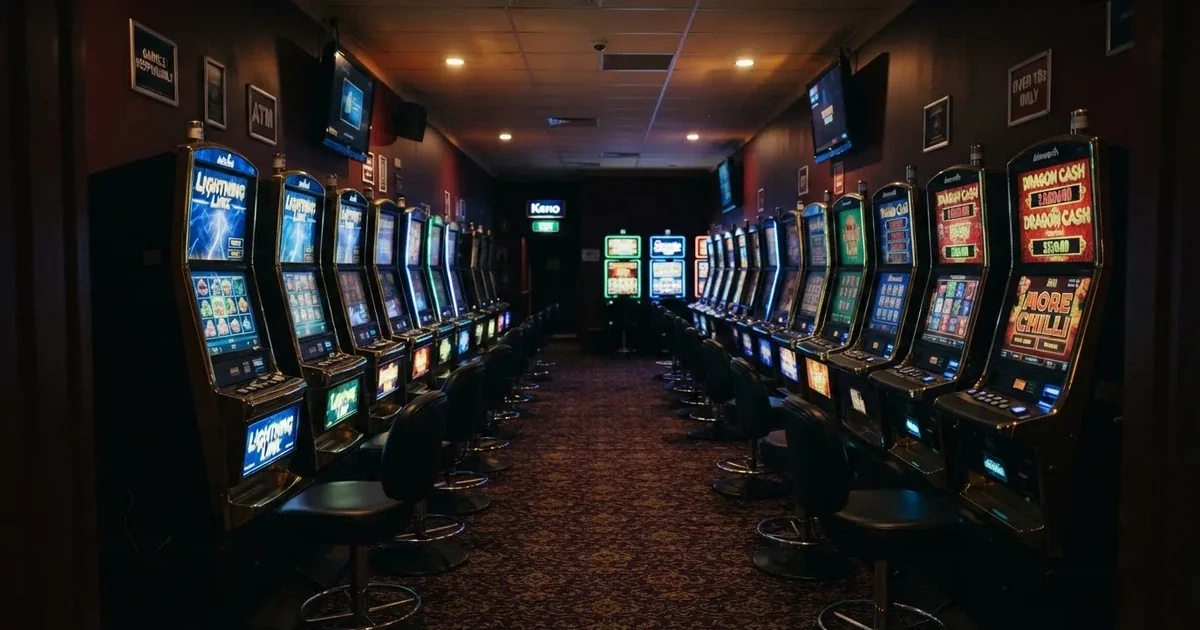
Australians searching for “pokies open near me” are usually after the same thing — a pub, club or casino down the road where the machines are running now, not next week. That destination is real, it is licensed, and it sits inside a market most people only partly see: 0.3% of the world’s population running about 3% of its pub and club poker machines, and a federal prohibition on the online version of those machines sitting across the top of it. Both halves matter, because the results return both a lawful answer and a long list of offshore sites that cannot lawfully take the bet. This page is for the reader who wants to know which is which, what those machines cost the country that hosts them, and what an ACMA warning letter actually closed off.
Current as of 29 October 2026 — licence claims and ACMA enforcement actions verified against the ACMA’s own published register and its enforcement reporting.
Table of Contents
- What the search returns, and why it splits in two
- The legal premise for finding pokies open nearby
- The federal prohibition on online pokies
- What enforcement looks like in practice
- The licensed venue you can actually walk into
- Where the harm-minimisation tools sit
- What the eleven brands on this page have in common
- What an Australian reader sees at each warning
- The advertised promise versus the legal promise
- What the page refuses to write
- What a reader can do with the page
- Frequently asked questions
What the search returns, and why it splits in two
A search for pokies near me returns two very different kinds of result, and the difference between them decides what a click actually does. On one side stand licensed pubs, registered clubs and the two casino complexes — Crown Melbourne and Crown Perth — that every state and territory separately regulates and that publish their trading hours plainly. On the other side sits a stream of offshore casino names, many of them indistinguishable to a casual reader: Woo Casino, RocketPlay, Ignition Casino, Instant Casino, National Casino, Bizzo Casino, Jackbit, Sky Crown, Casino Intense, Level Up Casino and Spirit Casino all appear in the index. Each has been the subject of an ACMA formal warning, the regulator’s first step before internet service providers are ordered to block the site at the network level.
The split is not symmetrical. The licensed venue answers the question: it accepts the player through the door, runs the machine under a state regulator’s rules, and pays out winnings on the spot. The offshore site answers a different question — can a brand outside Australia get the page to load — and the answer there changes whenever an ISP routing table does. What sits behind that split, and what each of the eleven brands on this page has in common, is the Interactive Gambling Act 2001 as tightened by the Interactive Gambling Amendment Act 2017. Neither casino games nor online pokies can be licensed for an Australian customer by any state or territory body, whatever licence ribbon the offshore site happens to display.

The search returns two answers because the legal market pushed one direction and the offshore market pushed another, and only one of them is auditable from inside Australia.
The legal premise for finding pokies open nearby
Pokies are legal in Australia. They are not, however, one legal thing: each state and territory sets its own minimum return-to-player, machine cap, venue cap, opening-hour rule and self-exclusion mechanic. That is why a New South Wales pub and a Tasmanian registered club do not look the same to a regulator, and why an answer to “which venue is open now” depends on the postcode typed in.
The minimum return-to-player, or the percentage of money wagered a machine must on average return to players over its full working life, ranges from 85% in New South Wales, the Northern Territory and Queensland, to 87% in the Australian Capital Territory, Tasmania and at Crown Melbourne, 87.5% in South Australia, and 90% in Western Australia. Western Australia is the only mainland jurisdiction where the machines are not in pubs and clubs at all — Crown Perth has roughly 2,500 of them, every one approved by the state’s Gaming and Wagering Commission, but the surrounding venues do not. The Federal Group held Tasmania’s monopoly licence over poker machines from 1968 until November 2021, when legislation ended it and moved oversight to the Tasmanian Liquor and Gaming Commission. Tasmania also planned nation-leading mandatory pre-commitment cards — a system that would force a player to set a spending limit before a machine will accept them — but implementation was delayed until late 2025, so the practical impact is still to land.
Player numbers are the only way to see what scale that legal market actually operates at. New South Wales alone had 87,298 gaming machines outside casinos across 2,195 venues as of June 2023, with player losses of A$8.18 billion in 2022-23. Queensland had 21,122 in 351 venues in October 2023. Victoria ran 26,380 machines outside Crown Casino in 488 venues in 2021-22, sitting under a statewide cap of 30,000. Across the country, in 2020-21, Australians wagered almost A$150 billion through gaming machines and lost A$12.18 billion on them.
Those numbers are the legal market. They are also the reason a serious responsible-gaming conversation exists: Australia has about 0.3% of the world’s population but hosts around 3% of its pub and club poker machines, and that ratio is the headline statistic in every harm-minimisation debate the country has run for two decades. A reader choosing to enter a licensed venue is doing something lawful; whether the venue design, the opening-hours model and the machine mathematics make that visit a reasonable decision is a separate question, and one the responsible-gaming section below takes up in detail.
The federal prohibition on online pokies
Where the legal model ends, the federal prohibition begins. The Interactive Gambling Act 2001 makes it an offence to provide online casino games, online pokies or in-play betting to a person physically in Australia, and the Interactive Gambling Amendment Act 2017 strengthened the framework with the civil penalties and block-and-disrupt powers the ACMA now uses weekly. No state or territory issues the kind of licence that would let an offshore site take that bet lawfully.
A few things follow from that bare statement.
The licence ribbon an offshore site displays is decorative for an Australian customer. A Curaçao or Anjouan number on the footer of the page does not change the legal position of a brand offered to someone in Sydney or Perth. The operator named in the ACMA warning, not the licence number on the screenshot, is what counts, and it is the operator the regulator has the power to contact.
The player is not the target. The IGA aims at the provider, not the customer, so an Australian who opens an account with one of the offshore brands below does not commit an offence by doing so. What they lose is the protection an Australian-licensed venue has to offer — an Australian complaints body, an Australian regulator to escalate to, an Australian court to enforce a payout against — and the offshore site keeps the balance. Under IGA regimes elsewhere, courts have refused to compel withdrawals; in Australia the position is sharper because the player cannot lawfully have been offered the contract in the first place.
Payment rails narrow the gap further. Since 11 June 2024 credit cards, credit-related products and digital currency are banned as payment for licensed online and phone wagering, and licensed operators face penalties of up to A$247,500 for taking them. The legal deposit routes for licensed wagering are debit card, bank transfer, PayID, Osko and BPAY. An offshore site asking for a credit card or a crypto deposit is, by construction, outside the rules the licensed market runs on — which, again, says nothing about whether the deposit goes through, only about what the rules cover when it does not.
The block list itself now runs into the thousands. According to the ACMA as reported in June 2026, a total of 1,751 illegal gambling and affiliate marketing websites had been blocked since the first blocking request in November 2019, and more than 230 unlicensed gambling services had left the Australian market since enforcement was strengthened in 2017. A blocking round on 26 June 2026 added another twelve: 7Signs, ChromaBet, Donbet, Duospin, Freshbet, Slots Gem, Jacks Club, Lucky Start, Pointsbetz.com, Spinrise, Vinyl Casino and Wildsino. Each blocking request goes to every major Australian ISP, and the consumer does not see the request; what they see is a site that no longer loads.
The financial cost of the offshore channel is the closing argument. H2 Gambling Capital’s 2025 report estimates Australians lose about A$3.9 billion a year to illegal gambling sites, and that the share of gambling going through legal channels fell from 74% in 2021 to 64%. The legal share of the channel has compressed by ten percentage points in four years. That figure is the one a reader weighing a click should hold in mind — not the bonus on the landing page, which the page does not have, and not the licence ribbon, which the operator chooses.
What enforcement looks like in practice
The ACMA’s enforcement ladder has three visible rungs, and what an Australian reader sees is the bottom of it.
A formal warning is the first rung. It names the operator behind a brand, gives a date, lists the prohibited interactive gambling services the brand has been offering to Australians, and gives the operator a defined period to stop. From the regulator’s point of view it is a paper step; from the consumer’s point of view it is the first public confirmation that a brand sits outside the Australian framework. The eleven brands on this page have all received one.
A blocking request is the second rung. Once the warning period lapses without compliance, the ACMA refers the brand to Australian internet service providers with a direction to block the underlying domain at the network level. The site goes dark from most Australian IP addresses, sometimes only for a few weeks before a mirror appears. New domains get new warnings; warnings expire and become new blocking requests; the registry grows by the round.
Civil penalties and litigation are the third rung. The 2017 amendments gave the ACMA the power to pursue civil penalties running into the hundreds of thousands of dollars per breach, and on more serious matters the regulator has sought enforceable undertakings and obtained orders from the Federal Court. Those orders target operators rather than players and they are not visible in the same way a block is, but they are the reason a brand that already carries one warning and one block instruction might choose to disappear from the Australian market entirely.
The Northern Territory racing and wagering regulator is the one quirky feature of the enforcement map. The Northern Territory Racing and Wagering Commission regulates 52 of Australia’s online bookmakers — including Sportsbet, Bet365 and Ladbrokes — which hold their licences in the Territory for tax reasons. The commission, as the ABC reported in April 2026, has no full-time staff and meets once a month in Darwin. That is the regulator for licensed racing and sports wagering only; it is not a window into online pokies, which the IGA prohibits end-to-end.
The BetStop register completes the picture from the consumer side. Live since August 2023, BetStop binds every Australian-licensed online and phone wagering service to honour a self-exclusion request, and a player can put themselves on the register for a chosen period. The crucial caveat is that BetStop binds Australian-licensed services only — an offshore casino is not connected to it, so a self-excluded player who opens an offshore account is not protected by the register they joined.
The licensed venue you can actually walk into
The legal answer to the search has three shapes, and the differences between them matter to anyone deciding where to play.
A licensed pub is the most common venue. In New South Wales the pub trade runs more than 87,000 of the country’s poker machines and accounts for almost exactly the same proportion of national player losses as its machine count implies. Opening hours are governed by the venue’s general licence, the Responsible Conduct of Gambling training the staff hold, and the state-level code on what hours the gaming room itself can be open. A reader in Sydney who wants a 6am session will find it harder to locate than a reader who wants an 11pm session, and that is not an accident of search results — it is the design of the New South Wales harm-minimisation framework.
A registered club is the model that started the industry. Registered clubs operated Australia’s first legal poker machines from 1956, in New South Wales, and the registered-club sector remains the structural backbone of the licensed trade in several states. Queensland runs 21,122 machines across 351 club and hotel venues as of October 2023, and clubs are where the bulk of harm-minimisation funding originates: community returns, gaming-machine-tax distributions and venue-level self-exclusion registers all sit inside the club envelope.
The casino is the third shape, and only two matter. Crown Melbourne is regulated by the Victorian Gambling and Casino Control Commission, which replaced the older VCGLR on 1 July 2022 and runs a high-stakes baccarat floor among its table product. Crown Perth is the only legal gaming-venue in Western Australia and runs roughly 2,500 machines, every one approved by the state’s Gaming and Wagering Commission under the same regime that bans the machines in surrounding pubs and clubs. The casino product is materially different from pub and club gaming: table minimums are higher, identification checks are tighter, and the baccarat product runs an entirely separate set of approved-game rules.
The opening-hours question is the one most readers actually type in. There is no national answer. A New South Wales pub adjusts its gaming-room hours to the venue’s overall licence; a Queensland licensed venue runs on the hours set in its liquor and gaming licence; Crown Melbourne operates 24 hours a day on its main gaming floor within the regulator’s required breaks. Some regional hotels close their gaming room during the small hours to keep the trade inside a quieter band of the day. The reliable approach is to call the venue, because the answer varies suburb by suburb.
Where the harm-minimisation tools sit
BetStop, the National Self-Exclusion Register, is the headline harm-minimisation tool at the federal level. Live since August 2023, it binds every Australian-licensed online and phone wagering operator to honour a registered exclusion for the chosen period — three months, six months, twelve months or longer — and the player cannot open or use an account with any bound operator for the duration. As above, the offshore channel is not bound by BetStop; a player who has put themselves on the register can still load an offshore casino site, which is the documented gap in the framework.
The National Gambling Helpline on 1800 858 858 is free, 24 hours a day, and routes callers to Gambling Help Online for chat-based support. It is the channel the licensed industry itself funds through a combination of state-level levies and industry contributions, and it operates independently of any operator — a player who wants advice without telling their venue about it can use it without trace. Counselling, financial counselling and peer-support referrals are part of the standard service mix.
State-level self-exclusion registers and venue-level barring schemes are the second tier. A pub or club is required to offer every patron the chance to bar themselves from that venue for a chosen period, and the bar travels between venues only when the patron joins the state register. Tasmania’s planned mandatory pre-commitment cards would have gone further again — a card that records loss limits at the player level and refuses play outside those limits — but the reform’s rollout slipped into late 2025 and is still bedding in.
The harm-minimisation principles behind the whole framework are short enough to fit on a card. Set a budget before you go in, and only carry that much cash. Use the venue’s self-exclusion option if you feel the spending is getting ahead of you. Keep the gambling part of the evening, not the whole evening. If you are worried about a friend or family member, the helpline line above takes calls about other people’s gambling too.
What the eleven brands on this page have in common
Each of the brands below sits on the page because the ACMA itself issued a formal warning over it. That is the only criterion, and the page deliberately holds no ranking or recommendation: the regulators, not the page, put these brands in front of the reader, and that order is the order the warnings were published in.
The format the comparison runs in is the same for every brand: a line on the licence situation (every offshore licence ribbon has no Australian counterpart, because there is no such thing), a line on the ACMA action, and a sentence on what a reader is actually looking at when they load the page. None of the columns carry a bonus figure because none of the brands offered one in a published, auditable form to an Australian audience — the bonus terms available came only through affiliate marketing pages, and the page does not transcribe those.
The brands and their ACMA actions, in publication order:
| Brand | ACMA action and date | Operator named by the ACMA | Subject support |
|---|---|---|---|
| RocketPlay | Formal warning, March 2026 | Pulsup Ltd | No-data |
| Level Up Casino | Formal warning, May 2022 | Dama N.V. | Listings-only (Bgaming.com) |
| Woo Casino | Formal warning, March 2025 | Dama N.V. | No-data |
| Spirit Casino | Formal warning, May 2025 | Dama N.V. | No-data |
| National Casino | Formal warning, July 2025 | Consolutetish S.R.L. | Listings-only (en.wikipedia.org) |
| Bizzo Casino | Formal warning, July 2025 and earlier 2022 | Consolutetish S.R.L. (TechSolutions earlier) | No-data |
| Ignition Casino | Formal warning, July 2025 | Bamboo Media | No-data |
| Instant Casino | Formal warning, February 2025 | EOD Code SRL | No-data |
| Jackbit | Formal warning, April 2026 | Ryker B.V. | No-data |
| Casino Intense | Formal warning, April 2025 | Sterplay Holding Ltd | Listings-only (Abc.net.au, acma.gov.au, Crownmelbourne.com.au) |
| Sky Crown | Formal warning, 2022 | Hollycorn N.V. | No-data |
The Dama N.V. block is the one the cluster pattern shows most clearly. Dama N.V. received an early warning over six brands in May 2022, then two more in March and May 2025. A reader comparing those entries should be reading the operator named in the warning rather than the marketing name on the page, because the publisher staying the same is what changes the regulatory exposure — rebrand away from a name and the regulator still has the corporate entity on file.
The Net result is simple: these are the names the ACMA has published, the dates the ACMA published them on, and the operators the regulator named when it did so. Some of these warnings are months old; some are years old; the operational consequence remains the same — the brand cannot lawfully offer casino games to a person in Australia, and the most recent warning doesn’t change that fact. What matters is whether a subsequent block order has followed, and whether the page still loads in an Australian browser.
What an Australian reader sees at each warning
Once a formal warning has been issued, the operational consequence depends on whether the underlying brand complies within the defined period or carries on regardless. Some brands go dark in Australia within weeks; some shift to a different domain name and start again; some keep running and accept the block order when it comes. The reader experiences none of that directly. What the reader experiences is a site that sometimes loads and sometimes does not, and a withdrawal process whose reliability has nothing behind it but the brand’s own terms.
The risk the warning is the visible part of is asymmetric. The regulated consequence for the operator is a block order at the network level, with the operator’s domain added to the register. The consumer-side risk is that the brand holds a balance in an account that the regulator has just told Australians to avoid, that any subsequent block ordering catches the site mid-withdrawal, and that no Australian consumer law protects the player against a refused payout from a brand the regulator had already named. The brand’s own terms may give the player a recourse to an offshore licence holder, but that licence holder is not subject to the IGA, and the player is bound to whatever complaint channel the terms describe.
The mitigation is older than the warning letter. A player who has put funds into an offshore casino and then sees the warning publishes has, in practice, three options: complete the wagering before a block arrives, withdraw whatever the brand will release while it remains reachable, or treat the balance as lost and contact the financial institution that originally moved the money. None of these is a consumer-protection mechanism; all three are pre-existing options any player of an offshore casino effectively carries without being told.
The brand’s commercial position explains the warning, not the warning itself. The eleven brands above are not accused of misrepresenting the licence — most of them print a licence number on the footer of the page — they are accused of offering a service Australian law prohibits offering to Australians. The licence ribbon is consistent with operating in the jurisdictions that issued it; what is not consistent is offering the same product to a customer in a jurisdiction that has expressly prohibited it.
The advertised promise versus the legal promise
Two promises sit behind every offshore casino landing page an Australian consumer can reach. The first is that the site holds a recognised licence; the second is that a player can move money in, gamble, and withdraw any winnings without interference. Both promises are partially true and both run into the same wall.
A licence ribbon is the more visible of the two. Offshore licences — Curaçao, Anjouan, occasionally the Kahnawake Gaming Commission — are issued for the purpose of regulating casino operations and they do that job. They are not, however, licences for offering products to Australians, because no such Australian licence exists. A reader who treats the ribbon as proof of legality for an Australian customer is making a category error the brand has not stopped them from making.
A seamless banking experience is the second promise, and it is the one the consumer actually pays for. Crypto deposits and credit-card deposits that are banned at the licensed Australian bookmaker will still go through at an offshore casino because the payment processor the brand uses is not bound by Australian rules. The withdrawal leg is the test of the system: a player who has accumulated a balance and asks for it back often finds that the offshore licence offers a complaints process the brand itself administers, and the brand has the final say about whether the payout is approved. That is the consumer experience the offshore channel delivers.
The legal landscape on which the offshore channel sits is the closing consideration. The share of gambling going through legal channels fell from 74% in 2021 to 64%, per H2 Gambling Capital’s 2025 report. The estimated A$3.9 billion a year Australia loses to illegal gambling sites is the same statistic in dollar terms. A reader making a decision about whether to load a search result should know that legal share is shrinking, that the warning register is one searchable list kept by the regulator, and that the ACMA’s blocking round of 26 June 2026 added another twelve names to that list.
What the page refuses to write
The page does not transcribe a bonus figure from any of the eleven brands above. The reason is mechanical rather than moral: every figure available was sourced from affiliate marketing pages, which exist to convert a click into a deposit and which carry no audit trail the ACMA warnings recognise. Transcribing the bonus would be quoting the affiliate funnel to the reader rather than the operator, and the value of the bonus is the thing the operator itself has not published.
The page does not direct a reader to an offshore casino or away from one. The eleven names above are reproduced because the ACMA itself has published them, and the comparison runs because the warnings do. Directing the reader is a different decision, the kind a regulator and the regulator alone is positioned to make, and the page does not step into that role.
The page does not pretend an offshore licence ribbon is an Australian licence ribbon. Each brand carries the line that an Australian licence for casino games does not exist, whatever ribbon the site displays. The reader knows what they are looking at.
The page does not promise an answer to “which venue is open right now”. The legal half of the page tells the reader what kinds of venue exist, what hours they typically run, and how to find a specific venue’s hours. The actual answer to a 11.42 pm question depends on the postcode and on the venue, and the only reliable source for that answer is the venue itself.
What a reader can do with the page
Take the warning register as it is. The eleven brands above are not a recommendation and not a blacklist; they are the regulator’s published action, in the order the regulator published it. A reader who has an open account with one of those brands and a balance they have not withdrawn has only the practical options the previous section describes.
Use the licensed channel for what it can do. A venue that is open right now, with a return-to-player set by a state regulator, with complaints handled through a regulator and payout in cash on the spot, is a different product from a brand the ACMA has warned. The numbers behind that difference — the legal share of channel spending, the volume of warnings, the volume of blocks — are what the regulator publishes and what a reader can compare against the marketing language on the landing page.
Keep the help line in mind. The National Gambling Helpline on 1800 858 858 is free and confidential. A reader who is reading this page for a friend is in scope for the same line as a reader reading it for themselves, and the chat service at Gambling Help Online covers text-based conversations for those who would rather type than call.
Frequently asked questions
What hours do Australian pubs and clubs keep their poker machines open?
Pub and club gaming rooms follow each venue’s overall liquor and gaming licence, so the hours vary by state and by suburb. A reader looking for late-night opening should call the venue directly; 24-hour trading is rare outside the casino complexes and a number of regional hotels close their gaming rooms in the small hours.
How can a reader check which nearby venue has poker machines open right now?
There is no single national register of which venue is open at a given minute. Each state and territory publishes its own register of licensed venues, but live opening hours sit with the venue itself, and the reliable approach is to phone the venue or check its website before travelling.
Are poker machines in a licensed pub or club the same thing as an online pokies game?
They are the same kind of game in design terms — both are electronic gaming machines running under fixed mathematical rules — but they are not legal equivalents in Australia. Online pokies are prohibited for Australian customers by the Interactive Gambling Act 2001, while pub, club and casino poker machines are licensed and regulated state by state.
Do all pubs and clubs run pokies 24 hours, or only some venues?
Only some venues run 24 hours. The two licensed casino complexes (Crown Melbourne and Crown Perth) are the closest the market comes to round-the-clock gaming. Most pub and club gaming rooms trade within the venue’s licensed hours, and a number of regional venues close their gaming rooms overnight for harm-minimisation reasons.
What identification does a venue ask for before letting someone play?
Identification rules vary by state and by venue. Most venues will ask for photo identification if a player looks under 25, and a player who self-excludes through the venue’s barring scheme will need to identify themselves to complete the barring. Casino complexes check identification at the entrance and again at the table.